

NVIDIA Earnings & Jackson Hole: Two Market-Shaking Events Collide in Late August 2026
NVIDIA reports record Q2 2026 earnings as Fed Chair Warsh signals rate hikes at Jackson Hole. Analysis of AI chip demand, Blackwell ramp, and monetary policy impact.

Key Takeaway
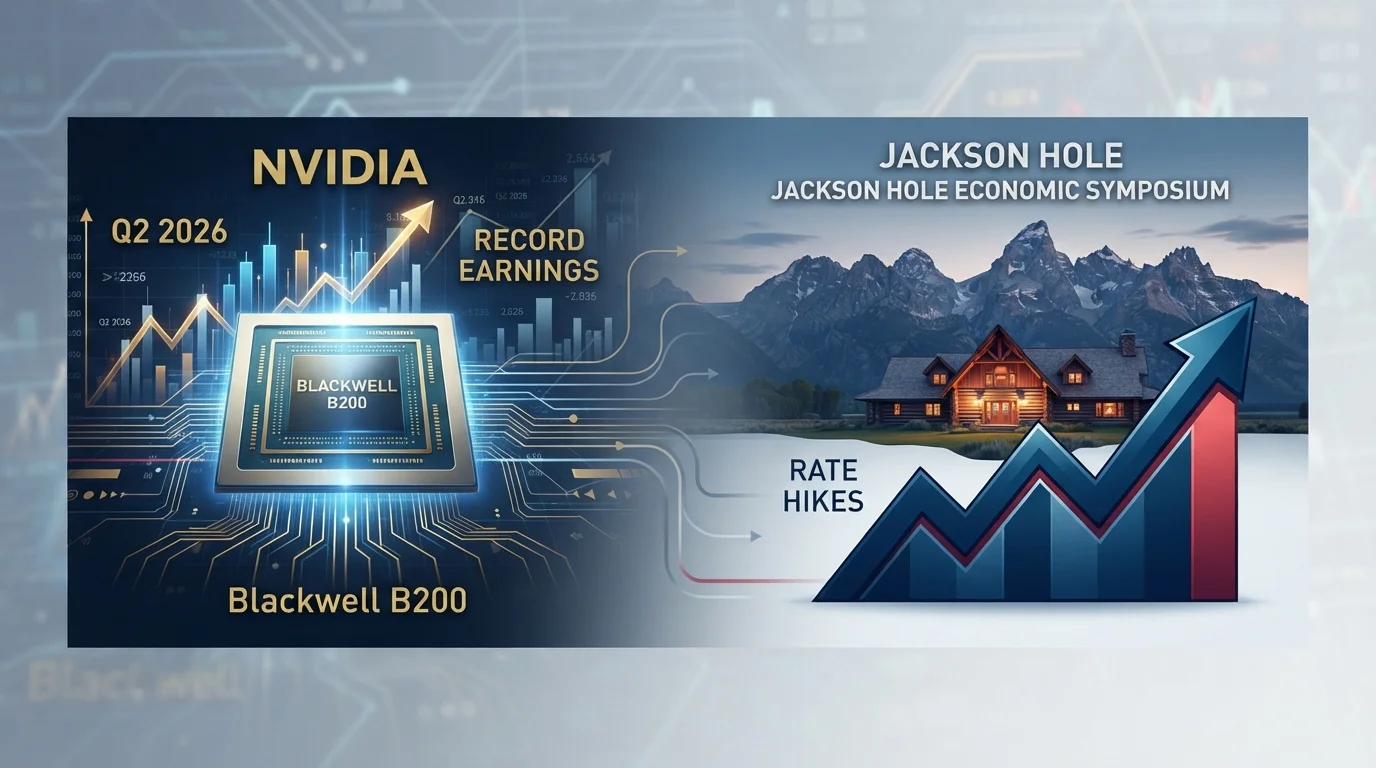
Late August 2026 has delivered a perfect storm of market-moving events that investors cannot afford to ignore. NVIDIA's blockbuster Q2 fiscal 2027 earnings report, released on August 26, revealed extraordinary revenue figures between $93 billion and $95 billion, representing approximately 96% year-over-year growth driven by insatiable demand for AI accelerators. Simultaneously, Federal Reserve Chair Kevin Warsh used his inaugural Jackson Hole Economic Policy Symposium appearance to signal that the central bank may need to raise interest rates in the coming months to combat persistent inflation that remains above the Fed's 2% target.
The convergence of these two events creates a fascinating tension for equity markets. On one hand, NVIDIA's results demonstrate that the AI infrastructure build-out shows no signs of slowing, with the company's Blackwell platform ramping production and demand significantly exceeding available supply. On the other hand, Warsh's hawkish rhetoric at Jackson Hole suggests that the era of accommodative monetary policy is firmly behind us, potentially putting pressure on valuations for growth stocks that derive significant value from expected future earnings. For investors navigating this complex landscape, understanding both the micro dynamics of AI chip demand and the macro implications of Federal Reserve policy has never been more critical.
NVIDIA Q2 2026 Earnings: Breaking Down the Numbers
NVIDIA's fiscal second quarter results have once again redefined what investors thought possible for a semiconductor company. The chipmaker reported adjusted earnings of approximately $2.22 per share, comfortably exceeding Wall Street's consensus estimate of $2.08 per share. Revenue came in at the high end of guidance, with the data center segment continuing to drive the overwhelming majority of growth as hyperscalers and enterprises race to build out AI infrastructure.
The magnitude of these numbers cannot be overstated. Just a few years ago, quarterly revenue above $90 billion would have seemed impossible for any semiconductor company. Today, NVIDIA is not only achieving these figures but doing so while maintaining robust margins and returning substantial capital to shareholders. During the first half of fiscal 2026, the company returned $24.3 billion to shareholders through share repurchases and cash dividends, demonstrating management's confidence in the sustainability of current demand trends.
Blackwell Platform: The Engine Behind NVIDIA's Growth
Central to NVIDIA's Q2 performance is the successful ramp of its Blackwell architecture, the company's latest AI accelerator platform designed specifically for training and inference of large language models. Blackwell began shipping in volume during the quarter, and demand has significantly exceeded available supply, creating a backlog that extends well into future quarters. This supply-constrained environment gives NVIDIA significant pricing power and visibility into future revenue.
At GTC 2026, CEO Jensen Huang expressed extraordinary confidence in the company's trajectory, stating that NVIDIA expects at least $1 trillion in cumulative revenue from its Blackwell and upcoming Rubin chips through 2027. This bold projection reflects not just optimism about AI adoption but a fundamental shift in how enterprises and cloud providers think about computational infrastructure. The transition from general-purpose computing to accelerated computing is no longer a theoretical discussion but a capital allocation reality playing out across the world's largest technology companies.
Data Center Dominance and Competitive Landscape
NVIDIA's data center revenue has reached stratospheric levels, now accounting for approximately 90% of total company revenue. The company's dominance in AI accelerators remains formidable, with NVIDIA currently holding approximately 80% market share in this critical category. However, investors should note that this share is expected to moderate to around 75% by the end of 2026 as hyperscalers develop custom chips and AMD scales its competing MI300 offerings.
The competitive dynamics are evolving rapidly. While NVIDIA's CUDA software ecosystem provides a formidable moat, the economic incentives for large cloud providers to develop in-house alternatives have never been stronger. Amazon's Trainium, Google's TPU, and Microsoft's Maia chips represent long-term strategic threats, even if they take years to achieve performance parity. For now, however, NVIDIA's technology lead and the urgency of AI deployment timelines mean that demand continues to outpace supply by a wide margin.
Jackson Hole 2026: Warsh Sets a Hawkish Tone
While NVIDIA was capturing headlines with its earnings beat, Federal Reserve Chair Kevin Warsh was delivering a message that could have equally significant implications for financial markets. Speaking at the annual Jackson Hole Economic Policy Symposium on August 28, 2026, Warsh laid the groundwork for potential interest rate increases in the coming months, arguing that inflation remains concerning and that the Fed has more work to do to achieve its price stability mandate.
This marked Warsh's first Jackson Hole appearance as Fed Chair, and investors were parsing every word for clues about the future direction of monetary policy. The message was clear: despite the economy's overall strength and full employment conditions, the central bank cannot be complacent about inflation that has remained above the 2% target for five consecutive years. Warsh's background as a former Fed governor during the Great Financial Crisis, combined with his evolution from hawk to dove and back again, gives his current stance particular credibility with market participants.
The Interest Rate Dilemma: Higher for Longer?
Warsh's Jackson Hole speech has reignited the debate about the appropriate level of interest rates in the current economic environment. The 10-year Treasury yield has already surged above 4.7% in August 2026, putting pressure on valuations for growth stocks that derive significant value from expected future cash flows. If the Fed follows through with additional rate hikes, this valuation compression could accelerate, creating headwinds for technology stocks that have led the market higher.
The Cleveland Federal Reserve President Beth Hammack reinforced this hawkish messaging on Thursday, repeating her call for higher interest rates and stating that recent inflation data show the central bank is still too far from its goal. This chorus of Fed officials singing from the same hawkish hymnal suggests that the September FOMC meeting could bring surprises for investors who have grown accustomed to the predictable monetary policy of the past decade.
Market Implications: Growth vs. Value Rotation
The combination of NVIDIA's strong earnings and the Fed's hawkish pivot creates a complex environment for portfolio positioning. On one hand, the structural growth story for AI infrastructure remains intact, with NVIDIA's results providing concrete evidence that demand is not just hype but real capital expenditure from the world's largest technology companies. On the other hand, rising interest rates typically favor value stocks over growth stocks, as higher discount rates reduce the present value of future earnings.
For investors seeking to navigate this environment, consider using Alphio AI's copy trading feature to mirror successful traders and smart money wallets who are positioning for this rotation.

Alternatively, explore agentic trading to automate your portfolio management with AI-powered strategies that can adapt to changing market conditions.

Treasury Yield Dynamics and Equity Valuations
The surge in Treasury yields has become a dominant narrative for equity markets in August 2026. The 30-year Treasury note yield recently touched 5.20%, while the 2-year note, which typically moves in line with short-term Fed policy expectations, hovers near 4.5%. This yield curve steepening suggests that markets are pricing in not just higher rates in the near term but a sustained period of elevated borrowing costs.
For technology stocks like NVIDIA, higher yields present a valuation challenge. The discounted cash flow models that justify premium multiples for growth stocks become less forgiving when the discount rate increases. However, NVIDIA's extraordinary earnings growth provides a partial offset to this valuation compression. When a company is growing revenue at nearly 100% year-over-year, even significantly higher discount rates cannot fully offset the power of compounding earnings.
AI Investment Cycle: Just Getting Started?
Despite the macro headwinds from monetary policy, many analysts believe that the AI infrastructure investment cycle is still in its early innings. NVIDIA's guidance and commentary suggest that demand for AI accelerators will continue to outstrip supply for the foreseeable future. The company is not just selling chips but complete AI factories, systems that include networking, software, and services to enable enterprises to deploy AI at scale.
This systems-level approach differentiates NVIDIA from traditional semiconductor companies and creates higher barriers to competition. While AMD and Intel can design competitive chips, replicating NVIDIA's full-stack solution requires years of software development and ecosystem building. For investors evaluating the durability of NVIDIA's competitive advantage, this ecosystem moat may be more important than any individual hardware specification.
Global Economic Context: Inflation Persistence
The Federal Reserve's concern about inflation reflects a global phenomenon that has proven more persistent than central bankers initially anticipated. Supply chain disruptions, geopolitical tensions, and structural shifts in labor markets have created inflationary pressures that cannot be easily addressed through monetary policy alone. Warsh's acknowledgment that the Fed has more work to do suggests a willingness to accept the economic costs of higher interest rates to prevent inflation from becoming entrenched.
For equity investors, this environment requires a more nuanced approach to portfolio construction. Companies with pricing power, strong balance sheets, and durable competitive advantages are likely to outperform in a higher-rate environment. NVIDIA checks many of these boxes, with gross margins above 70% and a dominant market position that allows the company to pass along cost increases to customers who have few alternatives.
Investment Strategy: Balancing Growth and Caution
The convergence of NVIDIA's earnings strength and the Fed's hawkish pivot creates both opportunities and risks for investors. Those who believe that AI represents a transformative technology with years of growth ahead may view any valuation compression from higher rates as a buying opportunity. Others may prefer to wait for greater clarity on the Fed's policy trajectory before adding exposure to growth stocks.
For traders looking to execute precise entry and exit strategies, Alphio's automations feature allows you to set conditional workflows that trigger based on price movements, earnings announcements, or Fed policy changes.

Additionally, conversational trading enables you to execute trades via natural language commands, making it easier to react quickly to market-moving events like earnings releases or Fed speeches.

Sector Rotation: Where the Smart Money is Moving
The market's reaction to these dual events reveals important insights about institutional positioning. Financial stocks have benefited from the prospect of higher rates, which improve net interest margins for banks. Energy stocks have also performed well as inflation concerns drive interest in real assets. Meanwhile, the technology sector has experienced increased volatility as investors weigh the growth potential against valuation concerns.
NVIDIA's ability to buck this trend with strong post-earnings performance suggests that company-specific fundamentals can still overcome macro headwinds. However, investors should be selective within the technology sector, focusing on companies with demonstrated earnings power rather than those trading on promise alone. The days of speculative growth stocks rallying regardless of fundamentals may be ending as the cost of capital rises.
The Week Ahead: What to Watch
As the market digests these significant developments, several key data points will shape trading in the coming weeks. The August employment report will provide fresh insight into labor market conditions and wage pressures that could influence Fed policy. Consumer price inflation data will be equally important, as any acceleration in price increases could cement expectations for rate hikes at the September FOMC meeting.
For NVIDIA specifically, investors should monitor commentary from other semiconductor companies and cloud providers for confirmation of sustained AI infrastructure demand. Any signs of demand deceleration or inventory buildup could trigger a reassessment of the stock's premium valuation. Conversely, continued evidence of supply constraints and strong order books would support the bull case for continued outperformance.
Conclusion
Late August 2026 has delivered a masterclass in the complexity of modern financial markets. NVIDIA's extraordinary Q2 earnings demonstrate that transformative technology cycles can generate returns that transcend macroeconomic headwinds. At the same time, Federal Reserve Chair Kevin Warsh's hawkish Jackson Hole speech reminds investors that monetary policy remains a powerful force that can reshape valuations across asset classes.
For investors, the path forward requires balancing enthusiasm for AI's transformative potential with respect for the valuation compression that higher interest rates can bring. Companies like NVIDIA that combine genuine earnings growth with dominant competitive positions are best positioned to navigate this environment. However, even the strongest fundamentals cannot completely insulate stocks from broad market volatility if the Fed follows through with aggressive rate increases.
The coming months will reveal whether the current inflationary pressures prove transitory or persistent, and whether the AI investment cycle can maintain its momentum in a higher-rate environment. For now, investors should remain nimble, diversify across sectors and styles, and focus on companies with the pricing power and balance sheet strength to thrive regardless of the macroeconomic backdrop.
To stay ahead of these market-moving events and automate your trading strategies, explore Alphio AI's comprehensive trading platform. Whether you're interested in copy trading successful strategies, implementing agentic trading systems, or setting up automated workflows, Alphio provides the tools you need to navigate volatile markets with confidence.
Don't let market volatility catch you off guard. Start using Alphio's AI-powered trading features today to position your portfolio for whatever the Fed and the AI revolution bring next.
FAQs
What were NVIDIA's Q2 2026 earnings results?
NVIDIA reported Q2 fiscal 2027 earnings on August 26, 2026, with revenue between $93-95 billion (approximately 96% year-over-year growth) and adjusted earnings of $2.22 per share, beating Wall Street's $2.08 consensus estimate. The data center segment drove the majority of growth, with Blackwell platform chips ramping production and demand exceeding supply.
What did Fed Chair Kevin Warsh say at Jackson Hole 2026?
At his first Jackson Hole Economic Policy Symposium as Fed Chair on August 28, 2026, Kevin Warsh signaled that the Federal Reserve may need to raise interest rates in coming months to combat persistent inflation. He described inflation as concerning and stated the Fed has more work to do to achieve its 2% price stability target, despite the economy's overall strength.
How do rising interest rates affect NVIDIA's stock valuation?
Rising interest rates typically pressure growth stock valuations by increasing discount rates used in valuation models, which reduces the present value of future earnings. However, NVIDIA's extraordinary revenue growth (96% year-over-year) provides a partial offset to this valuation compression. The company's dominant market position and pricing power also help maintain margins in a higher-rate environment.
What is NVIDIA's Blackwell platform?
Blackwell is NVIDIA's latest AI accelerator architecture designed for training and inference of large language models. The platform began shipping in volume during Q2 2026, with demand significantly exceeding available supply. NVIDIA expects at least $1 trillion in cumulative revenue from Blackwell and the upcoming Rubin platform through 2027.
What is the Jackson Hole Economic Policy Symposium?
The Jackson Hole Economic Policy Symposium is an annual three-day international conference hosted by the Federal Reserve Bank of Kansas City in Jackson Hole, Wyoming. It brings together central bank leaders, academics, journalists, and financial industry leaders to discuss economic policy. Fed Chair speeches at this event are closely watched by markets for signals about future monetary policy direction.
Related articles
- How to Rebalance a Concentrated Stock Portfolio in 2026: Mag7 Drift, Tax-Aware Trims, and Practical Rebalance a concentrated stock portfolio in 2026: Mag7 drift risk, 5pp bands, tax-aware trims, RSP/IWM diversifiers, and single-name caps.
- Small Cap Stocks Investing Guide 2026: Russell 2000, Fed Hikes, and the Financing TradeSmall-cap stocks investing guide 2026: Russell 2000 vs S&P, IWM rate sensitivity, floating-rate debt, Fed hikes, valuation discounts, and a practical checklist.
- Santa Claus Rally and the Year-End Stock Market: Investor Guide for Late 2026Santa Claus rally explained: 7-day window stats since 1950, Nov–Dec seasonality, post-midterm 2026 setup, and a risk-managed year-end investing playbook.
- Crude Oil Price Crash July 2026: Analyzing the Sharp Decline in Energy MarketsWTI crude oil plunged 6.82% to $83.22 while Brent crashed 7.85%. Discover the key factors behind this dramatic oil price decline and investment implications.
- Nvidia Stock Analysis: AI Chip Demand Surge and Market Outlook for 2026Comprehensive Nvidia stock analysis for July 2026. Explore AI chip demand, data center growth, valuation metrics, and investment strategy for NVDA investors.
- Alphio AI Platform 2026: The Complete Guide to AI-Powered TradingDiscover Alphio AI's trading platform featuring copy trading, agentic trading, and automated workflows. Complete guide to AI-powered investing in 2026.