

Crude Oil Price Surge: WTI Hits $102 as Iran Conflict Escalates
WTI crude oil surged above $102 as Middle East tensions escalate. Explore the market impact, key drivers, and what this means for investors heading into 2027.

Key Takeaway
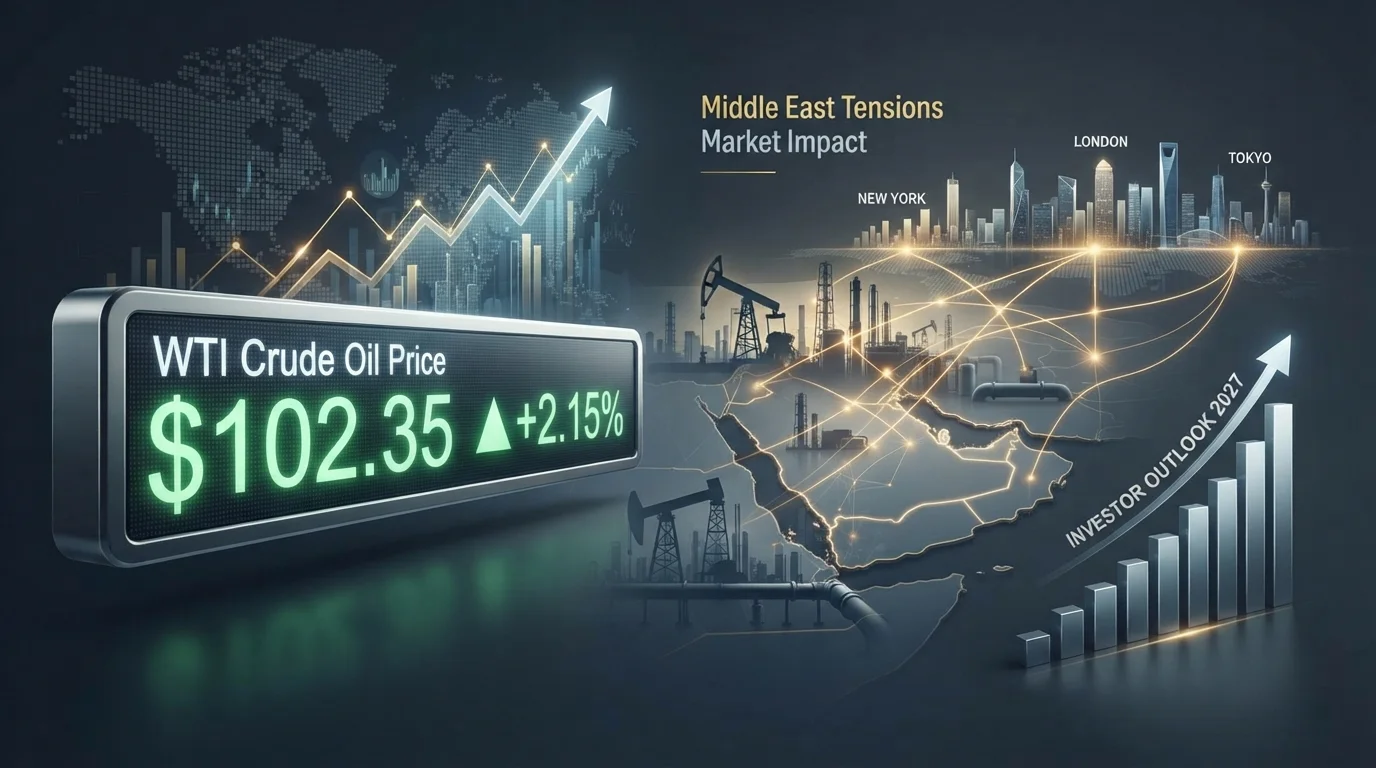
Crude oil prices have surged to their highest levels in five weeks, with West Texas Intermediate (WTI) crude briefly touching $102.11 per barrel on October 23, 2026. The rally, which marks a third consecutive weekly advance, has been driven primarily by escalating geopolitical tensions in the Middle East and growing concerns that the United States may resume military strikes against Iran following the upcoming midterm elections. This price action represents a dramatic shift in the commodity landscape, with WTI now up approximately 66% year-over-year and Brent crude trading near $114 per barrel.
The implications extend far beyond energy markets. Higher oil prices act as a tax on global consumers, potentially reigniting inflationary pressures just as central banks had begun to signal confidence in their progress toward price stability. For investors, the current environment demands a careful reassessment of portfolio positioning, as the interplay between geopolitical risk, monetary policy, and corporate earnings creates a complex and rapidly evolving investment landscape.
Why Oil Prices Are Surging
Renewed Tensions with Iran
The primary catalyst for the latest oil price spike stems from deteriorating relations between the United States and Iran. President Donald Trump has publicly stated that Washington is not currently negotiating with Tehran and has hinted that significant developments could occur in the near future. Reports indicate that US and Israeli military officials have already developed operational plans for a short but intensive campaign of strikes against Iranian targets, with execution potentially timed for after the US midterm elections in November.
Iran's response has only heightened tensions. The country's army chief announced that Iran's military has prepared for asymmetric warfare after strengthening its capabilities, signaling that any conflict would not follow a conventional pattern. This rhetoric, combined with Iran's historical capacity to disrupt shipping through the Strait of Hormuz—a chokepoint through which roughly 20% of global oil consumption passes—has put energy traders on high alert. The market is pricing in a meaningful probability of supply disruptions, and history suggests that such disruptions tend to cause sharp and sustained price rallies.
Regional Instability Beyond Iran
The geopolitical risk premium in oil prices extends beyond the US-Iran bilateral dynamic. Iran-aligned Houthi militants have continued their attacks on Saudi Arabian targets, creating additional pressure on the world's largest oil exporter. The US State Department has ordered non-essential personnel to leave the region, a move that typically signals elevated threat levels.
Perhaps most tellingly, Saudi Aramco has reportedly instructed staff to evacuate its Dhahran headquarters and work remotely. When the world's most important oil company takes such precautionary measures, market participants pay attention. Saudi Aramco's production decisions have historically served as a stabilizing force in oil markets, but the company's own operational disruptions could remove a key source of supply flexibility precisely when markets need it most.
The Supply-Demand Equation
Production Constraints and OPEC Policy
While geopolitical headlines grab attention, the fundamental supply-demand balance also supports higher prices. OPEC+ has maintained disciplined production cuts throughout 2026, with Saudi Arabia voluntarily reducing output by an additional 1 million barrels per day beyond agreed quotas. Russia has also implemented export restrictions, though compliance among some smaller members has been inconsistent.
US shale producers, meanwhile, have shown remarkable capital discipline despite higher prices. Unlike previous boom cycles where rising prices triggered a flood of new drilling activity, American producers have prioritized shareholder returns over production growth. This restraint reflects lessons learned from the boom-bust cycles of the 2010s and the existential crisis many companies faced during the 2020 price collapse. The result is a supply side that responds more sluggishly to price signals than in the past.
Global Demand Resilience
On the demand side, global oil consumption has proven more resilient than many analysts expected entering 2026. China's economic recovery, while uneven, has supported petroleum demand, particularly in the petrochemical sector. India's rapid economic growth continues to drive increasing oil imports, with the country now rivaling China as the primary engine of global demand growth.
Even in developed economies, demand destruction from higher prices has been limited. European natural gas markets have partially decoupled from oil price movements, but diesel and jet fuel consumption remain closely tied to economic activity. The International Energy Agency's latest monthly report revised global demand forecasts upward, citing stronger-than-expected industrial activity in emerging markets and robust aviation sector recovery.
Impact on Energy Stocks and Sectors
Integrated Oil Majors
The surge in crude prices has provided a significant tailwind for major integrated oil companies. ExxonMobil, Chevron, and their European counterparts have all benefited from improved upstream margins while their downstream refining operations capture wider crack spreads. The integrated model, which had fallen out of favor during the energy transition narrative of the early 2020s, has once again demonstrated its value in volatile commodity markets.
These companies have also used the period of strong cash generation to accelerate debt reduction and increase shareholder distributions. ExxonMobil's latest quarterly results highlighted record free cash flow generation, with management indicating plans for continued dividend growth and expanded share buyback programs. For investors, the combination of elevated commodity prices and disciplined capital allocation creates a compelling investment case.
Exploration and Production Companies
Pure-play exploration and production companies have experienced even more dramatic stock price movements relative to the underlying commodity. Companies like Occidental Petroleum, Pioneer Natural Resources, and EOG Resources have outperformed the broader energy sector as investors price in the sustainability of higher cash flows.
However, the sector's historical tendency toward value destruction through aggressive expansion remains a concern. The most successful E&P companies in this cycle have been those that maintained capital discipline, focusing on returns rather than production growth. Occidental Petroleum, for example, has prioritized debt repayment following its acquisition of Anadarko Petroleum, a strategy that has resonated with investors seeking stability in a volatile commodity environment.
Macroeconomic Implications
Inflation and Central Bank Policy
The most consequential aspect of the oil price surge may be its impact on inflation dynamics and central bank policy. The Federal Reserve, which had begun signaling potential rate cuts as inflation cooled through mid-2026, now faces renewed pressure from energy costs. Oil prices feed directly into headline inflation through gasoline and heating costs, and indirectly through transportation and manufacturing expenses.
The bond market has already begun repricing expectations. Treasury yields have risen across the curve as traders reduce expectations for aggressive rate cuts. The CME Group's FedWatch tool now shows a significantly lower probability of multiple rate cuts in the coming quarters, reflecting concerns that the Fed may need to maintain restrictive policy for longer than previously anticipated.
For equity markets, this creates a challenging environment. Higher discount rates reduce the present value of future cash flows, particularly for growth stocks with earnings concentrated in distant years. The technology sector, which had benefited from falling rate expectations, has come under renewed pressure as the inflation outlook has deteriorated.
Currency Markets and Dollar Dynamics
Oil prices also influence foreign exchange markets through their impact on trade balances and inflation differentials. Countries that are net oil exporters—such as Norway, Canada, and Russia—see their currencies supported by improved terms of trade. Conversely, major oil importers including Japan, India, and most European nations face currency headwinds as their import bills increase.
The US dollar's response has been more nuanced. While higher oil prices generally support the dollar through inflation differentials and safe-haven flows, the US itself is now a significant oil producer, reducing the pure import shock effect. The dollar has strengthened modestly against most major currencies but has not experienced the dramatic appreciation that characterized previous oil price spikes.
What Investors Should Consider
Portfolio Positioning Strategies
For investors navigating this environment, several strategies merit consideration. Energy sector allocations, which had reached multi-decade lows as a percentage of major indices in recent years, now offer both defensive characteristics and upside optionality. The sector's improved balance sheets and shareholder-friendly capital allocation provide a cushion even if oil prices retreat.
Consider using Alphio AI's copy trading feature to mirror successful commodity traders and smart money wallets who have navigated similar geopolitical disruptions in the past. This approach allows investors to benefit from the expertise of experienced energy market participants without requiring deep commodity expertise.

Commodity-linked investments beyond direct oil exposure also warrant attention. Natural gas prices have risen in sympathy with crude, benefiting producers and infrastructure companies. Energy transition metals, including copper and lithium, may see increased demand as higher fossil fuel costs improve the relative economics of renewable energy and electric vehicles.
Risk Management Considerations
While the case for higher oil prices appears strong, investors must also consider downside scenarios. A diplomatic breakthrough with Iran, however unlikely in the near term, could trigger a sharp reversal. OPEC+ could surprise markets by increasing production if members face fiscal pressures. Alternatively, a global economic slowdown could reduce demand more quickly than supply can adjust.
Options strategies provide one avenue for managing this uncertainty. Energy sector put spreads can protect against downside while preserving upside participation. For more sophisticated investors, direct commodity options or volatility trades offer additional tools for expressing views on both direction and uncertainty.
Alternatively, explore agentic trading to automate your portfolio management with AI-powered strategies that can dynamically adjust energy sector exposure based on real-time market conditions and geopolitical developments.

Historical Context and Future Outlook
Lessons from Previous Oil Shocks
History provides useful context for understanding how oil price spikes typically evolve. The 1990-91 Gulf War saw crude prices initially double before retreating to pre-crisis levels within months. The 2003 Iraq invasion produced a similar pattern—an initial surge followed by gradual normalization. The Congressional Research Service's analysis of historical oil shocks found that prices generally return to pre-crisis levels within three to six months unless the conflict causes sustained production disruptions.
However, the current situation differs from these historical precedents in important ways. The global spare production capacity is lower than in previous decades, reducing the market's ability to absorb disruptions. Sanctions on Russian exports following the Ukraine conflict have already strained alternative supply sources. And the energy transition, while gradual, has discouraged long-term investment in fossil fuel production, potentially limiting the supply response to higher prices.
Price Forecasts for Late 2026 and 2027
Analyst forecasts for oil prices through the end of 2026 and into 2027 reflect these competing forces. Goldman Sachs has raised its 12-month Brent forecast to $120 per barrel, citing persistent geopolitical risks and limited spare capacity. Morgan Stanley takes a more conservative view, expecting prices to retreat toward $95 as demand growth moderates and non-OPEC supply increases.
The options market implies significant uncertainty, with implied volatility for crude oil futures well above historical averages. This elevated volatility premium reflects genuine uncertainty about both the probability of military conflict and its potential duration and severity.
For investors seeking to set conditional workflows around energy price movements, Alphio's automation features enable sophisticated trading rules that respond to price thresholds, volatility spikes, or news events without requiring constant market monitoring.

Conclusion
The surge in crude oil prices to above $102 per barrel represents more than a temporary spike driven by headlines. It reflects a confluence of geopolitical tensions, constrained supply, and resilient global demand that together create a supportive fundamental backdrop for energy markets. For investors, this environment demands careful attention to portfolio positioning, with energy sector allocations offering both defensive characteristics and potential upside.
The coming weeks will be critical. The US midterm elections may provide clarity on the likelihood of military action against Iran. OPEC+ will face pressure to respond to higher prices with increased production, testing the group's cohesion. And central banks must weigh the inflationary implications of expensive energy against the risks of overtightening into an already slowing global economy.
For those looking to capitalize on commodity market opportunities or protect existing portfolios from energy-driven volatility, now is an opportune moment to explore advanced trading tools. Alphio's conversational trading platform allows you to execute trades, analyze markets, and manage positions through natural language commands—making sophisticated commodity trading accessible to a broader range of investors.

Whether oil prices continue their ascent or retreat as geopolitical tensions ease, the current environment underscores the importance of maintaining diversified exposure across asset classes while remaining alert to the ways in which commodity markets influence broader financial conditions. The energy sector's resurgence after years of underperformance may have further to run, but prudent risk management remains essential in these volatile markets.
FAQs
Why did crude oil prices surge above $102 in October 2026?
WTI crude oil surged above $102 due to escalating geopolitical tensions between the US and Iran, with reports of planned military strikes after the November midterm elections. Iran's threats of asymmetric warfare and ongoing Houthi attacks on Saudi Arabia have raised concerns about potential supply disruptions through the Strait of Hormuz, which handles about 20% of global oil consumption.
How do higher oil prices affect the stock market?
Higher oil prices create mixed effects on equity markets. Energy stocks typically benefit from improved margins and cash flows, while sectors dependent on consumer discretionary spending may suffer as gasoline costs reduce household purchasing power. Technology and growth stocks face headwinds from higher discount rates if inflation prompts central banks to maintain restrictive monetary policy.
What is the outlook for oil prices through 2027?
Analyst forecasts vary significantly. Goldman Sachs projects Brent crude at $120 per barrel over 12 months due to limited spare capacity and geopolitical risks. Morgan Stanley expects a retreat toward $95 as demand growth moderates. The wide range of forecasts reflects genuine uncertainty about whether current tensions will escalate into sustained supply disruptions or resolve diplomatically.
Which energy stocks benefit most from higher oil prices?
Integrated oil majors like ExxonMobil and Chevron benefit from both upstream production margins and downstream refining operations. Pure-play exploration and production companies such as Occidental Petroleum and Pioneer Natural Resources typically see the most direct stock price impact. Oilfield service companies and midstream pipeline operators also benefit from increased drilling activity and volumes.
How can investors hedge against oil price volatility?
Investors can manage oil price risk through several strategies: diversifying across sectors to reduce concentration in energy-sensitive industries, using options strategies like put spreads on energy ETFs, allocating to oil-importing countries' currencies, or utilizing AI-powered trading platforms like Alphio that offer automated risk management and copy trading features to follow experienced commodity traders.
Related articles
- How to Rebalance a Concentrated Stock Portfolio in 2026: Mag7 Drift, Tax-Aware Trims, and Practical Rebalance a concentrated stock portfolio in 2026: Mag7 drift risk, 5pp bands, tax-aware trims, RSP/IWM diversifiers, and single-name caps.
- Small Cap Stocks Investing Guide 2026: Russell 2000, Fed Hikes, and the Financing TradeSmall-cap stocks investing guide 2026: Russell 2000 vs S&P, IWM rate sensitivity, floating-rate debt, Fed hikes, valuation discounts, and a practical checklist.
- Santa Claus Rally and the Year-End Stock Market: Investor Guide for Late 2026Santa Claus rally explained: 7-day window stats since 1950, Nov–Dec seasonality, post-midterm 2026 setup, and a risk-managed year-end investing playbook.
- Paper Trading: The Ultimate Guide to Risk-Free Trading PracticeMaster paper trading with our comprehensive guide. Learn how to use stock simulators for risk-free practice, discover top virtual trading platforms, and transition confidently from demo to live tradin
- AI Penny Stocks: Top 10 Artificial Intelligence Stocks to Watch in 2026Discover the best AI penny stocks under $5 for 2026. From defense drones to quantum computing, explore top picks like RCAT, RKLB, BBAI, and more.
- Stocks to Watch: How to Build a Winning Watchlist for 2026Master the art of building a winning stock watchlist for 2026. Learn how to find momentum stocks, manage your watchlist, and discover top stocks to watch including quantum computing and AI chip leader