

Cash-Secured Puts in a High-VIX Market: How to Sell Puts During a Correction
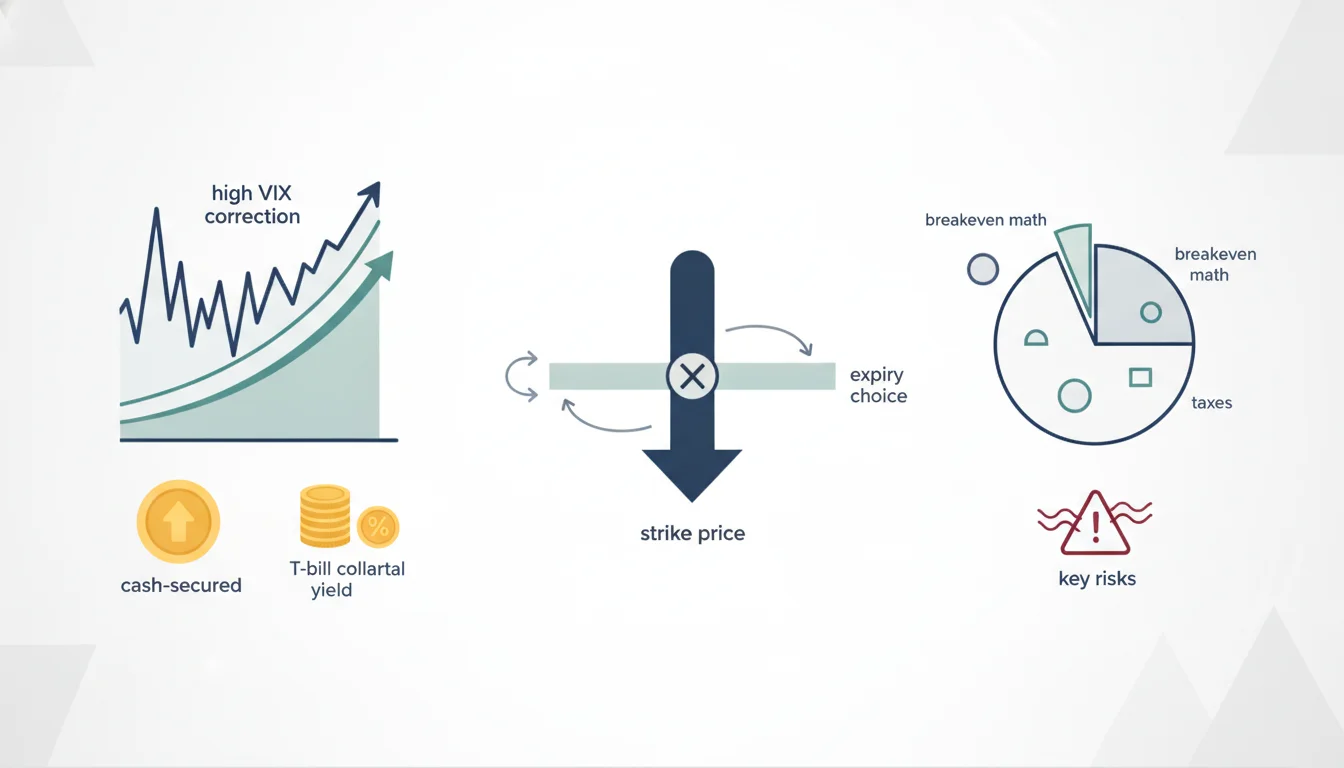
Learn how cash-secured puts work in a high-VIX correction: strike and expiry choice, breakeven math, T-bill collateral yield, assignment, taxes and key risks.

Key Takeaway
When fear spikes, option premiums swell, and one of the oldest income strategies in the options market suddenly looks far more generous. On Friday, November 20, 2026, the S&P 500 closed at 6,910.39 after a 3.7% one-day drop, leaving it roughly 11.6% below its October 6 record close of 7,818.93, while the Cboe Volatility Index (VIX) finished the session at 35.89, according to CNBC and S&P Dow Jones Indices data on FRED. Early Monday, November 23, S&P 500 futures were up close to 3% and the VIX had eased toward 30, per Yahoo Finance's premarket coverage around 7 a.m. Eastern. Volatility that high means investors are paying up for downside protection, and someone has to sell it to them.
A cash-secured put is the most straightforward way for an ordinary investor to be that seller. You agree to buy a stock or ETF at a set price if it falls there, set aside the full cash needed to do so, and collect a premium up front for taking that obligation. In a calm market, that premium can feel trivial. In a correction with the VIX in the 30s, it can be meaningful, and the cash parked as collateral currently earns more than 4% in Treasury bills.
But high premiums are not free money. They are high because the risk of being assigned shares that keep falling is high. This guide explains how cash-secured puts work, what the long-run evidence on put-writing shows, how to choose the underlying, strike, and expiration in a volatile tape, how to manage trades after you place them, and how taxes and broker rules apply. It is educational content, not a recommendation to trade any security.
What a Cash-Secured Put Is and Why It Matters Now
The mechanics in plain terms
A put option gives its buyer the right to sell 100 shares of an underlying security at a fixed strike price before or at expiration. When you sell, or write, that put, you take the other side: you accept the obligation to buy those 100 shares at the strike if the buyer exercises. In exchange, you receive the option premium immediately, and it is yours to keep regardless of what happens next. The position is called cash-secured because you hold enough cash in the account to pay for the shares in full. Fidelity's options education material, which reprints a Cboe Options Institute explainer, describes exactly this setup, with the investor depositing the full purchase amount in a money market account while the put is open.
Why a VIX in the 30s changes the math
Option prices are driven largely by implied volatility, the market's estimate of how much the underlying will move. When implied volatility rises, every option gets more expensive, and puts usually get the biggest boost because investors rush to hedge. The VIX measures implied volatility on S&P 500 index options, so a reading near 36, as on November 20, signals that protection is costly across the board. Yahoo Finance noted that the VIX was at its highest level since the April 2025 tariff shock. For a put seller, that is the moment when the same strike, the same expiration, and the same stock can pay several times the premium available during a quiet summer.
How it differs from naked puts and covered calls
A naked put carries the same obligation but without the full cash set aside, relying on margin instead. That adds leverage and the risk of margin calls if the stock falls sharply, which is exactly what tends to happen in a correction. A covered call is a cousin strategy: you own the shares and sell someone the right to buy them from you. The two have similar payoff shapes, and both trade away upside for income. The practical difference is the starting point. A cash-secured put begins with cash and may end with shares, while a covered call begins with shares and may end with cash.
The Numbers Behind a Cash-Secured Put
Breakeven, maximum profit, and maximum loss
Consider a purely hypothetical example. A stock trades at $100, and you sell one put with a $95 strike expiring in about 30 days for a premium of $3.00 per share, or $300 per contract. You set aside $9,500, the cost of buying 100 shares at $95. If the stock stays above $95 at expiration, the put expires worthless and you keep the $300. That is your maximum profit. If the stock falls below $95, you will likely be assigned and buy the shares at $95, but your effective cost is $92 because of the premium you collected. Fidelity's material defines the breakeven the same way: strike price minus premium received. Your maximum loss is that $92 per share, or $9,200, if the stock goes to zero.
Your collateral is not idle
One of the overlooked parts of the strategy in 2026 is the yield on the cash itself. The Federal Reserve raised its target range to 3.75% to 4.00% in September, and short-term Treasury bills reflect that. On November 20, 2026, the Treasury's daily bill rates showed the 4-week bill at a 4.11% coupon-equivalent yield and the 13-week bill at 4.23%. Many brokers let you hold collateral in a money market fund or Treasury bills while a put is open. In the hypothetical above, $9,500 earning roughly 4.1% for one month would add about $32 of interest on top of the $300 premium, a small but real cushion that did not exist in the near-zero-rate years.
Annualizing premiums without fooling yourself
It is tempting to annualize. Earning $300 on $9,500 of collateral in a month is about 3.2%, which naively compounds into a spectacular annual figure. That math assumes you can repeat the same trade every month at the same premium without ever being assigned at a loss, an assumption that breaks precisely in the kind of market that produced the fat premium in the first place. A more honest way to think about it is that elevated premiums are compensation for a higher probability of owning shares below today's price. Annualized yields are useful for comparing two trades side by side, not for projecting what a year of put-selling will earn.
What the Long-Run Evidence on Put-Writing Shows
The volatility risk premium
The case for systematically selling puts rests on a well-documented gap: implied volatility has historically run above the volatility that actually materializes. In a 2019 white paper on the Cboe S&P 500 PutWrite Index (ticker PUT), Professor Oleg Bondarenko of the University of Illinois at Chicago found that from 1990 to 2018, average implied volatility as measured by the VIX was 19.3%, while average realized volatility on the S&P 500 was 15.1%. That roughly four-point difference is the volatility risk premium. Option buyers pay it for insurance, and option sellers collect it over time, much as an insurer collects more in premiums than it pays in typical claims.
Lower volatility, but a heavier left tail
The PUT index sells at-the-money one-month S&P 500 puts each month and holds Treasury bills as collateral, according to Cboe's methodology. Over June 1986 to December 2018, Bondarenko reported annualized volatility of 9.95% for PUT versus 14.93% for the S&P 500, a beta of 0.56, and higher risk-adjusted return measures than the index. The same study also reported skewness of -2.09 for PUT versus -0.81 for the S&P 500. In plain English, put-writing produced a smoother ride most of the time but was more prone to sudden, outsized losses in crashes. An earlier study by Ennis Knupp covering 1986 to 2008 found the index tended to underperform in months when stocks rose sharply, because a put seller's upside is capped at the premium.
What the studies do and do not prove
These numbers deserve some caution. Cboe sponsored or published much of the research, the PUT index is a mechanical index strategy rather than a real portfolio paying commissions and bid-ask spreads, and past results do not guarantee future ones. Selling puts on a single stock is also a very different risk than selling puts on a diversified index, because one company can fall 40% on bad news while the S&P 500 rarely does in a month. The evidence supports a narrower claim: over long periods, investors who sold index puts with full collateral were paid for bearing crash risk. It does not show that any specific put sold this week will work out.
Choosing the Underlying in a Correction
Only sell puts on what you actually want to own
The single most important rule of cash-secured puts is that the strategy should begin with a buy decision, not a premium hunt. If you would be unhappy owning 100 shares of a company at the strike price, the premium is not worth it. Saxo's options strategist made the same point in a September 2026 note, writing that "the premium is priced, not free." In a sell-off, the highest premiums often sit on the stocks with the most uncertainty, such as heavily shorted names, speculative growth stocks, and companies facing binary events. Those are exactly the positions most likely to keep falling after assignment. A better starting list is companies whose balance sheets, cash flows, and valuations you would be comfortable holding through a longer downturn.
Index ETFs versus individual stocks
Selling puts on a broad ETF such as SPY or QQQ spreads the company-specific risk across hundreds of holdings, and these products have deep, liquid option markets with tight spreads. The trade-off is lower premiums, since individual stocks can gap on earnings, guidance cuts, or leadership changes. One practical approach is to use index puts as the core of a put-selling program and reserve single-stock puts for a short list of high-conviction names where you have already done the work on valuation and analyst views.
Watch the calendar for event risk
Implied volatility does not rise evenly. It tends to jump before scheduled events and collapse afterward. Over the next few weeks, that calendar is crowded. The Bureau of Economic Analysis releases October PCE inflation data on November 25, markets close for Thanksgiving on November 26 and shut early on November 27, and the Federal Reserve meets on December 8 and 9, when Yahoo Finance reported that bond markets were pricing about a 92% chance of another rate hike. For single stocks, an earnings date inside your option's life adds gap risk that a higher premium may not fully compensate. Knowing what falls before expiration is part of pricing the trade.
Picking the Strike and Expiration
Delta and distance from the current price
Most put sellers choose a strike below the current price, called out of the money. The further below, the lower the premium and the lower the chance of assignment. Many traders use an option's delta as a rough guide to that probability: a put with a delta of about 0.30 is often treated as having roughly a 30% chance of finishing in the money, though delta is a model output rather than a promise. In a high-volatility market, the same delta sits further below the current price than it would in a calm one, which is one of the real advantages of selling into fear. You can choose a strike that provides a larger price cushion while still collecting a premium worth the risk.
Skew makes downside strikes richer
Options on the same underlying and expiration rarely share one implied volatility. Lower strikes usually carry higher implied volatility than strikes near the money, a pattern called skew. Saxo's September analysis of QQQ illustrated this: its further out-of-the-money put showed implied volatility of about 25% while a closer strike showed about 21%. That means headline volatility measures such as the VIX can understate or overstate what you will actually receive at the strike you care about. Before selling, compare premiums across several strikes and ask which one gives the best trade-off between cushion, income, and the price at which you genuinely want to buy.
Monthly versus weekly expirations
Time decay accelerates as expiration approaches, which is why some traders prefer weekly options. Weeklies require more frequent decisions, more commissions, and more exposure to sudden overnight gaps without time to adjust. Many educational sources favor expirations of roughly 30 to 45 days as a balance between meaningful time decay and manageable activity. Whatever you choose, apply it consistently.
If you would rather not stare at option chains every morning, you can set a recurring review that checks implied volatility, your target strikes, and upcoming earnings dates on a schedule you choose with Alphio's Scheduled Task feature.

Managing the Trade After You Sell
Taking profits early
You do not have to hold a short put to expiration. If volatility falls and the stock rises, the option you sold may lose most of its value well before expiry, and you can buy it back for a fraction of what you received. Many disciplined put sellers set a profit target, for instance closing a position once they have captured half or more of the original premium, and redeploying the collateral. That rule lowers exposure to late-cycle surprises and frees capital for new trades if volatility stays elevated.
Rolling down and out
If the stock falls toward your strike, you have three basic choices: accept assignment, close the position at a loss, or roll it. Rolling means buying back the current put and selling a new one with a later expiration and often a lower strike, ideally for a net credit. Rolling can buy time and lower your eventual cost basis, but it is not a cure. A roll that chases a collapsing stock lower and further out keeps your capital tied to a losing idea. Decide in advance what would make you simply take the shares or close the trade, and write that rule down before you place the order.
When assignment happens: the wheel
Assignment is not a failure; it is one of the two outcomes you agreed to. Once you own the shares, many investors switch to selling covered calls above their effective cost, a cycle often called the wheel. If the calls are exercised, the shares are sold and the cycle can start again with puts. The wheel works well on quality companies that recover and badly on companies whose fundamentals have broken.
Risks, Taxes, and Account Rules
The risks that matter most
Before selling a cash-secured put, it helps to keep the core risks in one place:
- Gap risk: a stock can fall far below your strike overnight, and the premium covers only a small part of the loss.
- Opportunity cost: if the market rebounds sharply, your gain is capped at the premium while buy-and-hold investors capture the full rally.
- Early assignment: U.S. equity options can be exercised on any business day, so assignment can come before expiration, especially when a put is deep in the money.
- Concentration: selling several puts on related stocks, such as chipmakers in an AI-driven sell-off, can create far more correlated exposure than it appears.
How the IRS treats put premiums
IRS Publication 550 lays out the tax rules for put writers. If the put expires unexercised, the premium you received is a short-term capital gain. If you buy it back, the difference between what you received and what you paid is a short-term gain or loss. If the put is exercised and you buy the shares, the premium is not taxed separately at that point; instead, you reduce your cost basis in the stock by the amount you received, and your holding period starts on the date you buy the shares, not the date you wrote the put. Tax-advantaged accounts follow different rules, and you should consult a tax professional about your own situation.
Broker approval and account types
Brokers require options trading approval before you can sell puts, and their approval tiers and labels differ. Cash-secured puts are typically allowed at a lower tier than naked options, and many brokers permit them in IRAs because the obligation is fully funded. Check whether your broker sweeps collateral into an interest-bearing vehicle and what contract fees apply, since small costs matter on a strategy built on modest premiums.
If you want to talk through a potential trade, such as asking how far a strike sits below the current price or what events fall before expiration, Alphio's Conversational Trading lets you research and act in plain language.
Conclusion
Cash-secured puts sit at an unusual intersection right now. A correction has pushed implied volatility to levels last seen in the spring of 2025, Treasury bills pay more than 4% on the collateral, and the Fed's December decision keeps uncertainty high. That combination makes put premiums more attractive than they have been in a long time, and the long-run research on index put-writing suggests that sellers have historically been compensated for providing insurance when others want it most.
The strategy still demands discipline. It works best when you start with a stock or ETF you genuinely want to own, pick strikes that represent a price you would be glad to pay, size positions so assignment would not strain your portfolio, and decide in advance how you will handle profit-taking, rolling, and assignment. Premiums are high because risk is high, and a falling market can turn a steady income plan into an unwanted, concentrated position.
For investors who want rules-based execution rather than reacting trade by trade, Alphio's Autonomous Trading can help apply a predefined plan consistently. If you would rather learn from how experienced traders handle volatility, Copy Trade lets you follow strategies and see how they manage risk in real time. Whatever tool you use, treat every put you sell as a commitment to buy, because that is exactly what it is.
FAQs
What is a cash-secured put?
A cash-secured put is a short put option where you set aside enough cash to buy 100 shares per contract at the strike price if you are assigned. You collect a premium up front in exchange for that obligation. It is often used to get paid while waiting to buy a stock at a lower price.
Is it a good idea to sell cash-secured puts when the VIX is high?
High implied volatility means larger premiums, which can make the strategy more rewarding, but it also signals a higher risk that the stock falls below your strike. It makes the most sense on securities you would be happy to own at the strike price. Position sizing and a plan for assignment matter more than usual in a volatile market.
What is the maximum loss on a cash-secured put?
The maximum loss is the strike price minus the premium received, multiplied by 100 shares per contract, which occurs if the stock falls to zero. For example, a $95 put sold for $3 has a breakeven of $92 and a maximum loss of $9,200 per contract. In practice, losses are usually smaller, but deep declines are possible in a correction.
How are cash-secured put premiums taxed?
According to IRS Publication 550, a premium on a put that expires is a short-term capital gain, and closing a put creates a short-term gain or loss. If you are assigned, the premium reduces your cost basis in the shares instead of being taxed separately at that time. Rules differ in tax-advantaged accounts, so consult a tax professional.
Can I sell cash-secured puts in an IRA?
Many brokers allow cash-secured puts in IRAs because the obligation is fully funded with cash, but you still need options trading approval. Approval levels and rules vary by broker. Check your broker's requirements and how it handles collateral and assignment in retirement accounts.
Related articles
- Short Interest Explained: How to Read Days to Cover and Squeeze Risk in the 2026 Sell-OffLearn how to read short interest, days to cover and short squeeze risk in the November 2026 sell-off, with FINRA and Nasdaq data and a practical checklist.
- What Happens to Your Stock When a Company Is Acquired? Lessons From the CrowdStrike-Zscaler DealWhat happens to your stock when a company is acquired? Cash vs stock deals, merger spreads, taxes, and deal risks, explained with the CrowdStrike-Zscaler deal.
- Momentum Investing After the 2026 AI Unwind: Why Momentum Crashes and How to Manage ItMomentum investing explained after the 2026 AI unwind: how MTUM picks stocks, what research says on momentum crashes, and how to size and hedge factor risk.
- How to Size Stops and Max Drawdown When Copy TradingLearn how to size stops and max drawdown for crypto copy trading: per-trade risk, per-lead budgets, portfolio circuit breakers, and cooling-off rules.
- How to Set a Budget Cap for AI Trading Agents and Copy TradeLearn how to set hard budget caps for AI trading agents and copy trading: per-trade, daily, portfolio, and drawdown circuit breakers.
- Self-Custody vs Exchange Custody for Copy TradersCompare self-custody, exchange API, and custodial copy wallets for crypto copy trading—what each protects, what it doesn’t, and how to choose.