

Apple Q4 2026 Deep Dive: Ternus' First Print Beat the Street—Then Memory, Services & Margins Spooked
After the close on Monday, November 2, 2026, Apple (NASDAQ: AAPL) handed Wall Street a September-quarter scorecard that, on paper, looked like a victory l…

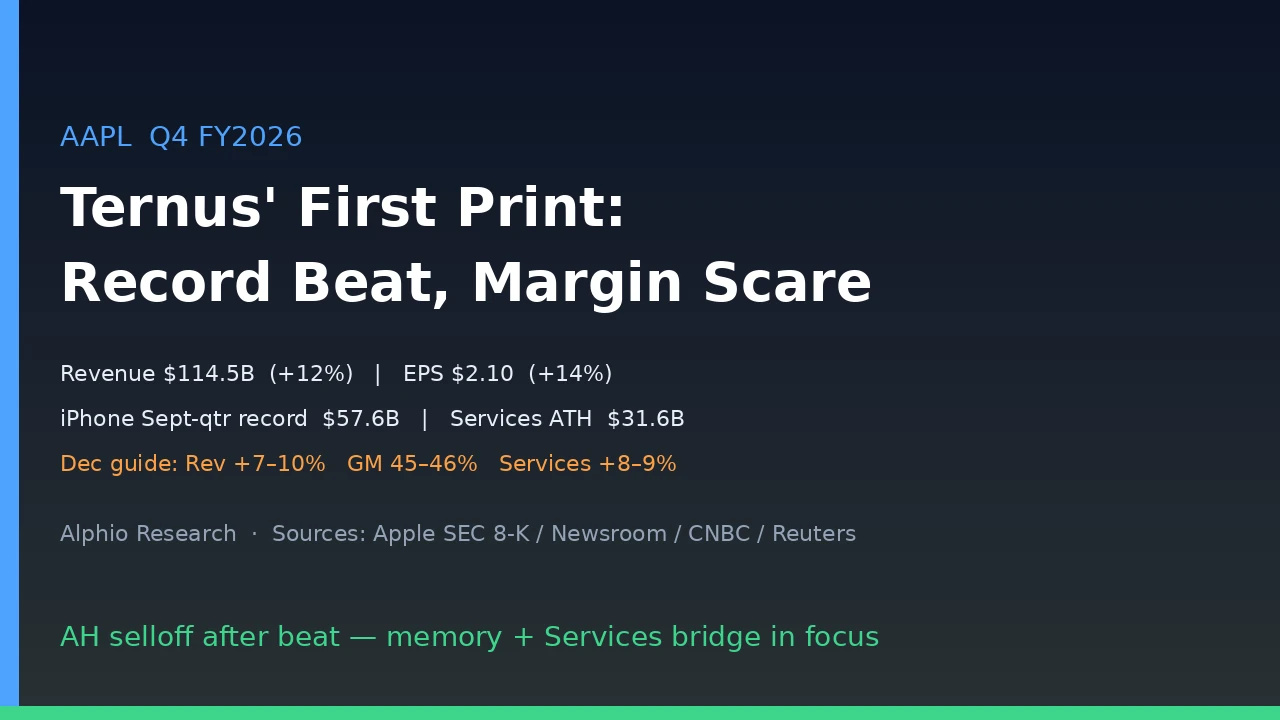
Apple Q4 2026 Deep Dive: Ternus' First Print Beat the Street—Then Memory, Services & Margins Spooked the Tape
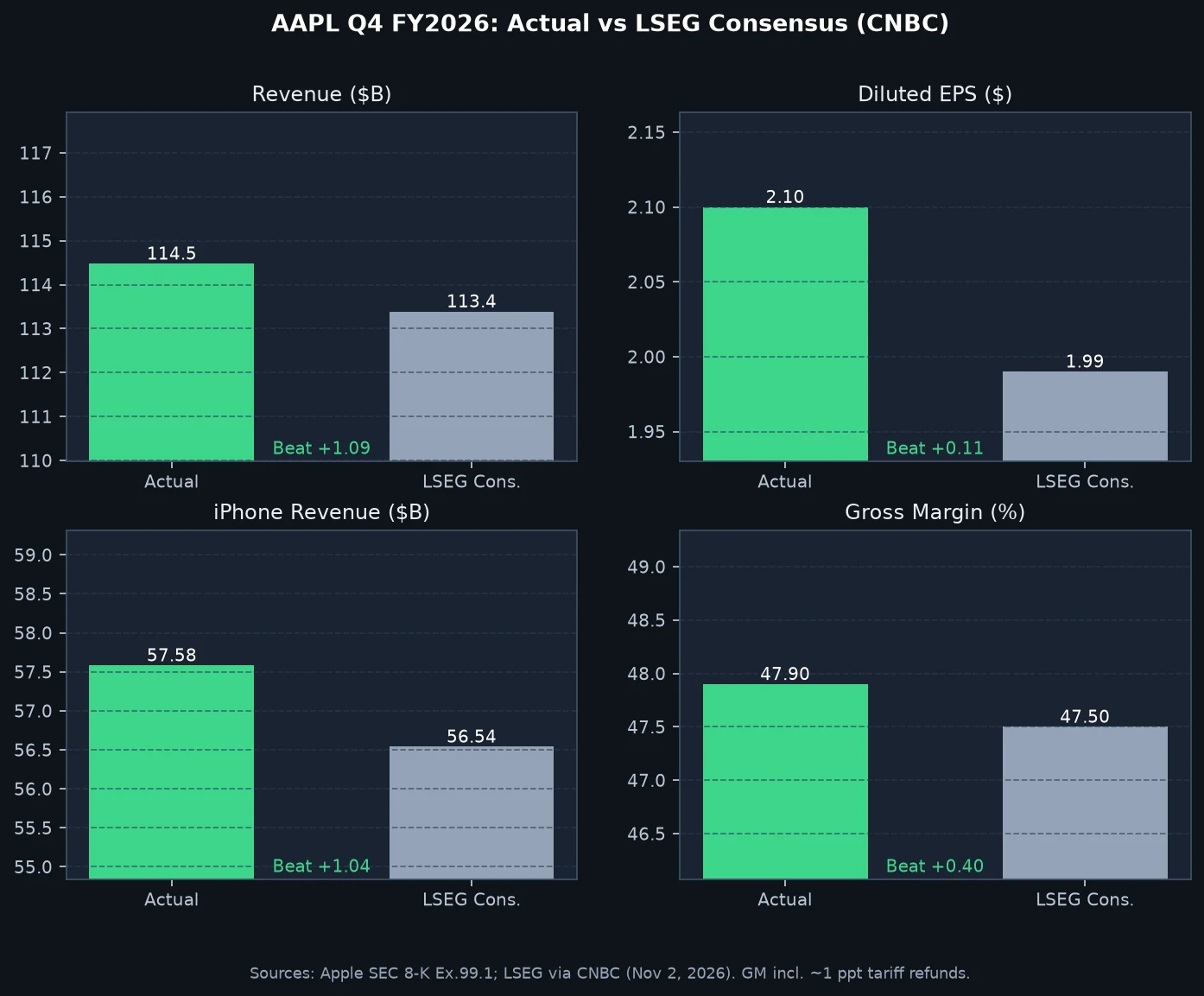
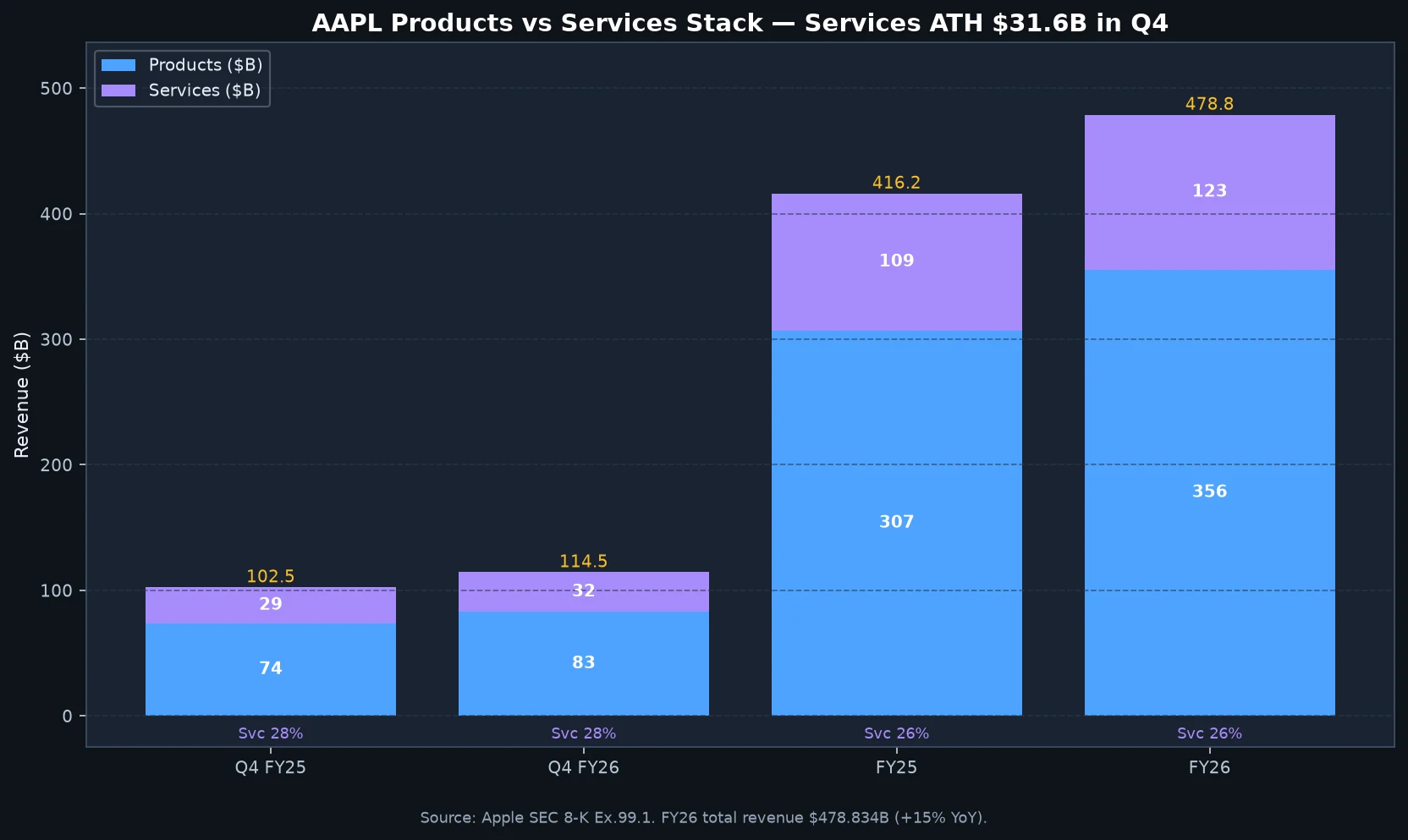
After the close on Monday, November 2, 2026, Apple (NASDAQ: AAPL) handed Wall Street a September-quarter scorecard that, on paper, looked like a victory lap for new CEO John Ternus—his first earnings print since succeeding Tim Cook on September 1. Revenue printed $114.477B (+12% YoY) versus LSEG's ~$113.39B; diluted EPS landed at $2.10 (+14%) versus ~$1.99 (LSEG via CNBC); iPhone hit a September-quarter record at $57.583B; Services set an all-time high at $31.573B; and fiscal 2026 closed as Apple's "best fiscal year ever" at $478.834B of revenue and $8.98 diluted EPS (Apple Newsroom / SEC 8-K Ex.99.1).
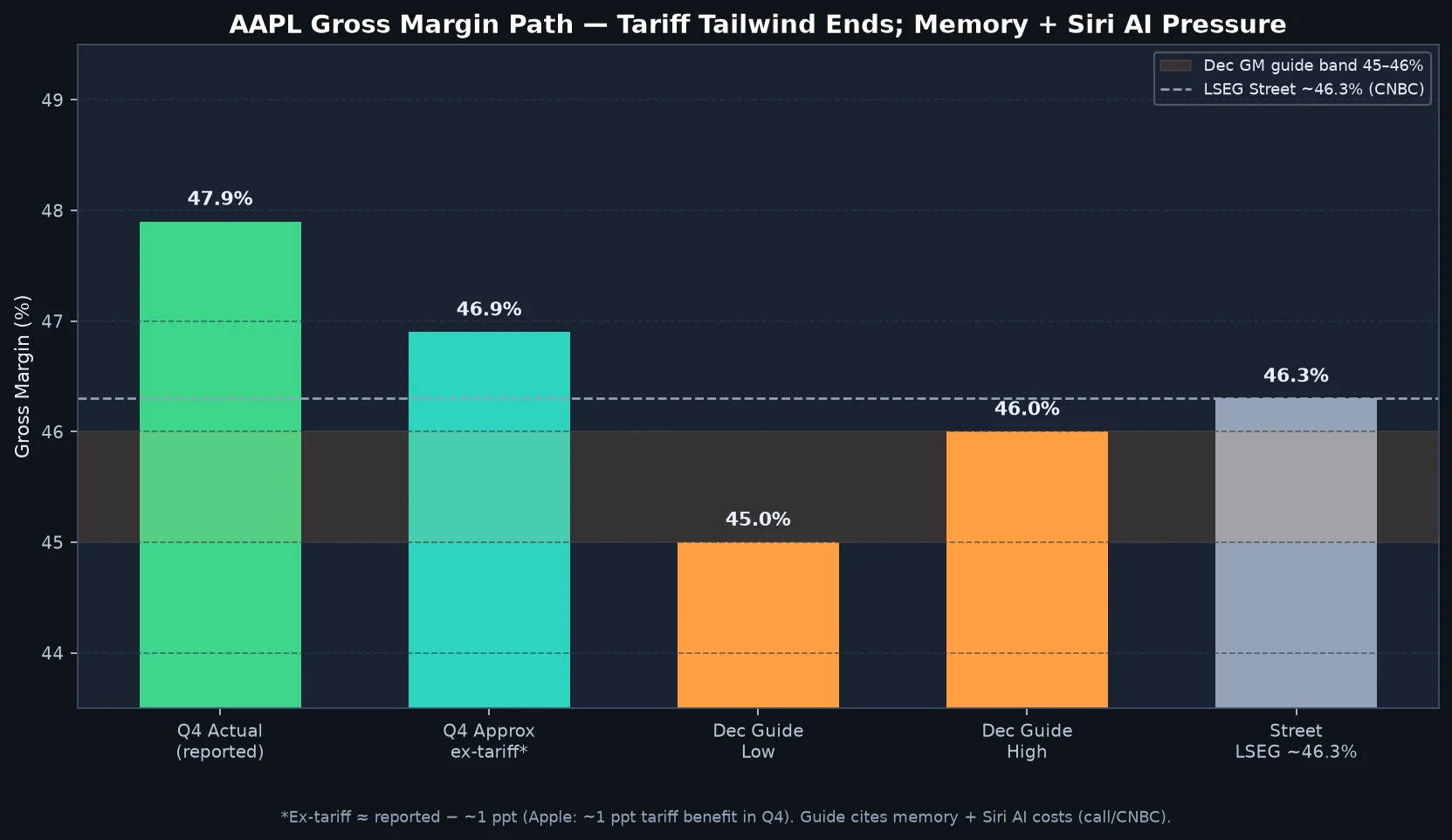
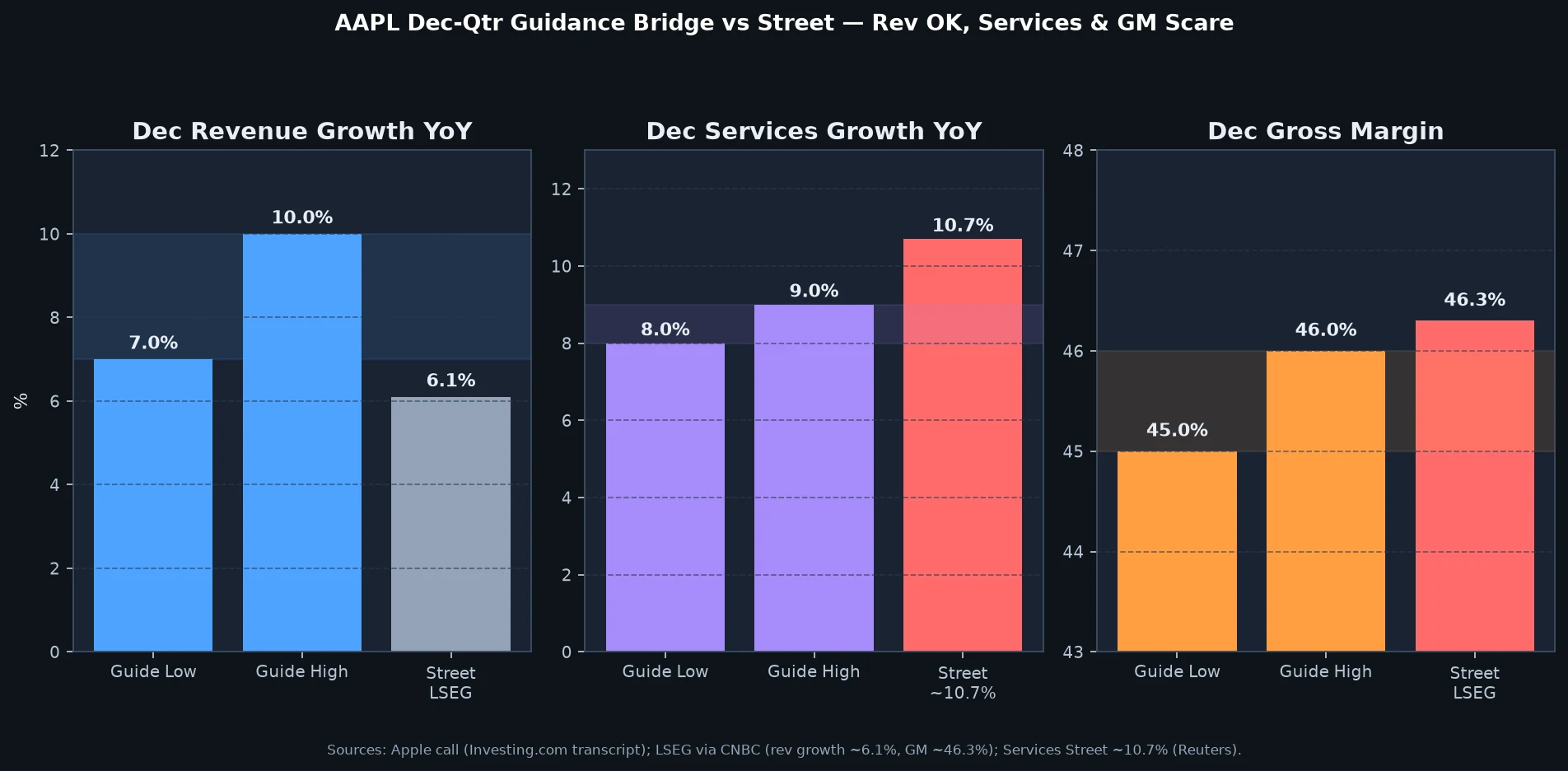
The tape did not throw a party. AAPL closed the regular session at roughly $338.32 (−1.83% from ~$344.63), then slipped further after hours—Investing.com put the AH print near $328.85 (−2.8% from the close)—while Reuters described shares falling about 4% during the conference call as executives walked through December-quarter color. The conflict is the story: records on the income statement, scare on the bridge. Gross margin guided 45–46% (below LSEG's ~46.3% per CNBC); Services growth guided only +8% to +9% (below analysts' ~10.7% per Reuters); memory costs were called "unprecedented"; Mac and iPad remain supply-constrained into the holidays; and the ~1 percentage point tariff-refund tailwind that padded Q4's 47.9% gross margin (and ~$0.05 of EPS) is largely done.
This note reads the print the way the after-hours tape did—as a first-CEO credibility exam colliding with a memory-cycle margin scare—then rebuilds the mechanism from Apple's Newsroom release, the SEC 8-K exhibit condensed financials (https://www.sec.gov/Archives/edgar/data/320193/000032019326000024/a8-kex991q4202609262026.htm), and named secondary coverage (CNBC live blog, Investing.com transcript, Reuters). Consensus anchors are LSEG as cited by CNBC/Reuters. Numbers below are from the primary SEC/Newsroom tables unless attributed to a secondary source.
1. What the Market Was Celebrating—and What It Feared
Heading into Ternus' first call, the constructive braid was thick:
- iPhone cycle durability — four quarters of strong growth behind the prior cycle, early iPhone 18 Pro sell-through, and a foldable iPhone Duo launch that sold out online within hours (Reuters / CNBC), even with crack-screen headlines.
- China recovery — Greater China had already staged a fiscal-year rebound; the Street wanted confirmation that mainland upgrade demand was durable, not a one-quarter bounce.
- CapEx-light AI contrast — while hyperscalers ate the tape on AI buildout anxiety, Apple remained the megacap that spends tens of billions on buybacks rather than hundreds of billions on data-center CapEx (CNBC framing into the print).
- Wall Street's preferred megacap — CNBC noted AAPL was up ~27% YTD into the report, outpacing leading peers, and had just swapped with Nvidia for the world's most-valuable-company crown over the weekend.
The fear set, which after-hours made canonical, was the opposite braid:
- Gross-margin cliff after tariff refunds — Q4's 47.9% included ~1 ppt of tariff refunds; strip that and sequential GM was already down ~1 point on memory (CFO Parekh on the call). December guide 45–46% forces the Street to price memory inflation as a multi-quarter P&L issue, not a footnote.
- Services deceleration optics — September Services +10% was already the slowest expansion since 2022 (CNBC); guiding Dec to +8–9% versus ~10.7% Street (Reuters) hits the "high-margin compounder" narrative that props the multiple.
- Hardware supply vs demand mismatch — management repeatedly said demand outran supply on iPhone, Mac, and iPad in Q4, with Dec constraints concentrating on Mac/iPad via memory (COO Sabih Khan on the call). Beats that are supply-capped are hard to extrapolate.
- First-CEO premium risk — Ternus inherits Cook's machine and Cook's multiple. A beat that arrives with a margin scare invites the market to re-underwrite the new regime rather than rubber-stamp continuity.
Pre-print, AAPL had already slipped ~2% on Monday as Nvidia/Apple swapped the valuation crown (CNBC). The AH extension said investors were looking through the September records into December unit economics.
2. Scorecard: Beat the Print, Lose the Bridge
| Metric | Q4 FY2026 actual | Benchmark / prior year | Read-through |
|---|---|---|---|
| Revenue | $114.477B | PY $102.466B; LSEG ~$113.39B (CNBC) | +12% YoY; clear beat |
| Diluted EPS | $2.10 | PY $1.85; LSEG ~$1.99 (CNBC) | +14%; incl. ~$0.05 tariff refunds |
| Gross margin | 47.9% | LSEG ~47.5% (CNBC); ~1 ppt tariff benefit | Beat headline; ex-tariff softer |
| Products revenue | $82.904B | PY $73.716B | +12% |
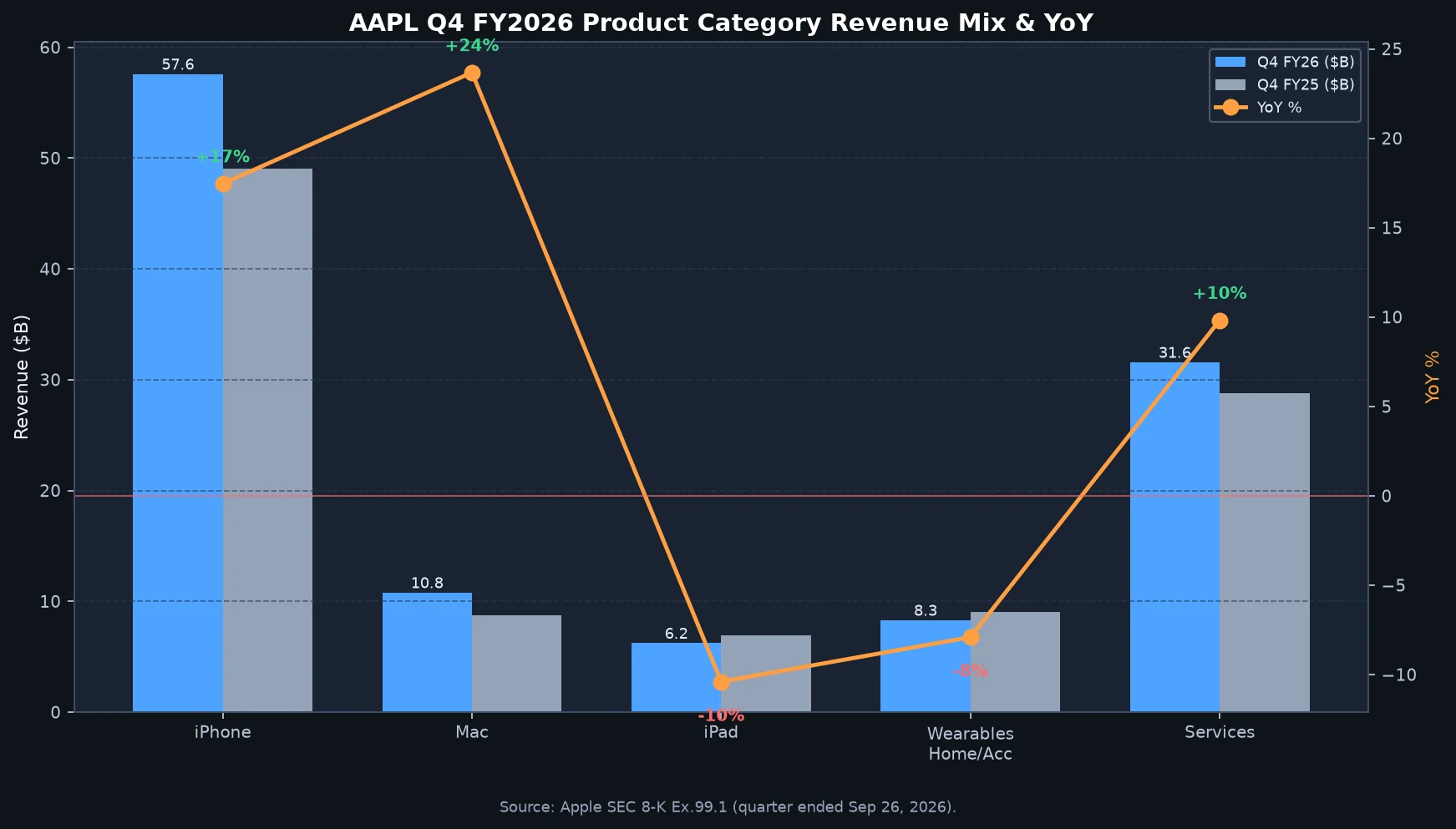
| Services revenue | $31.573B | PY $28.750B; LSEG ~$31.58B | ATH; ~in-line |
| iPhone | $57.583B | PY $49.025B; LSEG ~$56.54B | +17%; Sept-qtr record; beat |
| Mac | $10.792B | PY $8.726B; LSEG ~$9.61B | +24%; biggest category growth |
| iPad | $6.229B | PY $6.952B; LSEG ~$6.7B | −10%; miss; supply + tough comp |
| Wearables/Home/Acc | $8.300B | PY $9.013B; LSEG ~$9.06B | −8%; miss; tough prior launches |
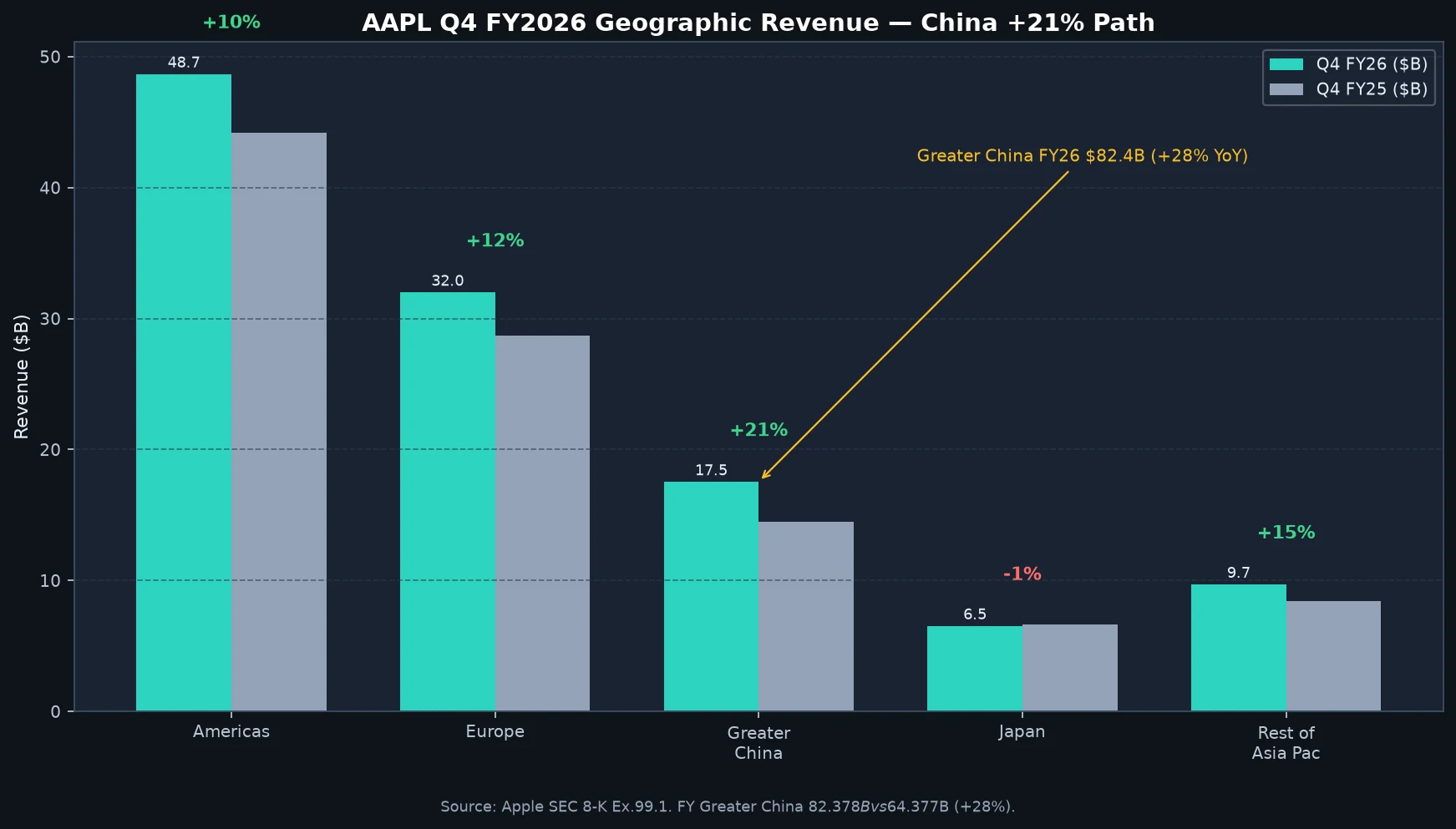
| Americas / Europe | $48.680B / $32.008B | PY $44.192B / $28.703B | Solid; Sept-qtr geo records |
| Greater China | $17.539B | PY $14.493B | +21%; key bull exhibit |
| Japan / RoAPAC | $6.540B / $9.710B | PY $6.636B / $8.442B | Japan soft; RoAPAC +15% |
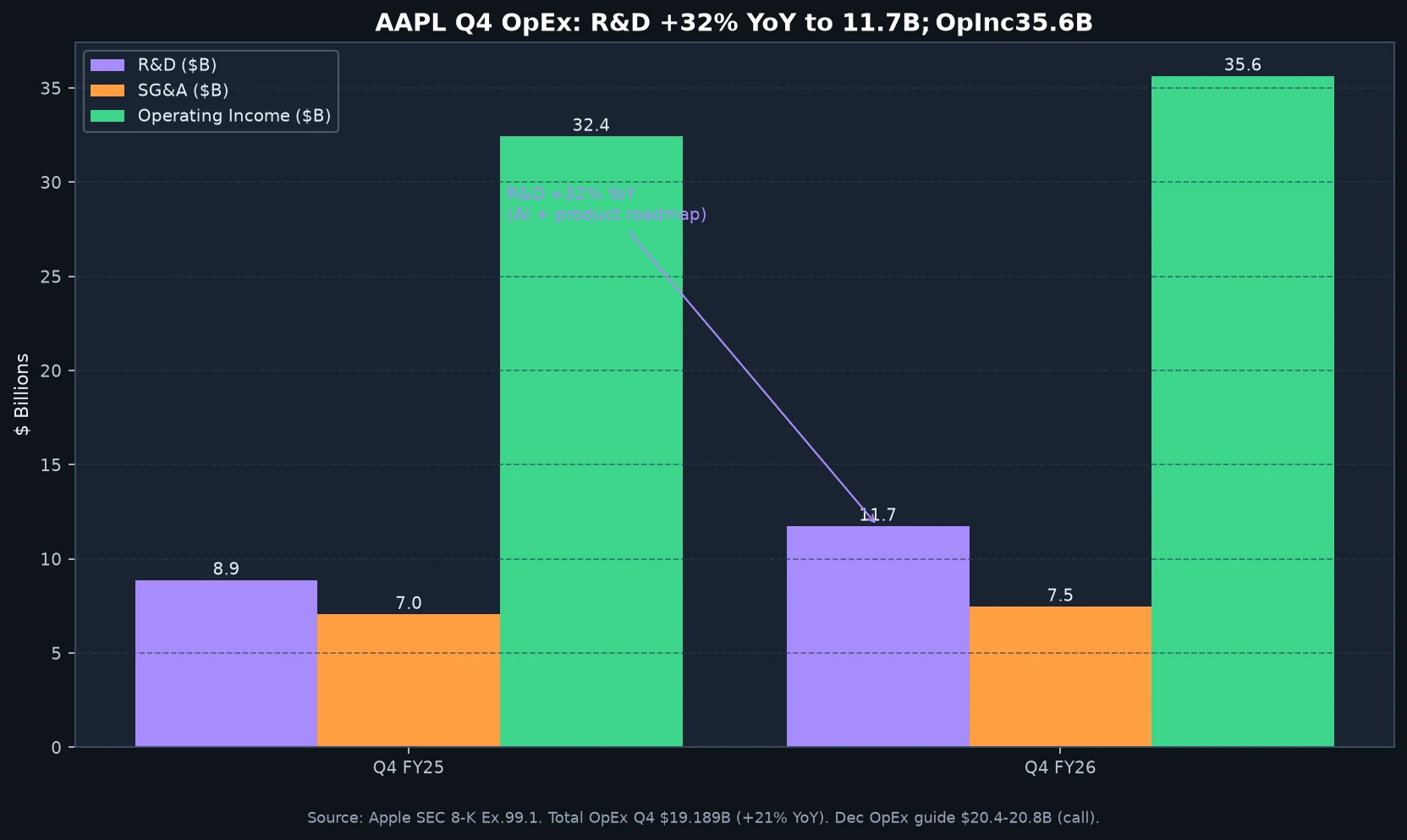
| R&D / SG&A | $11.730B / $7.459B | PY $8.866B / $7.048B | R&D +32%; OpEx +21% |
| Operating income | $35.631B | PY $32.427B | +10% |
| Net income | $30.711B | PY $27.466B | Sept-qtr record |
| FY revenue / EPS | $478.834B / $8.98 | PY $416.161B / $7.46 | Best year; EPS +20% |
| Inventories | $14.541B | PY $5.718B | +154% — side-plot red flag |
| Q4 OCF / capital return | ~$28.1B / $28B | Call: ~$24B buybacks + ~$3.9B div | Cash machine intact |
| Dec rev growth guide | +7% to +10% | LSEG ~6.1% (CNBC) | Above Street; "best quarter in history" |
| Dec Services growth | +8% to +9% | Street ~10.7% (Reuters) | The scare |
| Dec GM guide | 45–46% | LSEG ~46.3% (CNBC) | Memory + Siri AI costs |
| Dec OpEx / tax | $20.4–20.8B / ~17% | OpEx +11–13% YoY (call) | AI R&D continues, pace moderates |
Trap 1: Celebrating the EPS beat without noting ~$0.05 of tariff refunds—and that Apple says the "vast majority" of tariff refunds related to tariffs paid have already been received (Parekh). Trap 2: Reading Services ATH as acceleration when the YoY rate slowed to +10% and Dec guides slower still. Trap 3: Treating Mac's +24% as unconstrained demand when management says Mac/iPad remain memory-constrained into December. Trap 4: Ignoring the inventory spike to $14.5B from $5.7B—a balance-sheet tell that "carry-in inventory" is both a margin offset and a working-capital commitment.
3. Management Voice: Prolific Launches, Unprecedented Memory, "Best Quarter in History"
CEO John Ternus (Newsroom / call): "Today, Apple is proud to report a September quarter revenue record of $114.5 billion, up 12 percent from a year ago, with iPhone reaching a September quarter record and Services reaching an all-time high, capping off our best fiscal year ever… We're closing the year with our most ambitious lineup yet. That includes the iPhone Duo, the most transformational iPhone since the original, alongside iPhone 18 Pro and iPhone 18 Pro Max… Together with the all-new Siri AI, it's an incredible lineup to carry us into the holiday season." On the call he framed the moment as "one of the most prolific launch periods in our history" and cast iPhone as the "intelligent personal hub" of Apple's AI strategy, with privacy as the differentiator: "no one can access users' data, not even Apple."
CFO Kevan Parekh (Newsroom / call): September records for net income and EPS; Q4 OCF $28.1B funding $28B of shareholder returns; install base of active devices at an all-time high across major categories and geos. On the outlook: "We expect our December quarter total company revenue to grow between 7% and 10% year-over-year, which reflects our best view of constrained supply. We expect this to be the best quarter for revenue in the history of the company." Services +8–9% with sequential headwinds from third-party licensing and FX; GM 45–46% on "primarily the impact of higher memory costs, as well as some costs related to the ramp of Siri AI"; OpEx $20.4–20.8B; tax ~17%.
Memory mechanism (Ternus / Parekh / COO Sabih Khan): Pricing is "unprecedented." Ex-tariff, company and products GM were down ~1 point sequentially in September, "primarily driven by higher memory costs," partly offset by carry-in inventory and lower non-memory component costs. December expects even higher memory costs, partly offset by June/September price increases (iPad/Mac then iPhone), remaining carry-in benefit, and non-memory cost relief—but carry-in benefit is expected to decrease over time, and memory purchase prices keep rising beyond December. Manufacturing purchase obligations jumped $33B from June to September (to appear in the 10-K). Khan: Dec Mac/iPad constraints are "primarily driven by memory, as demand has been higher than what we expected"; advanced-node SoC constraints that hit Q4 are easing as the lineup moves to 2nm.
Siri AI accounting tell: Cloud costs flow through Services cost of sales; hardware deferrals will reflect the addition of Siri AI (Parekh)—so AI is not just an OpEx R&D story; it is a gross-margin story on both Products and Services.
Product cadence change: Apple is spacing iPhone launches—Pro and Duo this year, other models expected next year (Reuters)—and flooding the holiday quarter with non-iPhone firsts (Touch MacBook Pro, HomeView hub, new HomePod mini / Apple TV 4K). Analysts read this as an attempt to smooth the old "huge holiday boom, late-summer fade" cycle (Reuters).
4. The Risk Ledger: Memory, Margin, Services, Inventory, AI Spend, CapEx Optics
| Risk | What we know | Why it matters |
|---|---|---|
| Dec GM vs Street | Guide 45–46% vs LSEG ~46.3% (CNBC) | Multiple hangs on margin durability |
| Memory duration | "Unprecedented" pricing; rising beyond Dec; carry-in benefit fades (call) | Not a one-quarter scrub |
| Tariff refund cliff | ~1 ppt / ~$0.05 EPS in Q4; vast majority already received | Easy comps disappear |
| Services guide miss | +8–9% vs ~10.7% Street (Reuters); App Store/gaming/licensing/FX headwinds | Challenges the compounder narrative |
| Supply constraints | Mac/iPad memory-limited into Dec; Duo still constrained (Khan/Ternus) | Upside capped even if demand is real |
| Inventory spike | $14.541B vs $5.718B PY (SEC) | Working capital + mix/aging questions |
| R&D intensity | Q4 R&D $11.73B (+32%); FY R&D $45.8B vs $34.6B | AI spend is real even if CapEx is light |
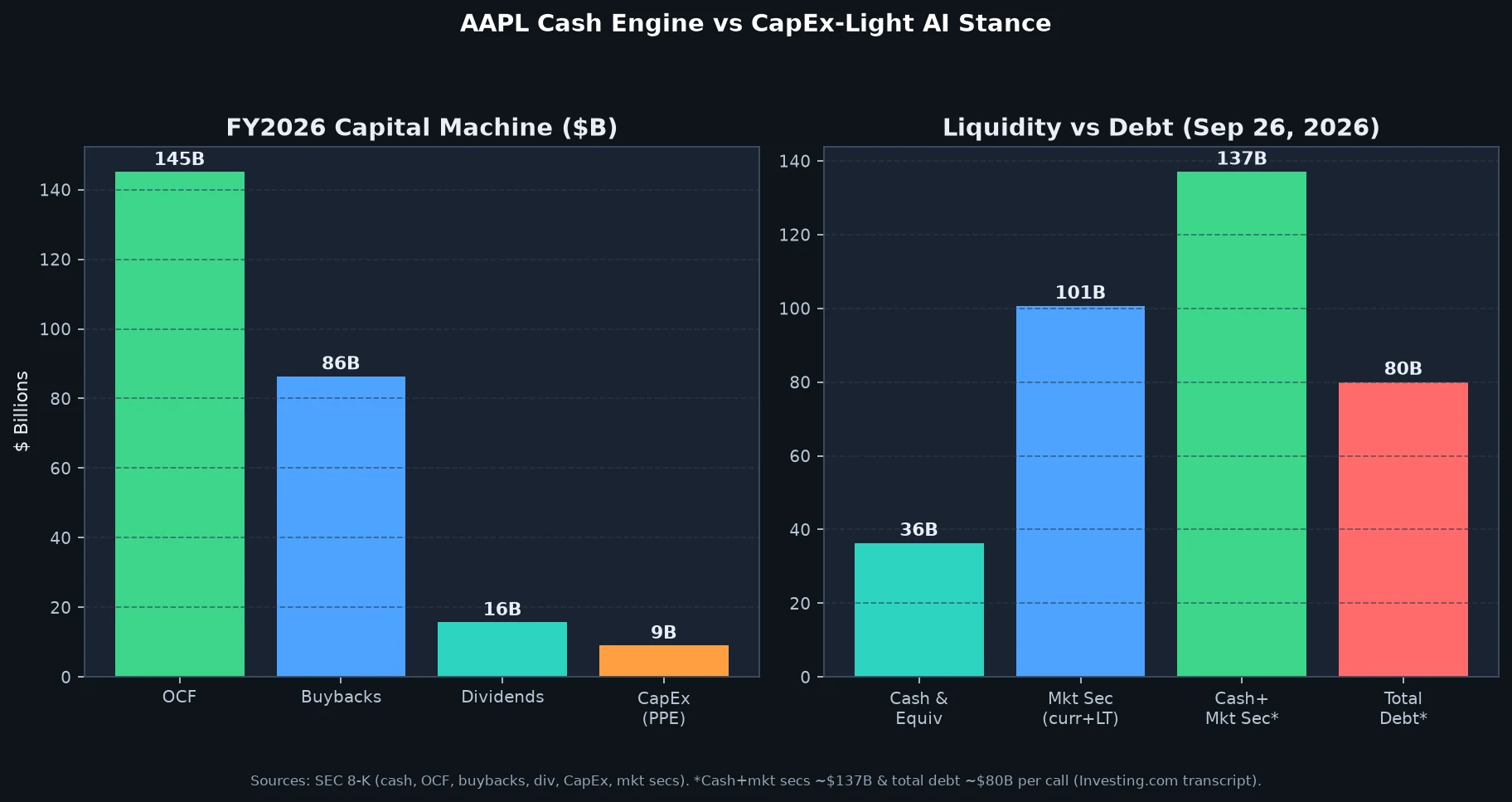
| CapEx-light optics | FY PPE payments only $9.041B; CNBC: Q CapEx ~$2.24B vs LSEG ~$3.33B | Bull: capital discipline; Bear: under-investing vs AI peers |
| iPad / Wearables miss | Both below LSEG; Wearables −8% on tough comps | Mix drag if holiday attach disappoints |
| Duo quality headlines | Crack-screen returns; Ternus to Reuters: "very small percentage," replacing units | Brand/execution risk under new CEO |
| Regulatory / App Store | Link-out ruling (US); model changes abroad; gaming headwinds (Parekh) | Structural Services pressure |
| Price elasticity unknown | iPhone +$100; Mac/iPad prices up in June; "early to assess" (Parekh) | ASP help vs unit risk |
The ledger's center of gravity is margin duration + Services growth credibility, not whether iPhone beat by a billion. That is why a September-quarter revenue/EPS record coexisted with an AH selloff.
5. Long vs Short Debate (Named Sources)
The short / skeptic case (tape + named desks): The after-hours path—regular-session −1.83% to ~$338, then Investing.com's AH ~$328.85 (−2.8%), with Reuters citing ~−4% during the call—is the market's vote that December GM and Services matter more than September records. Barclays stayed Underweight into the print, "cautious on the stock given iPhone uncertainties this cycle, limited monetization of AI, and renewed fears on the App Store," arguing preferential memory pricing benefits are fading (CNBC preview). Needham's Laura Martin (Hold framing on CNBC) argued Apple has "bet the farm" on the smartphone's continuing relevance while Meta/Google chase new AI form factors. TECHnalysis' Bob O'Donnell (Reuters) framed the forward question as weathering component-price inflation that has already slowed PC/smartphone competitors, with Duo needing both quality fixes and manufacturing ramp before it moves the needle. The Services guide below ~10.7% Street (Reuters) and GM below ~46.3% LSEG (CNBC) give skeptics two clean "miss the emotional bar" exhibits.
The long / continuity case (management + residual Buy desks): Bank of America (Wamsi Mohan) maintained Buy with PT $370 into the print (CNBC), focusing investor attention on component inflation and Services durability rather than abandoning the franchise. Management's rebuttal stack is concrete: Dec revenue guided above LSEG growth (~7–10% vs ~6.1%), explicitly framed as the best revenue quarter in company history; iPhone +17% and Mac +24% despite constraints; Greater China +21% (FY +28%); install base >2.5B active devices; >1.5B paid subscriptions; cash + marketable securities ~$137B against ~$80B total debt (call); FY OCF $145.1B funding $86.4B buybacks and $15.7B dividends. Ternus' AI monetization answer leans hardware upgrade cycles plus future paid expanded access to server-side Siri AI / Apple Intelligence features via iCloud+-like packaging—not a hyperscaler CapEx arms race. The long mechanism: if memory inflation peaks slower than feared or price increases stick without crushing units, the AH scare is a bridge-quarter scrub inside a record year—not a regime break.
Synthesis: Bears are not arguing the September quarter was fake. They are arguing the equity story was priced as a margin-resilient, Services-compounding megacap, and Ternus' first guide forced a re-underwrite of both pillars at once. Bulls are arguing the same selloff reprices a still-beating machine that just guided the biggest revenue quarter in Apple history while peers panic over AI CapEx.
6. Side Plots: Inventory Spike, China Rebound, Product Cadence, CapEx-Light AI
Inventory spike. Inventories jumped to $14.541B from $5.718B a year earlier (SEC). Management markets the carry-in as a near-term GM offset against rising memory purchase prices. The other reading: Apple is stocking aggressively into a constrained supply chain (purchase obligations +$33B QoQ) while iPad/Wearables already missed. Watch whether inventory converts into December revenue or becomes a mix/aging overhang when carry-in benefit fades.
China. Greater China Q4 $17.539B (+21%); FY $82.378B (+28%) after two years of declines (call / Arete question). Ternus attributed the rebound to iPhone (Sept-qtr record) and Mac (strong double digits); mainland China record upgraders; Worldpanel top-three smartphones in urban China; Counterpoint: MacBook Air and MacBook Neo top two laptops, Mac mini top desktop in the September quarter. This is the bull side plot—if it holds, it is company-leading regional growth; if it fades, the FY26 rebound was a product-cycle sugar high.
Product cadence change. Spacing the iPhone family and packing Touch Mac, HomeView, and Home hardware into the holiday quarter is a Ternus-era operating signature (Reuters analysis). Success looks like a smoother revenue sine wave; failure looks like diluted launch energy plus Duo execution noise (crack screens, long ship dates into 2027 per CNBC).
CapEx-light vs hyperscaler panic. FY CapEx (PPE payments) only $9.041B against $145.1B OCF—while Meta/Google/Microsoft debates center on AI cash burn. CNBC flagged quarterly CapEx ~$2.24B below LSEG ~$3.33B. Bulls call this capital discipline and on-device AI leverage; bears call it strategic under-investment if Siri AI cloud costs scale faster than Ternus expects (Parekh: mix of on-device vs Private Cloud Compute still "very early").
Capital return still the other AI. Q4 returned $28B (~$24B buybacks + ~$3.9B dividends); dividend declared $0.27 payable November 16 (record November 12). Net cash neutral is no longer the target—Parekh reiterated evaluating cash and debt independently while returning excess cash after investing in the business (call / Melius question).
7. Braided Thesis
Apple Q4 FY2026 / Ternus Print One is a record machine colliding with a margin-and-Services credibility test. Track one—revenue $114.5B, EPS $2.10, iPhone Sept-qtr record, Mac +24%, Services ATH, FY $479B, China +21%, Dec revenue guided as the best quarter in company history—is the Apple the Street owned into the print. Track two—GM guided 45–46% with memory called unprecedented and tariff refunds largely exhausted, Services guided +8–9% below ~10.7% Street, iPad/Wearables misses, inventories more than doubling, Duo quality headlines, and AH price discovery toward the low $320s—is what the tape priced when Parekh finished prepared remarks.
The braided read: this was not a demand collapse. Management is explicit that supply, not demand, is the binding constraint on Mac/iPad into December, and that iPhone grew 17% despite constraints. It was a unit-economics and narrative-duration event. Ternus' first guide asked investors to accept (a) lower near-term GM, (b) slower near-term Services growth, and (c) AI costs landing in gross margin—while still promising the largest revenue quarter Apple has ever printed. Dilution is not the Intel problem here; expectation architecture is. The multiple was built on margin resilience and Services compounding. Both were marked down on the bridge even as the P&L printed records.
For Alphio readers thinking in copy-trade / budget terms: AAPL after this print is no longer a pure "buy the megacap fortress" autopilot. It is a high-quality compounder with a live memory-cycle overlay, where position sizing has to respect GM guide bands, Services sequential headwinds, and the fact that the first Ternus call taught the tape to trade the bridge harder than the beat. The iPhone/China charts remain the bull screenshots. The Dec GM/Services bridge remains the bear screenshot. Both are true.
8. Falsifiable Watchpoints
- December revenue vs +7–10% guide — a print toward the high end with GM ≥46% would argue memory was over-discounted; a miss below +7% with GM ≤45% re-opens downside.
- Services growth vs +8–9% — reclaiming double-digit YoY in March would falsify the "slowest since 2022" regime; another sub-9% print validates the bear compounder-break thesis.
- Gross margin trajectory after carry-in fades — management says memory purchase prices keep rising and carry-in benefit decreases; watch whether price increases fully offset or unit elasticity appears.
- Inventory conversion — $14.5B stock should show up as Dec revenue/mix; if inventory stays elevated while GM keeps compressing, the "offset" story flips to overstock.
- Duo supply-demand balance + quality — Ternus/Khan cannot yet predict balance; crack-screen "small percentage" must stay small as volumes ramp.
- China durability — another +double-digit Greater China quarter would confirm rebound; a fade toward flat would mark FY26 as cycle sugar.
- Siri AI cost mix — on-device vs Private Cloud Compute mix and any upward revision to server inference costs (Parekh: early days).
- Mac/iPad constraint relief — memory availability that lets constrained demand convert would unlock upside to the already-above-Street revenue guide.
FAQ
Why did Apple stock fall after beating earnings?
Because the December-quarter bridge—gross margin 45–46% (below LSEG ~46.3%) and Services growth +8–9% (below ~10.7% Street per Reuters)—hit the two narratives that support Apple's multiple, even though Q4 revenue/EPS/iPhone beat LSEG (CNBC). After-hours price discovery (Investing.com ~$328.85; Reuters ~−4% during the call) priced margin/Services fear over September records.
How much did tariff refunds help the quarter?
Apple said company gross margin of 47.9% included a favorable impact of approximately 1 percentage point from tariff refunds, and diluted EPS of $2.10 included about $0.05 from those refunds (Newsroom / SEC). CFO Parekh said the vast majority of refunds related to tariffs paid have been received—so the tailwind should not repeat at the same scale.
Is Apple still guiding for a record holiday quarter?
Yes. Parekh said December-quarter total company revenue growth of 7% to 10% YoY should make it "the best quarter for revenue in the history of the company," even after reflecting constrained supply (call / CNBC). The debate is quality of that revenue (margins, Services mix), not whether the top line can still print a record.
Sources: Apple Newsroom (Nov 2, 2026) and SEC Form 8-K Exhibit 99.1 condensed financial statements for the quarter ended September 26, 2026; CNBC live blog (Kif Leswing et al., Nov 2, 2026) for LSEG consensus and call color; Investing.com earnings-call transcript for prepared remarks, Q&A, AH price ~$328.85, cash+marketable securities ~$137B / total debt ~$80B, and capital-return split; Reuters (Stephen Nellis, Nov 2, 2026) for Services Street ~10.7%, ~4% call move, Duo interview color. This article is independent research commentary for Alphio readers, not investment advice.
Disclaimer: For information and research-methodology demonstration only—not investment advice, a recommendation, or a performance guarantee. Figures follow Apple Newsroom, the SEC 8-K exhibit, and public earnings-call transcripts/media; consensus figures are as reported by financial media citing LSEG and may differ by vendor. Investors should review SEC filings (including the forthcoming Form 10-K) and form independent judgments.
FAQs
Why did Apple stock fall after beating earnings?
Because the December-quarter bridge—gross margin **45–46%** (below LSEG ~**46.3%**) and Services growth **+8–9%** (below ~**10.7%** Street per Reuters)—hit the two narratives that support Apple's multiple, even though Q4 revenue/EPS/iPhone beat LSEG (CNBC). After-hours price discovery (Investing.com ~$328.85; Reuters ~−4% during the call) priced margin/Services fear over September records.
How much did tariff refunds help the quarter?
Apple said company gross margin of **47.9%** included a favorable impact of approximately **1 percentage point** from tariff refunds, and diluted EPS of **$2.10** included about **$0.05** from those refunds (Newsroom / SEC). CFO Parekh said the vast majority of refunds related to tariffs paid have been received—so the tailwind should not repeat at the same scale.
Is Apple still guiding for a record holiday quarter?
Yes. Parekh said December-quarter total company revenue growth of **7% to 10%** YoY should make it *"the best quarter for revenue in the history of the company,"* even after reflecting constrained supply (call / CNBC). The debate is quality of that revenue (margins, Services mix), not whether the top line can still print a record.
Related articles
- Stock Market Surges After 2026 Midterms: What the Democratic Sweep Means for Your PortfolioThe stock market rallied after Democrats won the 2026 midterms. Discover what the election means for investors, tech stocks, and the S&P 500 outlook.
- Stock Market Surges After 2026 Midterms: What the Democratic Sweep Means for Your PortfolioThe stock market rallied after Democrats won the 2026 midterms. Discover what the election means for investors, tech stocks, and the S&P 500 outlook.
- Oil Prices Surge Above $105 Amid US-Iran Conflict: Energy Investment Opportunities in November 2026Oil prices climb past $105 as US strikes Iran's Qeshm Island. Discover energy investment opportunities, top oil stocks, and market outlook for November 2026.
- Gold Price Forecast August 2026: Will Fed Policy Drive Gold to $4,900?Gold price forecast for August 2026: Analysis of Fed rate policy impact, inflation hedge demand, and expert predictions targeting $4,500-$4,900 range.
- Nvidia Earnings August 2026: AI Chip Leader's Q2 Preview & Investment OutlookNvidia reports Q2 FY27 earnings August 26, 2026. Wall Street expects $93-95B revenue. Analysis of AI demand, Blackwell ramp, and investment outlook.
- Nvidia Stock Earnings August 2026: AI Chip Leader's Q2 Preview & Investment OutlookNvidia reports Q2 FY2027 earnings on August 26, 2026. Explore analyst forecasts, key metrics to watch, and investment strategies for NVDA stock ahead of the catalyst.