

Nvidia Earnings August 2026: AI Chip Leader's Q2 Preview & Investment Outlook
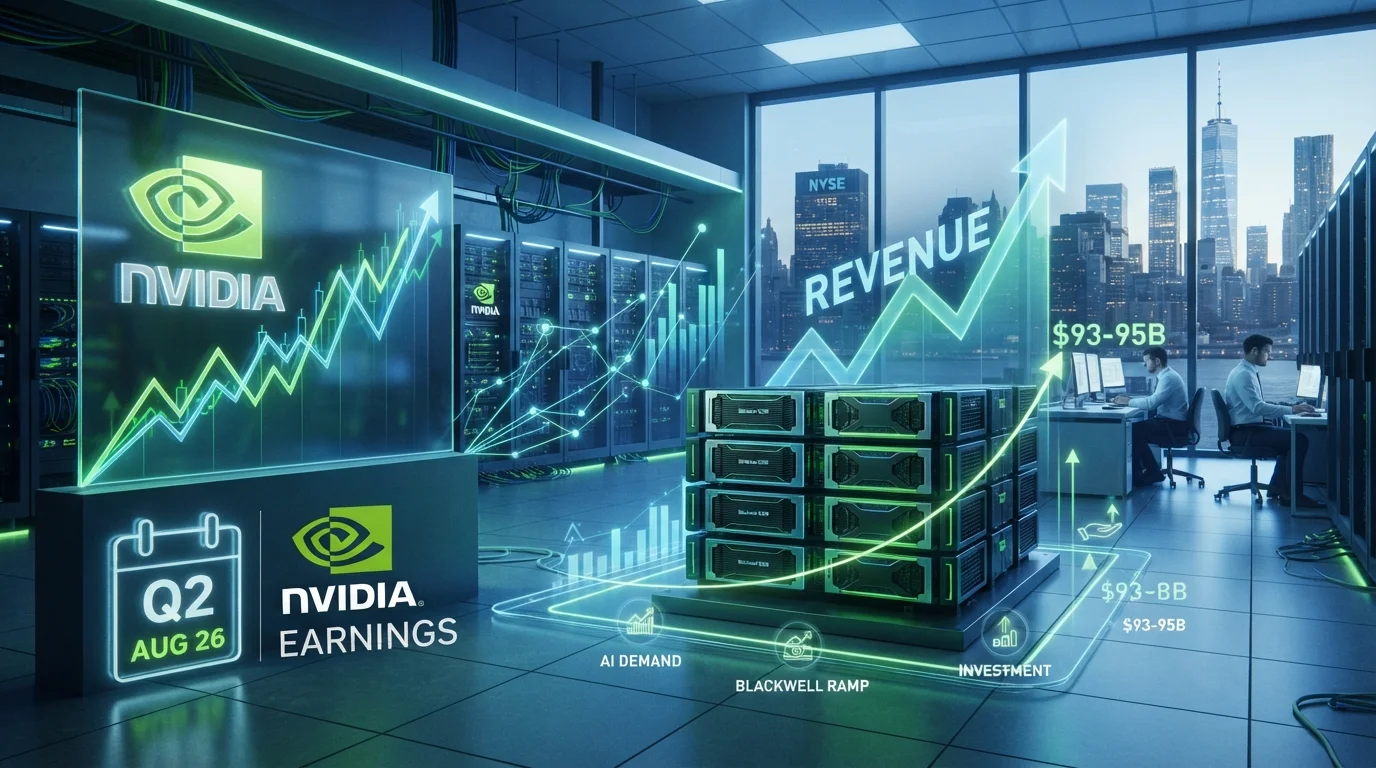
Nvidia reports Q2 FY27 earnings August 26, 2026. Wall Street expects $93-95B revenue. Analysis of AI demand, Blackwell ramp, and investment outlook.

Key Takeaway
Nvidia is scheduled to report its fiscal second-quarter 2027 earnings on August 26, 2026, and Wall Street analysts are anticipating another blockbuster quarter with revenue expectations ranging from $93 billion to $95 billion. The semiconductor giant, which has seen its stock rise approximately 17.7% year-to-date to around $219, faces a critical moment that could determine whether it reclaims its position as a market leader or continues to underperform the broader S&P 500. With analysts projecting continued strength in data center demand and the ramp-up of its next-generation Blackwell architecture, investors are closely watching whether Nvidia can maintain its extraordinary growth trajectory in an increasingly competitive AI chip market.
The significance of this earnings report extends beyond just the headline numbers. Nvidia has become the bellwether for the entire AI infrastructure buildout, and its guidance will likely set the tone for how investors view the sustainability of AI-related capital expenditures across the technology sector. The company's data center segment, which generated $75.2 billion in the previous quarter representing a 92% year-over-year increase, continues to dwarf all other business lines. This concentration presents both opportunities and risks as the company navigates supply constraints, geopolitical tensions, and emerging competition from custom silicon solutions being developed by major cloud providers.
Understanding Nvidia's Current Market Position
Nvidia's transformation from a gaming-focused graphics card manufacturer to the dominant force in AI computing represents one of the most remarkable corporate pivots in modern technology history. The company's stock has become synonymous with the AI revolution, with its market capitalization swelling to make it one of the most valuable companies globally. This valuation reflects not just current earnings but the market's expectation that Nvidia will remain the primary beneficiary of the massive capital flowing into AI infrastructure.
The company's competitive moat stems from its comprehensive ecosystem approach. Beyond just selling chips, Nvidia provides the entire software stack through CUDA and related frameworks that have become the industry standard for AI development. This ecosystem lock-in creates significant switching costs for customers and provides Nvidia with pricing power that few semiconductor companies have historically enjoyed. The result has been extraordinary financial performance, with the company reporting fiscal year 2026 revenue of $15.94 billion, representing a 65.47% increase from the previous year.
However, the stock's performance in 2026 has been more measured compared to the explosive gains of previous years. Trading around $219, Nvidia has gained approximately 17.7% year-to-date, which while respectable, trails the broader technology sector's rally. This relative underperformance reflects growing investor concerns about valuation, competition, and the sustainability of current growth rates. The upcoming earnings report will be crucial in determining whether these concerns are justified or whether Nvidia can demonstrate that its growth story remains intact.
Q2 FY27 Earnings Expectations and Key Metrics
Wall Street analysts have set high expectations for Nvidia's second quarter, with consensus revenue estimates clustering around $93-95 billion. This would represent a sequential increase from the $81.6 billion reported in Q1 FY27 and demonstrate continued momentum in the company's core data center business. The growth is expected to be driven by sustained demand for the company's Hopper architecture GPUs, which remain the workhorse for AI training and inference workloads across the industry.
Earnings per share expectations are similarly elevated, with analysts looking for non-GAAP EPS in the range of $2.10 to $2.20. This would represent meaningful growth from the $1.87 reported in the previous quarter and underscore the company's ability to convert revenue growth into profitability. Nvidia's gross margins have been exceptional for a semiconductor company, consistently exceeding 70%, and investors will be watching to see if this level of profitability can be maintained as the product mix evolves and competition intensifies.
The data center segment will undoubtedly be the focus of attention, with expectations for revenue approaching $80 billion or higher. This segment has grown from representing roughly half of Nvidia's business to now accounting for approximately 90% of total revenue. While this concentration has driven extraordinary financial results, it also means that any slowdown in data center spending would have an outsized impact on the company's overall performance. Management commentary on the sustainability of current demand levels will be critical in shaping investor sentiment following the report.
The Blackwell Architecture: Next Growth Engine
A key focus of the upcoming earnings call will be updates on the ramp of Nvidia's next-generation Blackwell architecture. Blackwell represents a significant technological leap, offering substantial performance improvements over the current Hopper generation for AI workloads. The successful transition to Blackwell is essential for Nvidia to maintain its technological leadership and pricing power in an increasingly competitive market.
Initial production ramp of Blackwell began in the second quarter, and investors will be looking for concrete guidance on volume shipments and customer adoption. The transition to a new architecture always carries execution risks, including potential yield issues, supply chain constraints, and customer qualification timelines. However, early indications suggest strong demand for Blackwell, with major cloud providers and enterprise customers eager to deploy the latest technology for their AI initiatives.
The pricing dynamics of Blackwell will also be closely watched. Nvidia has historically been able to command premium pricing for its latest generation products, and Blackwell is expected to continue this trend. However, the company faces a delicate balance between maximizing revenue per unit and maintaining market share in the face of emerging competition. Management's commentary on pricing trends and customer willingness to pay for performance improvements will provide important insights into the company's competitive positioning.
For investors seeking exposure to the AI infrastructure buildout, understanding the Blackwell transition is essential. The architecture represents Nvidia's answer to growing competition and increasing customer demands for performance and efficiency. A smooth ramp would validate the company's technology roadmap and support continued premium valuation multiples, while any execution challenges could raise concerns about the sustainability of Nvidia's market dominance.
Competitive Landscape and Market Dynamics
While Nvidia remains the dominant player in AI accelerators, the competitive landscape is evolving rapidly. Major cloud providers including Amazon, Google, and Microsoft are investing heavily in custom silicon solutions designed to reduce their dependence on Nvidia and improve their cost structures for AI workloads. These custom chips, while not yet matching Nvidia's performance for training workloads, are gaining traction for inference applications and represent a long-term threat to Nvidia's market share.
AMD has emerged as the most credible alternative to Nvidia in the general-purpose AI accelerator market, with its MI300 series gaining traction among customers seeking alternatives. While AMD's market share remains small compared to Nvidia, the company has demonstrated that it can deliver competitive performance for certain workloads. The competitive dynamics between Nvidia and AMD will be an important factor to watch, particularly as both companies ramp production of their next-generation products.
Traditional semiconductor companies like Intel are also attempting to re-enter the AI accelerator market, though with limited success to date. Intel's Gaudi series has struggled to gain meaningful market share, but the company's manufacturing capabilities and enterprise relationships could pose a longer-term competitive threat. Additionally, a host of startups are developing specialized AI chips, though these companies face significant challenges in competing with Nvidia's ecosystem and established customer relationships.
The competitive environment has implications for Nvidia's pricing power and margins. While the company currently enjoys a dominant market position, the emergence of viable alternatives could pressure pricing over time. Management's commentary on competitive dynamics and customer conversations about alternative solutions will be important in assessing the durability of Nvidia's competitive advantages.
Data Center Demand Trends and Customer Insights
The sustainability of data center demand is perhaps the most critical question facing Nvidia investors. The company's extraordinary growth has been driven by massive capital expenditures from cloud providers and enterprises building out AI infrastructure. Understanding the trajectory of this spending is essential for modeling Nvidia's future revenue potential.
Major cloud providers including Microsoft Azure, Amazon Web Services, and Google Cloud Platform have been among Nvidia's largest customers, deploying hundreds of thousands of GPUs to support their AI services. These companies have indicated plans to continue increasing their AI infrastructure investments, though the pace of growth may moderate from the explosive rates seen in 2024 and 2025. Enterprise customers across industries including financial services, healthcare, and automotive are also ramping their AI investments, providing an additional source of demand growth.
However, questions remain about the utilization rates of deployed AI infrastructure and the timeline for translating these investments into profitable AI services. Some analysts have raised concerns about a potential slowdown in AI infrastructure spending if the return on these investments fails to meet expectations. Nvidia's management commentary on customer deployment trends, utilization rates, and forward-looking demand indicators will be closely scrutinized for insights into the durability of current growth rates.
The geographic distribution of demand is also evolving, with increasing interest from regions outside the United States seeking to build domestic AI capabilities. This trend has implications for Nvidia's supply chain and go-to-market strategy, as well as potential regulatory considerations related to export controls and technology transfer restrictions.
For investors looking to capitalize on the AI infrastructure trend, tools like Alphio AI's copy trading feature can help mirror the strategies of successful tech investors who have navigated similar transformational technology cycles.

Supply Chain and Manufacturing Considerations
Nvidia's ability to meet the extraordinary demand for its products has been constrained by manufacturing capacity, particularly at its primary foundry partner TSMC. The advanced process nodes required for Nvidia's latest GPUs are in high demand from multiple customers, and TSMC has been investing heavily to expand capacity. However, these capacity expansions take time, and supply constraints have limited Nvidia's ability to fully capitalize on current demand.
The transition to Blackwell adds additional complexity to the supply chain, as new products typically face yield challenges in the early stages of production. Management's commentary on manufacturing yields, capacity expansion progress, and the outlook for supply-demand balance will be important in assessing the company's ability to execute on its growth opportunities.
Geopolitical considerations also factor into the supply chain equation. Tensions between the United States and China have resulted in export controls that limit Nvidia's ability to sell its most advanced products to Chinese customers. While the company has developed lower-performance variants that comply with export restrictions, these products generate lower revenue and margins than their unrestricted counterparts. Any changes to export control policies could have meaningful implications for Nvidia's addressable market.
The company's supply chain strategy extends beyond just chip manufacturing to include the complex ecosystem of components required for complete AI systems. Nvidia has been expanding its offerings to include complete data center solutions through its DGX product line, which integrates networking, storage, and software to provide customers with turnkey AI infrastructure. This strategy increases Nvidia's revenue per deployment while also deepening customer relationships.
Financial Analysis and Valuation Considerations
Nvidia's financial performance has been extraordinary by any measure, with revenue growth exceeding 85% year-over-year in recent quarters and gross margins consistently above 70%. This profitability profile is rare in the semiconductor industry and reflects the company's pricing power and operational efficiency. However, investors must consider whether current valuation levels adequately reflect the company's growth prospects and competitive risks.
Trading at approximately $219 per share, Nvidia commands a premium valuation multiple relative to both the broader market and semiconductor peers. The stock's price-to-earnings ratio based on forward earnings estimates remains elevated, reflecting investor optimism about continued growth. Analyst price targets for the stock range from $200 to $238, with the consensus suggesting modest upside from current levels.
The company's balance sheet remains strong, with substantial cash reserves and minimal debt. This financial flexibility provides Nvidia with options for strategic investments, acquisitions, and returning capital to shareholders through dividends and share repurchases. The company initiated a quarterly dividend in 2024 and has been steadily increasing the payout, though the yield remains modest relative to the stock price.
Free cash flow generation has been exceptional, with the company generating tens of billions of dollars annually that can be deployed for growth investments or returned to shareholders. This cash flow profile provides a measure of valuation support and financial flexibility that many high-growth technology companies lack.
Investors considering Nvidia should evaluate the stock within the context of their overall portfolio and risk tolerance. While the company's growth prospects remain compelling, the elevated valuation leaves limited room for disappointment. Tools like Alphio AI's agentic trading can help automate portfolio management and risk controls for investors navigating the volatility of high-growth technology stocks.

Investment Outlook and Strategy Considerations
The investment case for Nvidia rests on the continued growth of AI infrastructure spending and the company's ability to maintain its dominant market position. For investors with a long-term horizon and tolerance for volatility, Nvidia offers exposure to one of the most significant technology trends of the decade. However, the stock's valuation and concentration in a single end market create risks that investors must carefully consider.
Near-term catalysts include the Q2 earnings report itself, updates on Blackwell ramp progress, and any changes to the competitive or regulatory environment. The stock has historically been volatile around earnings releases, with significant moves in either direction based on the company's results and guidance. Investors should be prepared for potential volatility and consider position sizing accordingly.
For investors seeking to build a position in Nvidia, dollar-cost averaging can help mitigate the impact of short-term price volatility. Rather than investing a lump sum at a single price point, spreading purchases over time can reduce the risk of buying at a temporary peak. This approach is particularly appropriate for a stock with Nvidia's volatility and valuation characteristics.
Diversification within the AI theme is also worth considering. While Nvidia is the most direct play on AI infrastructure, other companies including AMD, Broadcom, and Marvell Technology also offer exposure to AI-related growth. Additionally, cloud providers that are major Nvidia customers may benefit from the AI trend while offering more diversified business models.
The broader market environment will also influence Nvidia's stock performance. Changes in interest rate expectations, economic growth forecasts, and investor risk appetite can all impact the valuation multiples applied to high-growth technology stocks. The current environment of moderating inflation and potential Federal Reserve rate cuts could provide a supportive backdrop for growth stocks, though this outlook is subject to change based on economic data.
For active traders looking to capitalize on earnings volatility, Alphio AI's automations can help set conditional workflows to execute trades based on specific price levels or market conditions.

Risks and Challenges to Monitor
While Nvidia's growth story remains compelling, investors should be aware of several risks that could impact the stock's performance. The most significant risk is a potential slowdown in AI infrastructure spending if the return on these investments fails to meet expectations. If AI services do not generate sufficient revenue to justify the massive capital expenditures currently underway, demand for Nvidia's products could decline sharply.
Competition represents another meaningful risk, particularly as alternative solutions mature and gain market acceptance. While Nvidia's ecosystem provides significant switching costs, major customers have strong incentives to develop or adopt alternatives that reduce their dependence on a single supplier. The pace of competitive encroachment will be a critical factor in Nvidia's long-term market share and pricing power.
Regulatory risks also warrant attention, particularly related to export controls and potential antitrust scrutiny. The U.S. government's restrictions on technology exports to China have already impacted Nvidia's addressable market, and further restrictions could limit growth opportunities. Additionally, Nvidia's dominant market position could attract regulatory attention, though the company has thus far avoided the intense scrutiny faced by major technology platforms.
Execution risks related to the Blackwell transition should not be underestimated. New product ramps often face unexpected challenges, and any delays or yield issues could impact revenue and customer relationships. Nvidia's track record of successful product transitions provides some confidence, but each new architecture introduces new complexities.
Finally, valuation risk remains a consideration for investors. The stock's premium multiple reflects high expectations for continued growth, and any disappointment relative to these expectations could result in significant price declines. Investors should carefully consider their entry points and position sizes to manage this risk.
Conclusion
Nvidia's upcoming Q2 FY27 earnings report represents a critical moment for the company and its investors. With expectations set for revenue of $93-95 billion and continued strength in data center demand, the company has the opportunity to validate its growth trajectory and reclaim market leadership. The successful ramp of Blackwell, sustainable data center demand trends, and effective navigation of competitive and regulatory challenges will be key factors in determining the stock's performance.
For investors, Nvidia offers exposure to the transformative AI infrastructure buildout that is reshaping the technology landscape. The company's dominant market position, exceptional financial performance, and strong competitive moat support a compelling long-term investment case. However, the elevated valuation and concentration risks require careful consideration of position sizing and risk management.
As we approach the August 26 earnings date, investors should prepare for potential volatility and consider their strategy for managing position risk. Whether you are a long-term holder or an active trader, understanding the key metrics and catalysts outlined in this analysis will help you navigate what promises to be a pivotal earnings report for one of the market's most closely watched stocks.
Ready to enhance your trading strategy? Explore Alphio AI's conversational trading to execute trades via chat and access AI-powered market insights that can help you navigate earnings season with confidence.

For those seeking to automate their investment approach, consider leveraging Alphio AI's copy trading feature to mirror successful traders and smart money wallets. Combined with agentic trading capabilities, you can build a sophisticated, automated approach to capturing opportunities in the dynamic AI semiconductor sector.
FAQs
When is Nvidia reporting Q2 FY27 earnings?
Nvidia is scheduled to report its fiscal second-quarter 2027 earnings on August 26, 2026. The report will cover the three-month period ended July 2026 and will include guidance for the upcoming quarter.
What revenue is Wall Street expecting from Nvidia in Q2?
Wall Street analysts expect Nvidia to report revenue between $93 billion and $95 billion for Q2 FY27. This would represent a sequential increase from the $81.6 billion reported in Q1 FY27 and approximately 70-75% year-over-year growth.
What is Nvidia's Blackwell architecture?
Blackwell is Nvidia's next-generation GPU architecture designed specifically for AI workloads. It represents a significant technological leap over the current Hopper generation, offering substantial performance improvements for AI training and inference. The ramp-up of Blackwell production began in Q2 2026.
What are the main risks facing Nvidia investors?
Key risks include a potential slowdown in AI infrastructure spending, increasing competition from AMD and custom silicon solutions, regulatory risks related to export controls, execution risks around the Blackwell transition, and valuation risk given the stock's premium multiple.
How does Nvidia make most of its money?
Nvidia generates approximately 90% of its revenue from the data center segment, which sells GPUs and related products for AI training and inference workloads. The remaining revenue comes from gaming, professional visualization, and automotive segments. Data center revenue grew 92% year-over-year in the most recent quarter.
Related articles
- Stock Market Surges After 2026 Midterms: What the Democratic Sweep Means for Your PortfolioThe stock market rallied after Democrats won the 2026 midterms. Discover what the election means for investors, tech stocks, and the S&P 500 outlook.
- Stock Market Surges After 2026 Midterms: What the Democratic Sweep Means for Your PortfolioThe stock market rallied after Democrats won the 2026 midterms. Discover what the election means for investors, tech stocks, and the S&P 500 outlook.
- Oil Prices Surge Above $105 Amid US-Iran Conflict: Energy Investment Opportunities in November 2026Oil prices climb past $105 as US strikes Iran's Qeshm Island. Discover energy investment opportunities, top oil stocks, and market outlook for November 2026.
- Fed Interest Rate Decision August 2026: Market Impact & Investment StrategyComprehensive analysis of the August 2026 Fed interest rate decision, market reactions, and investment strategies. Learn how rate changes affect stocks and portfolios.
- Best Value Stocks to Watch in 2026: A Comprehensive Investor's GuideDiscover the best value stocks to watch in 2026. Our expert analysis covers top undervalued companies, valuation metrics, and investment strategies for building wealth.
- July Jobs Report Signals Fed Rate Cut: Market Impact and Investment StrategyUS unexpectedly lost 23,000 jobs in July. Learn how weak employment data is reshaping Fed policy expectations and what it means for stocks, bonds, and gold.