

AMD Q3 2026 Deep Dive: Helios MI450 Beat-and-Raise Party Meets FCF Compression, Warrants & a PC Trou
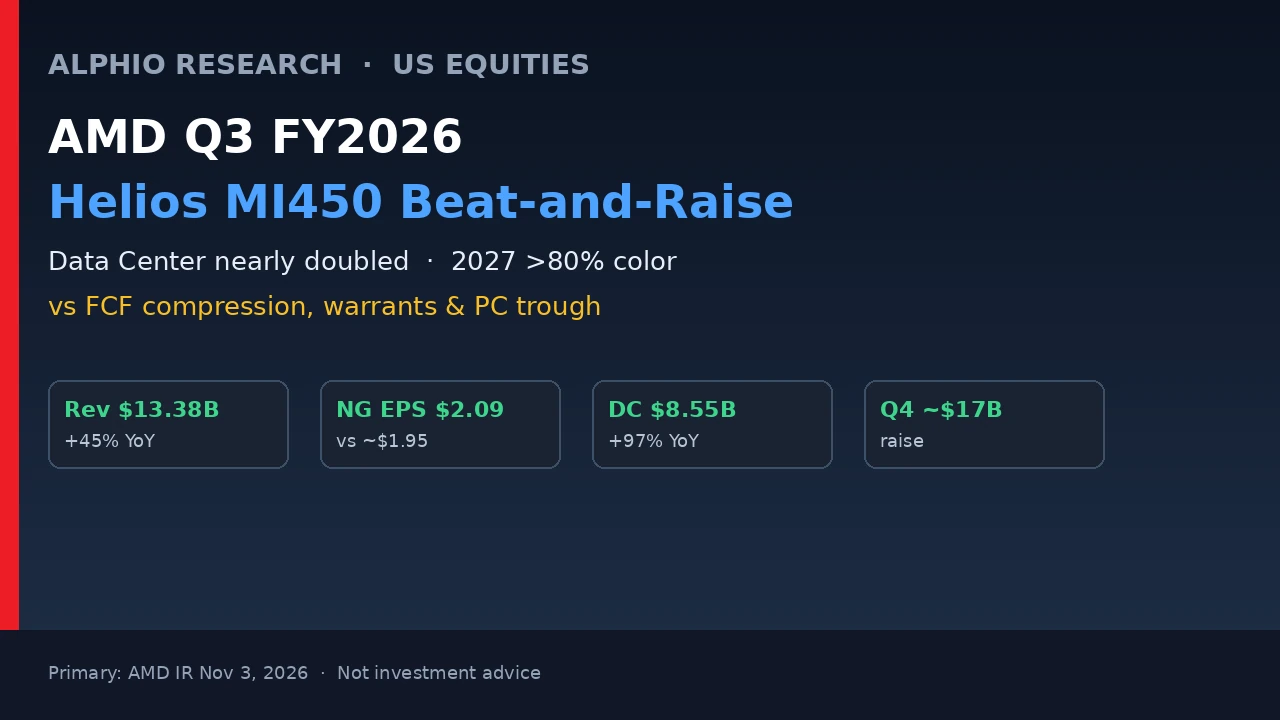
AMD Q3 FY2026: $13.38B rev (+45%), non-GAAP EPS $2.09 vs ~$1.95 Street, Data Center $8.55B (+97%). Q4 ~$17B guide; 2027 >80% growth—vs FCF $554M, warrants, PC trough.

AMD Q3 2026 Deep Dive: Helios MI450 Beat-and-Raise Party Meets FCF Compression, Warrants & a PC Trough
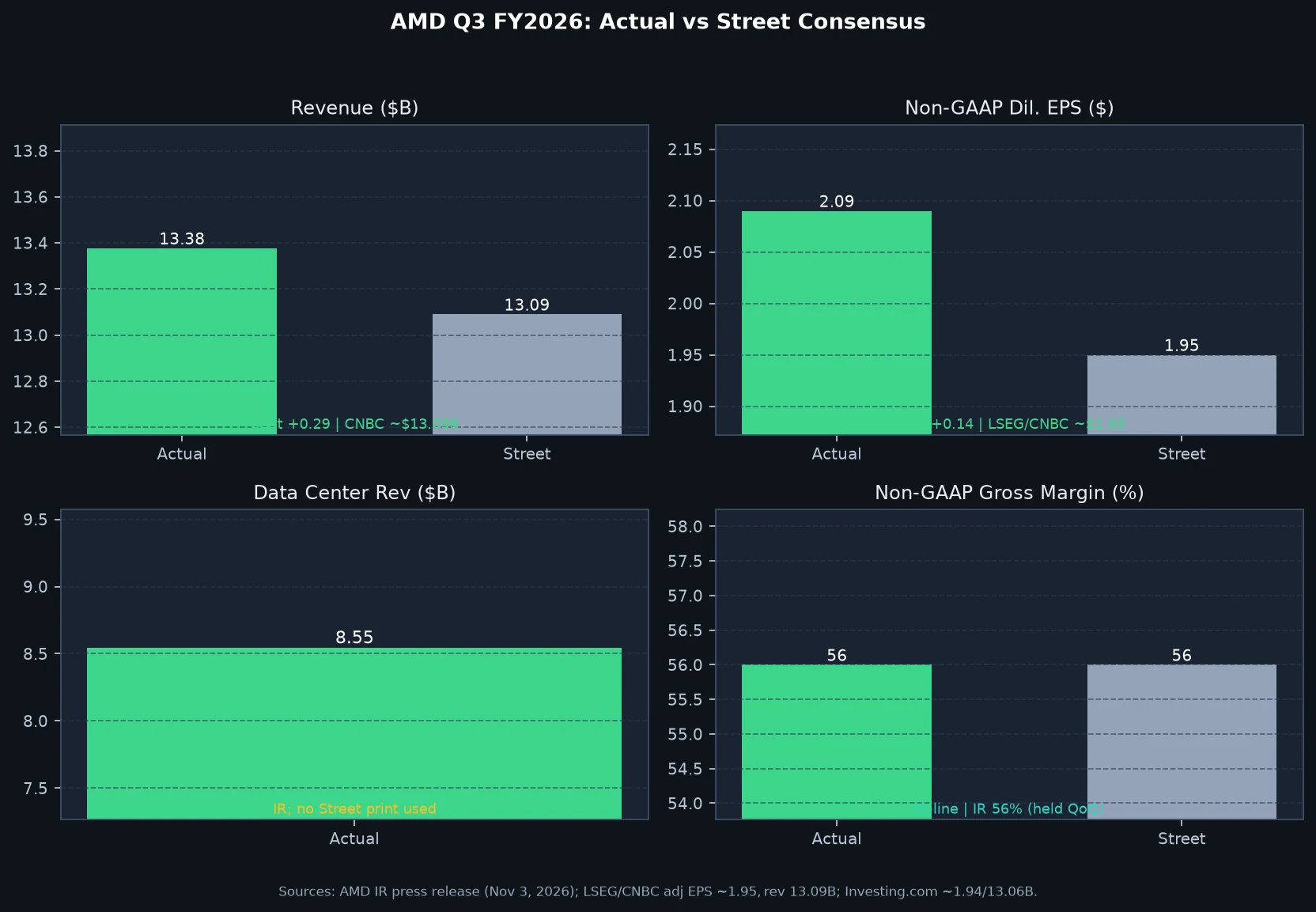
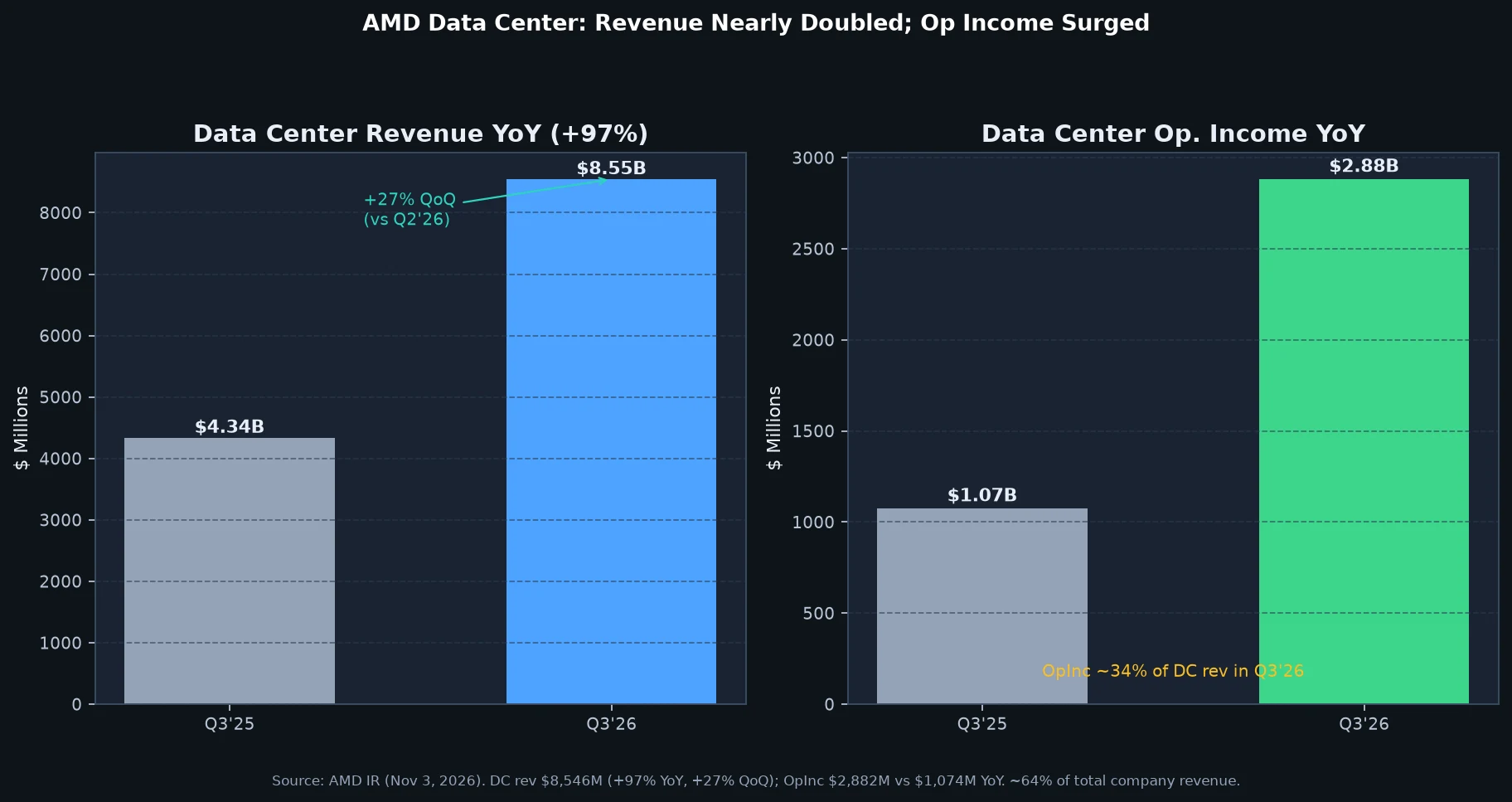
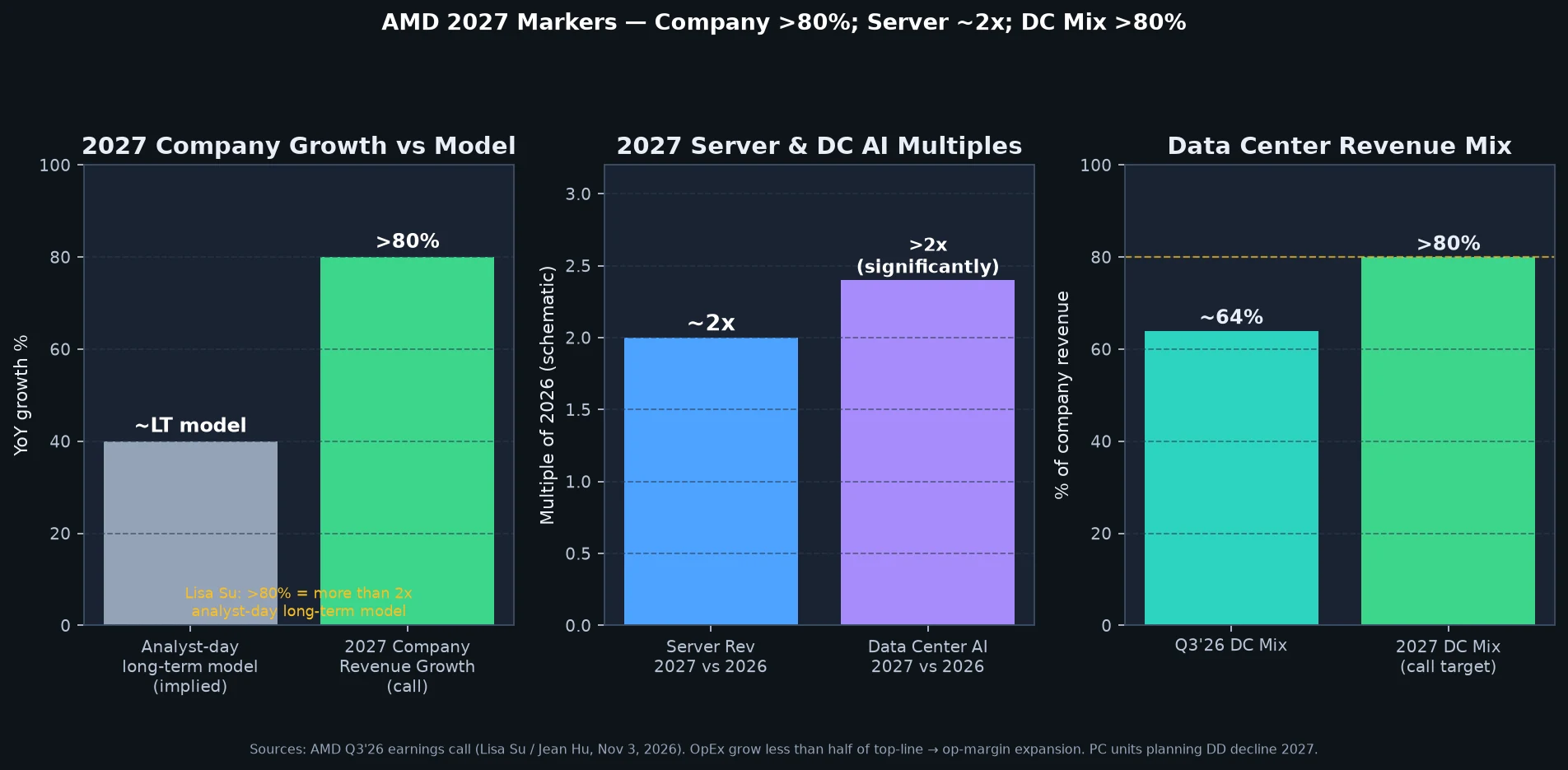
After the close on Monday, November 3, 2026, Advanced Micro Devices (NASDAQ: AMD) handed Wall Street the highest-signal mega-cap semiconductor print of the week—and the tape treated it like a celebration that still had unpaid bills. Revenue printed $13.377B (+45% YoY, +16% QoQ) versus LSEG/CNBC consensus around $13.09B (Investing.com also cites ~$13.06B). Non-GAAP diluted EPS landed at $2.09 versus LSEG/CNBC ~$1.95 (Investing.com ~$1.94). Data Center revenue nearly doubled to $8.546B (+97% YoY, +27% QoQ) and already accounts for roughly 64% of the company. Then management raised the bridge: Q4 revenue guided to about $17B ±3%—Investing.com put that against Street ~$16.23B—with Data Center expected up ~50% sequentially and 2027 company revenue growth colored at more than 80%.
The price path matched the beat-and-raise emotion. AMD closed the regular session near $483.90 (+3.65% from prior ~$466.84) and ripped after hours into roughly $516.50–$520.40—about +7–9% from the close and roughly +11–12% from the prior close (Investing.com / CNBC / Yahoo framing of the AI/data-center story). This note reads that celebration the way a sell-side desk should: as a demand-and-roadmap victory colliding with free-cash-flow compression, customer-warrant fair-value noise, a Client/Gaming trough, and an AI CapEx financing debate that the call itself kept putting on the table.
Primary figures below come from AMD's Investor Relations press release dated November 3, 2026 (https://ir.amd.com/news-events/press-releases/detail/1303/amd-reports-third-quarter-2026-financial-results) and the earnings-call voice attributed in the task brief / public coverage. Consensus anchors are LSEG via CNBC and Investing.com where noted. Nothing below invents a Street number that is not attributed.
1. What the Market Was Celebrating—and What It Still Feared
Heading into Lisa Su's print, the constructive braid was thick enough to price a party:
- AI accelerator product cycle — Helios / MI450-class GPUs moving from design-win theater into volume shipments, with Anthropic, Meta, Microsoft, OpenAI, and Oracle named among first Helios rack customers on the call.
- Server CPU share continuity — Turin EPYC as the most-deployed EPYC generation in public cloud (>540 instance types), with OpenAI selecting Turin as host CPUs for first custom accelerator platforms—CPU and GPU demand reinforcing rather than cannibalizing.
- Second-source AI narrative — the Street's preferred "not only Nvidia" hedge, especially as hyperscalers talk multi-vendor racks, power envelopes, and multi-gigawatt deployments.
- Beat-and-raise preconditioning — into the print, AMD was already a momentum megacap; a clean Data Center beat plus a Q4 raise into the high teens of billions would validate the 2026–2027 AI compounding story.
The fear set—which the after-hours tape chose not to dominate, but which the income statement and balance sheet still force into any honest note—was the opposite braid:
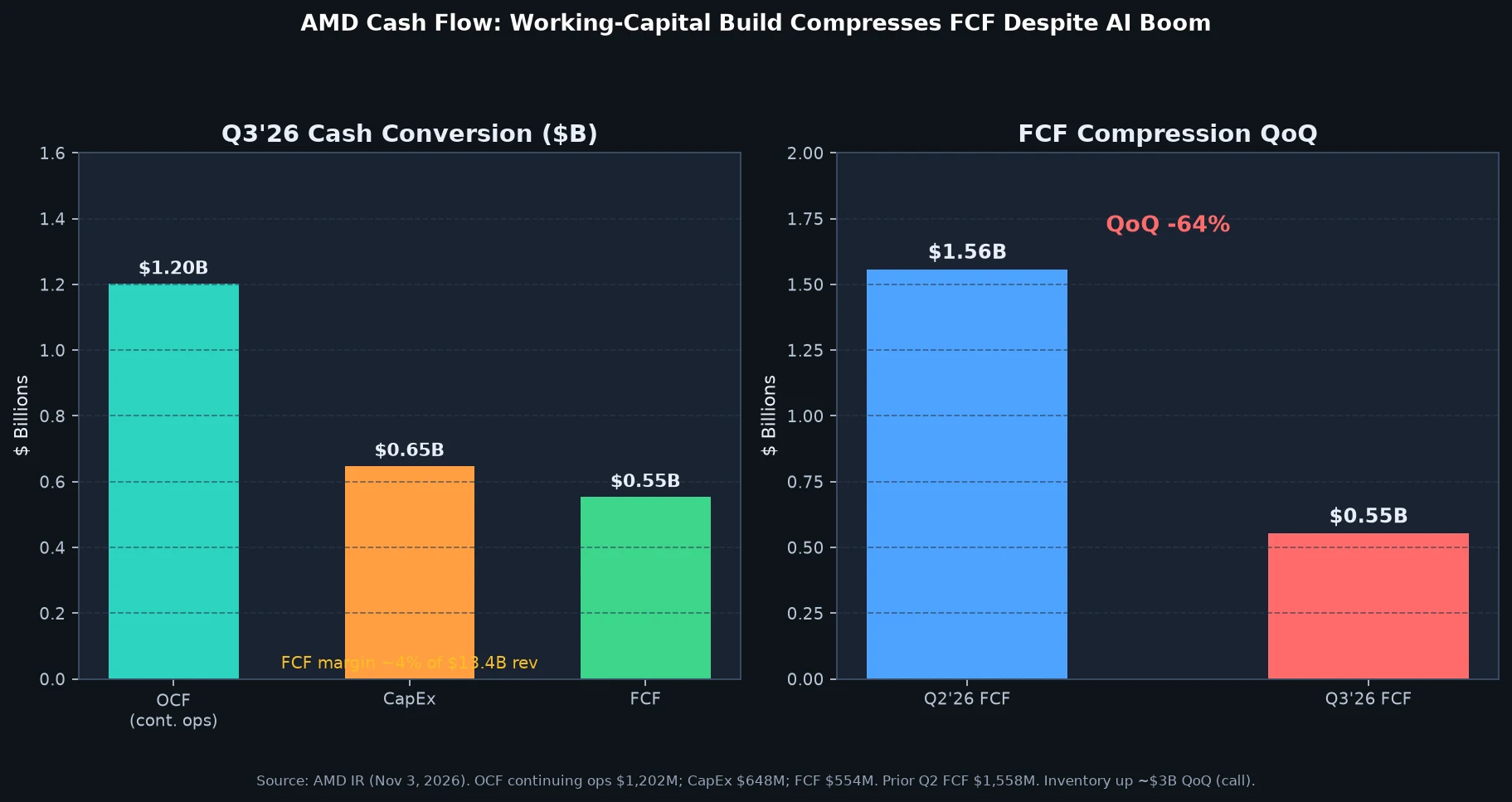
- Free-cash-flow compression — Q3 FCF only $554M (about 4% of revenue) after Q2's $1.558B, with inventories up roughly $3B sequentially per the call and CapEx $648M against OCF from continuing ops of $1.202B.
- Customer warrant fair-value noise — a $1.097B GAAP change in fair value of warrant liability tied to customer warrants as MI450 shipped; non-cash, excluded from non-GAAP and FCF, but Jean Hu was explicit that future FV adjustments will continue.
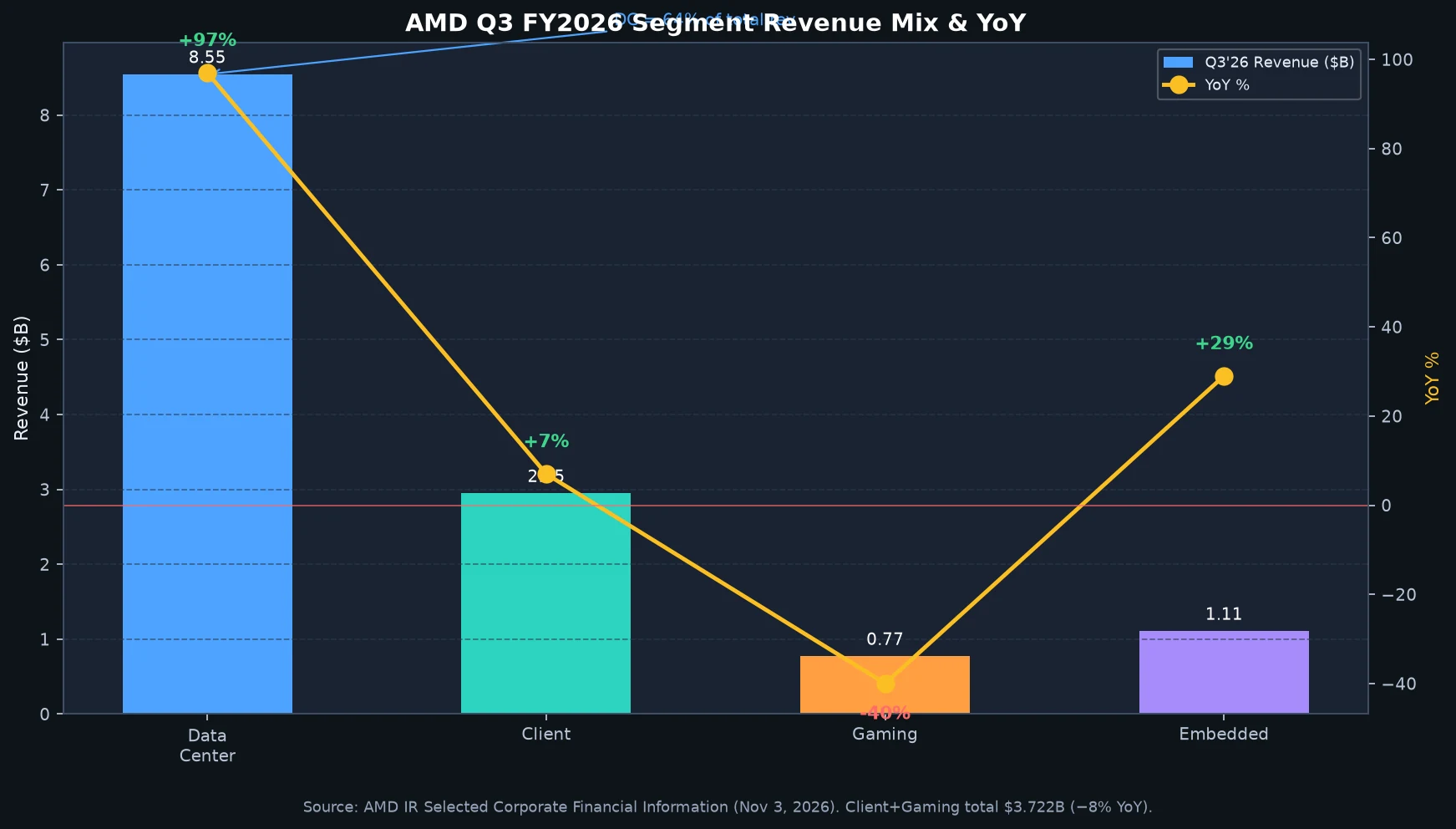
- PC / Client trough — Client $2.949B (+7% YoY, −4% QoQ); Gaming $773M (−40% YoY); Client+Gaming combined $3.722B (−8% YoY). Q4 guide: Client+Gaming more than −20% QoQ. 2027 planning assumes a double-digit unit decline in the PC market, with AMD concentrating on premium/enterprise.
- AI CapEx financing, power, and shells — analysts on the call (Barclays, BofA, TD Cowen, UBS, Cantor, Bernstein, Morgan Stanley, BMO) kept returning to supply versus demand, HBM costs, gross-margin mix between AI and server CPU, and the financing/power/shell reality of ~3GW-scale deployments.
Pre-print, AMD was already marking the AI optimism into the regular session (+3.65% into the close). The AH extension said investors were willing to look through FCF and warrants into the Helios/2027 raise—at least overnight. The research question is whether that look-through survives the next working-capital print.
2. Scorecard: Beat the Print, Raise the Bridge—Watch the Cash Conversion Traps
| Metric | Q3 FY2026 actual | Benchmark / prior | Read-through |
|---|---|---|---|
| Revenue | $13.377B | PY $9.246B; Q2 $11.536B; Street ~$13.09B (CNBC) / ~$13.06B (Inv.com) | +45% YoY, +16% QoQ; clear beat |
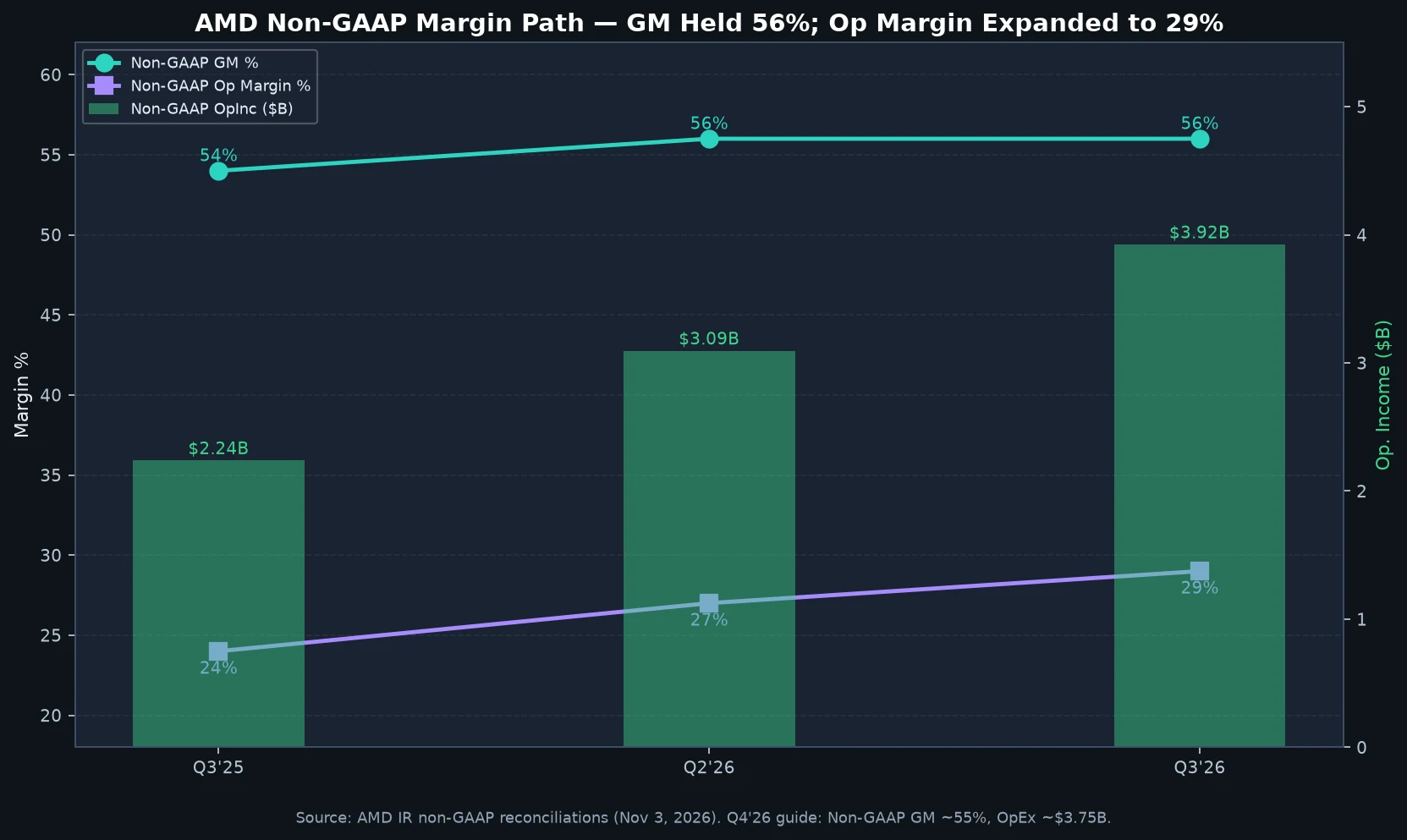
| GAAP GM | 54% | PY 52%; Q2 54% | Held QoQ; +2 ppt YoY |
| Non-GAAP GM | 56% | PY 54%; Q2 56% | Held; Q4 guide ~55% |
| GAAP OpEx | $4.378B | PY $3.510B; Q2 $4.213B | Scaling with AI ramp |
| Non-GAAP OpEx | $3.560B | PY $2.754B; Q2 $3.394B | Q4 guide ~$3.75B |
| GAAP Op income / margin | $2.832B / 21% | PY $1.270B / 14%; Q2 $1.990B / 17% | Operating leverage visible |
| Non-GAAP Op income / margin | $3.923B / 29% | PY $2.238B / 24%; Q2 $3.094B / 27% | +2 ppt QoQ expansion |
| GAAP net income / dil. EPS | $2.428B / $1.46 | PY $1.243B / $0.75; Q2 $2.297B / $1.38 | Warrant FV noise inside GAAP |
| Non-GAAP net income / dil. EPS | $3.471B / $2.09 | PY $1.965B / $1.20; Q2 $2.760B / $1.66; Street ~$1.95 | Clean beat |
| Diluted shares | 1.661B | — | Q4 ~1.67B incl. Taalas/World Labs |
| Data Center rev / OpInc | $8.546B / $2.882B | PY OpInc $1.074B; +97% / +27% rev | ~64% of total rev |
| Client | $2.949B | +7% YoY; −4% QoQ | Premium mix; units soft |
| Gaming | $773M | −40% YoY | Hard trough |
| Client+Gaming | $3.722B | −8% YoY; OpInc $573M | Q4 guide >−20% QoQ |
| Embedded | $1.109B | +29% YoY; +14% QoQ; OpInc $453M (41% margin) | Quiet compounder |
| Adj. EBITDA | $4.162B | — | Earnings power proxy |
| OCF / CapEx / FCF | $1.202B / $648M / $554M | Q2 FCF $1.558B | Trap: FCF margin ~4% |
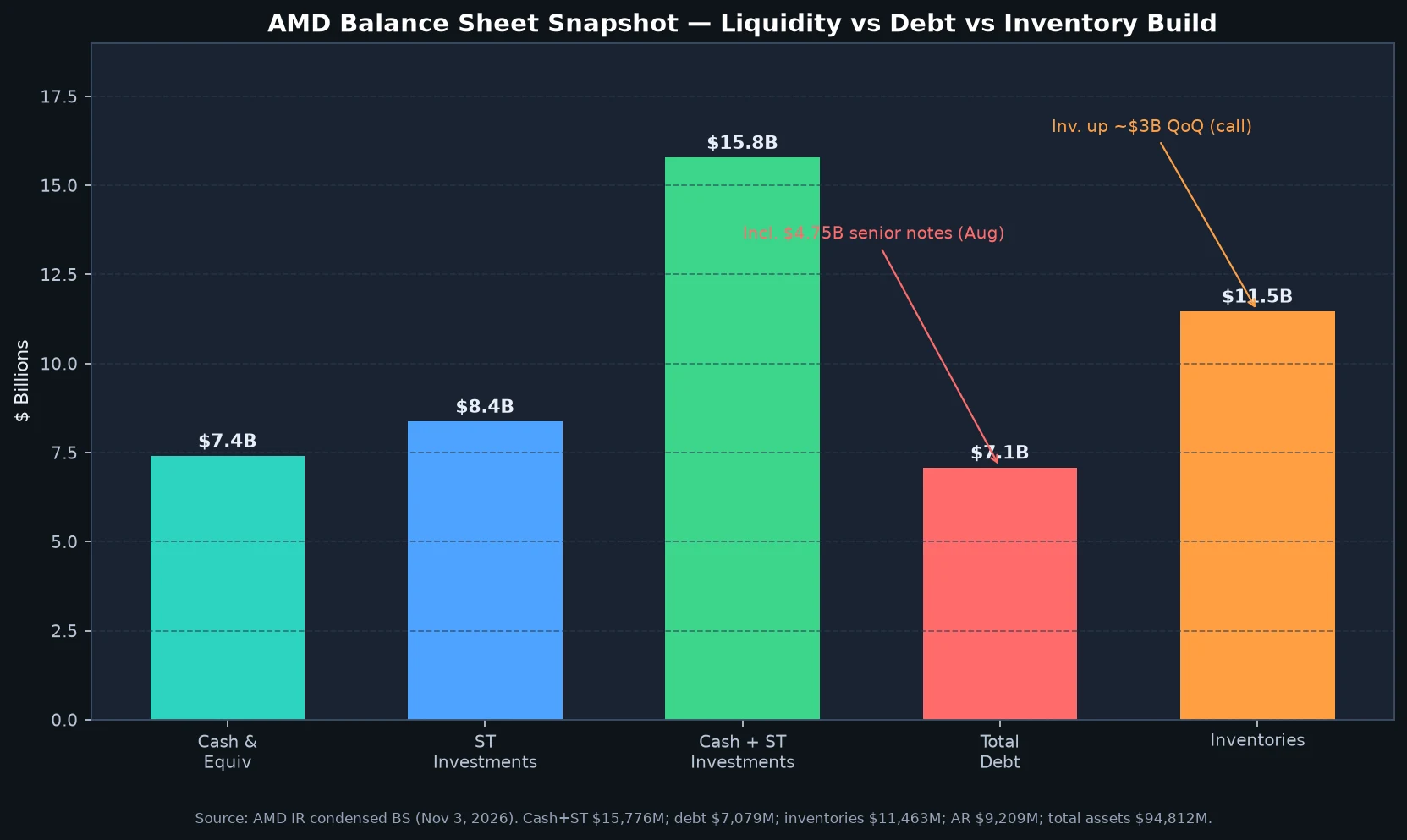
| Cash + ST investments | $15.776B | Cash $7.404B; ST $8.372B | Liquidity still thick |
| Inventories | $11.463B | Up ~$3B QoQ (call) | Working-capital bind |
| Total debt | $7.079B | Incl. $4.75B senior notes (Aug) | Leverage up vs prior YE |
| AR / Total assets | $9.209B / $94.812B | — | Scale of AI receivables |
| GAAP warrant FV change | $1.097B | Non-cash; MI450-linked | Does not hit non-GAAP/FCF |
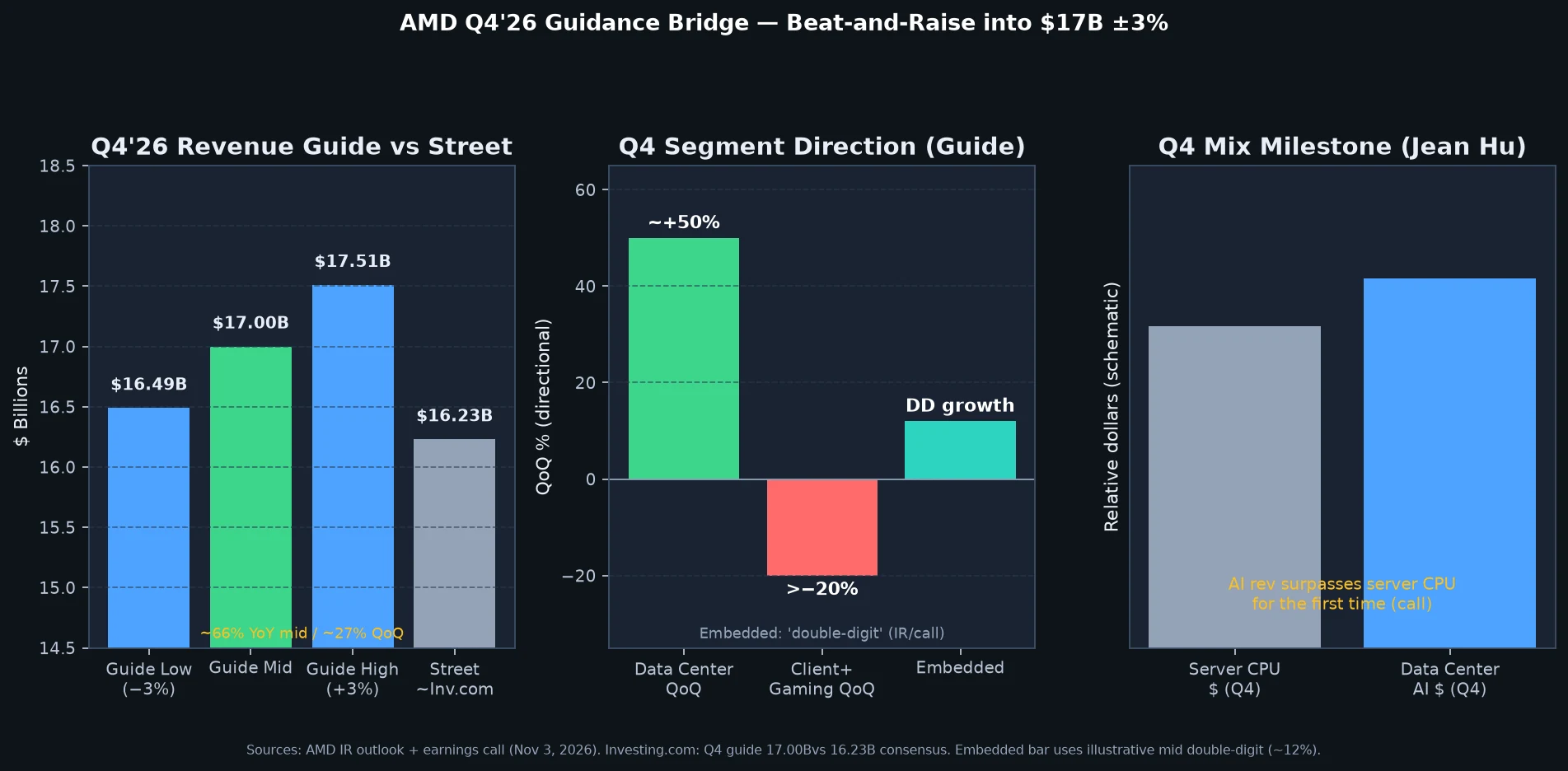
| Q4 rev guide | ~$17B ±3% | Street ~$16.23B (Inv.com); ~66% YoY mid; ~27% QoQ | Beat-and-raise |
| Q4 Non-GAAP GM / OpEx / tax | ~55% / ~$3.75B / 13% | — | Slight GM mix pressure |
| 2027 company growth color | >80% | "More than 2x" analyst-day LT model | Regime marker |
Trap 1: Celebrating non-GAAP EPS $2.09 without noting that GAAP still carries a $1.097B warrant fair-value swing—and that Jean Hu said future FV adjustments continue as the customer relationship and share price evolve. Trap 2: Extrapolating Data Center +97% without respecting that Q4 Client+Gaming is guided more than −20% QoQ, so company growth is increasingly a single-engine story. Trap 3: Reading the Q4 $17B raise as pure operating triumph while FCF compressed to $554M on inventory build—demand that ships into inventory and receivables is not yet demand that compounds cash. Trap 4: Treating Non-GAAP GM 56% as permanently stable when Q4 guides ~55% on AI versus server mix and HBM cost debates that multiple sell-side voices flagged on the call.
3. Management Voice: Record Quarter, Helios Racks, 2027 >80%, Demand Still Ahead of Supply
CEO Lisa Su framed a record quarter around product conversion, not slogans: Helios / MI455X moving into volume ship; Anthropic, Meta, Microsoft, OpenAI, and Oracle among the first Helios rack customers; Venice EPYC beginning revenue shipments; Helion positioned as all-CPU agentic racks; ROCm 10 as the software continuity layer; EuroHPC LUMI-AI on MI430X as a sovereign HPC exhibit. On the inorganic side, AMD is acquiring World Labs (with Fei-Fei Li moving toward a chief-scientist role) and Taalas (inference silicon), expected to close by year-end—explicitly baked into Q4 diluted-share guidance of roughly 1.67B.
The 2027 color is the call's gravity well. Su / Hu guided investors to company revenue growth of more than 80%—described as more than 2x the analyst-day long-term model—with server revenue roughly doubling, Data Center AI growing even faster / significantly more than double, and Data Center becoming more than 80% of total company revenue. OpEx is expected to grow less than half of top-line growth, which is management's mechanism for "significant" operating-margin expansion. On PCs: the company is planning around a double-digit unit decline in 2027 market units while concentrating AMD's Client franchise on premium and enterprise sockets. On supply: demand still exceeds supply, and the working agenda is wafers, substrates, HBM, and packaging—not finding incremental customers.
CFO Jean Hu carried the bridge and the accounting tells. Q4 revenue ~$17B ±3%; Non-GAAP GM ~55%; OpEx ~$3.75B; tax 13%; diluted shares ~1.67B including Taalas/World Labs. Segment color: Data Center ~+50% QoQ; Client+Gaming more than −20% QoQ; Embedded double-digit growth. The mix milestone Hu underscored: in Q4, Data Center AI revenue surpasses server CPU dollars for the first time—the moment the AI GPU line formally overtakes the CPU cash engine inside Data Center. On warrants: the $1.097B GAAP fair-value change is tied to customer warrants as MI450 shipped; it is non-cash and does not hit non-GAAP or free cash flow; future fair-value adjustments will continue.
Call Q&A themes (named desks): Barclays' Tom O'Malley, BofA's Vivek Arya, TD Cowen's Josh Buchalter, UBS's Tim Arcuri, Cantor's CJ Muse, Bernstein's Stacy Rasgon, Morgan Stanley's Joe Moore, and BMO's Harsh Kumar pressed the same cluster: can supply catch demand without wrecking mix; how HBM costs flow into the ~55% Q4 GM; whether AI GPU mix versus server CPU is a margin headwind or a scale gift; how to underwrite warrants without treating them as "fake" earnings; how deep the PC trough runs; what Helion's all-CPU agentic rack means for ASP and software attach; and how customers finance power, shells, and ~3GW-class deployments without stretching AMD's own working capital.
4. The Risk Ledger: FCF, Warrants, Mix, PC Trough, Supply, Financing
| Risk | What we know | Why it matters |
|---|---|---|
| FCF compression | Q3 FCF $554M vs Q2 $1.558B; FCF margin ~4%; OCF $1.202B; CapEx $648M | AI growth without cash compounding invites multiple compression |
| Inventory build | Inventories $11.463B; up ~$3B QoQ (call) | Working-capital soak; mix/aging risk if AI configs slip |
| Warrant FV volatility | $1.097B GAAP charge/change; future FV adjustments continue (Hu) | GAAP EPS noise; optics risk even if non-GAAP clean |
| Q4 GM mix | Guide ~55% after 56% held for two quarters | HBM + AI vs CPU mix is live |
| Client+Gaming trough | Q3 combined −8% YoY; Q4 >−20% QoQ; 2027 PC units DD decline planned | Non-DC engine shrinking as DC becomes >80% of 2027 |
| Debt step-up | Total debt $7.079B incl. $4.75B Aug senior notes | Liquidity still fine ($15.8B cash+ST) but net leverage story changed |
| Receivables scale | AR $9.209B on $13.4B quarterly rev | Customer concentration / payment-timing risk in AI |
| Supply chain bottlenecks | Demand > supply; wafers/substrates/HBM/packaging (call) | Upside capped; competitors fight for same constrained inputs |
| Acquisition dilution / integration | World Labs + Taalas; shares ~1.67B in Q4 | Execution and culture risk around Fei-Fei Li / inference silicon |
| AI CapEx financing debate | ~3GW deployment questions from sell-side on call | Customer ability to pay / take product may lag AMD's ship plan |
| Gross-to-op leverage durability | OpEx to grow <½ of revenue growth in 2027 (call) | If OpEx undershoots discipline, 2027 margin story breaks |
| Competitive share | Still a second-source narrative versus Nvidia | Design-win logos ≠ sustained utilization or software lock-in |
The ledger's center of gravity is cash conversion + concentration, not whether Data Center beat. That is why a intellectually honest note can cheer the AH rally and still refuse to pretend FCF at 4% of sales is a footnote.
5. Long vs Short Debate (Named Sources)
The long / beat-and-raise case (tape + Buy desks + management): The after-hours path—regular close ~$483.90 (+3.65%), then AH roughly $516–$520 (+7–9% from close; ~+11–12% from prior close)—is the market voting that Helios volume, OpenAI/Meta/Microsoft/Oracle/Anthropic rack logos, Q4 $17B (above Investing.com's ~$16.23B Street), and 2027 >80% company growth dominate near-term FCF optics. Goldman reiterated Buy with a $700 price target (AllMind / Investing.com coverage into/around the print). Management's rebuttal stack is concrete: Data Center $8.55B and OpInc $2.88B; non-GAAP op margin 29% and rising; server sales more than doubled YoY in both cloud and enterprise; Turin >540 public-cloud instance types; AI revenue overtaking server CPU dollars inside Data Center in Q4; OpEx growth intentionally lagged versus the 2027 revenue step-function. The long mechanism: if inventory converts into Q4/Q1 revenue at guided GM, and if customer financing for multi-GW clusters clears, AMD is mid-metamorphosis into a Data-Center-dominant AI compounder whose 2027 P&L will make 2026's FCF dip look like a working-capital bridge quarter.
The short / skeptic case (cash + concentration + PC + warrants): Morgan Stanley raised its price target from $465 to $510 but kept Equal Weight (ad-hoc / Yahoo)—a polite way to say the raise is real and the valuation is already working hard. Skeptics do not need to deny Helios. They need only argue that (1) FCF falling from $1.56B to $0.55B while inventories jump ~$3B is the classic late-cycle AI tell of shipping ahead of cash; (2) a company guiding Data Center to >80% of 2027 revenue is a single-engine equity whose multiple should embed customer CapEx pauses, HBM shocks, and competitive share loss; (3) Client+Gaming guiding more than −20% QoQ into a 2027 PC unit decline removes the old ballast; (4) $1.1B of warrant fair-value noise—and the promise of more—keeps a wedge between GAAP optics and the non-GAAP story retail holders screenshot; (5) sell-side questions about financing, power, and shells for ~3GW deployments are not academic—they are the demand-side falsifier for "demand exceeds supply."
Synthesis: Bulls are not inventing the print. Bears are not inventing the cash conversion. The equity story after November 3 is a duration debate: can AMD convert Helios backlog and 2027 >80% ambition into rising free cash flow before the market re-prices AI second-source scarcity as AI customer indigestion?
6. Side Plots: Warrants, World Labs / Taalas, Helion / Helios, OpenAI / Meta
Customer warrants. The $1.097B GAAP fair-value change is the quarter's most important "non-operating" operating fact. It exists because a strategic customer relationship was structured with warrants that mark with product shipment and share-price paths. Hu's insistence that it does not hit non-GAAP or FCF is correct accounting communication; her insistence that future FV adjustments continue is the research tell. For Alphio readers: treat warrant marks as a volatility sleeve around GAAP, not as a reason to discard non-GAAP—and not as a reason to pretend GAAP is irrelevant for covenant, optics, or narrative risk.
World Labs and Taalas. Buying World Labs (spatial intelligence / Fei-Fei Li toward chief scientist) and Taalas (inference silicon), closing by year-end, is AMD trying to own more of the stack above and beside the GPU—model-adjacent talent plus inference-specific silicon—while diluted shares step to ~1.67B in Q4. Bull case: software-and-inference gravity that makes Helios racks stickier. Bear case: classic semiconductor M&A distraction priced into a momentum multiple.
Helios and Helion. Helios / MI455X volume ship with named frontier-lab and hyperscaler logos is the bull screenshot. Helion as all-CPU agentic racks is the quieter side plot: it says AMD thinks a slice of agentic workloads wants EPYC density and memory bandwidth without a GPU tax—useful diversification if GPU supply stays tight, or a margin mix complication if Helion ASPs and attach under-earn GPU racks.
OpenAI and Meta (and Microsoft, Oracle, Anthropic). The call's customer roll-call is deliberately dense. OpenAI selecting Turin as host CPUs for first custom accelerator platforms ties AMD's CPU franchise to someone else's custom silicon roadmap—an unusual but powerful second-order demand channel. Meta / Microsoft / Oracle / Anthropic on Helios racks is the utilization proof the Street wanted. The falsifier is not "will they buy a first rack"; it is "will they scale racks through 2027 financing, power, and software reality."
Embedded. At $1.109B (+29% YoY) and 41% operating margin, Embedded is the unfashionable compounder. It will not move the AMD narrative while Data Center is printing +97%, but it is the ballast Client/Gaming no longer provide.
7. Braided Thesis
AMD Q3 FY2026 is a Helios conversion print colliding with a working-capital and concentration stress test. Track one—revenue $13.4B, non-GAAP EPS $2.09, Data Center $8.55B (+97%), non-GAAP op margin 29%, Q4 guide $17B ±3% above $16.23B Street, 2027 company growth >80% with Data Center mix >80%, AH price discovery toward the $516–$520 area—is the AMD the momentum tape owned into the print. Track two—FCF $554M (down from $1.56B), inventories $11.5B (+$3B QoQ), Client+Gaming trough and Q4 >−20% QoQ guide, $1.1B warrant FV noise, debt up to $7.1B after August notes, and sell-side interrogation of multi-GW customer financing—is what an honest risk ledger refuses to edit out of the victory lap.
The braided read: this was not a demand miss. Management is explicit that demand exceeds supply across wafers, substrates, HBM, and packaging, and that Q4 Data Center should jump ~50% sequentially as Helios ramps and AI dollars overtake server CPU dollars inside the segment. It was a cash-conversion and equity-duration event. Lisa Su's 2027 raise asks investors to accept a company that is becoming a Data-Center-AI specialist—with PC units planned down double digits and OpEx growing less than half of sales—while Jean Hu's bridge asks them to accept near-term GM ~55%, share count ~1.67B, and ongoing warrant marks. The AH party says the Street bought Track one. The research discipline says Track two decides whether that party was a regime confirmation or a positioning squeeze into a raise.
For Alphio readers thinking in copy-trade / budget terms: AMD after this print is no longer a diversified x86/GPU swing trade. It is a high-beta AI infrastructure compounder with a live working-capital overlay, where position sizing has to respect inventory builds, customer CapEx financing, and the fact that 2027's >80% ambition increases—not decreases—single-engine risk. The Helios/OpenAI charts remain the bull screenshots. The FCF/inventory/warrant charts remain the bear screenshots. Both are true on the same IR release.
8. Falsifiable Watchpoints
- Q4 revenue vs $17B ±3% — a print toward the high end with Non-GAAP GM ≥55% would confirm Helios conversion; a miss below the −3% band with GM <54% re-opens the mix/HBM scare.
- Q4 / Q1 free cash flow — reclaiming toward Q2's $1.56B run-rate as inventory converts would falsify the "AI ships but cash stalls" bear case; another sub-$700M FCF quarter validates it.
- Inventory trajectory — $11.5B should fall as Q4 Data Center +50% ships through; if inventory stays elevated while AR stays at $9.2B-scale, working-capital risk compounds.
- Data Center AI vs server CPU dollars — Hu's Q4 crossover is a binary watchpoint; if AI dollars fail to surpass CPU dollars, the mix-milestone narrative slips a quarter.
- Client+Gaming vs >−20% QoQ — a shallower decline would soften single-engine optics; a steeper drop confirms the trough is still deepening into 2027's planned PC unit decline.
- Warrant FV marks — magnitude and sign of next quarter's GAAP FV adjustment; large adverse marks into a flat share price would stress the non-GAAP trust bridge.
- 2027 OpEx vs <½ revenue growth — first formal 2027 OpEx framework that breaks this rule falsifies the margin-expansion mechanism.
- Named customer rack utilization — evidence that OpenAI/Meta/Microsoft/Oracle/Anthropic Helios deployments scale beyond first racks into sustained GW-class takeaways; logos without utilization are not a 2027 >80% proof.
FAQ
Why did AMD jump after hours on the Q3 2026 print?
Because the company beat Street revenue (~$13.38B vs ~$13.09B LSEG/CNBC) and non-GAAP EPS ($2.09 vs ~$1.95), nearly doubled Data Center revenue to $8.55B, and raised Q4 revenue to ~$17B ±3% (above Investing.com's ~$16.23B consensus) while coloring 2027 company growth at >80%. Regular close ~$483.90 and AH ~$516–$520 priced the Helios/AI raise more than the FCF compression.
How bad is the free-cash-flow compression?
Material on the quarter, not yet a thesis killer. Q3 FCF was $554M (OCF continuing ops $1.202B minus CapEx $648M) versus Q2 FCF $1.558B, with inventories up ~$3B QoQ per the call. Bulls call it a working-capital bridge into Helios; bears call it the cash tell that must reverse in Q4/Q1.
What are the customer warrants and do they affect cash?
AMD recorded a $1.097B GAAP change in fair value of warrant liability as MI450 shipped under a customer warrant structure. Jean Hu said the item is non-cash and does not hit non-GAAP results or free cash flow, but that future fair-value adjustments will continue—so expect ongoing GAAP EPS noise even when the operating story is clean.
What exactly did AMD guide for Q4 2026?
Revenue about $17B ±3%; Non-GAAP gross margin ~55%; Non-GAAP OpEx ~$3.75B; tax rate 13%; diluted shares ~1.67B (including Taalas/World Labs). Data Center ~+50% QoQ; Client+Gaming more than −20% QoQ; Embedded double-digit growth. Hu also said Q4 Data Center AI revenue surpasses server CPU dollars for the first time.
What is the 2027 growth color from the call?
Lisa Su / Jean Hu pointed to company revenue growth of more than 80% (more than 2x the analyst-day long-term model), server revenue roughly doubling, Data Center AI growing significantly more than double, Data Center mix >80% of total revenue, and OpEx growing less than half of top-line growth. PC market units are planned for a double-digit decline, with AMD focused on premium/enterprise.
Did Goldman and Morgan Stanley agree on the stock after the print?
Not perfectly. Goldman reiterated Buy with a $700 price target (AllMind/Investing.com). Morgan Stanley raised its PT from $465 to $510 but kept Equal Weight (Yahoo/ad-hoc)—a split that mirrors the long-vs-duration debate in this note.
Sources: AMD Investor Relations press release, "AMD Reports Third Quarter 2026 Financial Results" (Nov 3, 2026), including GAAP/non-GAAP consolidations and Selected Corporate Financial Information (https://ir.amd.com/news-events/press-releases/detail/1303/amd-reports-third-quarter-2026-financial-results); AMD Q3 FY2026 earnings call remarks and Q&A themes (Lisa Su, Jean Hu; analysts Tom O'Malley, Vivek Arya, Josh Buchalter, Tim Arcuri, CJ Muse, Stacy Rasgon, Joe Moore, Harsh Kumar); CNBC / LSEG for consensus adj EPS ~$1.95 and revenue ~$13.09B; Investing.com for ~$1.94 / $13.06B consensus and Q4 guide $17.00B vs ~$16.23B Street, plus AH movers framing; Goldman Buy/$700 and Morgan Stanley PT $465→$510 Equal Weight as reported via AllMind/Investing.com and Yahoo/ad-hoc. Price path: regular close ~$483.90 (+3.65% from ~$466.84); AH ~$516.50–$520.40. This article is independent research commentary for Alphio readers, not investment advice.
Disclaimer: For information and research-methodology demonstration only—not investment advice, a recommendation, or a performance guarantee. Figures follow AMD IR primary disclosures and public earnings-call/media attributions; consensus figures are as reported by financial media citing LSEG and Investing.com and may differ by vendor. Investors should review AMD's SEC filings and form independent judgments.
FAQs
Why did AMD jump after hours on the Q3 2026 print?
AMD beat Street revenue (~$13.38B vs ~$13.09B LSEG/CNBC) and non-GAAP EPS ($2.09 vs ~$1.95), nearly doubled Data Center to $8.55B, and raised Q4 revenue to ~$17B ±3% (above Investing.com ~$16.23B) while coloring 2027 company growth at >80%. AH price discovery toward ~$516–$520 priced the Helios/AI raise.
How bad is AMD's free-cash-flow compression in Q3 2026?
Q3 FCF was $554M (OCF continuing ops $1.202B minus CapEx $648M) versus Q2 FCF $1.558B, with inventories up ~$3B QoQ per the call—FCF margin about 4% of $13.4B revenue. Bulls call it a Helios working-capital bridge; bears want Q4/Q1 cash conversion to reverse it.
What are the AMD customer warrants and do they affect cash?
AMD recorded a $1.097B GAAP change in fair value of warrant liability as MI450 shipped. CFO Jean Hu said the item is non-cash and does not hit non-GAAP results or free cash flow, but that future fair-value adjustments will continue.
What did AMD guide for Q4 2026?
Revenue ~$17B ±3%; Non-GAAP GM ~55%; Non-GAAP OpEx ~$3.75B; tax 13%; diluted shares ~1.67B including Taalas/World Labs. Data Center ~+50% QoQ; Client+Gaming more than −20% QoQ; Embedded double-digit growth. Hu: Q4 Data Center AI revenue surpasses server CPU dollars for the first time.
What 2027 growth color did Lisa Su give on the call?
Company revenue growth more than 80% (more than 2x the analyst-day long-term model); server revenue roughly doubling; Data Center AI growing significantly more than double; Data Center mix >80% of total revenue; OpEx growing less than half of top-line growth. PC market units planned for a double-digit decline.
How did Goldman and Morgan Stanley frame AMD after the print?
Goldman reiterated Buy with a $700 price target (AllMind/Investing.com). Morgan Stanley raised its PT from $465 to $510 but kept Equal Weight (Yahoo/ad-hoc)—a split that mirrors the beat-and-raise versus valuation/duration debate.
Related articles
- Stock Market Surges After 2026 Midterms: What the Democratic Sweep Means for Your PortfolioThe stock market rallied after Democrats won the 2026 midterms. Discover what the election means for investors, tech stocks, and the S&P 500 outlook.
- Stock Market Surges After 2026 Midterms: What the Democratic Sweep Means for Your PortfolioThe stock market rallied after Democrats won the 2026 midterms. Discover what the election means for investors, tech stocks, and the S&P 500 outlook.
- Oil Prices Surge Above $105 Amid US-Iran Conflict: Energy Investment Opportunities in November 2026Oil prices climb past $105 as US strikes Iran's Qeshm Island. Discover energy investment opportunities, top oil stocks, and market outlook for November 2026.
- Dollar-Cost Averaging vs Lump-Sum Investing in 2026: Evidence, Psychology, and a Plan You Can AutomaCompare dollar cost averaging vs lump sum investing using Vanguard data, late-2026 market returns, investor psychology, and hybrid plans you can automate.
- US Bank Stocks After the Fed Hold: How Investors Should Read NIM, Credit Quality, and EarningsHow to read US bank earnings after the Fed’s Oct 2026 hold—NIM, NII, credit quality, and loan growth across JPM, BAC, WFC, and GS for stock investors.
- AI CapEx ROI After the October Wobble: How Investors Should Read Hyperscaler EarningsAfter Meta's FCF scare and Alphabet's cash burn: investor guide to evaluating AI CapEx versus free cash flow across MSFT, GOOGL, AMZN, and META stocks.