

Airline Stocks in 2026: How Falling Jet Fuel and Thanksgiving Travel Are Driving the Trade
Airline stocks are rallying as oil falls and Thanksgiving demand holds. See how jet fuel, Q3 earnings, fares and risks shape the trade for investors in 2026.

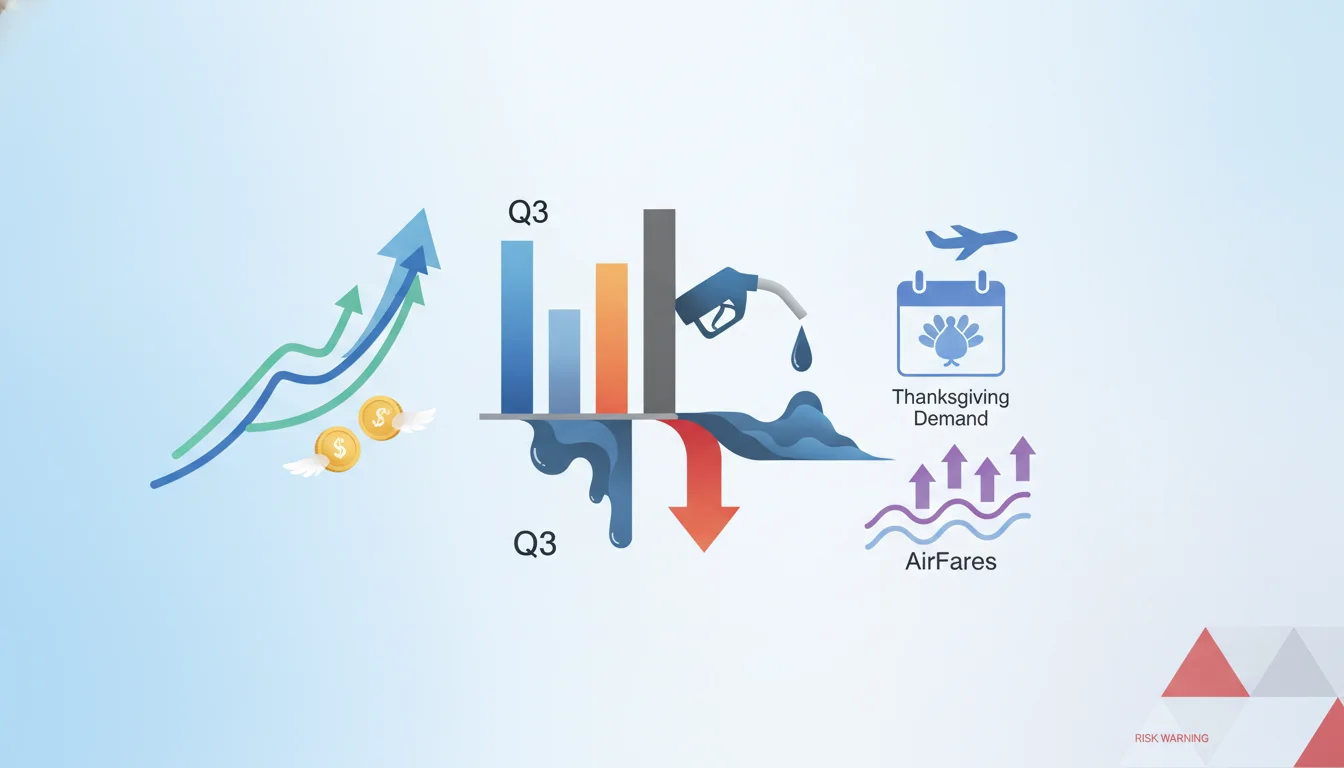
Key Takeaway
Airline stocks have been doing something unusual this autumn: going up while the rest of the market goes down. According to Opening Bell Daily, Southwest gained 17.6%, United 15.3%, Delta 14.9% and American 11.4% in the month from October 16 to November 16, 2026, while the S&P 500 fell 3.2% over the same window. The selling then got worse. On Thursday, November 19, the S&P 500 dropped about 2% to roughly 7,176, its sixth losing session in a row, according to end-of-day reports from Yahoo Finance and The Motley Fool.
The main reason for the gap is oil. Brent crude fell to $92.44 a barrel on November 16, down from $108.64 in early November, as Middle East exports recovered and the International Energy Agency began to forecast a fourth-quarter supply surplus. For carriers that just absorbed record jet fuel prices, every dollar off a barrel of crude matters. On top of that, Thanksgiving demand is holding up even with fares at a 10-year high, and capacity is tight.
This guide covers why airline stocks react so strongly to fuel, what third-quarter earnings showed about pricing power, how the Thanksgiving travel picture fits in, and how investors can approach the group without getting caught by its well-known volatility. Airlines are a cyclical, high-beta industry. The fuel tailwind is real, but it can reverse quickly, and the right position size matters as much as the thesis.
Why Airline Stocks Are Rallying While the Market Falls
The scoreboard investors are watching
Airline stocks have spent most of 2026 under pressure from fuel. US and Israeli strikes on Iran on February 28 pushed oil and jet fuel prices sharply higher. Through November 16, results were uneven: Delta was up 24.8% year to date and Southwest 12.4%, both ahead of the S&P 500's 8.3%, while United was down 0.9% and American down 13.6%, according to Opening Bell Daily. The October-to-November rally lifted all four. That spread shows how differently investors are pricing balance sheets and business models even within one industry.
The chart of the US Global Jets ETF (JETS) shows the pattern clearly. Airline shares have tended to move opposite to crude this year. They sold off as oil spiked and rallied hard when diplomacy or supply news pushed prices down. Reuters reported in June that the S&P 500 Passenger Airlines index hit an all-time high after the June 12 US-Iran peace announcement briefly sent crude below its pre-war level. Oil later climbed back above $100, and the airline trade gave back much of that gain. The current rally is the latest round of the same pattern.
Fuel is the swing factor, not demand
Fuel and labor together make up about 55% of airline operating costs, according to Opening Bell Daily. Labor costs are set by multi-year union contracts and barely change from quarter to quarter. Fuel can move tens of percent in a few weeks. So fuel is the line that drives quarterly earnings surprises, and investors trade airline stocks heavily on the oil price.
American Airlines shows the scale. Live and Let's Fly, citing the company, reported that each one-cent change in the price of a gallon of jet fuel moves American's costs by about $10 million, and that its fourth-quarter fuel bill had risen by roughly $1 billion. A drop of 50 cents a gallon would therefore be worth about half a billion dollars for that one carrier, which is why the stocks move so much on oil news.
Why the sell-off elsewhere helps the trade
The wider market decline has also helped airlines. The November sell-off has been led by AI and semiconductor names, with Nvidia and AMD among the hardest hit on November 19. When money leaves crowded growth trades, it often moves into cheaper cyclical groups that have their own catalyst. Airlines currently have one: falling input costs.
Jet Fuel: The Single Biggest Swing Factor
Record prices in October
Jet fuel has been far more expensive than crude alone would suggest. Airlines for America reported that the average jet fuel spot price reached a record $4.64 a gallon in October, beating the record set one month earlier. NPR, citing the tracking firm Argus, reported that the US average topped $4.75 a gallon in the week of October 23, nearly double the year-ago level. These figures use different measures and dates, so they don't match exactly, but they point the same way. Fuel costs in the fall of 2026 were the highest the industry has ever paid.
Part of the problem is the refining margin, the "crack spread" between crude and finished jet fuel. In 2026, disruption to Middle East product exports widened that spread. Even if crude falls, airlines do not get the full benefit until refinery margins narrow too. Delta is partly protected because it owns a refinery. Its fourth-quarter guidance included a refining benefit of about $0.40 a gallon.
The lag between oil and earnings
Airline earnings respond to lower oil with a delay. Fuel is bought ahead of time, some carriers hedge, and guidance is often set from a forward curve fixed weeks earlier. Analysts made the same point in June: fuel bills reflect earlier purchases and contracts, so savings show up over several months. Reuters estimated then that US airlines could save more than $40 billion a year if prices stayed low. That figure is a scenario, not a forecast, but it shows how much is at stake.
For stock investors, the delay means fourth-quarter earnings will still look weighed down by October's record prices. Lower fuel costs, if they last, would mostly show up in first-half 2027 results. Share prices usually move well before the earnings do.
What crude forecasters expect
Several forecasts now point to lower oil. The IEA said in mid-November that it expects fourth-quarter 2026 supply to exceed demand by 1.7 million barrels a day, a reversal of its earlier shortfall forecast. Goldman Sachs, in a November 15 note, projected Brent averaging $88 a barrel in 2027. These are projections, and in a war-affected market they can be wrong. The next test is the OPEC+ meeting on November 29, where producers will discuss 2027 production policy.
What Third-Quarter Earnings Revealed
Delta: strong revenue, squeezed margins
Delta's September-quarter report showed the industry's tension clearly. Revenue rose about 21% year over year to roughly $20.2 billion, while adjusted earnings per share of $1.72 missed the roughly $1.81 consensus because of fuel. The company cut its full-year 2026 adjusted EPS outlook to $5.10 to $5.60, from $6.50 to $7.50. For the fourth quarter it guided to $1.15 to $1.65, assuming fuel of about $4.25 a gallon based on the forward curve as of October 2. CEO Ed Bastian said Delta was absorbing roughly $6 billion of higher fuel costs this year while still targeting about $4.5 billion of pretax profit.
The detail that matters for investors is how customers reacted to higher fares. NPR reported that Bastian described a "limited amount of resistance" from travelers. Opening Bell Daily reported that premium revenue grew at least 17% at both Delta and United last quarter. The higher-income traveler who buys first class, premium economy and international seats is still spending.
United: guidance built on expensive fuel
United reported record third-quarter revenue of $17.9 billion and adjusted EPS of $2.54, while fuel expense rose by about $1.8 billion, or roughly 62%. Its fourth-quarter guidance of $0.50 to $1.50 in adjusted EPS came in well below the roughly $1.76 analysts had modeled, mainly because United assumed fuel near $4.80 a gallon, the latest spot prices at the time. United said in its October 20 investor update that it would beat the top of its earlier guidance range if fuel returned to early-July levels.
That conservative fuel assumption is useful to investors now. If jet fuel stays well below $4.80 through December, United's fourth quarter could land toward the high end of its range, or above it. Expectations that were cut on expensive fuel can be beaten if fuel gets cheaper. That partly explains why United's stock rebounded so sharply from its lows.
Fare pass-through is the hidden lever
Both carriers said they plan to recover the fuel shock through pricing. United's chief financial officer said the airline expects to pass on 100% of fuel costs by the end of the year. When fuel later falls, airlines rarely cut fares at the same pace, especially when seats are scarce. That gap between costs and fares is how a fuel decline turns into margin expansion. Investors should note that this can also attract regulatory and political attention if fares stay high.
Thanksgiving Travel: Strong Demand, Expensive Seats
Passenger forecasts for the holiday
Airlines for America expects nearly 29 million passengers over the 11-day Thanksgiving travel period from November 20 to November 30, or about 2.7 million a day, with Sunday, November 29, and Monday, November 30, as the expected peaks. That is below the group's 2025 forecast of more than 31 million. AAA projects 81.5 million Americans will travel at least 50 miles between November 24 and November 30, a decline of about 0.1% from last year. Volume is roughly flat, not booming, which is reasonable given the prices.
Fares at a decade high
Hopper's 2026 Holiday Travel Index put the average domestic round-trip Thanksgiving fare at $402, up 31% from last year, and the average Christmas fare at $452, up 23%. Hopper's lead economist told NPR that fares were at a 10-year high because of jet fuel, and that travelers were unlikely to make major changes to their holiday plans. Chris Sununu, who heads Airlines for America, told CNBC that "the airlines themselves are eating most of that cost," arguing that fare increases have not fully covered fuel.
For investors, the combination is what counts: steady traffic at much higher prices. Revenue per available seat mile, the key unit-revenue measure, is rising quickly. Delta and United have both guided to fourth-quarter revenue growth of about 20% or more, according to Opening Bell Daily.
Tight capacity supports pricing
Airlines are also limiting how many seats they offer. Delta expects seat growth of less than 2% this quarter. Several carriers have cut weaker routes, retired older and less fuel-efficient aircraft, and raised checked-bag fees, according to Airlines for America. Live and Let's Fly reported that Southwest cut its planned 2026 capacity growth to roughly 1% to 1.5%, and noted that Spirit stopped flying on May 2, removing a low-fare competitor from many routes. When demand is steady and supply is limited, airlines hold pricing power longer, and that matters most when fuel is falling.

Airline stocks move on a busy calendar: weekly fuel data, the OPEC+ meeting, holiday traffic numbers and January earnings. Instead of checking oil prices all day, you can set up recurring reviews with Alphio's Scheduled Task feature, so your airline watchlist is checked around fixed dates and rules rather than headlines.
Not All Airlines Are Built the Same
Premium-heavy network carriers
The year-to-date gap between Delta (up 24.8%) and American (down 13.6%) through mid-November shows that business mix and balance sheets matter. Network carriers with large premium cabins, strong loyalty programs and co-branded credit card deals earn revenue that holds up better when fuel spikes. Those loyalty and card businesses are steady fee streams that keep paying regardless of what a barrel of oil costs, which gives the market a reason to value those carriers more highly.
Valuation matters here. After cuts to 2026 earnings estimates, some network carriers trade on low multiples of depressed earnings. The question is whether 2027 estimates will rise as fuel falls, or fall again if oil rebounds. A valuation screen like the one above helps you compare where a stock trades against its own history and its peers before you decide to buy.
Low-cost and domestic-focused carriers
Low-cost and mostly domestic airlines are more exposed to price-sensitive leisure travelers and usually have less premium revenue to offset costs. That makes them more sensitive to fuel in both directions. Southwest led the one-month rally with a 17.6% gain, which reflects that sensitivity as fuel prices eased. It also means these stocks can fall fastest if crude spikes again.
Balance sheets decide who survives a shock
Leverage is the third factor. Airlines with heavy debt have less room to absorb a fuel spike or a sudden fall in demand, and equity holders in those companies feel shocks most. When you compare names, look at net debt relative to earnings, upcoming maturities and liquidity. Spirit's exit from the market in 2026 is a reminder that in airlines, a weak balance sheet can end in a shutdown, not just a falling share price.
Risks That Could Ground the Rally
Oil can reverse fast
The biggest risk is the same thing driving the rally. The oil market is still shaped by the Iran conflict. Iran's Revolutionary Guards said tankers struck mines in the Strait of Hormuz in mid-November, though Reuters could not verify the claims. Brent fell more than 4% in a single day in early November on peace-proposal headlines, so it can rise just as quickly on bad news. If talks fail or shipping is disrupted again, airline stocks would likely give back gains fast.
A consumer slowdown would hit unit revenue
The second risk is demand. Airlines have passed on higher costs because travelers kept paying, but this is a cyclical business. The broader market sell-off, rising rates and worries about recession could eventually reduce discretionary travel, starting with price-sensitive leisure customers. AAA's forecast of a slight drop in Thanksgiving travelers is an early sign of resistance at current prices. If unit revenue weakens at the same time fuel falls, the margin gains would be much smaller.
Operational and political shocks
Operations are a third risk. A telecom failure in mid-November caused a nationwide FAA ground stop of more than four hours, which Opening Bell Daily described as the longest since 9/11. Reuters counted more than 18,500 cancellations, and Bernstein estimated the cost to the four largest carriers at about $345 million. Add possible scrutiny of fares, labor talks and air-traffic-control staffing, and there are several risks unrelated to oil that can hurt a quarter.
How to Invest in Airline Stocks Now
ETF versus individual names
Investors who want broad exposure to the fuel trade can use an airline ETF such as JETS, which holds a basket of US and international carriers plus some aircraft and travel companies. A basket reduces the risk of any one airline having a strike, an outage or a balance-sheet problem. Investors who prefer individual stocks usually pick by business model: premium-heavy network carriers for steadier earnings, or low-cost carriers for more leverage to falling fuel and more downside if fuel rises.
Position sizing for a high-beta group
Airlines are among the most volatile stocks in the market, and this year's moves of 15% or more in a month prove it. A sensible approach is to size airline holdings as a tactical position inside a diversified portfolio, not as a core holding. Decide in advance what would prove the thesis wrong, for example Brent moving back above a set level or management cutting revenue guidance, and write it down before you buy. Some investors add to positions gradually around events like the OPEC+ meeting rather than buying everything at once.
Using conversation to stress-test the thesis
Before you buy, it helps to test the idea with questions. How did this carrier's shares react to the last three oil spikes? What fuel price does its guidance assume? How much of its revenue is premium? You can ask questions like these in plain language with Alphio's Conversational Trading and get the context first, so the decision rests on data rather than a headline.

Catalysts to Watch Into 2027
The near-term calendar
Several events over the next ten weeks will show whether the airline rally can continue. These are the main ones to track:
- November 29 OPEC+ meeting: the decision on 2027 production policy could confirm or undercut the surplus forecasts.
- Weekly jet fuel prices: Argus and Airlines for America data show whether the crack spread is narrowing along with crude.
- Thanksgiving and December traffic: actual passenger counts compared with the 29 million forecast.
- January fourth-quarter earnings: results versus fuel-heavy guidance, plus the first 2027 outlooks.
- Middle East developments: shipping through Hormuz and the status of US-Iran talks.
What a good setup looks like
The best case for airline shareholders is jet fuel falling steadily, fares staying high because capacity remains tight, and premium demand holding up. In that case, 2027 earnings estimates would probably rise and the stocks could keep re-rating. The worst case is oil spiking again while consumers pull back, which would cut margins from both sides. Most outcomes will land somewhere between, so position sizing and pre-set exit rules matter more than an exact forecast.
Conclusion
Airline stocks have outperformed during a falling market because jet fuel, their most volatile cost, is finally coming down while Thanksgiving demand stays firm at decade-high fares. Third-quarter earnings showed that carriers can pass on costs. Conservative fourth-quarter guidance built on near-record fuel leaves room for upside surprises if oil keeps easing. The same oil sensitivity can work against investors just as fast, so treat airlines as a tactical, risk-managed position, not a set-and-forget holding.
If you want help sticking to a plan, Alphio has tools for a rules-based approach. Copy Trade lets you follow experienced traders' strategies within your own risk limits. Autonomous Trading can carry out your predefined entry and exit rules automatically once you have written down your fuel thresholds, position sizes and exit criteria. No tool removes the risk of investing in airlines, but a clear process makes this fast-moving, fuel-driven trade much easier to manage.
FAQs
Why do airline stocks go up when oil prices fall?
Fuel is one of an airline's largest and most volatile costs, so lower oil prices quickly improve expected profit margins. Fuel and labor together account for about 55% of operating costs, and labor is largely fixed by contracts, so changes in fuel drive most earnings surprises.
Are airline stocks a good buy before Thanksgiving 2026?
Thanksgiving demand looks steady, with Airlines for America forecasting nearly 29 million passengers, and fares are at a decade high, which supports revenue. However, much of that is already known and priced in, and the stocks remain highly sensitive to oil, so any purchase should be sized as a tactical position with clear exit rules.
How much did jet fuel cost airlines in 2026?
Airlines for America reported that the average jet fuel spot price reached a record $4.64 a gallon in October 2026, and Argus data cited by NPR showed weekly averages above $4.75. Delta said it was absorbing roughly $6 billion of higher fuel costs for the year.
Which is better, an airline ETF or individual airline stocks?
An ETF like JETS spreads risk across many carriers and reduces exposure to any single airline's strike, outage or balance-sheet problem. Individual stocks let you choose a business model, such as premium-heavy network carriers for steadier earnings or low-cost carriers for more fuel sensitivity, but they carry more company-specific risk.
What could cause airline stocks to fall again?
The biggest risk is a renewed spike in oil if Middle East diplomacy fails or shipping through the Strait of Hormuz is disrupted. A consumer slowdown that weakens fares, or operational shocks like the November FAA ground stop, could also hurt earnings and share prices.
Related articles
- Leveraged ETFs in the 2026 Sell-Off: Why TQQQ and SOXL Dip Buyers Got Crushed by Volatility DecayLeveraged ETFs like TQQQ and SOXL fell hard in the 2026 sell-off. Learn how daily resets and volatility decay work, and how to size and time-box 3x trades.
- Dividend Stocks vs 5% Treasury Yields: How Income Investors Should Adapt in 2026With 10-year Treasury yields above 5% and the S&P 500 yielding about 1.1%, here is how to judge dividend stocks, avoid yield traps, and build income in 2026.
- Roth Conversion in a Down Market: How to Use the 2026 Sell-Off Before December 31Stocks fell 8% from their high. Learn how a Roth conversion in a down market works, how to size it with 2026 tax brackets, and the traps to avoid by Dec 31.
- Nvidia Earnings & Jackson Hole: The Perfect Storm Testing AI Stocks Against Rising RatesNvidia earnings and Jackson Hole symposium converge this week. Discover how Fed policy and AI chip demand could reshape the stock market rally in August 2026.
- Amazon Stock Analysis: AWS 37% Growth Powers AMZN to New Highs in 2026Amazon (AMZN) stock analysis for August 2026. Discover how AWS's record 37% growth and AI investments are driving Amazon's $200B quarterly revenue milestone.
- Nvidia Earnings Preview August 2026: AI Chip Leader Faces Oil Market CrosswindsNvidia's Q2 earnings on August 26, 2026 could drive major market moves. Analysis of AI chip demand, oil price volatility, and investment strategies.