樂
樂觀
樂觀 · 25%WDC
$80.21
情境價格
$364.320
+12.533 (+3.44%)收盤時
Western Digital Corporation is a developer, manufacturer and provider of data storage devices and solutions on hard disk drives (HDD) technologies. The Company manufactures, markets, and sells data storage devices and solutions through its sales personnel, dealers, distributors, retailers, and subsidiaries. Its portfolio of technology and products addresses end markets: Cloud, Client, and Consumer. Cloud is comprised primarily of products for public or private cloud environments and enterprise customers. Through the Client end market, the Company provides its original equipment manufacturer (OEM) and channel customers with a broad array of high-performance HDD solutions across desktops and notebooks. The Consumer end market offers a range of retail and other end-user products. Its product portfolio includes Internal HDD, Data Center Drives, Data Center Platforms, External Drives, Portable Drives, network-attached storage (NAS) for Home and Office, and Accessories.
Western Digital Corp is currently not a strong buy due to its low RSI of 12.55, indicating oversold conditions, and a significant recent price drop of 16.43% over the past 5 days. However, the company has shown strong revenue growth, with Q4 2026 revenue reaching $3.747 billion and a gross margin of 54.12%. The main risk is the insider selling activity, which has increased by 11088.46% over the last month, signaling potential concerns among insiders about the stock's future performance.
UBS
$470
2026-10-12
UBS
2026-10-12
目標價
$470
Citi
$800
2026-08-07
Citi
2026-08-07
目標價
$800
Morgan Stanley
$676
2026-08-06
Morgan Stanley
2026-08-06
目標價
$676
Baird
$630
2026-08-06
Baird
2026-08-06
目標價
$630
Rosenblatt
$800
2026-08-06
Rosenblatt
2026-08-06
目標價
$800
情境價格取自當年最後一個月度預測區間。機率為固定的模型權重(25 / 50 / 25),不構成保證。
Western Digital Corporation is a developer, manufacturer and provider of data storage devices and solutions on hard disk drives (HDD) technologies. The Company manufactures, markets, and sells data storage devices and solutions through its sales personnel, dealers, distributors, retailers, and subsidiaries. Its portfolio of technology and products addresses end markets: Cloud, Client, and Consumer. Cloud is comprised primarily of products for public or private cloud environments and enterprise customers. Through the Client end market, the Company provides its original equipment manufacturer (OEM) and channel customers with a broad array of high-performance HDD solutions across desktops and notebooks. The Consumer end market offers a range of retail and other end-user products. Its product portfolio includes Internal HDD, Data Center Drives, Data Center Platforms, External Drives, Portable Drives, network-attached storage (NAS) for Home and Office, and Accessories. It operates in the Technology sector (COMPUTER STORAGE DEVICES industry).
Western Digital Corp is currently not a strong buy due to its low RSI of 12.55, indicating oversold conditions, and a significant recent price drop of 16.43% over the past 5 days. However, the company has shown strong revenue growth, with Q4 2026 revenue reaching $3.747 billion and a gross margin of 54.12%. The main risk is the insider selling activity, which has increased by 11088.46% over the last month, signaling potential concerns among insiders about the stock's future performance.
29 analysts cover WDC: 22 rate it Buy, 7 Hold and 0 Sell. The average price target is 189.74.

$WDC reports Q1/FY2027 earnings on October 22nd. WS analysts expect earnings per share of $4.08 on revenue of $4.14B.
展開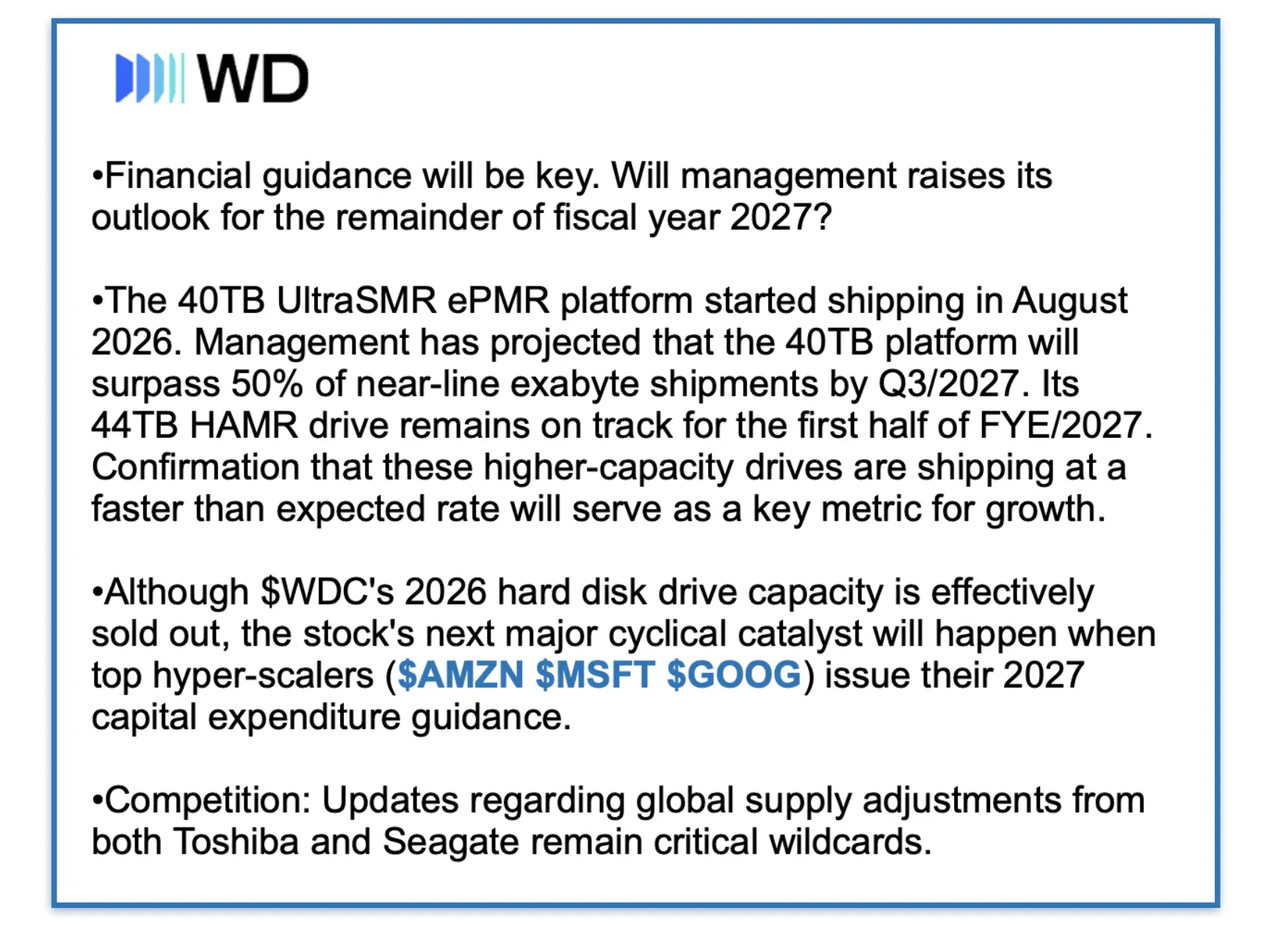

#U.S. Memory Stocks Extend Losses #ShareWeekly AI memory stocks under pressure: the market is reassessing growth, competition, and profitability 💾 AI demand keeps growing, but the memory sector is facing a tougher test. On Friday, October 16, investors' concentrated bets on the AI infrastructure theme ran into another warning. Seagate Technology fell 4.9% to $657.41; Western Digital fell 4.6% to $339.84; Micron fell 5.6%. The Nasdaq Composite dropped 2.1%, reflecting broad pressure on tech stocks. The important shift is that investors are no longer focused only on AI demand forecasts. They are starting to ask a harder question: **if competition intensifies and market expectations cool, which companies can defend their margins?** Three developments driving the selloff 1. Valuations are being tested by higher expectations Memory stocks have benefited from expectations of strong AI-related spending, tight supply, and improving profitability. But after a large rally, if investors believe future growth is already reflected in valuations, even positive business news may not be enough to support the share price. The recent tech selloff has also heightened concerns about the financing and eventual returns of large-scale AI infrastructure investment. 2. Competition could challenge pricing power Reports that China's CXMT has made progress on higher-density DRAM designs have added to concerns about future memory chip competition. Meanwhile, reports that Toshiba plans to expand hard drive capacity have put the HDD supply outlook under scrutiny. These developments do not prove an imminent direct shock to the industry, but they raise new questions about long-term pricing and market share. 3. Different products carry different risks The memory industry is not a homogeneous sector. Micron is involved in DRAM, high-bandwidth memory, and NAND flash; SanDisk focuses on flash storage; Western Digital and Seagate focus on hard drives. Their earnings react differently to memory pricing, enterprise SSD demand, data center orders, and production capacity. 🔬 Where the next wave of opportunity may lie | Company | Key metrics to watch | |---|---| | **Micron (MU)** | HBM demand, memory pricing, and competition | | **SanDisk (SNDK)** | NAND pricing and enterprise SSD adoption | | **Western Digital (WDC)** | HDD supply, pricing, and customer demand | | **Seagate (STX)** | High-capacity HDD shipments and margins | The upcoming earnings reports from Western Digital and Seagate are especially important, because management guidance will help investors assess whether AI-related demand remains strong enough to support current supply and pricing expectations. ⚖️ Bull case and bear case Bull case AI workloads continue to grow, data center operators need more storage, and disciplined production helps support pricing power. As a result, the share price decline may reflect a valuation reset rather than a deterioration in underlying demand. Bear case New capacity, intensifying competition, and rising financing costs squeeze margins, while elevated expectations leave little room for error on performance. In this scenario, even if the memory market keeps growing, shareholder returns could be uneven. 🎯 Signals to watch next Rather than judging the entire sector based on a single trading day, investors may want to track four fundamental indicators: - Pricing: Are the economics of DRAM, HBM, NAND, and HDD continuing to improve? - Demand: Are cloud service and enterprise customers maintaining storage spending? - Margins: Is revenue growth translating into stronger operating profitability? - Supply: Is capacity expansion outpacing demand absorption? If these fundamentals remain healthy while prices stabilize and sentiment improves, confidence in a sustained recovery would be higher. Final view: the opportunity in AI storage has not disappeared, but the market demands stronger evidence that growth can translate into durable profits. The next leaders may be companies that combine technological relevance, pricing discipline, efficient production, and stable cash generation.
展開

#U.S. Memory Storage Sector Extends Losses #ShareWeekly AI memory stocks under pressure: the market is reassessing growth, competition, and profitability. 💾 AI demand keeps expanding, but investment in the memory sector is facing a tougher test. On Friday, October 16, another warning sign for investors heavily positioned in the AI infrastructure theme. Seagate Technology fell 4.9% to $657.41; Western Digital fell 4.6% to $339.84; Micron fell 5.6%. The Nasdaq Composite dropped 2.1%, reflecting broad pressure on tech stocks. The important shift is that investors are no longer focused only on AI demand forecasts. They are starting to ask a harder question: **if competition intensifies and market expectations cool, which companies can defend their margins?** Three developments driving the selloff 1. Valuations face higher expectations Memory stocks benefited from expectations of strong AI-related spending, tight supply, and improving profitability. But after sharp share-price gains, if investors believe future growth is already reflected in valuations, even positive business news may not be enough to support the stock price. The recent tech selloff has also raised concerns about the financing and eventual returns of large AI infrastructure investments. 2. Competition could challenge pricing power Reports that China's CXMT has made progress on higher-density DRAM designs have intensified concerns about future memory chip competition. Meanwhile, reports that Toshiba plans to expand hard drive manufacturing capacity have put the HDD supply outlook under scrutiny. These developments do not prove an imminent direct shock to the industry, but they do raise new questions about long-term pricing and market share. 3. Different products carry different risks The memory industry is not a single investment target. Micron is involved in DRAM, high-bandwidth memory, and NAND flash; SanDisk focuses on flash storage; Western Digital and Seagate focus on hard drives. Their earnings react differently to memory pricing, enterprise SSD demand, data center orders, and manufacturing capacity. 🔬 Where the next round of opportunities may appear | Company | Key metrics to watch | |---|---| | **Micron (MU)** | HBM demand, memory pricing, and competition | | **SanDisk (SNDK)** | NAND pricing and enterprise SSD adoption | | **Western Digital (WDC)** | HDD supply, pricing, and customer demand | | **Seagate (STX)** | High-capacity HDD shipments and margins | The upcoming earnings reports from Western Digital and Seagate are especially important, because management guidance can help investors assess whether AI-related demand remains strong enough to support current expectations for supply and pricing. ⚖️ Bull case and bear case Bull case AI workloads continue to expand, data center operators need more storage, and disciplined production helps support pricing power. As a result, the share-price decline may reflect a valuation reset rather than a deterioration in underlying demand. Bear case New capacity, intensifying competition, and rising financing costs squeeze margins, while elevated expectations leave little room for disappointing results. In this scenario, even if the memory market continues to grow, shareholder returns could be uneven. 🎯 Signals to watch next Rather than judging the sector's performance based on a single trading day, investors may want to track four fundamental indicators: - Pricing: Are the economics of DRAM, HBM, NAND, and HDD still supported? - Demand: Are cloud and enterprise customers maintaining storage spending? - Margins: Is revenue growth translating into stronger operating profitability? - Supply: Is capacity expansion outpacing demand absorption? If these fundamentals remain healthy while prices stabilize and sentiment improves, the case for a sustained recovery would be stronger. Final view: the opportunity in AI storage has not disappeared, but the market is demanding stronger evidence that growth can translate into durable profits. The next group of leaders may be companies that combine technological relevance, pricing discipline, efficient production, and stable cash generation.
展開
US memory stocks extend their decline: Is the AI trade losing momentum, or creating a new opportunity? US memory stocks have recently sold off, raising an important question: Is this just a healthy pullback after a strong AI-driven rally, or is the market starting to reassess the sector's earnings potential and future valuation? Companies like Micron, SanDisk, Western Digital, and Seagate have benefited from demand growth tied to AI infrastructure, cloud computing, and data center expansion. However, even strong sectors can experience sharp pullbacks when investors begin to worry about valuations, take profits, or question whether future earnings can support elevated share prices. In my view, the key is not to buy just because prices have fallen. Investors need to understand what is changing beneath the surface. 1. Micron (MU): AI memory demand under scrutiny Micron remains an important company to watch because of its exposure to DRAM, high-bandwidth memory (HBM), and advanced memory solutions used in AI infrastructure. AI accelerator demand can support HBM consumption, while traditional DRAM demand also depends on PCs, smartphones, and enterprise systems. Still, strong demand does not necessarily guarantee continued stock gains. I will be watching memory pricing, gross margin forecasts, capacity, and management's forward guidance. If earnings expectations remain resilient during the pullback, MU could regain attention. If forecasts weaken, the decline could last longer. 2. SanDisk (SNDK): NAND flash remains a key factor SanDisk is closely tied to NAND flash and solid-state drives (SSDs). Enterprise SSD adoption could benefit from growing demand to store and retrieve massive amounts of AI-generated data. However, NAND is a cyclical market. Changes in supply, inventory levels, and contract prices can significantly affect profitability. I will be watching whether NAND prices stabilize, whether enterprise demand continues to expand, and whether earnings expectations remain supported. A lower share price alone is not enough to prove that SNDK's valuation has become attractive. 3. Western Digital (WDC): The case for high-capacity HDDs Western Digital offers a different perspective, as high-capacity hard disk drives remain closely tied to cloud storage and large data centers. AI infrastructure needs not only high-speed memory and SSDs, but also massive space to store datasets, backups, and other information. Therefore, cloud providers' capital expenditure plans and demand for nearline HDDs are important indicators. Investors should watch shipment growth, pricing power, gross margins, and free cash flow to judge whether the company's fundamentals support its valuation. 4. Seagate (STX): Storage demand and valuation risk Seagate is another major beneficiary of high-capacity storage demand. As data center operators expand infrastructure, demand for efficient high-capacity drives could remain an important long-term driver. However, investors must distinguish between genuine earnings growth and expectations already reflected in the share price. I will be watching order trends, product mix, margins, and management's outlook on future demand. What could trigger a sustained recovery? I will be watching three main signals: - Fundamental stabilization: Memory and NAND prices stop weakening, while earnings expectations and company guidance remain stable. - Technical confirmation: Stocks form higher lows, reclaim important moving averages, and volume improves. - Reasonable valuation: Expected earnings growth can support current prices even under a less optimistic market scenario. The broader macroeconomic environment also matters. Rate expectations, US Treasury yields, tech sector sentiment, and corporate spending plans all influence how investors value AI-related companies. My final take I remain positive on the long-term opportunity in the storage sector, but I will avoid treating MU, SNDK, WDC, and STX as identical investments. DRAM, HBM, NAND flash, and hard disk drives each have different demand drivers, competitive dynamics, and supply cycles. Pullbacks driven by profit-taking may create opportunities. Declines caused by weakening demand, falling prices, or deteriorating earnings guidance require more caution. For now, I will prioritize fundamental evidence, valuation discipline, and confirmation from price action rather than rushing to buy the dip. #USMemoryStocksExtendLosses #ContentMining #PlanYourTradesThisWeek
展開

#US stock memory sector decline widens The key question is whether this is a healthy pullback after an AI-driven rally, or the start of a deeper repricing process for the memory industry. Rather than simply buying just because prices have fallen, I focus on earnings expectations, memory prices, and whether companies can maintain margins. My views on memory sector stocks: * Micron (MU): Watch DRAM and HBM demand, AI-related memory growth, and gross margin forecasts. Strong AI demand could boost earnings, though these expectations may already be reflected in the stock price. * SanDisk (SNDK): Focus on NAND flash prices, enterprise SSD demand, and whether the earnings recovery can continue. NAND supply-demand and pricing cycles can make this stock especially volatile. * Western Digital (WDC): Assess AI data center demand for nearline (high-capacity/easily accessible) HDDs, cloud spending, and free cash flow. The factors affecting HDD demand differ from those affecting NAND and DRAM. * Seagate (STX): As data center storage demand grows, watch demand for high-capacity drives, pricing power, and margins. * Track NAND market conditions, enterprise SSD adoption rates, and how company valuations compare to earnings expectations. What signs might be enough to support rebuilding positions? I would watch for three things: * Fundamental indicators stabilizing: memory and NAND prices, company guidance, and earnings expectations stop deteriorating. * Price action confirmation: stocks form higher lows and reclaim key moving averages, with stronger volume. * Attractive valuation: even under a less optimistic scenario, expected earnings growth is enough to support the current stock price. A falling stock price by itself is not a buy signal. If earnings expectations are revised down faster than the stock price falls, valuations may not actually be getting cheaper. Rather than buying the entire memory sector indiscriminately, I prefer to differentiate among individual companies. Although AI demand is a long-term positive, memory, NAND flash, and hard drives each have their own supply-demand cycles, competitive pressures, and margins. One important distinction: a pullback caused by profit-taking is fundamentally different from one caused by weak forward guidance or falling memory prices. The latter requires much more caution. Which of these stocks are you watching most closely - MU, SNDK, WDC, or STX? I can help you compare their valuations, earnings outlooks, technical levels, and potential recovery drivers. $MU $SNDK $WDC $STX
展開
本頁僅供研究參考,不構成投資建議。模型可能出錯。過往表現不代表未來結果。