
W
Western Digital Corporation
+ 持有SNDK
+23.57%
3個月報酬率
$1,255.580
+17.829 (+1.42%)收盤時
SanDisk Corporation is a developer, manufacturer and provider of data storage devices and solutions based on NAND flash technology and has consumer brands and franchises globally. The Company's solutions include a range of solid state drives (SSDs) embedded products, removable cards, universal serial bus (USB) drives, and wafers and components. Its broad portfolio of technology and products addresses multiple end markets of Datacenter, Edge and Consumer. Its Datacenter end market is composed primarily of products for public or private cloud environments and enterprise customers. The Company, through the Edge end market, provides original equipment manufacturer and channel customers a broad array of high-performance flash solutions across personal computer, mobile, gaming, automotive, virtual reality headsets, at-home entertainment, and industrial spaces. The Company serves the Consumer end market with a broad range of retail and other end-user products.
While Sandisk's current price of $1,238.03 suggests potential for growth, the RSI of 19.192 indicates that the stock is oversold, and the forward P/E of 8.0386 reflects an attractive valuation. However, the recent 30-day change of -30.36% raises concerns about short-term volatility. Investors should be cautious as the memory sector is historically volatile, and the stock may face significant sell-offs after booms. Therefore, holding is recommended until clearer trends emerge.

Sandisk's Stock Surge Sparks Speculation of a Split

Sandisk Stock Volatility Ahead of Earnings Report

SK Hynix Sets Record with $26.5 Billion ADR Offering

AI Stocks Poised for Growth Amid Market Competition
Sandisk's New Business Model Drives Stock Surge Amid Soaring Demand
SanDisk Corporation is a developer, manufacturer and provider of data storage devices and solutions based on NAND flash technology and has consumer brands and franchises globally. The Company's solutions include a range of solid state drives (SSDs) embedded products, removable cards, universal serial bus (USB) drives, and wafers and components. Its broad portfolio of technology and products addresses multiple end markets of Datacenter, Edge and Consumer. Its Datacenter end market is composed primarily of products for public or private cloud environments and enterprise customers. The Company, through the Edge end market, provides original equipment manufacturer and channel customers a broad array of high-performance flash solutions across personal computer, mobile, gaming, automotive, virtual reality headsets, at-home entertainment, and industrial spaces. The Company serves the Consumer end market with a broad range of retail and other end-user products. It operates in the Technology sector.
While Sandisk's current price of $1,238.03 suggests potential for growth, the RSI of 19.192 indicates that the stock is oversold, and the forward P/E of 8.0386 reflects an attractive valuation. However, the recent 30-day change of -30.36% raises concerns about short-term volatility. Investors should be cautious as the memory sector is historically volatile, and the stock may face significant sell-offs after booms. Therefore, holding is recommended until clearer trends emerge.

$SKHYNIX $SNDK Yesterday and the day before, I repeatedly reminded everyone that SanDisk and SK Hynix had a breakout structure, and I strongly suggested going long. The records are all there to see. No need to say more about the track record—you can also see my own live positions. Feel free to follow me!
展開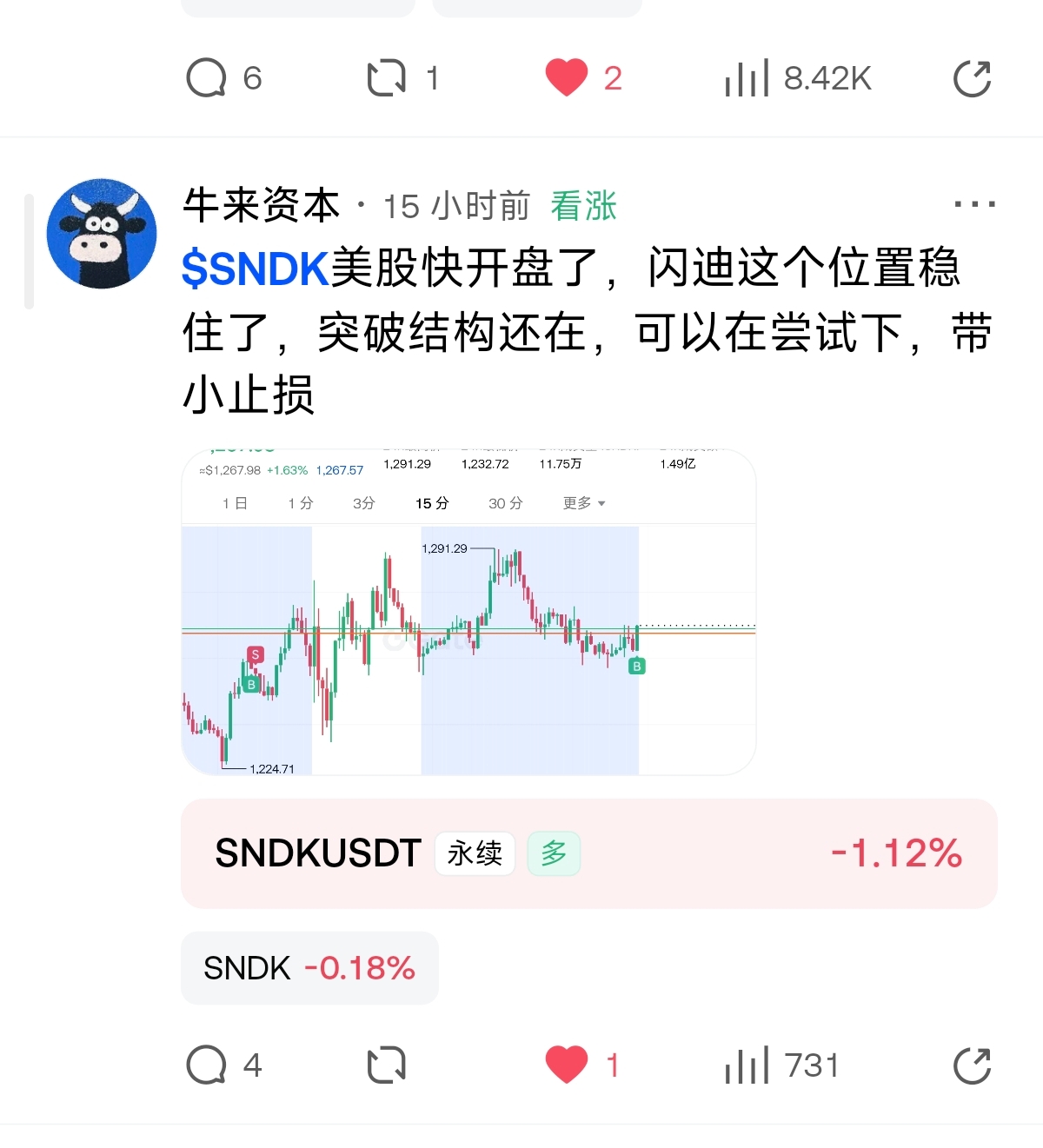

On 10-25 I wrote that I would only acknowledge it at 1246.42, and after writing that I left it alone. Three days later it was 1307.64; it did not stop at 1246 and pushed all the way to 1318.19. My mistake at the time: I only marked the confirmation line, not whether to chase. Now to add one point: the confirmation line and the entry line are never the same line. 10-27 20:00 1283.59. 10-27 21:00 1300.40, volume 1.8 million contracts. 10-28 00:00 1310.00, high 1318.19. 10-28 08:00 1307.64. After 1318.19, all eight candles ground between 1290 and 1313, with volume back to a few hundred thousand. This time I will not chase the top; I will place a conditional order at 1298 and only act if it holds. If it breaks 1290 I will withdraw; ma20 sits right at 1290.94, so breaking the price means breaking the line. $SNDK I am waiting flat; if the condition is not met, I will not move. (Not investment advice; profit and loss are your own responsibility.)
展開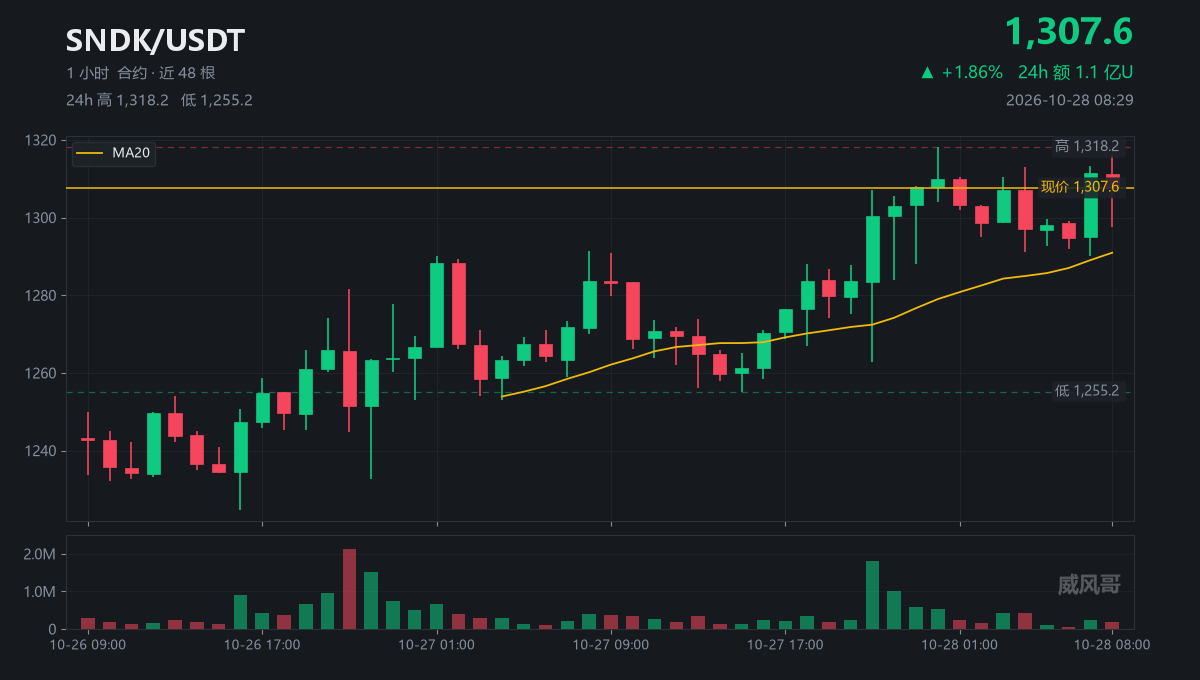

$SNDK To be honest, I used to chase 100x gains too, got liquidated, and stared at the charts at 3 a.m. cursing the market makers. Later I realized the market makers don't know me, and the market doesn't owe me anything. The only reason I'm still here is that I've lost enough to be scared—I set stop-losses fast, stick to my own thinking, and would rather stay in cash and watch than take trades I shouldn't touch. It's not that my skills improved, it's that I understand more. In crypto, understanding is the core competitive edge. #BTC争夺8万美元关口
展開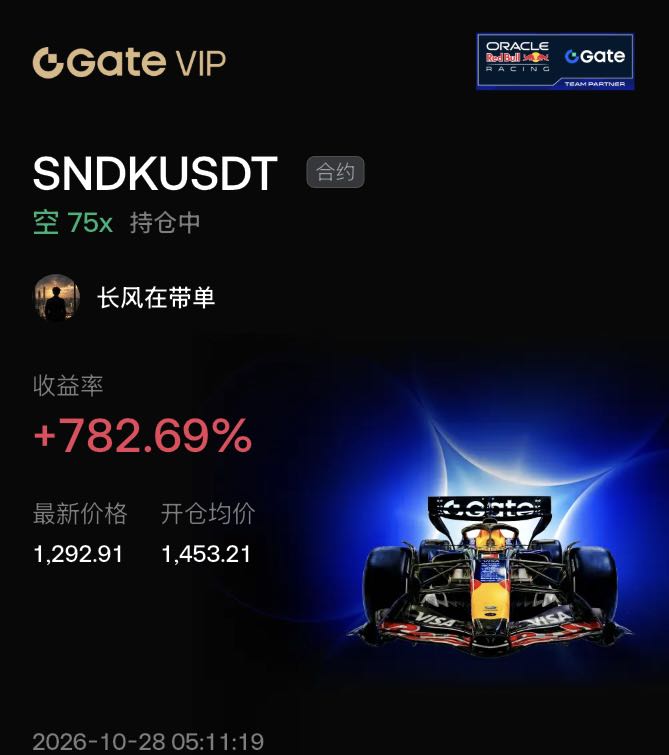

#EarningsSeason I expect $GOOGL Google's earnings this round: even if cloud growth expectations are raised again, it's already priced in, and an beat is likely. But the real hidden risk is capex — hundreds of billions of dollars poured into data centers means free cash flow likely won't look good. Right now large-model companies are signing hundred-billion-level long-term compute contracts one after another; on the surface it locks in demand for the next few years, but in reality it forces the giants to grit their teeth and spend wildly on infrastructure. Following this cash-burning chain downward, the logic for $MU $SNDK AI memory semiconductors is even stronger than cloud itself. Large models' appetite for compute has directly made HBM (high-bandwidth memory) and high-end DRAM hard currency. As long as cloud giants' capex guidance keeps charging ahead without braking, the underlying logic of upstream shortages and price increases remains intact. So once earnings trigger an after-hours selloff over "burning cash for growth," it instead becomes a window to watch for mispriced opportunities in the HBM supply chain. Still, keep one thing in mind: once the market starts measuring these sky-high orders with the ruler of "monetization efficiency," the memory stocks that rose the fastest will also be the first to bleed when valuations get cut. #CanGoogleEarningsHoldItsGround (SNDKUSDT) (GOOGLUSDT) (MUUSDT)
展開本頁僅供研究參考,不構成投資建議。模型可能出錯。過往表現不代表未來結果。