B
Bull
Bull · 25%ASST
$4.95
Scenario price
$15.590
+0.667 (+4.28%)At close
Strive, Inc. is an asset management Bitcoin treasury company. The Company is focused on increasing Bitcoin per share to outperform Bitcoin over the long run. The Company's subsidiary, Strive Asset Management, LLC, is a SEC-registered investment adviser, which has assets under management (AUM) across approximately 13 exchange-traded funds, collective investment trusts, and a direct indexing platform. In addition, the Company owns Semler Scientific, Inc., a healthcare technology subsidiary focused on early disease detection products. Through its healthcare businesses, Semler Scientific and its wholly-owned subsidiary, CardioVanta, Inc. develop and market products and services for early detection and monitoring of chronic diseases. Semler Scientific's flagship product, QuantaFlo, provides rapid point-of-care testing to measure arterial blood flow in the extremities. The QuantaFlo test aids in the diagnosis of peripheral arterial disease.
Given the current price of $14.51, the RSI at 13.96 indicates the stock is oversold, but the significant recent declines (32.07% over the last 5 days and 49.91% over the last 20 days) suggest a bearish trend. The forward P/E ratio of 1.6412 is attractive, but the negative gross margin of -479.86% in the most recent quarter raises concerns about profitability. Therefore, while there may be potential for recovery, the risks outweigh the rewards at this time.
Scenario prices are the last monthly forecast band of the current year. Probabilities are fixed model weights (25 / 50 / 25), not guarantees.
OKXICE Platform Launch Faces High Rejection Rate

Bitcoin Faces Significant IPO Pressure Ahead of Major Listings

Strive Completes $630 Million Preferred Stock Offering to Fund Bitcoin Strategy

Strive Inc. Successfully Closes Upsized IPO of 7 Million Preferred Shares
Saylor Claims Strive's Daily Dividends Outperform Strategy's Payouts
Strive, Inc. is an asset management Bitcoin treasury company. The Company is focused on increasing Bitcoin per share to outperform Bitcoin over the long run. The Company's subsidiary, Strive Asset Management, LLC, is a SEC-registered investment adviser, which has assets under management (AUM) across approximately 13 exchange-traded funds, collective investment trusts, and a direct indexing platform. In addition, the Company owns Semler Scientific, Inc., a healthcare technology subsidiary focused on early disease detection products. Through its healthcare businesses, Semler Scientific and its wholly-owned subsidiary, CardioVanta, Inc. develop and market products and services for early detection and monitoring of chronic diseases. Semler Scientific's flagship product, QuantaFlo, provides rapid point-of-care testing to measure arterial blood flow in the extremities. The QuantaFlo test aids in the diagnosis of peripheral arterial disease. It operates in the Financials sector (SERVICES-PREPACKAGED SOFTWARE industry).
Given the current price of $14.51, the RSI at 13.96 indicates the stock is oversold, but the significant recent declines (32.07% over the last 5 days and 49.91% over the last 20 days) suggest a bearish trend. The forward P/E ratio of 1.6412 is attractive, but the negative gross margin of -479.86% in the most recent quarter raises concerns about profitability. Therefore, while there may be potential for recovery, the risks outweigh the rewards at this time.


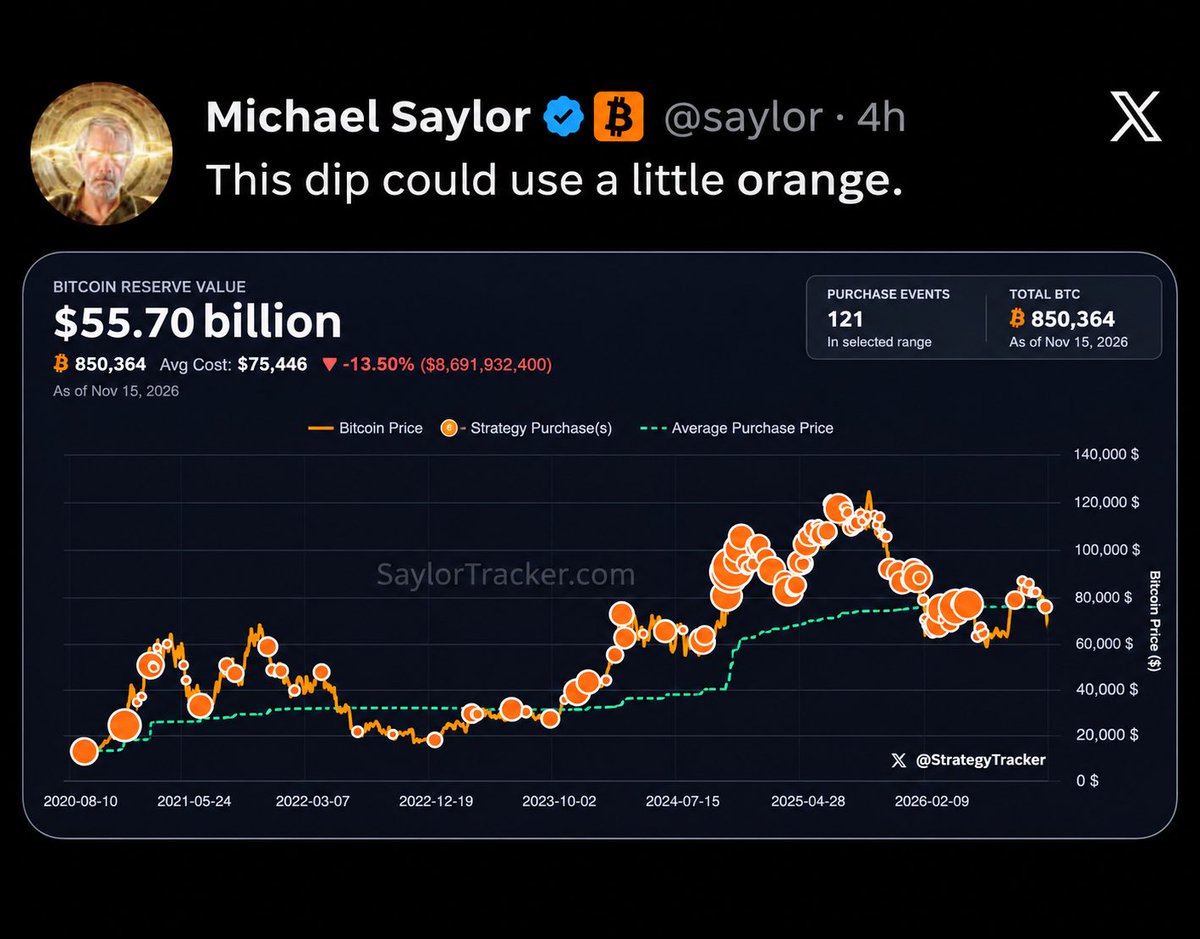
Strategy repurchased $205M of STRC; Strive spent $511M to buy Bitcoin. After Strive's latest record purchase, its Bitcoin holdings are only 1,000 less than Metaplanet's; meanwhile, Strategy prioritized repurchasing preferred stock. Quick overview ⚠️ Personal market analysis only. Not financial advice — please manage risk and do your own research. This content is for educational purposes only and does not constitute investment advice, nor a recommendation to buy, sell, deposit, or withdraw any asset. No paid promotion or referral/affiliate links.
Show more

#StriveCEOHintsAtMoreBitcoinBuying Strive now holds 43,000 BTC, but the real test is the amount of Bitcoin per common share. On October 25, CEO Matt Cole posted a chart of Strive's holdings with the caption "sat/$SATS perpetual swap has launched," which the market interpreted as a hint at another imminent purchase. An SEC filing submitted on Monday confirmed that Strive bought 6,182 BTC for $511.4 million between October 17 and 23 at an average price of $82,732, raising holdings to 43,000 BTC. ASST fell nearly 5% that day to $27.55. With BTC near $80,000, the question is whether Strive can keep increasing the BTC per common share without significant dilution. Confirmed and Speculative Confirmed: Since September 28, Strive has bought for four consecutive weeks, totaling 15,538 BTC for $1.295 billion at an average price of $83,340. Holdings were 29,462 BTC in early October and 7,525 BTC in December 2025. Speculative: anything after October 23. Cole's post did not disclose the size or timing of purchases. If the pattern from Monday's disclosure continues, the next update will be on November 2. Cost of Buying More BTC at $80,000 - 1,000 BTC = $80M (14% of cash), holdings rise to 44,000 - 2,500 BTC = $200M (36%), holdings rise to 45,500 - 5,000 BTC = $400M (72%), holdings rise to 48,000 Cash and marketable securities are $554.6 million, of which $157.5 million is reserved for dividend payments, plus a new $1B SATS market offering program. Last week's purchase pace was 6,182 BTC, so buying 5,000 BTC is not far-fetched. SATS Funding Capacity and Cost Strive sold 7 million SATS at $90 per share, raising $630 million, expanded from the $500M target size. Dividends accrue at 15% on a $100 notional amount, or $15 per share per year; at a $90 share price, that is a 16.67% yield, or about $105M per year. If a dividend is declared, payments will begin on November 9 and be made every business day. The $157.5 million reserve covers 18 months. Selling the full $1B program size at $90 per share would add about $167M in annual dividends and could fund about 12,500 BTC before fees. The threshold is clear: common shareholders benefit only if BTC returns exceed the roughly 16.7% annual funding cost. Bitcoin Per Share Based on a fully diluted market cap of $3.3-3.4 billion and a share price of $26.75-27.55, fully diluted shares are about 124 million. If the share count stays unchanged, fully diluted BTC per share would rise from 0.000297 at 36,818 BTC held to 0.000347 at 43,000 BTC, a 16.8% increase. Further purchases would bring that figure to 0.000355 (44,000), 0.000367 (45,500), and 0.000387 (48,000). After deducting the $700M SATS notional amount (about 8,750 BTC), the current figure would fall to about 0.000276 before accounting for cash and SATA. The filing also reported warrant exercises, so the share count needs to be rechecked. Debt and Concentration The SATS dividend equals about 1,312 BTC per year, or 3.1% of the $3.44 billion treasury assets. SATA also pays a variable daily dividend on 14.03 million shares. BTC is about 86% of total BTC and cash ($3.44 billion/$3.99 billion), and Strive reports no debt, bonds, credit facilities, or leveraged positions. Strategy holds 848,517 BTC, nearly 20 times Strive's holdings, while Metaplanet holds about 44,000 BTC. Premium or Discount BTC net asset value is about $3.44 billion. The $2.75 billion basic market cap equals 0.80x, and the $3.4 billion fully diluted market cap equals 0.99x. Including the $700M SATS and deducting $554.6 million in cash, enterprise value is nearly $3.55 billion, or 1.03x, before accounting for SATA. Previously, a tracking tool showed a 1.42x valuation at 36,818 BTC held, so the premium has narrowed. Near 1x, issuing more common shares adds only slightly to BTC per share, so preferred stock is the main growth lever, and its 16.7% cost is the key variable. Accumulation Under Pressure: BTC Drops 10% If BTC falls to $72,000, treasury assets would decline by about $344M to $3.1 billion. The 15,538 BTC bought since September 28 would show an unrealized loss of $52M (-4.0%) at $80,000 and $176M (-13.6%) at $72,000. With no debt, there is no margin call; $554.6 million in cash is enough to cover SATS dividends for more than five years. The pressure point is issuance, because new SATS sales depend on whether market demand can hold near the offering price. A lower price does make cash go further: $80M buys 1,111 BTC at $72,000 versus only 1,000 BTC at today's $80,000. Confirmation Signals An SEC filing or updated holdings disclosure can confirm whether a purchase occurred. Watch the next update on November 2 and November 9, when SATS dividend payments begin; earnings are also expected that day. The CEO's hint alone does not confirm the size or timing of a purchase. The core test is not how much Bitcoin Strive can accumulate, but whether its funding structure can increase BTC per common share without excessive dilution or funding pressure.
Show more

#StriveCEOHintsAtMoreBitcoinBuying #WCTCS9 36,818 BTC reserve, $1 billion financing capacity, and the next accumulation signal Strive's recent Bitcoin activity is more than a single purchase. It shows how aggressively the company is expanding its BTC reserve and why the next announcement is worth watching. But the key question is not just whether Strive will buy more Bitcoin, but whether this growth can translate into higher Bitcoin exposure per share without excessive financing costs or equity dilution. Between October 12 and October 16, 2026, Strive purchased 4,045 BTC for approximately $335 million, at an average price of $82,803 per Bitcoin, including fees and expenses. The purchase was carried out in two stages: 2,822 BTC at an average price of $83,266 from October 12 to 13, followed by another 1,223 BTC at about $81,734 from October 14 to 16. As of October 16, its total holdings had reached 36,818 BTC, up from 32,773 BTC on October 9. The financing strategy matters as much as the accumulation itself. Warrant exercises are expected to bring in about $369.2 million in gross proceeds, while Strive also priced a preferred stock offering expected to raise about $630 million after offering costs. On October 20, the company announced the completion of an upsized offering of 7 million shares of SATS preferred stock at $90 per share, with a stated annual dividend rate of 15%. This provides additional financing capacity, but it also introduces a substantial ongoing cost of capital that investors should not overlook. Now let's look at the signal from CEO Matt Cole. On October 25, he posted that "sats/$SATS perpetual swaps are live." The remark fueled speculation about another Bitcoin purchase update, especially after the recent large accumulation. However, the post itself did not confirm any new BTC acquisition. Until a company announcement or SEC filing discloses the amount, purchase price, and transaction dates, another purchase remains a possibility, not a confirmed event. Behind the headline numbers is a more important metric: Bitcoin per share. As the reserve expanded, Strive's actual common shares outstanding rose from about 110.4 million on October 9 to 124.1 million on October 16. Based on these figures, BTC exposure per actual common share was about 29,689 sats on October 9 and about 29,677 sats on October 16. In other words, despite the headline expansion of the reserve, Bitcoin exposure per share did not automatically increase. That is why share count and financing structure matter as much as total BTC holdings. Strive claims it aims to become the second-largest Bitcoin holder among publicly traded companies by the end of 2026, a challenging goal. Whether it can achieve this will depend on future purchases, the pace at which other reserve companies expand, available funding, and the market price of Bitcoin. A larger reserve can strengthen the company's position, but it does not guarantee higher returns for shareholders. I am now watching three signals: whether a new SEC filing confirms additional BTC accumulation, whether the next purchase increases Bitcoin per share, and how much financing cost the company pays for further accumulation. I will also watch whether new capital strengthens the balance sheet or adds to the burden of preferred dividends and common stock dilution. The next announcement may reveal whether Strive is continuing its buying pace, but the quality of growth matters more than the headline quantity. For me, the best reserve strategy is not just the one that accumulates the most Bitcoin, but the one that expands shareholder exposure while managing financing costs and market risk.
Show more

Strive CEO Hints at More Bitcoin Buying: Is a New Wave of BTC Accumulation Coming? Bitcoin continues to draw attention from institutional investors, business leaders, and long-term crypto believers. Recent discussion around Strive's potential Bitcoin purchase plans has once again raised an important market question: can more corporate Bitcoin accumulation help BTC enter its next major move? Strive has positioned Bitcoin as an important part of its long-term treasury strategy. Its leadership hinting at possible further Bitcoin purchases could increase investor interest in the trend of more companies adding BTC to their balance sheets. However, the specific timing, size, and execution of any additional purchases remain important details to watch. Why Strive's Bitcoin Strategy Matters Corporate Bitcoin accumulation has become a significant narrative in the crypto market. When companies choose to hold BTC as a long-term asset, it signals their view of Bitcoin's potential role as a store of value. At the same time, every company has its own financial goals, funding strategy, and risk tolerance. If Strive makes further Bitcoin purchases, market participants may focus more on three main factors: Institutional confidence: Continued accumulation could reinforce the view that some companies see Bitcoin as a strategic treasury asset. Market sentiment: Positive corporate buying news could boost investor confidence, but sentiment alone does not guarantee a price increase. Long-term supply dynamics: Bitcoin has a limited maximum supply of 21 million coins. Sustained demand from companies and other investors could influence market supply and demand over time. What This Means for BTC Price The impact on Bitcoin will depend on actual purchase activity, overall market liquidity, trading volume, and broader economic conditions. Corporate buying may support bullish sentiment, but it does not necessarily lead to an immediate rally. Traders should watch the following key levels on the BTC chart: - Resistance: A confirmed breakout above the current resistance zone could attract more momentum buyers. - Support: Holding key support levels could help Bitcoin maintain a bullish structure. - Volume: Rising buy volume during a breakout may provide stronger confirmation than price movement alone. - Market risk: Even with positive corporate buying news, a stronger dollar, changing rate expectations, or profit-taking could put pressure on BTC. Rather than chasing headlines, investors may prefer to wait for confirmed announcements and watch price action before making decisions. The Bigger Picture: Corporate Bitcoin Adoption Strive's Bitcoin strategy reflects a broader discussion about how companies should manage their treasury assets in an increasingly digital financial environment. Bitcoin has long-term upside potential, but it also comes with significant volatility and financial risk. If further purchases are confirmed, the news could become another important development in the institutional Bitcoin adoption narrative. The key question is whether real demand is enough to influence market momentum, rather than just creating short-term speculation. My market view: Strive's potential Bitcoin accumulation is worth watching, but confirmation matters more than hints. For BTC to achieve a sustainable rise, it needs more than positive headlines—it also needs real demand, healthy liquidity, and strong price confirmation. Can more corporate Bitcoin buying push BTC toward new highs, or will market volatility remain the biggest obstacle? Share your thoughts below. #Bitcoin #BTC #Strive #CryptoMarket
Show more
This page is for research only and is not investment advice. Models can be wrong. Past performance does not guarantee future results.