
$1.010
+0.010 (+1.00%)終値時点
ATNM のニュース




ATNM のイベント
Actinium Pharmaceuticals Presents New Data on ATNM-400 at Lung Cancer Conference
Actinium Pharmaceuticals on June 2 presented new preclinical data on ATNM-400 in non-small cell lung cancer, or NSCLC, at the Society of Nuclear Medicine and Molecular Imaging 2026 Annual Meeting in Los Angeles, California. The new KRAS-mutant data, together with a growing body of EGFR-mutant data, demonstrate ATNM-400's activity across the two major mutation driver classes in NSCLC and support a distinct strategic opportunity. ATNM-400 can be developed as a potential mutation-agnostic backbone for the broader NSCLC market, alone or in combination with standard-of-care therapies, rather than as another mutation-specific drug for a narrow subset. NSCLC accounts for roughly 85% of the more than two million lung cancer cases diagnosed globally each year, a market more than twice the size of prostate cancer. It is also highly heterogeneous: no single mutation dominates, so treatments are fragmented across mutation-specific therapies such as EGFR, KRAS, BRAF, ALK and others, each marketed by different companies, each addressing only a molecular subset, and each ultimately limited by acquired resistance. ATNM-400, Actinium-225 antibody radioconjugate, is designed to break out of that single-mutation paradigm. Rather than blocking a specific mutant protein, it delivers a high-linear-energy-transfer alpha-particle payload that induces dense, irreversible double-strand DNA breaks and tumor-cell death independent of a tumor's driver mutation or signaling pathway, the mechanistic basis of its mutation-agnostic activity. In new KRAS-mutant studies presented at SNMMI, sotorasib and adagrasib increased ATNM-400's target up to 3.5- and 3.8-fold, respectively, and adding ATNM-400 deepened tumor-cell killing beyond either inhibitor alone. These results demonstrate the same target-expression increasing, synergy-enabling biology shown previously with the EGFR inhibitor osimertinib, which produced tumor growth inhibition of 107% when combined with ATNM-400. These combination benefits also broaden ATNM-400's commercial opportunity. The franchises it could enhance are substantial; the KRAS inhibitor class in NSCLC is projected to exceed $5B in peak sales, and the EGFR-mutant segment has peak sales estimates over $15B, led by osimertinib which generated $7.3B in 2025. This positions ATNM-400 to participate in these established markets by enhancing the standard of care, while also reaching the broader NSCLC population beyond any single mutation.
Actinium Appoints Steffen Heeger as Chief Medical Officer
Actinium Pharmaceuticals announced the appointment of Steffen Heeger, MD, MSc, as Chief Medical Officer. Dr. Heeger brings a rare combination of radiotherapy expertise, global oncology drug development leadership, and public-company experience. Over his career, he has translated multiple programs from IND submission through global clinical approval in the US, EU, and Japan including the blockbuster Erbitux and led as CMO an oncology company acquired for $1.4B. Most recently Dr. Heeger served as CMO of a clinical-stage radiotherapy company where he advanced into global development, a PSMA program directly relevant to Actinium's ATNM-400 asset. His appointment comes at a pivotal moment as Actinium prepares to advance Actimab-A, ATNM-400, and Iomab-ACT toward key data readouts and expanded clinical trials in the second half of 2026.
Actinium Pharmaceuticals Presents New Radiochemistry Data at Annual Meeting
Actinium Pharmaceuticals, on May 31, presented new radiochemistry data at the Society of Nuclear Medicine and Molecular Imaging 2026 Annual Meeting taking place in Los Angeles, California. Highlights: Antibody-DOTA conjugates spanning CAR 0.7-9 were prepared. CAR greater than or equal to1.7 enabled robust 225Ac labeling, while CAR 0.7 was insufficient. This establishes the minimum loading needed to carry an effective radioactive dose. Antigen binding stayed high at low CAR (91-98% at CAR 0.7-3.2) but fell at high CAR (79-85% at CAR 7-9), and low-CAR conjugates internalized more, keeping more of the antibody functional. Median Fluorescence Intensity (MFI) is a proxy for binding or antigen affinity retention. Findings suggest overloading the antibody degrades its ability to find and enter cancer cells. In vivo, both conjugates showed comparable tumor uptake and sustained retention through 192 h, but the low-CAR (2.5) conjugate significantly reduced liver and spleen uptake, providing a basis for a wider therapeutic index. Both conjugates remained stable over 7 days (radiochemical purity above 97%), showing that CAR can be optimized for performance without compromising manufacturability or clinical supply. Safety and targeting gains can come with no manufacturing trade-off. A wider therapeutic index could allow more dose to reach the tumor at a given level of safety, a proprietary radiochemistry framework Actinium is applying to de-risk its broader pipeline resulting in lower technical risk across the portfolio.
Actinium Pharmaceuticals Announces Preclinical Results for ATNM-400
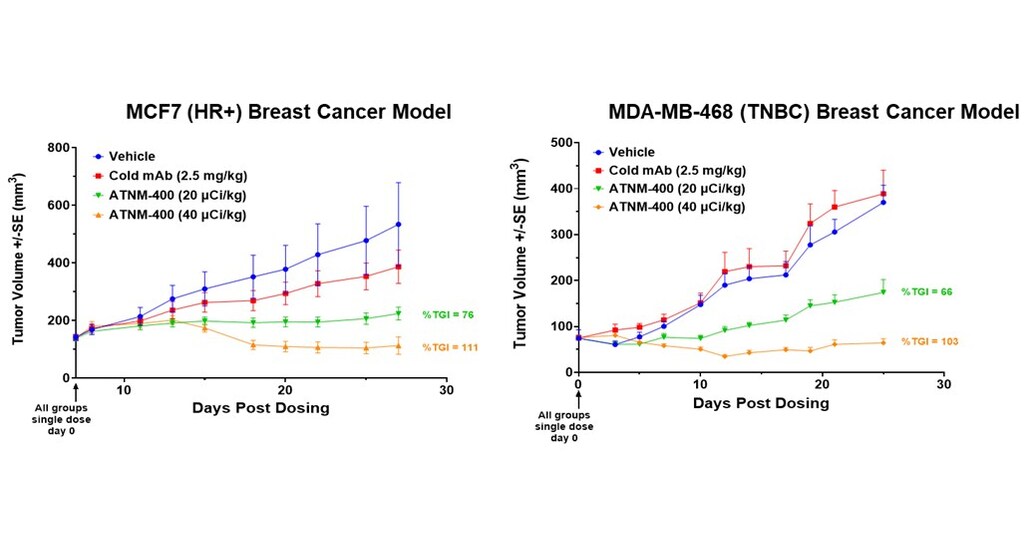
Actinium Pharmaceuticals announced preclinical results for ATNM-400 across prostate, lung, and breast cancer models presented at the American Association for Cancer Research, or AACR, Annual Meeting in San Diego, CA. ATNM-400 is a novel, first-in-class targeted radiotherapy utilizing the Actinium-225, or Ac-225, radioisotope that targets a non-PSMA membrane antigen overexpressed in advanced and therapy-refractory solid tumors across multiple oncology indications. ATNM-400 is a novel, first-in-class targeted radiotherapy whose differentiation stems from both its target and its isotope. The target is a non-PSMA membrane antigen associated with treatment resistance in advanced solid tumors that is overexpressed across prostate cancer, non-small cell lung cancer, and breast cancer, and is further upregulated following treatment with standard-of-care therapies - providing a strong mechanistic rationale for ATNM-400 in the treatment-resistant disease settings that represent the greatest unmet need, and for combination regimens designed to exploit this treatment-induced target upregulation. The isotope, Actinium-225, is a potent alpha emitter that, compared to beta emitters such as Lu-177, delivers high-energy radiation capable of inducing irreversible double-stranded DNA breaks, with a shorter path length that may limit off-target effects and enhance therapeutic precision. Together, this target-and-isotope combination positions ATNM-400 to overcome conventional resistance pathways and deliver durable tumor control while potentially avoiding toxicities such as interstitial lung disease that limit the use of antibody-drug conjugates - expanding the population of patients who could benefit from treatment. New preclinical data support ATNM-400 as a differentiated Ac-225 radioconjugate with potential applicability across multiple high-value solid tumor indications. ATNM-400 demonstrates a favorable tolerability profile, with no significant toxicity observed at therapeutic doses and additionally: Demonstrates in vivo efficacy across prostate cancer models with low, medium, and high PSMA expression, including PSMA-negative models; in lung cancer new data in the NCI-H1975 EGFR-mutant NSCLC model shows ATNM-400 as monotherapy or in combination with osimertinib exceeds the tumor growth inhibition of osimertinib plus chemotherapy, the current standard of care in post-osimertinib progression; and in breast cancer new head-to-head data in the BT474 Clone-5 trastuzumab-resistant HER2+ breast cancer model which is a clinically relevant model of the post-trastuzumab setting, where treatment options are limited, demonstrate that ATNM-400, both as monotherapy and in combination with trastuzumab deruxtecan, achieves anti-tumor activity comparable to the approved HER2-ADC trastuzumab deruxtecan.
Actinium Pharmaceuticals Presents Actimab-A Anti-Leukemic Activity Data at AACR Meeting
Actinium Pharmaceuticals highlighted data presented at the American Association for Cancer Research, or AACR, Annual Meeting supporting transcriptional reprogramming as a central mechanism driving the mutation-agnostic anti-leukemic activity of Actimab-A, or lintuzumab-Ac225, in acute myeloid leukemia, or AML. Preclinical translational data demonstrated that lintuzumab-Ac225 delivers potent cytotoxic activity across AML models harboring common mutations, including FLT3, NPM1, KMT2A, and TP53, as well as in primary patient samples. Importantly, combining Actimab-A with standard-of-care therapies - the menin inhibitor revumenib, the FLT3 inhibitor gilteritinib, and the hypomethylating agent azacitidine - resulted in enhanced leukemic cell killing in vivo across all tested models, independent of mutation status. These results support a combination-driven clinical strategy aimed at improving depth and durability of response. The findings provide the mechanistic foundation for Actimab-A's observed clinical activity and, together with the manageable safety profile demonstrated across prior Actimab-A trials in more than 150 AML patients, reinforce its suitability as a combination backbone across multiple treatment settings. Actimab-A is Actinium's lead clinical radiotherapy delivering Actinium-225, a potent alpha-emitter radioisotope payload that produces lethal double-strand DNA breaks to kill CD33-expressing AML cells. In the relapsed/refractory AML setting Actimab-A in combination with the intensive chemotherapy regimen CLAG-M produced an 83% overall response rate and 75% MRD-negativity in a Phase 1 trial which forms the basis of a Phase 2/3 registrational study for which Actinium has FDA alignment and is seeking a development partner. Actimab-A is also being studied in newly diagnosed patients via the ongoing NCI-sponsored frontline triplet trial of Actimab-A with venetoclax and ASTX-727; and has shown promise in post-remission and MRD-directed settings; as well as myelodysplastic syndrome and other CD33-expressing myeloid malignancies. Combination treatment produced consistent pathway-level changes compared with monotherapy. Gene set enrichment analyses showed enhanced myeloid differentiation signatures with the addition of Actimab-A (lintuzumab-Ac225) to revumenib, gilteritinib, and azacitidine. Together, these findings show that Actimab-A combinations don't just add cytotoxicity - they reprogram AML cells from proliferation toward differentiation and apoptosis, providing the mechanistic basis for deeper, more durable MRD-negative responses and reinforcing Actimab-A's role as a universal combination backbone across AML.
本ページは調査目的であり、投資助言ではありません。モデルは誤ることがあります。過去の実績は将来の成果を保証しません。