

Triple Witching December 2026: What Expires on Dec. 18 and How Investors Should Plan
Triple witching hits Dec. 18, 2026, alongside the S&P 500 rebalance, Fed and CPI. Learn what expires, how it moves prices, and how investors can plan ahead.


Key Takeaway
Triple witching is the quarterly session when stock index futures, stock index options and single-stock options all expire on the same day, and the next one lands on Friday, December 18, 2026. It rarely changes the long-term direction of the market, but it reliably changes how the market trades for a day. On the December 19, 2025 expiration, Bloomberg reported that more than 26 billion shares changed hands on US exchanges, about 50% above the 12-month average, as Citigroup estimated roughly $7.1 trillion of notional open interest was set to expire. The S&P 500 actually rose 0.9% that day, a useful reminder that heavy volume does not automatically mean a sell-off.
This December the expiration does not arrive alone. The Federal Reserve's two-day meeting runs December 8 to 9, the Bureau of Labor Statistics publishes November CPI on December 10, and the quarterly S&P 500 rebalance takes effect after the close on the third Friday, which is the same December 18 session. The Nasdaq-100 has also historically used the December expiration for its annual reshuffle. All of that hits a market that is still repairing damage: the S&P 500 closed at 7,297.49 on November 27, 2026, after a holiday-week rebound, but remains roughly 6.7% below its October 6 record, according to AP and CNBC data.
This guide explains what actually expires, why expiration can move prices, what the historical record does and does not show, and how long-term investors and active traders can plan around December 18 rather than react to it. Figures are as of November 27, 2026 (America/New_York) unless noted. Nothing here is a forecast or a promise of returns.
What Triple Witching Actually Means
Three contract types, one Friday
The name sounds dramatic, but the definition is mechanical. Four times a year, on the third Friday of March, June, September and December, three families of derivatives reach their quarterly expiration together: stock index futures such as the E-mini S&P 500, stock index options such as the standard monthly SPX contracts, and options on individual stocks and ETFs. Monthly options expire on the third Friday of every month, so the quarterly months simply stack the futures expiration on top of an already busy options cycle. That overlap concentrates hedging, rolling and closing activity into a single session, which is why volume spikes even when the news calendar is quiet.
Why you still hear "quadruple witching"
Older articles describe the event as quadruple witching because single-stock futures used to expire on the same schedule. Those contracts never gained much traction in the US, and OneChicago, the main exchange that listed them, wound down in 2020. Many traders and some outlets still use the two terms interchangeably, so you will see both in December headlines. The practical point is the same either way: the third Friday of a quarter-end month carries more expiring exposure than any other day in that quarter.
The December 18, 2026 calendar
Counting Fridays makes the date easy to confirm. December 2026 begins on a Tuesday, so the Fridays fall on the 4th, 11th, 18th and 25th, and the third Friday is December 18. The NYSE's published 2026 trading calendar lists the S&P 400, 500 and 600 rebalances on the third Friday of March, June, September and December, with rebalance announcements released after the close on the first Friday of those months, which this time is December 4. Because Christmas Day falls on the following Friday and the NYSE closes early on Christmas Eve, the December expiration is effectively the last full-liquidity Friday of the year, which is another reason positioning tends to cluster around it.
How Expiration Moves Prices
Dealer hedging and the gamma effect
Options market makers usually try to stay close to market-neutral, so when they sell an option they buy or sell the underlying stock or futures to offset it. The amount of hedging they need changes as prices move, a sensitivity traders call gamma, and gamma tends to be largest for options that are near the money and close to expiration. When a large block of those contracts expires, the hedges attached to them are no longer needed and get unwound. If dealers were long gamma, their hedging had been dampening moves by buying dips and selling rallies; once that cushion expires, the market can become more sensitive to fresh news in the following sessions. If they were short gamma, the reverse can happen. Nobody outside the dealers sees their exact book, so treat public gamma estimates as rough sketches rather than precise forecasts.
Morning settlement versus the closing bell
Not everything expires at the same moment, and this detail trips up newer traders. Standard monthly SPX options and the quarterly E-mini S&P 500 futures settle to a Special Opening Quotation, a value calculated from the opening prices of each index component on expiration Friday morning, so the last day to trade AM-settled SPX contracts is actually Thursday. Weekly and end-of-month SPX contracts, along with options on individual stocks and ETFs, trade through the Friday close and settle on closing prices. The result is two pressure points in one day: an opening print that determines settlement for trillions of dollars of index exposure, and a closing auction that handles stock options, ETF options and index rebalancing trades.
Pinning and the round-number magnet
Traders often notice that heavily traded stocks drift toward a strike price with large open interest as expiration approaches, a pattern known as pinning. The usual explanation is dealer hedging: as a stock moves away from a big strike, hedge adjustments tend to push it back. Pinning is a tendency, not a law, and it can break instantly on a news headline or a large closing imbalance. For a long-term investor, the main lesson is that unusual intraday stability or sudden late-day moves in a popular stock on December 18 may say more about options positioning than about the company's fundamentals.
What the Historical Record Shows
Volume reliably jumps, direction does not
The most consistent feature of triple witching is volume. A Dow Jones Market Data analysis cited in March 2026 found that triple-witching sessions since January 2020 averaged roughly one-third more trading volume than ordinary days, and the December 2025 session cleared 26 billion shares. Direction is far less consistent. The same Dow Jones analysis found an average S&P 500 decline of about 0.5% on triple-witching days over that period, yet the record December 2025 expiration delivered a 0.9% gain. An average built from roughly two dozen sessions, each with its own Fed, earnings and macro backdrop, is not a reliable trading signal.
Bigger notional numbers need context
Headlines about "trillions expiring" are technically accurate but easy to misread. Notional value multiplies the number of contracts by the underlying price and the contract multiplier, so it grows mechanically as markets rise and as options volume expands. It does not represent money that must be bought or sold. A deep out-of-the-money option counts toward notional but requires almost no hedging, while a contract sitting right at the strike can require a lot. Even analysts who cite record notional figures tend to stress that the directional exposure, usually measured as delta, is a small fraction of the headline amount.
Zero-day options have changed the rhythm
The rise of zero-days-to-expiration (0DTE) options has spread expiration activity across every trading day. Cboe reported that 0DTE options hit a record average daily volume of 24.2 million contracts in the third quarter of 2026, about 36% of all US options volume, while 0DTE index options averaged 3.4 million contracts a day, or 56% of index option flow. In October 2026, SPX 0DTE volume set another record at about 3.58 million contracts per day. Because so much hedging now resets daily, quarterly expiration has become one large event among many smaller ones, rather than the single dominant release valve it was a decade ago.
Why December 2026 Is Unusually Crowded
The Fed and CPI arrive in back-to-back sessions
The December 18 expiration comes at the end of a heavy macro stretch. The Federal Reserve's calendar shows the FOMC meeting on December 8 and 9, with the statement and press conference on the 9th, and the BLS schedule lists November CPI for 8:30 a.m. ET on December 10. Markets have spent much of the autumn debating another rate hike, so a surprise from either event could force traders to reposition options that were opened weeks earlier. Positions adjusted after the Fed and CPI then roll off on December 18, which means any volatility those events trigger can echo through expiration week.
Index rebalancing shares the same closing bell
S&P Dow Jones Indices typically announces quarterly changes on the first Friday of the month and implements them after the close on the third Friday. In December 2025, for example, S&P announced that CRH, Carvana and Comfort Systems USA would join the S&P 500, with the changes tied to that month's rebalance. Index funds tracking the benchmark must buy additions and sell deletions near the official close, so those trades flow into the same closing auction that handles expiring stock options. The Nasdaq-100's annual reconstitution has followed the same rhythm, with the 2025 changes announced on December 12 and effective before the open on December 22. Nasdaq has discussed methodology updates, so confirm the 2026 process when its announcement appears.
A market still healing from a correction
Context matters more than the calendar. The S&P 500 slid about 11.6% from its October 6 record of 7,818.93 to its November 20 close of 6,910.39, then rebounded roughly 5.6% during Thanksgiving week, according to AP and CNBC data. A market that has recently corrected tends to carry more hedges, and many of those protective puts were bought for December expiration. If they are allowed to expire or are rolled further out, the related dealer hedges unwind too. That can add fuel to a year-end rally, but it can also leave the market with less natural support if new negative news arrives after December 18.
Index Rebalancing and the Closing Auction
How additions and deletions really trade
When a stock joins a major index, the funds that track it have little discretion about timing because they aim to match the index at its official closing price. That is why rebalance trades concentrate in the closing auction, the final pricing mechanism exchanges use to match large market-on-close orders. Active traders often try to buy announced additions early and sell them to index funds at the close, which is why much of the price reaction happens between the announcement and the effective date. By the time the closing bell rings on December 18, a good share of the expected demand may already be priced in.
Closing imbalances can move individual stocks
Exchanges publish order imbalance information in the minutes before the close, and large imbalances can produce sharp last-minute moves in individual stocks. On triple-witching Fridays, those imbalances combine rebalancing orders, option-related hedge unwinds and ordinary end-of-week flows. A stock can close noticeably higher or lower than where it traded at 3:45 p.m. ET for reasons unrelated to its business. For long-term holders this is noise, but it can matter if you placed a market-on-close order or if a stop order sits close to the current price.
What ETF holders actually feel
If you own a broad index ETF, rebalancing happens inside the fund and you will not need to do anything. Large funds are designed to absorb these changes efficiently, and turnover from quarterly rebalances in broad benchmarks is usually modest. The bigger effect for ETF owners is indirect: heavy closing volume can widen intraday spreads in less liquid funds, and leveraged or options-income ETFs may have their own reset or roll schedules tied to the same date. Reading a fund's prospectus or roll calendar is more useful than watching headlines about trillions in expiring notional.
A Practical Playbook for Expiration Week
For long-term investors
Most long-term investors should treat triple witching as a liquidity event rather than an investment signal. The practical risks are mostly about execution: placing a market order during the opening rotation or the final minutes of trading, when prices can be erratic, or reacting emotionally to a sharp intraday swing that reverses by Monday. If you plan to add money, rebalance or harvest losses in December, it can help to set those decisions in advance and execute them on a calmer day, or at least use limit orders. A recurring review, such as an Alphio Scheduled Task that reminds you to check your allocation the week after expiration, keeps the decision tied to your plan rather than to Friday's noise.

For options holders
If you hold options that expire on December 18, the expiration is no longer abstract. A few housekeeping steps matter most:
- Decide in advance whether to close, roll or let each position expire, rather than waiting until the final minutes.
- Remember that equity options that finish at least $0.01 in the money are generally exercised automatically under OCC procedures, which can leave you holding, or short, shares on Monday.
- Watch short options near the strike, where pin risk means you may not know until after the close whether you will be assigned.
- Check whether your index options are AM-settled, which stop trading Thursday and settle on Friday's opening values, or PM-settled.
- Confirm your broker's cutoff times, margin requirements and any early-exercise risk around dividends.
Using expiration as a research checkpoint
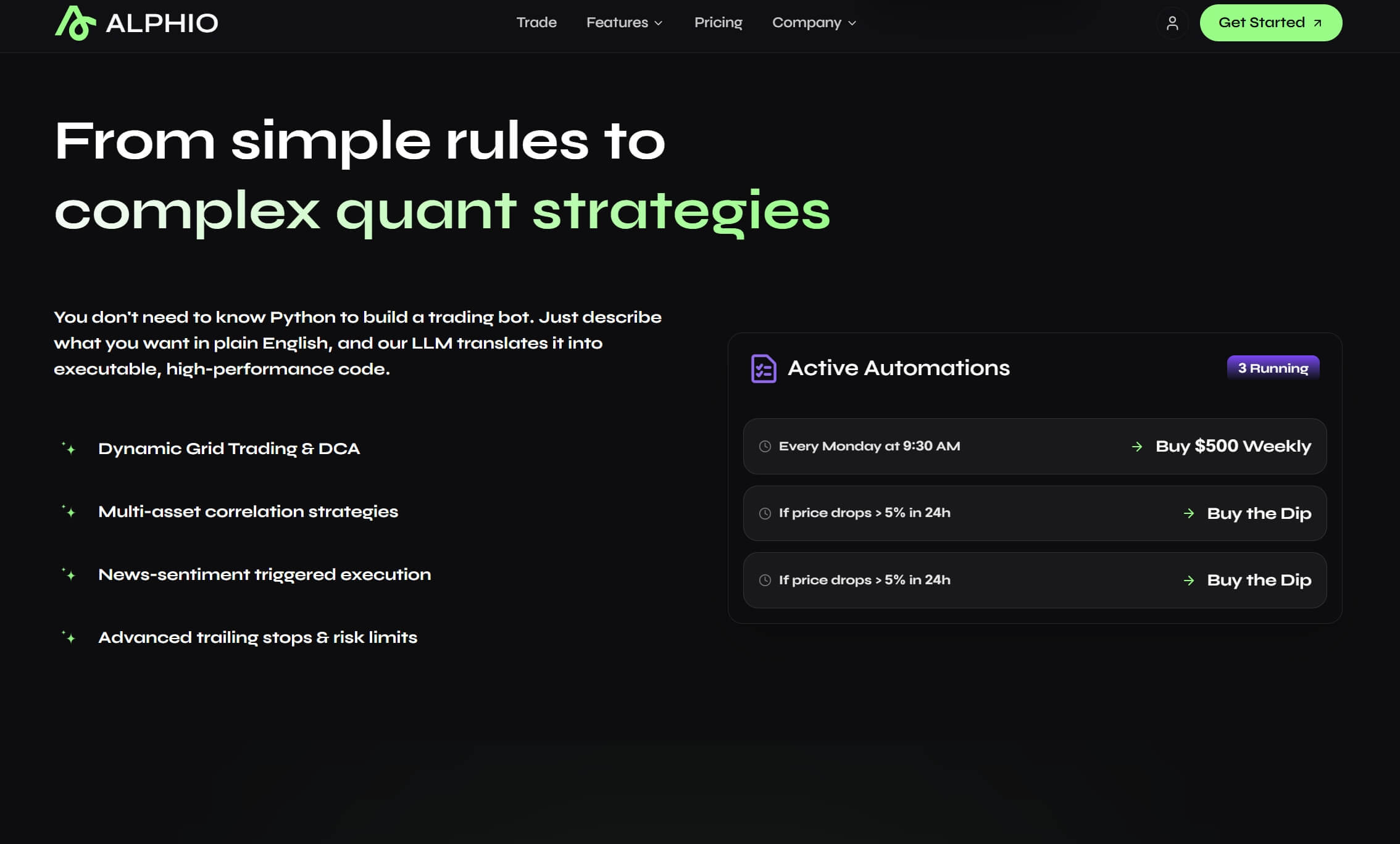
Expiration week also offers a useful pause to review what the options market is pricing. Implied volatility on index options, put-call skew and the cost of protection into January can tell you whether traders are paying up for hedges or relaxing after the November rebound. Instead of trying to trade the event, you can ask structured questions, such as how much a holding typically moves in the week after quarterly expiration, or how open interest is distributed across strikes. A tool like Alphio's Conversational Trading lets you work through those questions in plain language and turn the answers into a written plan.
Common Myths and Mistakes
"Triple witching causes crashes"
Expiration can amplify moves that news has already started, but it is rarely the root cause of a major decline. Several large sell-offs in recent years began well before or after expiration dates, and some of the busiest expirations, including December 2025, ended with gains. If the market falls sharply on December 18, check whether the Fed decision, CPI data or company news shifted expectations before attributing it to the witches.
Overreading the week after
Some traders watch the week after quarterly expiration closely, arguing that the release of hedges leaves markets freer to trend. There is anecdotal support for that view in certain years, but results vary widely and depend heavily on the macro backdrop. This year the week after expiration also overlaps with the start of the Santa Claus rally window, which begins on December 24 under the Stock Trader's Almanac definition, so seasonal stories may get tangled together. Treat any single-week pattern as context, not as a strategy on its own.
Leverage and short-dated bets
The most expensive mistake around expiration is using short-dated options or leveraged products to bet on a direction for a single session. Time decay accelerates sharply in the final days of an option's life, and a contract that is slightly out of the money on Friday morning can expire worthless by the close. Leveraged ETFs reset daily and can lose value in choppy markets even when the index ends flat. If you want exposure to a year-end move, sizing the position so that a total loss would not derail your plan matters more than picking the right day.
How to Read Expiration Headlines Like a Pro
Separate notional from directional exposure
When you see a headline about record expiring notional, ask what share of that exposure is near the money and how much delta it represents. Many sell-side desks publish both numbers, and the gap between them is usually large. A record notional figure is not automatically a warning sign.
Watch positioning, not predictions
More useful than any prediction is a set of observable data points. These include the level of the VIX and VIX futures, the cost of downside puts relative to calls, large open interest at round-number strikes on the S&P 500, and the official rebalance announcements from index providers. None of these tells you where the market will close on December 18, but together they explain why prices might behave strangely and help you avoid mistaking mechanical flows for a change in fundamentals.
Conclusion
Triple witching on December 18, 2026 is worth knowing about, but it is not worth fearing. Expect heavy volume, a busy opening settlement, a crowded closing auction that also carries the S&P 500 quarterly rebalance, and possible echoes from the Fed decision on December 9 and the CPI report on December 10. History shows a reliable jump in trading activity and a mixed record on direction, with the record December 2025 session finishing higher. For long-term investors the best response is procedural: decide your trades in advance, use limit orders, and avoid the opening and closing minutes if you do not need them.
If you want to turn that discipline into a habit, set an Alphio Scheduled Task to review your portfolio and options positions before and after each quarterly expiration, so the calendar works for you instead of against you. When you are ready to put rules into practice, Alphio's Autonomous Trading can help you execute a predefined strategy with consistent sizing and risk limits instead of reacting to intraday noise. Markets will keep finding new ways to make the third Friday dramatic; a written plan is what keeps it from becoming expensive.
FAQs
When is triple witching in December 2026?
The December 2026 triple witching falls on Friday, December 18, the third Friday of the month. The quarterly S&P 500 rebalance is also scheduled to take effect after the close that day, so volume is likely to be heavy into the closing bell.
What expires on triple witching day?
Stock index futures, stock index options and options on individual stocks and ETFs all reach their quarterly expiration on the same day. Standard SPX options and E-mini S&P 500 futures settle to a special opening quotation on Friday morning, while most stock and ETF options settle on Friday's closing prices.
Does the stock market usually fall on triple witching days?
Not reliably. A Dow Jones Market Data analysis found an average S&P 500 decline of about 0.5% on triple-witching days since 2020, but individual sessions vary widely and the record December 2025 expiration ended with a 0.9% gain. Volume is the most consistent feature, not direction.
Should long-term investors do anything before triple witching?
Most long-term investors do not need to change their strategy, but they should be careful with execution. Using limit orders and avoiding market orders at the open and in the final minutes of trading can help you avoid getting caught in temporary price swings.
What is the difference between triple witching and quadruple witching?
Quadruple witching included single-stock futures, which used to expire on the same quarterly schedule. Those contracts largely disappeared from US markets after 2020, so triple witching is the more accurate term today, though many outlets still use both.
Related articles
- Copper Prices After the Record: How to Invest in Copper Stocks and ETFs in Late 2026Copper is down about 17% from its September 2026 record. Learn why prices fell and how copper stocks, miner ETFs, futures funds and physical trusts compare.
- Santa Claus Rally 2026: Will December Deliver After a Correction and a Fed Hike?Will the Santa Claus rally show up in 2026? See December seasonality data, the Fed hike and CPI calendar, failed-rally history, and how to plan your trades.
- Bear Market Rally or Real Bottom? How to Judge the S&P 500's November 2026 ReboundIs the S&P 500's 5.6% November 2026 rebound a bear market rally or a real bottom? History, breadth signals, Fed risks, and how investors can position now.
- Position Sizing: How Much to Invest in One Stock When Markets Swing 30% in a WeekPosition sizing guide for volatile markets: percentage caps, the 1% risk rule, ATR and volatility sizing, and Kelly, with lessons from Nvidia's November swing.
- Jobs Report and the Stock Market: How to Trade Nonfarm Payrolls Before the December FedHow the jobs report moves stocks and bonds in a Fed hiking cycle: October's 165K payroll surprise, the Dec. 4 release before the Fed, and a jobs-Friday plan.
- How to Build a Bond Ladder in 2026: Treasury Rungs, Bond Funds, and a Fed Still HikingBond ladder guide for 2026: how to build Treasury rungs on a flat 1-5 year curve, ladder vs bond fund vs iBonds ETFs, costs, taxes, and mistakes to avoid.