

How to Build a Bond Ladder in 2026: Treasury Rungs, Bond Funds, and a Fed Still Hiking
Bond ladder guide for 2026: how to build Treasury rungs on a flat 1-5 year curve, ladder vs bond fund vs iBonds ETFs, costs, taxes, and mistakes to avoid.

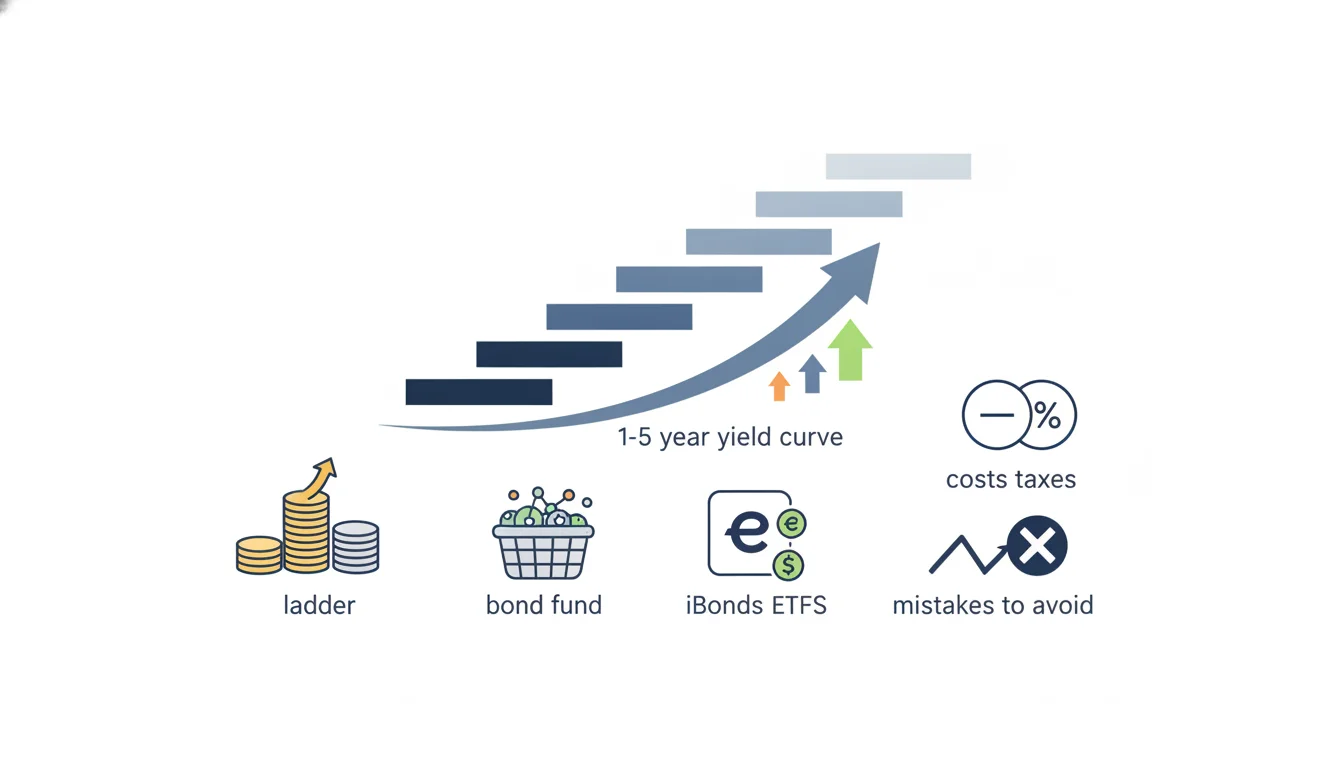
Key Takeaway
A bond ladder is one of the oldest income tools in investing, and late 2026 is an unusual moment to build one. The Federal Reserve is still raising rates rather than cutting them. Treasury's daily par yield curve for November 24, 2026 showed the 1-year bill at 4.59%, the 2-year note at 4.63%, the 5-year at 4.69%, and the 10-year at 4.91%. CNBC reported on November 23 that traders priced roughly a 98% chance of a quarter-point hike at the December meeting, according to the CME FedWatch tool. That backdrop changes how a ladder should be designed, because the classic advice to "lock in long yields before the Fed cuts" does not fit a hiking cycle.
The case for a ladder now is less about predicting rates and more about controlling them. With short and intermediate Treasury yields bunched within about 10 basis points of each other, an investor gives up very little income by keeping rungs short. Each maturing rung then rolls into whatever rates the market offers next year. If the Fed keeps hiking, the ladder reinvests higher. If the hiking cycle breaks and yields fall, the longer rungs keep paying the rates locked today. Neither outcome needs a forecast.
The trade-offs are real, though. Vanguard argues that holding individual bonds to maturity is mainly an emotional rather than economic advantage over bond funds. Defined-maturity ETFs now sit between the two choices. This guide explains how ladders work, how to size the rungs against the November 2026 yield curve, when a bond fund or a defined-maturity ETF is the better tool, and which mistakes cost ladder builders the most. Nothing here is a recommendation to buy any specific security, and yields quoted are as of the dates stated.
What a Bond Ladder Is and Why It Is Back in Demand
The basic structure
A bond ladder is a portfolio of individual bonds or CDs that mature on a staggered schedule, such as one rung every year for five years. Each rung is roughly the same size. When the shortest bond matures, the investor either spends the principal or buys a new bond at the far end of the ladder, which keeps the structure rolling. The appeal is simple: the investor knows the date and amount of each principal payment, assuming no default, and the interest from every rung arrives on a predictable calendar.
That predictability is the main reason ladders are popular with retirees and people saving for known future costs. A family with tuition bills in each of the next four years, or a retiree who wants to cover living costs without selling stocks in a down market, can match rungs to those dates. The ladder becomes a liability-matching tool rather than a bet on interest rates.
Why 2026 revived the strategy
For most of the decade after 2008, ladders were hard to justify. Short Treasury yields sat near zero, and building a five-year ladder meant locking in returns that often trailed inflation. The situation in late 2026 is very different. Treasury's par yield curve on November 24 showed every maturity from one month to 30 years above 4.2%, with the 20-year at 5.33% and the 30-year at 5.30%.
The Fed is also moving in the opposite direction from most of the past two decades. Alphio's earlier coverage of the PCE inflation report noted that the central bank raised its target range in September, held in October with two officials dissenting in favor of a hike, and meets again on December 8–9. A hiking cycle pushes short-term yields up first, which is exactly where a ladder reinvests. The fact that investors can now earn more than 4.5% on one-year paper without taking credit risk is why "bond ladder" searches and adviser commentary have returned.
Reading the November 2026 Yield Curve Before You Build
A flat front end with a steeper long end
The shape of the curve matters more for ladder design than the level of any single yield. On November 24, 2026, Treasury's par curve read 4.59% at one year, 4.63% at two years, 4.67% at three years, 4.69% at five years, and 4.79% at seven years. The jump from five to ten years was 22 basis points, and the jump from ten to twenty years was another 42 basis points. In plain terms, the first five years of the curve are almost flat, and most of the extra yield sits beyond the 10-year point.
That flat front end is the key insight for 2026 ladder builders. Extending a rung from one year to five years adds only about 10 basis points of yield while increasing interest-rate sensitivity several times over. An investor who builds a one-to-five-year ladder is not sacrificing much income compared with someone who stretches all the way out. On the curve as of November 24, an equal-weight ladder using one-, two-, three-, five-, and seven-year Treasuries would average about 4.67% before taxes, a simple average of the five par yields.
Why the Fed path changes the math
When the Fed is cutting, investors rush to lock in longer yields before they disappear. When the Fed is hiking, the logic flips. CNBC's November 23 report described the 2-year yield jumping more than 7 basis points to 4.69% intraday as hike odds rose, with traders pricing roughly 98% odds of a December quarter-point move. The 2-year Treasury is the market's best guess at where short-term policy rates are heading, and it was moving up.
A ladder is built for this uncertainty. Short rungs mature into a market that may offer higher rates, while longer rungs keep today's yields if the cycle reverses. The ladder spreads reinvestment across many dates, so no single decision dominates the outcome.
The long end is a separate decision
The 20-year and 30-year yields above 5.3% are tempting, but a bond that long can lose a large share of its market value if yields rise even modestly. For most income ladders, the long end is an optional extension, sized deliberately, not the core.
How to Build a Treasury Bond Ladder Step by Step
Choose the horizon and number of rungs
The first decision is how far the ladder should reach. A three-to-five-year ladder suits investors who mainly want stability and steady reinvestment. A ten-year ladder captures more of the curve's upward slope beyond the five-year point but carries more price volatility. More rungs mean smoother reinvestment, while fewer rungs mean less bookkeeping. Many individual investors land on five to ten rungs, which keeps the ladder simple enough to manage on a spreadsheet.
The horizon should be tied to a real need. If the money funds retirement spending over the next five years, a five-year ladder with annual rungs maps cleanly to that goal. If the money is a long-term fixed-income allocation with no specific spending date, a rolling ladder or a fund may be easier. Write down the purpose before buying the first bond, because that purpose determines what to do when each rung matures.
Buy at auction or on the secondary market
Treasuries are the default building block because they carry no meaningful credit risk and are highly liquid. TreasuryDirect states that all Treasury marketable securities require a minimum bid of $100, in increments of $100. That makes it possible to build a small ladder at Treasury auctions with no commission. Most brokerages also let customers buy new-issue Treasuries at auction or existing bonds on the secondary market.
The secondary market gives more control over exact maturity dates, while auctions are simpler and avoid dealer markups. TreasuryDirect also notes a 45-calendar-day holding period before securities bought there can be transferred.
Set the reinvestment rule in advance
The most important step is the one people skip: deciding what happens when a rung matures. In a rolling ladder, the proceeds buy a new bond at the longest rung, keeping the ladder's length constant. In a spending ladder, the proceeds are withdrawn to cover a known expense, and the ladder shrinks over time. Mixing the two without a plan is how ladders slowly turn into a pile of cash or an unbalanced bet on one maturity.
Investors who struggle with follow-through can automate the reminders. Alphio's Scheduled Task feature can run a recurring check, for example a monthly review of upcoming maturities, current Treasury yields by rung, and how the reinvestment rule should apply. The decision still belongs to the investor, but the process does not depend on memory.
Bond Ladder vs. Bond Fund: The Honest Comparison
The principal-at-maturity argument
The most common reason to prefer individual bonds is that the investor gets the face value back at maturity, while a fund has no maturity date. Vanguard challenges this directly. In its adviser guidance on bonds versus bond funds, the firm calls the principal-at-maturity idea a myth. It argues that holding a bond to maturity offers "little to no financial benefit" over pooled products when cash flows are reinvested.
The reasoning is that both portfolios lose market value when rates rise. The individual bond holder simply does not see the loss on a daily price screen. Vanguard describes a ladder that reinvests principal as similar to a mutual fund but with less diversification and likely higher costs. The point is not that ladders are bad. It is that the reason most people give for choosing them is weaker than it sounds.
Where ladders still win
Ladders do have practical advantages that funds cannot fully copy. The investor controls exactly which bonds are owned and when they mature, which is valuable for matching known liabilities. There are no ongoing fund expense ratios once the bonds are bought. For Treasury ladders, all interest is subject to federal tax but exempt from state and local taxes, according to TreasuryDirect, and the investor controls realized gains and losses directly.
There is also a behavioral benefit. A retiree who sees a fund's price fall 5% may panic and sell at the worst time. The same retiree holding a Treasury ladder knows the next rung will pay a fixed amount on a fixed date and is less likely to do anything rash. Vanguard frames this as emotional rather than economic, but in practice emotions drive many of the costliest investing mistakes.
Where funds still win
Bond funds win on diversification, simplicity, and small account sizes. A corporate or municipal ladder built from a handful of issues concentrates credit risk; Vanguard notes that a portfolio of only 10 or 20 individual bonds carries issuer-specific risk. Funds also handle reinvestment automatically and can be bought in any dollar amount. For investors with modest balances who want broad exposure, a low-cost intermediate Treasury or aggregate bond fund is often the easier tool.
Defined-Maturity ETFs: The Middle Ground
How target-maturity funds work
Defined-maturity ETFs combine features of both approaches. iShares says its iBonds ETFs hold a diversified portfolio of bonds with similar maturity dates, pay regular interest, and make a final payout in their stated maturity year. The funds terminate in October or December of the year in the fund's name, and shareholders receive a final distribution equal to the fund's net asset value after liabilities. Invesco offers a comparable family under its BulletShares brand.
This structure lets an investor build a ladder from ETFs rather than individual bonds. Buying five funds that mature in 2027, 2028, 2029, 2030, and 2031 creates a five-rung ladder with diversification inside each rung. For corporate and municipal exposure in particular, that solves the concentration problem of owning a few individual issues.
What to watch with target-maturity ETFs
These funds are not guaranteed to return a set amount. iShares states plainly that the funds do not seek to return any predetermined amount. If issuers in the fund default or are downgraded, the final distribution can be lower than expected. Expense ratios also apply each year until maturity, and trading prices can deviate from net asset value during market stress.
Investors should check each fund's yield to maturity, credit quality, and expense ratio before treating it as a rung. iShares says that since launching in 2010, 38 iBonds ETFs have matured and liquidated, which offers some track record. Still, a Treasury-only rung bought directly carries less credit uncertainty than a corporate target-maturity ETF. They fit best when an investor wants a ladder's schedule but cannot diversify credit risk with individual bonds; for a pure Treasury ladder, the case is weaker.
Choosing the Building Blocks: Treasuries, CDs, Munis, and Corporates
Treasuries as the core
For most ladders, Treasuries are the logical core because they combine low credit risk, deep liquidity, and state-tax exemption. That state-tax benefit matters most for residents of high-tax states. A Treasury rung yielding 4.69% may compete well against a bank CD at a slightly higher headline rate once state income tax is included. Investors should compare after-tax yields rather than headline yields.
Brokered CDs and their fine print
Brokered CDs can be useful rungs because they are FDIC-insured up to applicable limits and sometimes yield more than Treasuries of the same term. The trade-offs are less liquidity in the secondary market and, for some issues, call features that let the bank redeem the CD early if rates fall. A callable CD that disappears when rates drop defeats the purpose of locking in yield. Always check whether a CD is callable before buying it as a rung.
Municipal and corporate bonds
Municipal bonds can make sense for higher-bracket investors in taxable accounts, while corporate bonds add yield in exchange for credit risk. Both bring complications that Treasuries do not: wider bid-ask spreads, call provisions, and the need to research issuers. For investors building with individual issues, sticking to high credit quality and avoiding callable bonds keeps the ladder's maturity schedule intact.
Common Bond Ladder Mistakes and How to Avoid Them
Stretching for yield on the longest rung
The temptation in late 2026 is to add 20-year or 30-year bonds yielding above 5.3% to boost the ladder's average yield. But a single long rung can dominate the ladder's price risk. If long yields rise another half point, that one bond can lose more market value than the entire short end earns in a year. Sizing long rungs the same as short rungs effectively turns the ladder into a duration bet.
Ignoring costs, calls, and taxes
Small costs add up in fixed income because returns are modest. Dealer markups on secondary-market bonds can eat a meaningful share of a year's interest, especially on small orders. Brokers must disclose markups on many retail corporate and municipal trades, so read the trade confirmation carefully.
Treating the ladder as a forecast
A ladder works because it avoids rate forecasts. Investors who keep rebuilding the ladder around their latest view of the Fed lose that advantage. If someone shortens every rung because they expect more hikes, then lengthens everything after a soft inflation print, they are trading rates rather than laddering. The discipline is the product.
Where a Bond Ladder Fits in a Wider Portfolio
The ladder as a stability layer
In late 2026, the stock market has given investors reason to value stability. The S&P 500 closed at 7,201.09 on November 24, and Motley Fool's market coverage that day described a tech sell-off dragging the Nasdaq while the Dow rose on a value rotation. A ladder holding the next few years of planned withdrawals lets an investor ride out equity volatility without selling stocks at depressed prices.
Combining discipline with execution tools
Some investors want help turning a written plan into consistent action. Alphio's Conversational Trading lets users ask questions in plain language, such as comparing current yields across Treasury maturities or checking the duration of a bond ETF they hold. The research and the risk limits should still come first; the tool is a way to execute a plan, not a replacement for one.

A brokerage-side signal worth watching
Rising yields also affect the companies that hold investors' cash and bonds. Brokerages earn more on client cash balances when short-term rates rise, which ties their earnings to the same Fed path that shapes ladder reinvestment. Charles Schwab is one of the largest platforms where individual investors buy Treasuries and CDs, and its valuation offers a window into how the market is pricing that rate sensitivity.
Conclusion
A bond ladder is not a clever trick for beating the bond market. It is a way to organize fixed income around dates and decisions rather than forecasts. The November 2026 setup is unusually friendly to that approach. The front of the Treasury curve is nearly flat between one and five years, short yields are above 4.5%, and the Fed is still debating how far to hike. Short and intermediate rungs give investors solid income today and the chance to reinvest higher if rates keep rising, without betting everything on that outcome.
The honest caveats still apply. Vanguard's critique of the principal-at-maturity argument is worth taking seriously, and bond funds or defined-maturity ETFs may be the better tool for smaller accounts or credit exposure. Watch costs, avoid callable issues when the maturity schedule matters, size the long end deliberately, and set the reinvestment rule before the first rung matures. Yields and Fed pricing in this article are as of November 23–24, 2026 and will change.
For investors who want to keep that discipline consistent, Alphio's Scheduled Task can automate recurring maturity and yield reviews. Autonomous Trading can carry out rules-based strategies within limits the investor defines. Whatever tools you use, the ladder works best when the plan comes first and the execution simply follows it.
FAQs
What is a bond ladder?
A bond ladder is a portfolio of bonds or CDs that mature on a staggered schedule, such as one rung each year for five years. When a rung matures, the investor either spends the principal or reinvests it at the long end of the ladder. The structure spreads interest-rate risk across many reinvestment dates instead of one.
Is a bond ladder a good idea when the Fed is raising rates?
A ladder can work well in a hiking cycle because short rungs mature and roll into potentially higher yields. On November 24, 2026, Treasury's 1-year and 5-year yields were only about 10 basis points apart, so short rungs gave up little income. It is still not a guarantee, and bond prices fall when yields rise if you need to sell early.
Should I use a bond ladder or a bond fund?
Ladders offer control over maturity dates, no ongoing fund fees, and predictable payments, which helps with matching known expenses. Bond funds offer broader diversification, automatic reinvestment, and easy small purchases. Vanguard argues holding bonds to maturity is mainly an emotional rather than economic advantage, so the choice often comes down to account size and goals.
How much money do I need to build a Treasury ladder?
TreasuryDirect states that Treasury marketable securities require a minimum bid of $100, in $100 increments, so a small ladder is possible. Many brokerages also let customers buy Treasuries at auction without commission. Corporate or municipal ladders generally need more money to diversify across issuers.
What is a defined-maturity bond ETF?
A defined-maturity ETF holds bonds that mature in the same year and pays out a final distribution when the fund terminates in that year. Families such as iShares iBonds and Invesco BulletShares let investors build a ladder from ETFs. They are not guaranteed to return a set amount, and defaults or fees can reduce the final payout.
Related articles
- Position Sizing: How Much to Invest in One Stock When Markets Swing 30% in a WeekPosition sizing guide for volatile markets: percentage caps, the 1% risk rule, ATR and volatility sizing, and Kelly, with lessons from Nvidia's November swing.
- Jobs Report and the Stock Market: How to Trade Nonfarm Payrolls Before the December FedHow the jobs report moves stocks and bonds in a Fed hiking cycle: October's 165K payroll surprise, the Dec. 4 release before the Fed, and a jobs-Friday plan.
- Dow Jones vs S&P 500: Why the Dow Reclaimed 50,000 While Tech Sank, and How Price Weighting WorksDow Jones vs S&P 500 explained: why the price-weighted Dow reclaimed 50,000 on Nov. 24, 2026 while the S&P 500 and Nasdaq fell, and how investors can read it.
- Is S&P 500 Still a Safe Investment in 2026? Historical Evidence and Smart StrategiesDiscover why the S&P 500 remains a cornerstone investment in 2026 despite market volatility. Learn proven strategies, historical insights, and smart allocation tactics.
- NVIDIA Stock Analysis 2026: Navigating the AI Semiconductor Investment LandscapeComprehensive NVIDIA stock analysis for 2026. Explore AI semiconductor investment opportunities, financial metrics, and expert price targets for NVDA shares.
- Berkshire Hathaway Succession: What Abel's $4.5 Billion Bet Means for InvestorsGreg Abel's massive $4.5 billion Berkshire Hathaway stock purchase signals confidence in the post-Buffett era. Discover what this means for long-term investors.