

Copper Prices After the Record: How to Invest in Copper Stocks and ETFs in Late 2026
Copper is down about 17% from its September 2026 record. Learn why prices fell and how copper stocks, miner ETFs, futures funds and physical trusts compare.

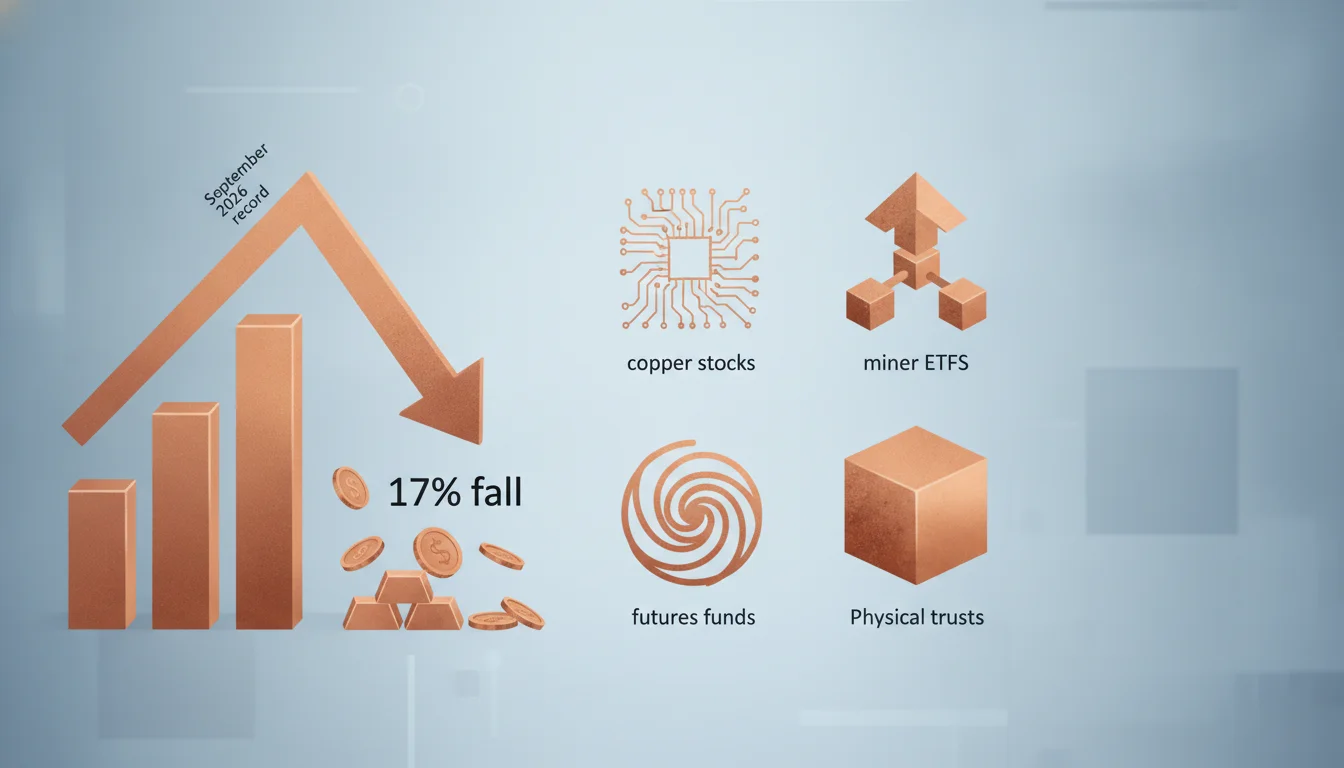
Key Takeaway
Copper spent most of 2026 as the market's favorite story about the physical side of artificial intelligence, and then it reminded everyone that it is still a cyclical commodity. Three-month copper on the London Metal Exchange touched an intraday record of $14,875 per tonne on September 10, 2026, according to ING, as US buyers stockpiled metal ahead of a possible tariff on refined copper and mine disruptions squeezed supply. By the LME close on November 27, 2026, the same contract stood at $12,330, about 17% below that peak, after touching a lower close of $11,758 on November 25, based on LME settlement data republished by Westmetall. The slide came alongside doubts about data-center spending, a US dollar near a 19-month high and markets pricing an almost certain Federal Reserve rate hike on December 9.
The question most investors now ask is not whether copper matters to electrification, grids and data centers, because it plainly does, but whether a 17% to 21% pullback makes copper exposure attractive or merely less expensive. The answer depends heavily on which vehicle you use. Mining stocks, futures-based funds and physical trusts behave very differently when the price falls, and the differences are large enough to turn the same view on the metal into very different results in a portfolio.
This guide walks through what drove the record and the reversal, how the main ways to invest in copper actually work, what the latest company results from Freeport-McMoRan and Southern Copper reveal about miner economics, and how to build a disciplined plan instead of chasing the next headline. Prices are as of November 27, 2026 (America/New_York) unless noted. Forecasts cited here are projections from named institutions, not promises, and nothing in this article is personalized investment advice.
Why Copper Hit a Record in 2026
The tariff stockpile that pulled metal into the US
The single biggest distortion in the 2026 copper market was a policy question. In July 2025, the White House imposed a 50% Section 232 tariff on semi-finished copper products and copper-intensive derivatives, while exempting refined cathodes and anodes, and its fact sheet noted a Commerce recommendation for a phased tariff on refined copper of 15% starting in 2027 and 30% in 2028. That possibility encouraged traders to ship refined metal into the United States before any duty arrived. Industry newsletter ConnectOre reported that COMEX warehouse inventories were roughly 700,000 tonnes in early October 2026, compared with about 290,000 tonnes a year earlier. Metal sitting in US warehouses as a tariff hedge is metal not available to fabricators elsewhere, which tightened the rest of the world and helped push LME prices to records.
Mine supply kept disappointing
The supply side added fuel. Saxo Bank, citing International Copper Study Group (ICSG) data, noted in September that global mine output fell 1.1% in the first half of 2026, with major producers such as Codelco and Freeport posting double-digit declines. Freeport's Grasberg operation in Indonesia was still recovering from the September 2025 mud-rush incident, and BHP's Escondida mine in Chile was briefly halted after a fatal accident in late September 2026 before restarting the following day, according to ConnectOre. Copper mines take many years to permit and build, so even a modest shortfall from a few giant operations can move a market that has little spare capacity.
The AI and electrification narrative
Behind the short-term drivers sat a long-term demand story that investors found compelling. Copper is the default conductor for power grids, transformers, electric motors and the dense electrical systems inside data centers. The International Copper Association has estimated that a battery electric car uses around 83 kilograms of copper versus roughly 23 kilograms for a conventional combustion-engine car. Bloomberg Intelligence has used an estimate of about 27 to 33 tonnes of copper per megawatt of data-center capacity, though other analysts, including Macquarie, use far lower figures, which shows how uncertain these intensity numbers are. When markets believed AI capital spending would keep accelerating, every new data-center announcement looked like incremental copper demand.
What Changed in November
AI doubts, a strong dollar and rate-hike bets
November turned several tailwinds into headwinds at once. Investors grew more skeptical about the pace of AI data-center spending, which hit both technology shares and the commodities tied to that build-out. The US dollar index climbed to a 19-month high near 104 on November 19, according to FXStreet, and a stronger dollar makes dollar-priced metals more expensive for buyers in other currencies. Interest-rate expectations matter too: after the Fed raised its target range to 3.75%–4.00% in September, CME FedWatch data cited by market outlets showed traders assigning close to a 98% probability to another hike at the December 9 meeting as of November 25. Higher financing costs and a slower expected global economy are rarely good news for industrial metals.
The tariff premium collapsed
The tariff trade also unwound. On September 10, the same day LME copper set its intraday record, the White House said no decision had been made on refined-copper tariffs, and COMEX copper fell more than 4% in a single session. A deadline at the end of September passed without an announcement, and by November, TD Securities said a refined-copper tariff looked less likely, according to Oilprice.com. As that expectation faded, the price gap between New York and London narrowed sharply, removing the incentive to keep shipping metal to the US. For investors, this is a clean example of how a policy premium can inflate a commodity price and then deflate it without any change in long-term demand.
Inventories rose, and the market noticed
Visible stocks added to the pressure. LME warehouse inventories climbed to 316,675 tonnes on November 6 and stood at 338,325 tonnes on November 27, according to Westmetall's LME data series, up from levels below 240,000 tonnes in September. Rising inventories tell traders that physical supply is not as tight as the record price implied. Goldman Sachs, quoted by Oilprice.com in mid-November, argued that the slide reflected investor positioning more than a change in fundamentals, which is a reasonable warning against reading too much into any single week. Still, the combination of higher stocks, a strong dollar and fading tariff premiums explains why the metal fell so quickly from its September peak.
The Supply and Demand Outlook From Here
What the ICSG now projects
The most useful neutral benchmark is the ICSG, an intergovernmental body that publishes regular balance forecasts. In its October 2026 update, reported by Canadian Mining Journal, the group projected a refined copper surplus of about 104,000 tonnes in 2026 and about 368,000 tonnes in 2027, with mine output growing 1.3% and 3.1% and refined usage growing 1.5% and 2.5% over those two years. That is a striking shift from a year earlier, when the ICSG had forecast a 2026 deficit of roughly 150,000 tonnes. A modest projected surplus does not mean copper must keep falling, but it does undercut the idea that the market is guaranteed to stay in shortage.
Bank forecasts are moving targets
Wall Street forecasts have moved around too. Goldman Sachs had published a year-end 2026 target of $14,700 per tonne and a 2027 average of $15,400, according to a Newsquawk headline, and in November the bank suggested its upper scenario might be too high, according to Finimize. Treat every price target as a scenario with assumptions attached rather than a destination. A forecast made when copper traded near $14,000 tells you how analysts were thinking then, not where the market must go next.
China remains the swing buyer
China is the world's largest consumer of refined copper, so its demand signals carry enormous weight. In November, Chinese buyers paid record import premiums at the port of Yangshan, according to Oilprice.com and other trade reports, which suggests physical demand in China firmed as prices dropped. Customs data reported by Mysteel showed unwrought copper and semi-finished imports of about 453,000 tonnes in October, down 1.7% from September. Investors watching for a turn should track Chinese premiums, import data and property and grid spending alongside LME inventories rather than relying only on US headlines.
How to Invest in Copper: The Main Routes
Copper mining stocks
Most investors get copper exposure through producers, and the two largest US-listed names are Freeport-McMoRan and Southern Copper. Miners offer operating leverage: because their costs are relatively fixed in the short run, profits rise faster than the copper price on the way up and fall faster on the way down. They also carry risks that the metal does not, including mine accidents, political and tax changes in host countries, labor disputes, and management decisions about spending and dividends. Freeport shares fell about 7% to $51.45 on November 18, the same day copper slid more than 3%, according to Trefis, which illustrates how sharply miners can amplify commodity moves.
Copper miner ETFs
A miner ETF spreads that company-specific risk across a basket. The Global X Copper Miners ETF (COPX) holds dozens of copper producers and explorers worldwide; Global X lists a 0.65% expense ratio, and the fund reported about $6.7 billion in net assets as of late October 2026. Diversification helps if one mine floods or one government raises royalties, but it does not remove the equity-market and leverage effects. COPX includes smaller, higher-cost producers, which usually fall harder than low-cost giants when prices drop. Check each fund's holdings, country exposure and weighting rules before buying, because two copper ETFs can look similar and behave quite differently.
Futures-based funds and physical trusts
For exposure to the metal itself, the United States Copper Index Fund (CPER) holds COMEX copper futures and tracks the SummerHaven Copper Index Total Return. Futures funds must roll expiring contracts, so their returns can drift from the spot price depending on the shape of the futures curve, and as commodity pools they may come with different tax reporting than an ordinary stock ETF, so read the fund's tax documents first. A newer option is the Sprott Physical Copper Trust, which listed on NYSE Arca in May 2026 under the ticker SCOP and held about 14,808 tonnes of copper as of June 30, 2026, according to Sprott. Physical trusts avoid roll effects but can trade at premiums or discounts to their net asset value and carry storage and management costs.
What Miner Earnings Reveal About Copper's Downside
Freeport's margins at different copper prices
Freeport's third-quarter 2026 report, filed with the SEC on October 27, gives a concrete sense of miner economics. The company produced 832 million pounds of copper, sold 749 million pounds at an average realized price of $6.54 per pound, and reported unit net cash costs of $2.07 per pound, with net income of $1.2 billion. It guided to about 3.0 billion pounds of copper sales for 2026 at roughly $1.90 per pound in unit costs. As simple illustrative arithmetic, not a forecast, a fall from $6.54 to $5.50 per pound cuts the price by about 16%, but the gap between price and unit cost shrinks from about $4.47 to about $3.43, a drop of roughly 23%. That is operating leverage in action, and it is why mining shares often fall more than the metal.
Southern Copper's cost cushion
Southern Copper sits at the other end of the cost curve. Its third-quarter 2026 results, released October 20, showed mined copper of 232,396 tonnes, down 1.1% from a year earlier, and net cash costs after by-product credits of just $0.09 per pound, thanks to large molybdenum, silver and zinc credits. Sales reached $4.70 billion, with net income of $1.80 billion. Extremely low costs give Southern Copper a buffer that higher-cost miners lack, though the stock still fell about 5.9% on November 18, according to Trefis. Low costs protect profits, but they do not protect a share price from a market-wide reset in expectations.
Execution risk at the big mines
Production recoveries rarely run on schedule. Freeport said Grasberg's Production Blocks 2 and 3 began ramping up at the end of March 2026, with the larger Block 1S targeted for mid-2027, and that mill throughput ran at about 67% of capacity in the third quarter, with targets of 80% by mid-2027 and near full rates by the end of 2027. Freeport also recorded $934 million of mud-rush-related costs through the first nine months of 2026, which it excludes from unit costs. Investors should treat these timelines as company targets and watch quarterly updates closely, because delays can affect both earnings and global supply.
Building a Copper Position After a Pullback
Decide what job copper does in your portfolio
Before buying anything, decide whether copper is a long-term allocation to electrification, a cyclical trade on global growth, or a diversifier against inflation. Each answer points to a different vehicle and holding period. A long-term electrification thesis may fit a modest, diversified miner ETF position held through cycles, while a tactical view on the metal might fit a futures fund with tighter risk limits. Most diversified investors already own some copper exposure through broad index funds that include materials stocks, so check existing holdings before adding more.
Size for volatility and scale in
Copper fell roughly 21% from its intraday record to its late-November closing low in less than three months, and miners moved even more, so position size matters more than entry price. Many investors limit any single commodity theme to a small share of their portfolio and build positions in several tranches rather than all at once, which reduces the cost of being early. Writing down a maximum loss and a rebalancing rule before you buy keeps a short-term drawdown from turning into an emotional decision. If you want those check-ins to happen on a fixed schedule rather than when headlines spike, an Alphio Scheduled Task can run a weekly review of copper prices, LME inventories and your miner positions and send you the results.

Know what would change your view
Every copper thesis should include clear signals that would prove it wrong. Bullish investors might watch for falling LME inventories, firm Chinese import premiums, a renewed tariff decision, or new mine disruptions. Bearish signals include rising visible stocks, further cuts to AI capital spending plans, a stronger dollar, and ICSG forecasts showing larger surpluses. Tracking a short list of indicators helps you separate a real trend change from day-to-day noise.
Key Risks to Watch in December and Beyond
Policy and the Fed
The December 8–9 Federal Open Market Committee meeting is the nearest major catalyst. A hike is largely priced in, so the bigger risk is guidance signaling more increases in 2027, which could strengthen the dollar and weigh on growth-sensitive assets. On the policy side, any announcement on refined-copper tariffs could quickly reopen the gap between COMEX and LME prices, sending US copper sharply higher relative to London. Because markets currently assume no tariff, a surprise decision would likely move prices quickly in either direction.
Data-center spending and demand surprises
The AI build-out is copper's most talked-about demand driver, and also its most fragile. If hyperscalers trim or delay capital expenditure plans in upcoming earnings reports, copper's long-term demand story may be questioned again. On the other hand, grid upgrades, defense spending and electric vehicles provide demand that does not depend on AI alone. Investors should look for diversified demand evidence rather than tying their whole thesis to one sector.
A quick research workflow
Copper is easier to research when you can ask specific questions and get fast answers. Instead of jumping between price charts, earnings releases and inventory reports, you can use Alphio's Conversational Trading to ask how Freeport's unit costs compare with its realized price, or how COPX has moved relative to copper futures over a given period, and then decide whether a trade fits your plan.

Conclusion
Copper's 2026 cycle shows how a strong long-term story can still create painful short-term swings. The record near $14,875 per tonne was supported by genuine supply problems and electrification demand, but it was also inflated by a tariff stockpile that later unwound alongside AI spending doubts, a strong dollar and rising inventories. With LME copper around $12,330 at the November 27 close and the ICSG now projecting surpluses for 2026 and 2027, the metal is cheaper but not necessarily cheap. The right approach depends on why you want exposure and which vehicle matches that goal, whether that is a low-cost miner, a diversified ETF, a futures fund or a physical trust.
Whatever you choose, discipline matters more than timing. Size positions for volatility, build them in stages, and define the signals that would change your mind before you invest. If you want to learn from investors who already follow a commodity-aware strategy, Alphio's Copy Trade lets you review and follow their approaches with clear visibility into positions. When you are ready to put your own rules into practice, Autonomous Trading can help execute a predefined plan with consistent sizing and risk limits instead of reacting to every swing in the copper market.
FAQs
Why did copper prices fall after hitting a record in 2026?
LME copper reached an intraday record of $14,875 per tonne on September 10, 2026, then fell about 17% by November 27. Fading expectations of a US refined-copper tariff, doubts about AI data-center spending, a strong dollar, Fed rate-hike expectations and rising LME inventories all contributed.
What is the best way to invest in copper?
Common options are copper mining stocks such as Freeport-McMoRan and Southern Copper, miner ETFs like COPX, futures-based funds like CPER, and physical trusts like the Sprott Physical Copper Trust. Miners offer operating leverage but add company risk, while futures and physical products track the metal more closely but come with roll, premium or storage considerations.
Do copper mining stocks move more than the copper price?
Often, yes. Because miners have relatively fixed costs in the short run, their profit margins change by a larger percentage than the copper price. Freeport shares fell about 7% on November 18, 2026, while LME copper fell a little over 3% that day.
Is the copper market in deficit or surplus?
In its October 2026 forecast, the International Copper Study Group projected a refined copper surplus of about 104,000 tonnes in 2026 and about 368,000 tonnes in 2027. These are projections and can change as mine output, Chinese demand and trade policy evolve.
Will a US tariff on refined copper affect prices?
Refined copper has been exempt from the 50% Section 232 tariff on semi-finished copper products, and no refined-copper tariff decision had been announced as of late November 2026. A surprise tariff would likely widen the gap between COMEX and LME prices, making US copper more expensive than metal priced in London.
Related articles
- Triple Witching December 2026: What Expires on Dec. 18 and How Investors Should PlanTriple witching hits Dec. 18, 2026, alongside the S&P 500 rebalance, Fed and CPI. Learn what expires, how it moves prices, and how investors can plan ahead.
- Santa Claus Rally 2026: Will December Deliver After a Correction and a Fed Hike?Will the Santa Claus rally show up in 2026? See December seasonality data, the Fed hike and CPI calendar, failed-rally history, and how to plan your trades.
- Bear Market Rally or Real Bottom? How to Judge the S&P 500's November 2026 ReboundIs the S&P 500's 5.6% November 2026 rebound a bear market rally or a real bottom? History, breadth signals, Fed risks, and how investors can position now.
- NVIDIA Stock Analysis: Is the AI Chip Leader Still a Buy in August 2026?Comprehensive NVIDIA stock analysis covering Q2 2026 earnings, AI demand trends, competition from AMD and Intel, and expert price targets for long-term investors.
- Trump Tariffs on Semiconductors and Solar: A Comprehensive Market Impact Analysis for InvestorsAnalysis of Trump tariffs on key semiconductor and solar panel components, examining impacts on stock markets, supply chains, and investment strategies in 2026.
- 10 AI Trading Bots to Consider in 2026Discover the top 10 AI trading bots for 2026. Compare features, pricing, and AI capabilities of leading automated trading platforms including Alphio AI, Trade Ideas, Intellectia.ai, and more.