

TIPS vs I Bonds in 2026: Real Yields Near 3% vs a 1.40% Fixed Rate
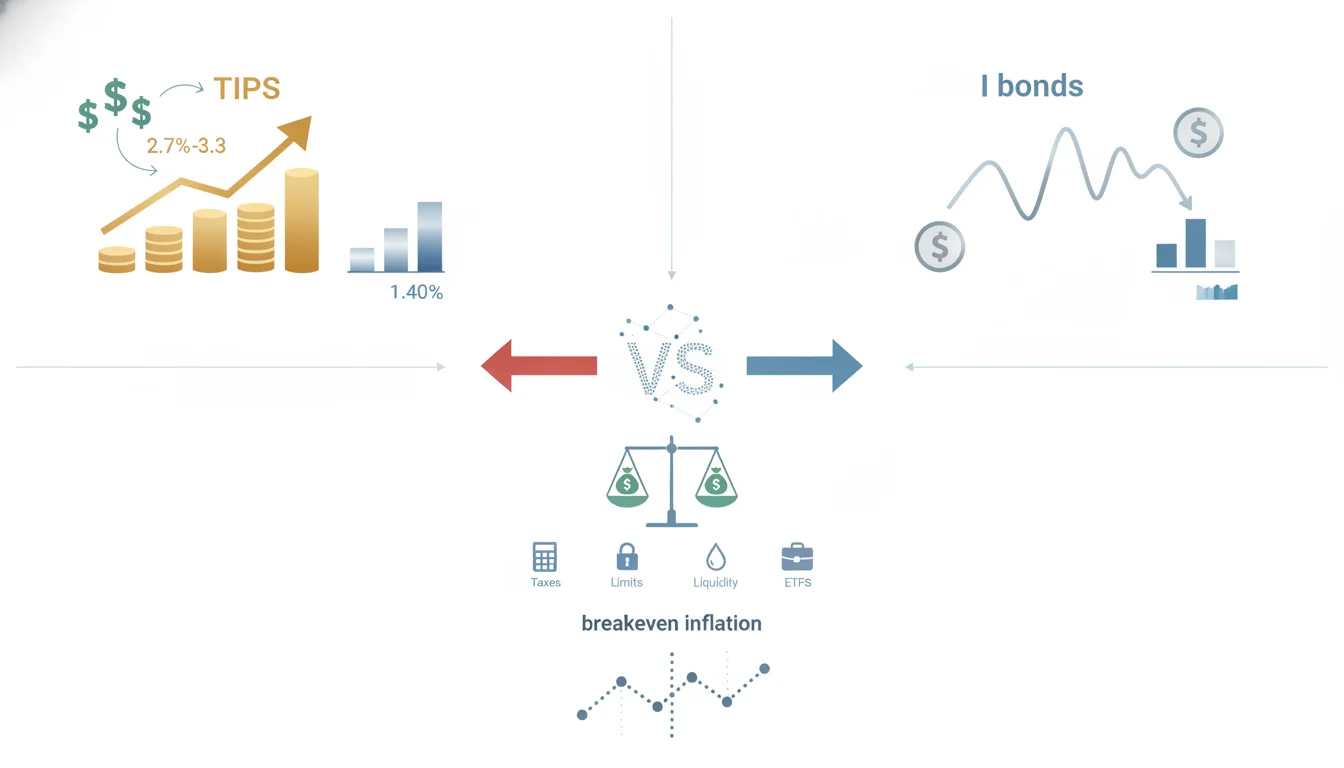
TIPS vs I bonds in 2026: compare the 1.40% I bond fixed rate with TIPS real yields near 2.7%-3.3%, plus taxes, limits, liquidity, ETFs and breakeven inflation.

Key Takeaway
Inflation protection has quietly become one of the most interesting trades in the bond market. On November 13, 2026, the U.S. Treasury's daily real yield curve showed a 5-year Treasury Inflation-Protected Security (TIPS) yielding 2.68% above inflation, a 10-year at 2.91%, and a 30-year at 3.28%. Two weeks earlier, on October 30, Treasury reset the Series I savings bond for purchases made from November 1, 2026 through April 30, 2027: a 1.40% fixed rate plus a 4.08% annualized inflation rate, for a 5.51% composite yield. That fixed rate is the highest Treasury has offered since 2006, and it still trails the real yields on marketable TIPS by well over a full percentage point.
That gap is the core of the 2026 "TIPS vs I bonds" decision. I bonds offer a headline rate that looks spectacular, no price volatility, and tax deferral, but they come with a $10,000 annual purchase cap, a 12-month lockup, and a three-month interest penalty before year five. TIPS offer higher locked-in real yields and no purchase limit, but their market prices move every day, and their inflation adjustments are taxed as income before you receive them. The right choice depends less on which instrument "wins" and more on how much money you are protecting, for how long, and in which type of account.
This guide explains how both instruments work, compares them on real return, liquidity, and taxes using current Treasury data, and shows where TIPS ETFs and the breakeven inflation rate fit into an investor's decision. Yields are as of the November 13, 2026 close (America/New_York) unless noted. Market yields change daily, inflation readings can surprise in both directions, and nothing here is personalized investment advice.
Why Inflation Protection Is Back on the Table
Inflation has not finished its job
The case for inflation-linked bonds always starts with the inflation data, and the 2026 data have not been comforting. The Bureau of Labor Statistics reported that the consumer price index rose 3.7% in the 12 months through September 2026. October's report showed headline CPI up 0.4% for the month and core CPI up 0.3%, the third straight 0.3% core reading.
The I bond formula captures this directly. Treasury's new 4.08% variable rate reflects 2.04% of CPI-U inflation over the six months from April to September 2026, doubled to an annual rate. Tipswatch, the TIPS-focused blog that tracks every reset, also reported that the 2027 Social Security cost-of-living adjustment will be 3.6%.
A hiking Fed has pushed real yields to multi-year highs
The Federal Reserve raised its federal funds target range to 3.75%–4.00% in September 2026, held it there on October 28, and meets again on December 8–9 with markets debating another quarter-point increase. Tighter policy has lifted nominal and real yields together. The Treasury's nominal par yield curve put the 10-year note at 5.15% on November 13, while the 10-year real yield was 2.91%, up from 2.86% just one session earlier.
For context, Tipswatch noted that the 10-year TIPS auctioned in July 2026 at a 2.438% real yield, the highest at auction for that maturity since October 2008. Secondary-market real yields are now meaningfully above that level.
How I Bonds Work in 2026
Fixed rate plus variable rate
A Series I savings bond pays a composite rate built from two parts. The fixed rate is set when you buy and stays with the bond for its entire 30-year life. The variable rate resets every six months based on CPI-U, so it rises and falls with inflation. Treasury combines them with a formula that adds the fixed rate, two times the semiannual inflation rate, and a small cross term. For bonds bought between November 1, 2026 and April 30, 2027, that works out to 1.40% fixed plus 4.08% variable, or a 5.51% composite for the first six months.
The variable part applies to every I bond ever issued, not only new ones. According to Tipswatch, an older I bond with a 0.0% fixed rate will earn 4.08% for its next six-month period, while bonds bought from May to October 2026 with a 0.90% fixed rate will earn 5.00%. Interest compounds semiannually, and the composite rate cannot fall below zero, so an I bond's redemption value never declines even in a deflationary period.
The rules that limit I bonds
I bonds are designed for household savers, and the rules reflect that. TreasuryDirect lets each Social Security number buy up to $10,000 in electronic I bonds per calendar year, and since January 1, 2025, I bonds have only been available electronically. You cannot redeem one in the first 12 months, and if you cash it in before five years you lose the last three months of interest.
The tax treatment is the main advantage. I bond interest is subject to federal income tax but exempt from state and local income tax, and you can defer the federal tax until you redeem the bond or it matures. That deferral means an I bond compounds without an annual tax drag, which matters more the longer you hold it.
What a 1.40% fixed rate really means
The fixed rate is the number that determines an I bond's long-run value, because it is your real return over inflation for as long as you hold it. A 1.40% fixed rate is excellent by the standard of the 2010s, when new I bonds often carried a 0.0% fixed rate. It is less impressive when the Treasury market is offering 2.68% to 3.28% real yields on marketable TIPS across maturities.
The 5.51% headline composite is mostly an inflation pass-through. If inflation cools next year, the variable rate will fall and the composite will fall with it, leaving the 1.40% fixed real return. If inflation stays hot, the composite will stay high, but TIPS holders will receive that same inflation compensation on top of a larger real yield. In other words, the headline number makes I bonds look better than TIPS, while the fixed rate shows the opposite.
How TIPS Work in 2026
Principal that grows with inflation
TIPS are marketable Treasury securities whose principal value is adjusted for changes in CPI-U. The coupon rate is fixed at auction, but it is paid every six months on the inflation-adjusted principal, so both your interest payments and your final principal rise with inflation. If prices fall, the principal can be adjusted downward, but at maturity Treasury pays the greater of the adjusted principal or the original face value, which provides a floor against deflation for investors who hold to maturity.
Treasury issues new TIPS in 5-year, 10-year, and 30-year maturities, with reopenings in between, and they can be bought at auction through TreasuryDirect or through a brokerage account in $100 increments. Unlike I bonds, there is no annual purchase limit, which is why TIPS are the default inflation hedge for larger portfolios, pensions, and retirement income plans.
What today's real yield curve offers
The real yield on a TIPS is the return you lock in above inflation if you buy at today's price and hold to maturity. On November 13, Treasury's real yield curve showed 2.68% for 5 years, 2.78% for 7 years, 2.91% for 10 years, 3.15% for 20 years, and 3.28% for 30 years. That upward slope means longer TIPS pay a higher real return, at the cost of more price sensitivity along the way.
Put in plain numbers, a 5-year TIPS bought at a 2.68% real yield and held to maturity would grow $10,000 to about $11,414 in today's purchasing power before taxes. An I bond with a 1.40% fixed rate held for the same five years would grow to about $10,720 in real terms. The difference, roughly $690 of extra purchasing power on a $10,000 investment, is the price an I bond buyer pays for zero volatility and tax deferral.
The catch: price risk and phantom income
TIPS trade every day, and their prices fall when real yields rise. Anyone who bought a 10-year TIPS at July's 2.438% auction yield and needed to sell after real yields climbed to 2.91% would have taken a loss. If you hold to maturity, those interim price swings do not change your locked-in real return, but they matter a great deal if you might need the money early.
Taxes are the second catch. The IRS treats the annual inflation adjustment to TIPS principal as taxable income in the year it occurs, even though you do not receive that cash until the bond matures or is sold. Investors call this phantom income. Like I bonds, TIPS are exempt from state and local income tax, but the annual federal tax bill on unpaid inflation adjustments makes individual TIPS a much better fit for IRAs, 401(k)s, and other tax-advantaged accounts than for taxable brokerage accounts.
TIPS vs I Bonds: The Head-to-Head Comparison
Real return favors TIPS right now
On the single most important measure, the real return you lock in, TIPS are clearly ahead in November 2026. The 5-year real yield of 2.68% beats the I bond fixed rate by 1.28 percentage points, and the gap widens at longer maturities.
The comparison can also change within the next year. The I bond fixed rate will be reset again on May 1, 2027, and TIPS real yields move daily. Investors who are building a position gradually should revisit the math at each reset rather than treating today's verdict as permanent.
Liquidity, limits, and flexibility
The practical differences often decide the question for individual savers. The main tradeoffs, using TreasuryDirect rules and Treasury data as of mid-November 2026, line up as follows:
- Purchase limit: I bonds are capped at $10,000 per person per year electronically; TIPS have no annual limit.
- Access to money: I bonds are locked for 12 months and lose three months of interest if redeemed before five years; TIPS can be sold any business day at the market price.
- Price volatility: I bond values never decline; TIPS prices rise and fall with real yields.
- Where you hold them: I bonds live only at TreasuryDirect; TIPS can be held at TreasuryDirect or in any brokerage account, including IRAs.
- Federal tax timing: I bond interest can be deferred until redemption; TIPS inflation adjustments are taxed each year in taxable accounts.
For an emergency fund that might be needed suddenly, neither is ideal in year one. For money you will not touch for at least five years, both work, and the deciding factors become account type and size.
Matching the instrument to the account
A simple framework covers most situations. In a taxable account, I bonds often make sense for the first $10,000 a year because of tax deferral and zero volatility, even with a lower fixed rate. In an IRA or 401(k), TIPS are usually the stronger choice because the phantom income problem disappears and the higher real yield compounds untaxed. Above the I bond cap, TIPS or a TIPS fund are the only scalable option.
Individual TIPS vs TIPS ETFs
A fund never matures
TIPS exchange-traded funds such as the iShares TIPS Bond ETF (TIP), the Schwab U.S. TIPS ETF (SCHP), and the Vanguard Short-Term Inflation-Protected Securities ETF (VTIP) offer instant diversification and daily liquidity. The tradeoff is that a fund continuously rolls its holdings, so it has no maturity date and no guaranteed real return. Its price will rise when real yields fall and drop when real yields rise, with no point at which you are sure to get your principal back.
That makes a TIPS ETF a different tool from an individual TIPS. A bond held to maturity locks in today's 2.68% or 2.91% real yield. A fund gives you exposure to the inflation-linked market, with returns that depend on where real yields go next.
Short-duration versus broad-market funds
Within TIPS funds, duration is the key variable. A short-term TIPS fund like VTIP holds securities maturing within about five years, so its price moves less when real yields change and its returns track current inflation more closely. A broad fund like TIP or SCHP holds the full maturity range, which offers more upside if real yields fall from today's elevated levels and more downside if the Fed keeps tightening.
Building a TIPS ladder
For retirees and anyone planning around known future expenses, a TIPS ladder offers the most certainty. You buy individual TIPS that mature in successive years, so each year a rung comes due and pays out inflation-adjusted principal that can fund that year's spending. Because each bond is held to maturity, the ladder's real return is locked in at purchase regardless of later price swings.
Investors can use Alphio's Scheduled Task feature to set recurring reminders for TIPS auction dates, the May and November I bond resets, and monthly CPI releases, so their inflation-protection plan is reviewed on a calendar rather than on impulse.

Breakeven Inflation: The Number That Settles the Debate
How to calculate it
The breakeven inflation rate is the difference between a nominal Treasury yield and a TIPS yield of the same maturity. It is the average inflation rate at which the two bonds would deliver the same return. Using Treasury's November 13 data, the 5-year breakeven was about 2.30% (4.98% nominal minus 2.68% real), the 10-year about 2.24% (5.15% minus 2.91%), and the 30-year about 2.19% (5.47% minus 3.28%).
If inflation averages more than the breakeven over the life of the bond, TIPS outperform a regular Treasury. If inflation comes in lower, the nominal Treasury wins. That makes breakeven a simple, market-based way to frame the TIPS-versus-nominal choice without having to forecast inflation precisely.
What today's breakevens are saying
Today's breakevens are strikingly low relative to recent inflation. The bond market is pricing about 2.2% to 2.3% average inflation over the next five to thirty years, while CPI ran at 3.7% year over year in September. That gap reflects confidence that a hawkish Fed will eventually bring inflation back near its 2% target, and it means investors can buy inflation insurance at a price that assumes inflation largely normalizes.
When breakevens are this far below current inflation, TIPS become a relatively cheap hedge. If inflation stays above 2.3% on average, TIPS holders come out ahead of nominal bondholders. If the Fed succeeds in pulling inflation down quickly, nominal Treasuries will do better, but TIPS investors still earn a real return near 3%, which is far from a bad outcome.
Fitting Inflation-Protected Bonds Into a Portfolio
TIPS and I bonds are not stock substitutes
Inflation-protected bonds are designed to preserve purchasing power, not to compound wealth at equity-like rates. A 3% real yield is attractive for the safe portion of a portfolio, but stocks remain the main long-term growth engine for most investors, even after a volatile 2026. The more useful question is how inflation-linked bonds can replace part of a portfolio's cash or nominal bond allocation, reducing the damage a surprise inflation spike would do to fixed income.
Investors who want to explore how these choices interact with their equity holdings can ask questions in plain English through Alphio's Conversational Trading, for example comparing the real yield on TIPS with the earnings yield of a broad stock index, or checking how a TIPS fund has behaved during recent rate-hike periods.

Cash versus TIPS for money you won't need soon
Short-term Treasury bills and money market funds currently yield in the low 4% range, which looks competitive with I bonds and TIPS on the surface. The difference is what happens if inflation reaccelerates. Cash yields would likely rise with Fed policy, but with a lag, while TIPS and I bonds adjust directly to measured inflation. For money needed within a year, cash remains the right home. For money with a three- to ten-year horizon, locking in a real yield near 2.7% to 2.9% through TIPS, or the 1.40% fixed rate through I bonds, removes inflation guesswork from the plan.
Common mistakes to avoid
The most frequent mistake is judging I bonds by the headline composite rate rather than the fixed rate. The 5.51% figure will change in six months, while the 1.40% fixed rate is what you keep. The second mistake is holding individual TIPS in a taxable account without planning for phantom income, which can create a tax bill in years with high inflation and no corresponding cash payout. The third is buying a long-duration TIPS fund for short-term money and being surprised by a price decline when real yields rise, as they have through much of 2026.
Conclusion
The 2026 version of the TIPS-versus-I-bonds debate has a clearer answer than usual. I bonds offer their best fixed rate since 2006, zero price risk, and tax deferral, which makes them a sensible home for up to $10,000 a year of long-term savings in a taxable account. TIPS offer meaningfully higher real yields, near 2.7% for five years and nearly 3% for ten, with no purchase limit, which makes them the stronger choice for larger amounts and for tax-advantaged accounts. Breakeven inflation rates near 2.2% to 2.3% suggest the market is pricing inflation protection cheaply relative to recent inflation.
Whichever route you choose, the discipline matters more than the instrument. Decide your time horizon, match the tool to the account, and write down when you will revisit the decision, ideally around each I bond reset and TIPS auction. Investors who want to learn from experienced traders can study how others position around rates and inflation with Alphio's Copy Trade, and those who prefer rules-based execution can explore Autonomous Trading to run predefined strategies after setting clear risk limits. Neither replaces your own homework, but both can help turn an inflation-protection plan into consistent action.

FAQs
Are TIPS or I bonds better in 2026?
As of mid-November 2026, TIPS offer higher locked-in real yields, about 2.68% for 5 years and 2.91% for 10 years, versus a 1.40% fixed rate on new I bonds. I bonds still appeal for up to $10,000 a year in taxable accounts because they never lose value and their federal tax can be deferred.
What is the I bond rate for November 2026?
I bonds issued from November 1, 2026 through April 30, 2027 earn a 5.51% composite rate for their first six months. That combines a 1.40% fixed rate, which lasts for the bond's life, with a 4.08% annualized inflation rate that resets every six months.
How are TIPS taxed?
TIPS interest and the annual inflation adjustment to principal are subject to federal income tax but exempt from state and local income tax. Because the inflation adjustment is taxed in the year it occurs even though it is not paid until maturity, many investors prefer to hold TIPS in IRAs or 401(k)s.
Can you lose money on TIPS?
Yes, if you sell before maturity after real yields have risen, because TIPS prices fall when real yields rise, and TIPS ETFs have no maturity date at all. If you hold an individual TIPS to maturity, you receive at least the original principal plus the real yield locked in at purchase.
What does breakeven inflation mean for TIPS investors?
Breakeven inflation is the nominal Treasury yield minus the TIPS yield of the same maturity, about 2.24% for 10 years on November 13, 2026. If actual inflation averages more than that rate, TIPS outperform regular Treasuries; if it averages less, nominal Treasuries come out ahead.
Related articles
- High Yield Bonds in 2026: What CCC Credit Stress Means for Income Investors and StocksHigh yield bonds pay about 8% in 2026, but CCC spreads have blown out. Learn what credit spreads signal for stocks and how to invest in junk bonds wisely.
- How to Trade Earnings Season: Implied Moves, Guidance and Risk Control for Stock InvestorsLearn how to trade earnings season in 2026: read the options implied move, focus on guidance, size positions before Nvidia and retail reports, and avoid traps.
- Equal-Weight vs Cap-Weighted S&P 500: RSP vs SPY After October's Rotation and Nvidia's CEO ShockEqual weight vs cap weighted S&P 500: how RSP and SPY differ, why October 2026's rotation was the widest since 2009, and how to blend both after Nvidia's shock.
- Semiconductor Stocks July 2026: Navigating the AI Chip Supercycle with NVDA and AMDComprehensive analysis of semiconductor stocks in July 2026. Compare NVDA and AMD performance, AI chip market trends, and investment strategies for the $1.3T semiconductor supercycle.
- NVIDIA Stock Analysis 2026: Is NVDA Still a Buy Amid $1 Trillion AI Demand?Comprehensive NVIDIA stock analysis for 2026. Explore NVDA's $1 trillion AI chip demand, earnings growth, valuation metrics, and investment risks. Expert outlook on AI infrastructure leader.
- Fed's Hawkish Turn: June 2026 Dot Plot Signals Rate Hikes AheadFederal Reserve holds rates at 3.50%-3.75% but dot plot signals potential rate hikes in 2026. Learn what this means for SPY, QQQ, and your investment portfolio.