

Equal-Weight vs Cap-Weighted S&P 500: RSP vs SPY After October's Rotation and Nvidia's CEO Shock
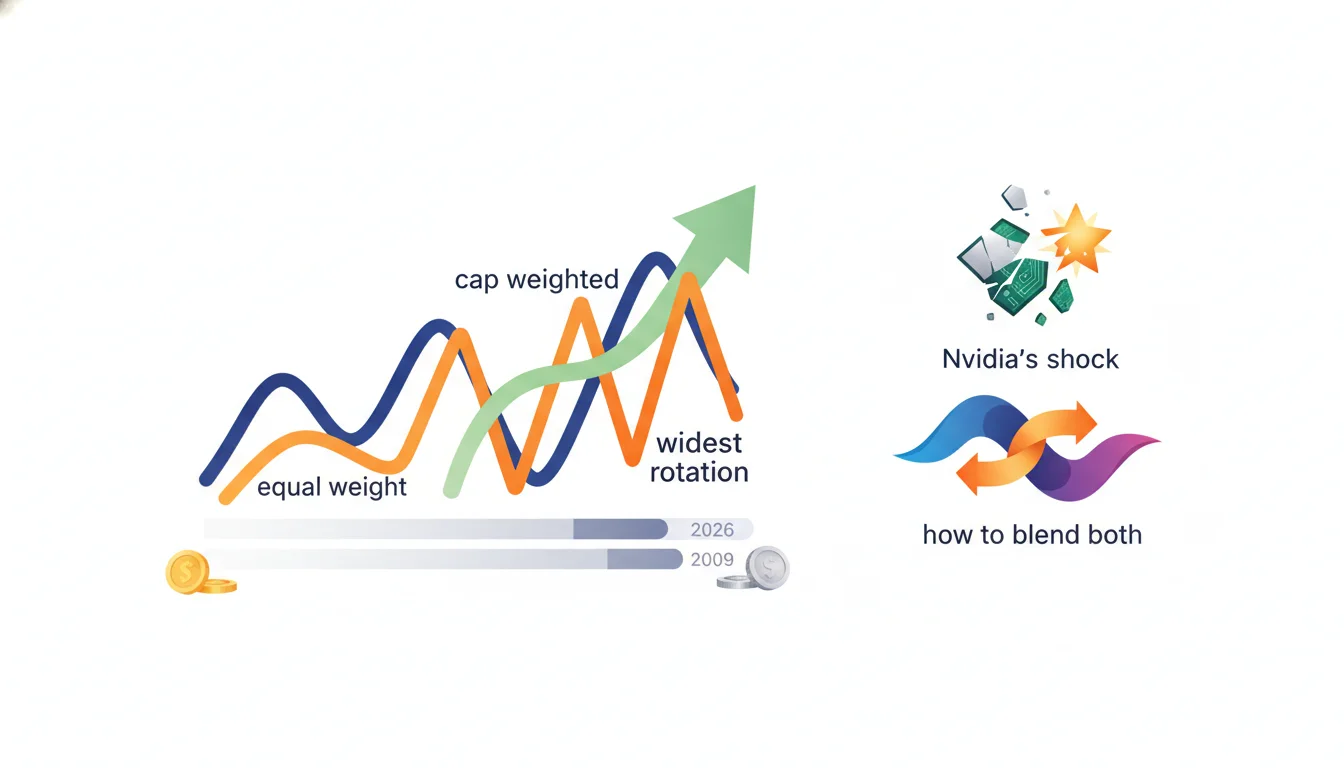
Equal weight vs cap weighted S&P 500: how RSP and SPY differ, why October 2026's rotation was the widest since 2009, and how to blend both after Nvidia's shock.

Key Takeaway
For most of the past three years, owning "the market" has really meant owning a handful of giant technology companies. As of November 12, 2026, the ten largest positions in the SPDR S&P 500 ETF Trust (SPY), which tracks the cap-weighted S&P 500, made up about 37% of the fund, led by Apple at 7.90%, Nvidia at 6.14% and Microsoft at 5.93%, according to State Street Global Advisors. The equal-weight version of the same index gives each of its roughly 500 members about 0.2% at every quarterly rebalance, according to Invesco, which runs the Invesco S&P 500 Equal Weight ETF (RSP). Same companies, very different portfolios.
That difference suddenly matters again. In October 2026 the equal-weight S&P 500 rose about 4.9% while the cap-weighted index slipped about 0.9%, a gap of roughly 5.8 percentage points that Bloomberg's Lisa Abramowicz and Seeking Alpha both described as the widest monthly margin since April 2009. Then, on November 12, Nvidia announced that Jensen Huang had resigned as chief executive, effective immediately, according to the company's Form 8-K, and the stock fell 4.34% that day. With Nvidia scheduled to report third-quarter fiscal 2027 results after the close on Tuesday, November 17, the question of how much of your index money rides on a few names is no longer academic.
This guide explains how equal-weight and cap-weighted indexes are built, what the long-run record says, why the two have diverged so sharply in 2026, and how investors can decide between RSP, SPY, or a blend of both. Market data are as of the November 13, 2026 close (America/New_York) unless noted. Historical patterns are not promises about the future, and nothing here is personalized investment advice.
How Cap-Weighted and Equal-Weight Indexes Work
Cap weighting: the market votes with its dollars
The standard S&P 500 weights each company by its float-adjusted market capitalization, so a company worth ten times as much as another gets roughly ten times the weight. This is the default for good reasons. It mirrors what the entire market actually owns, requires almost no trading because weights adjust automatically as prices move, and is extremely cheap to run. SPY, the oldest U.S.-listed ETF, launched on January 22, 1993, had about $807 billion in assets and charged a gross expense ratio of 0.0945% as of mid-November 2026, according to State Street.
The trade-off is that cap weighting is, by construction, a momentum strategy. Stocks that rise get bigger weights, and stocks that fall shrink. When leadership is concentrated in a few winners, as it has been during the artificial intelligence boom, the index becomes a concentrated bet on those winners, whether investors intended it or not.
Equal weighting: every company gets the same vote
The S&P 500 Equal Weight Index holds the same constituents but resets each to an identical weight, about 0.2%, at quarterly rebalances. Invesco notes that the index's history is calculated from January 8, 2003, and RSP itself launched on April 24, 2003, with a total expense ratio of 0.20%. Between rebalances, weights drift with prices, and then the index sells some of what has risen and buys what has lagged to restore equal positions.
That rebalancing gives equal weight three built-in tilts. It leans toward smaller companies, since the 500th-largest member counts as much as the largest. It leans toward value and away from momentum, because it systematically trims winners. And it produces very different sector weights, typically holding much less technology and communication services and more industrials, financials, utilities and real estate than the cap-weighted index.
What the two funds actually hold today
State Street's holdings data show how lopsided the standard index has become. Apple, Nvidia, Microsoft, Amazon, the two classes of Alphabet, Broadcom, Meta Platforms, Eli Lilly and Tesla together made up about 37.0% of SPY as of November 12. In other words, nine companies drove more than a third of the fund's daily moves. In RSP, those same ten share lines amount to only about 2% of the portfolio at a fresh rebalance.
Why the Gap Blew Open in 2026
October's historic rotation
The year has swung back and forth. Equal weight led for much of the first half as investors questioned the payoff from enormous AI capital spending, then the cap-weighted index caught up over the summer. In September, equal weight trailed by roughly 4.6 points, according to Bespoke Investment Group figures cited in market coverage. October reversed that violently. As AI-linked names sold off, the average stock gained while the giants fell, producing the widest monthly gap in favor of equal weight in more than 17 years.
The official numbers on SPY tell the cap-weighted side of the story. State Street reports SPY's net asset value return for October at negative 0.88%, leaving the fund up 11.66% for the year through October 31, compared with 11.77% for the S&P 500 index itself. A strong year, but one in which a growing share of the gains came from a narrowing group.
The Nvidia leadership shock
November added a new twist. Nvidia's November 12 release and 8-K said Huang stepped down as president, chief executive and director, with chief financial officer Colette Kress named interim CEO and former Synopsys chief executive Harvey C. Jones appointed chair. Nvidia shares fell more than 13% at the open before closing at $166.19, down 4.34%, according to Motley Fool market data, while the S&P 500 slipped only 0.35% to 7,592.40, per Yahoo Finance.
The next session showed the divergence in miniature. On November 13 the S&P 500 fell 0.40% to 7,561.67 and the technology sector dropped about 2%, while RSP rose about 0.2% and consumer staples gained about 1.4%, according to market recaps. More S&P 500 members rose than fell that day, roughly 314 against 185. Even so, the index still finished the week up about 2.5%.
A rates backdrop that complicates the story
The macro environment is not the classic setup for a broad, small-company-friendly rally. The Federal Reserve raised its target range to 3.75%–4.00% in September 2026 and meets again December 8–9, and the 10-year Treasury yield closed near 5.15% on November 13. Higher borrowing costs tend to hurt smaller, more indebted companies more than cash-rich megacaps. That is a reason to treat October's rotation as a signal worth watching, not as proof that a multi-year regime change has begun.
What the Long-Run Record Says
Equal weight has won over long stretches
Over the very long run, equal weighting has an edge. A January 2026 Motley Fool analysis reported that since 1971 the equal-weight approach has beaten the cap-weighted S&P 500 by an average of about 1.2 percentage points a year. Researchers generally attribute much of that to the size and value tilts described above, plus a rebalancing effect that forces the index to buy low and sell high at the margin.
The most striking episode came after the late-1990s technology bubble. According to the same analysis, the cap-weighted index beat equal weight by about 28% over 1997 to 1999, after which equal weight outperformed for seven consecutive years. Over the following decade, often called the "lost decade," equal weight returned about 65% while the S&P 500 declined about 9%. A similar pattern appeared after the "Nifty Fifty" era of the early 1970s.
But recent years have been brutal for equal weight
The flip side is that cap weighting can dominate for years at a time. From the start of 2023 through the end of 2025, the S&P 500 produced a total return of about 86% while its equal-weight counterpart returned about 43%, according to the Motley Fool, the widest three-year margin since 1971. An investor who switched to equal weight in early 2023 would have finished 2025 with roughly 30% less money than one who simply stayed in the standard index.
That is the honest summary of the strategy. Equal weight is not a free lunch, but a different set of bets, and it can lag badly when a few dominant companies keep growing earnings faster than everyone else. The historical case for it rests on mean reversion after extreme concentration, and nobody can say in advance how long concentration will last.
Volatility, drawdowns and what you give up
Because equal weight holds more smaller and more cyclical companies, it has historically tended to be somewhat more volatile in sharp economic downturns, when small and leveraged firms suffer most. It also gives up the "let your winners run" feature that made cap-weighted index funds so powerful during the AI boom. If Nvidia, Microsoft or Apple compounds earnings for another decade, an equal-weight holder will own far less of that growth.
Concentration Risk: The Case for Equal Weight
When a single CEO headline moves your index fund
The Nvidia news is a reminder that cap-weighted investors carry real single-company risk. With Nvidia at about 6% of SPY and Apple at nearly 8%, one company's leadership shake-up, earnings miss or regulatory problem can move a "diversified" fund more than dozens of smaller members combined. A 10% drop in a 6% position takes about 0.6% off the whole index before anything else happens.
Equal weight dilutes that risk dramatically. A 10% drop in a 0.2% position subtracts about 0.02%. For investors who already own large technology stocks directly, through employer stock plans, growth funds or individual holdings, equal weight can reduce the doubling-up that happens when their "core" index fund owns the same names in size.
Sector balance and the AI trade
Concentration is not only about companies; it is about themes. Many of the largest holdings are tied to the same AI investment cycle, which means a shift in sentiment about data center spending can hit several top positions at once. Equal weight spreads exposure across banks, manufacturers, retailers, health care companies and utilities, which respond to different drivers such as loan growth, industrial orders or consumer spending.
A hedge against being wrong about the leaders
Owning equal weight does not require predicting that megacaps will fall. It is a way to admit uncertainty. If AI leaders keep winning, a cap-weighted core still participates. If the October pattern persists and the broader market catches up, an equal-weight sleeve captures more of it. For many investors, that two-sided protection is more valuable than trying to call the turn.
The Case for Staying Cap-Weighted
Cost, simplicity and tax efficiency
SPY's 0.0945% gross expense ratio, and the even lower fees on some competing S&P 500 funds, compare with 0.20% for RSP. On a $100,000 position, that is roughly $95 versus $200 a year, a small gap but a permanent one. Equal weight also trades more because of its quarterly rebalancing, which adds transaction costs inside the fund. ETF structures generally help limit capital gains distributions, but investors in taxable accounts should check each fund's distribution history.
The leaders earn their weight
Cap weighting reflects the market's collective judgment. The largest companies are large largely because they generate enormous profits, and many have strong balance sheets that matter more when the 10-year yield sits above 5%. Shifting to equal weight means deliberately owning more of the smaller, often less profitable members of the index, which is a bet that may or may not pay off.
Rotations often fade
October-style reversals have happened before without starting a new era. Market commentators have noted that several sharp megacap sell-offs in recent years proved temporary, with leadership snapping back once earnings came through. If Nvidia's November 17 report and guidance reassure investors, the cap-weighted index could regain the lead quickly. Investors who switch entirely after a big month risk buying the strategy at exactly the wrong time.
How to Use Equal Weight in a Real Portfolio
The core-and-satellite blend
For most long-term investors, the choice need not be all or nothing. A common approach is to keep a cap-weighted S&P 500 fund as the core and add an equal-weight fund as a satellite, perhaps 20% to 50% of U.S. large-cap exposure depending on how much concentration risk you want to reduce. The blend lowers the weight of the top ten companies without abandoning them, and it narrows the range of outcomes relative to either extreme.
Write the rebalancing rule before you need it
Whatever mix you choose, decide in advance how and when you will rebalance. A calendar rule, such as checking quarterly, or a threshold rule, such as rebalancing when a sleeve drifts five points from its target, prevents the blend from quietly turning back into a megacap bet after a strong run. Investors who want reminders that do not depend on memory can set calendar-based portfolio reviews with Alphio's Scheduled Task feature once the rules are written down.
Check your overlap before you buy
Before adding equal weight, look at what you already own. Growth funds, technology sector funds and individual mega-cap positions all add to concentration, while small-cap, value and international holdings already provide some of what equal weight offers. A quick overlap check can show whether equal weight would genuinely diversify your portfolio or merely duplicate a small-cap fund you hold elsewhere.
Key Dates and Signals to Watch
Nvidia earnings and the AI capex read
Nvidia's results on November 17, with CFO commentary posted shortly after the release and a conference call at 5 p.m. ET, according to the company's investor relations site, are the near-term test. Investors will weigh both the numbers and how the new leadership frames guidance. A strong report could revive megacap leadership; a disappointment could extend the rotation that favored equal weight in October.
Breadth, rates and the December Fed meeting
Beyond Nvidia, watch breadth measures such as the share of S&P 500 members above their 200-day moving averages, and the relative performance line of RSP versus SPY. On the macro side, the November jobs report on December 4 and the Fed's December 8–9 decision will shape whether smaller, rate-sensitive companies can keep gaining. Persistently high yields would be a headwind for the equal-weight thesis.
Using research tools without outsourcing judgment
When you want to test a question quickly, such as how a rebalance would change your sector exposure or how RSP and SPY have behaved after past rotations, a conversational research tool can speed up the homework. Alphio's Conversational Trading lets you ask those questions in plain language, but the answers should support your written plan, not replace it.
Conclusion
The equal-weight versus cap-weighted debate comes down to one question: how comfortable are you letting a few giant companies drive most of your stock returns? With the top ten holdings at about 37% of SPY, an October rotation that produced the widest monthly gap since 2009, and Nvidia facing its first earnings report since an abrupt CEO exit, 2026 has made that question concrete. History offers support to both sides. Equal weight has won over very long periods and after past bouts of extreme concentration, yet cap weighting crushed it from 2023 through 2025.
The practical answer for many investors is a deliberate blend with a written rebalancing rule, chosen for risk reasons rather than as a short-term trade. Once that plan exists, tools can help you stick to it. Investors who want to see how experienced traders are positioning around rotations can study strategies through Alphio's Copy Trade, and those ready to automate rule-based execution within strict limits can explore Autonomous Trading. Whatever you choose, keep the focus on diversification and discipline, not on predicting which index wins next month.
FAQs
What is the difference between equal-weight and cap-weighted S&P 500 funds?
A cap-weighted S&P 500 fund such as SPY weights each company by its market value, so the largest firms dominate. An equal-weight fund such as RSP gives every member roughly the same weight, about 0.2%, and resets those weights at quarterly rebalances.
Is RSP better than SPY?
Neither is better in all periods. Equal weight has outperformed over very long stretches and after past bouts of extreme concentration, but it trailed badly from 2023 through 2025, when the S&P 500 returned about 86% versus about 43% for equal weight, according to the Motley Fool.
Why did the equal-weight S&P 500 outperform in October 2026?
AI-linked megacaps sold off while the average stock rose, so the equal-weight index gained about 4.9% as the cap-weighted index slipped about 0.9%. Commentators including Bloomberg's Lisa Abramowicz called it the widest monthly gap since April 2009.
How concentrated is the S&P 500 right now?
As of November 12, 2026, SPY's top ten holdings, covering nine companies led by Apple, Nvidia and Microsoft, made up about 37% of the fund, according to State Street. That means a few company-specific events can move a broad index fund noticeably.
Should I split my money between equal-weight and cap-weighted funds?
Many investors use a cap-weighted fund as the core and add an equal-weight sleeve to reduce concentration risk without abandoning the market leaders. The right mix depends on your existing holdings, costs, taxes and risk tolerance, and it works best with a written rebalancing rule.
Related articles
- Money Market Funds vs High-Yield Savings vs T-Bills: Where to Park Cash as the Fed HikesMoney market funds, high-yield savings or T-bills? Compare November 2026 yields, taxes, FDIC rules and liquidity as the Fed hikes, and build a smart cash plan.
- Homebuilder Stocks With Mortgage Rates Above 7%: An Investor's Guide for Late 2026Homebuilder stocks face 7% mortgage rates and a 16-year low in home sales. See what D.R. Horton, Lennar and Pulte earnings show and how to invest in 2026.
- Bitcoin Bear Market 2026: Why BTC Fell Below $70K and How Investors Can Manage Crypto RiskBitcoin is about 45% below its $126K peak as Fed hikes, 5% yields and ETF outflows bite. See how the 2026 bear market compares and how to manage crypto risk.
- Best Value Stocks to Watch in 2026: A Comprehensive Investor's GuideDiscover the best value stocks to watch in 2026. Our expert analysis covers top undervalued companies, valuation metrics, and investment strategies for building wealth.
- July Jobs Report Signals Fed Rate Cut: Market Impact and Investment StrategyUS unexpectedly lost 23,000 jobs in July. Learn how weak employment data is reshaping Fed policy expectations and what it means for stocks, bonds, and gold.
- NVIDIA Stock Analysis: Is the AI Chip Leader Still a Buy in August 2026?Comprehensive NVIDIA stock analysis covering Q2 2026 earnings, AI demand trends, competition from AMD and Intel, and expert price targets for long-term investors.