

Portfolio Rebalancing Strategy in Late 2026: Calendar, Threshold, and Hybrid Rules That Survive AI D
How to rebalance a stock portfolio in late 2026: calendar vs threshold vs hybrid rules, AI/tech drift, chip volatility, and automation with budget caps.

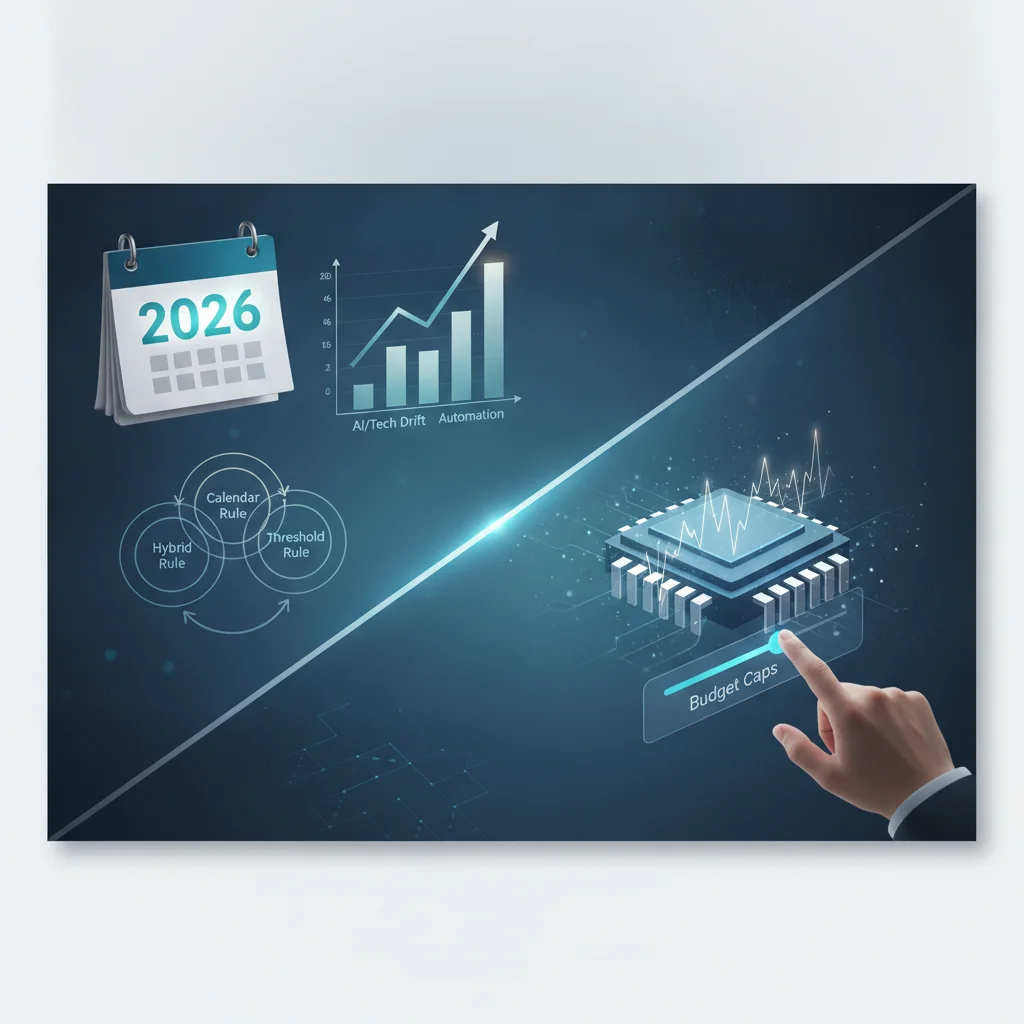
Key Takeaway
Late October 2026 has a familiar problem dressed in new numbers. The S&P 500 closed October 26 at 7,676.77, up 0.70% on the day, while the Nasdaq Composite finished at 26,169.38, up 0.82%, as Anthropic’s IPO filing revived AI and tech sentiment. Year-to-date price gains through October 23 already looked respectable—Fidelity’s index table put the S&P 500 at +11.37% and the Nasdaq Composite at +11.67%—but total real returns with dividends reinvested through October 26 tell a more uneven story underneath the index averages. VOO is up roughly 13.14% year to date, QQQ 16.33%, Apple 26.85%, SCHD 31.85%, Microsoft only 10.83%, and Nvidia 16.09% after a sharp air pocket from its October 6 peak.
That dispersion is exactly why a portfolio rebalancing strategy matters more than a market narrative. When winners compound faster than your written policy weights, risk concentrates without anyone placing a new trade. Calendar rebalancing, threshold bands, and hybrid rules exist to interrupt that silent drift. The same discipline applies if you run copy-trade sleeves or autonomous agents: without budget caps and correlation rules, “set and forget” becomes “set and overweight.” This piece walks through how investors systematically rebalance stock portfolios in late 2026, what the recent AI/tech and chip swings imply for bands, and how to keep automation from rewriting your risk budget by accident.
Why Portfolios Drift After a Year Like 2026
Winners, laggards, and silent concentration
A year does not need a crash to break a carefully chosen allocation. It only needs uneven returns. Through October 26, Apple’s total real return of about 26.85% and SCHD’s roughly 31.85% have outpaced Microsoft’s 10.83% and left Nvidia’s 16.09% looking strong on the year yet fragile after a −9.71% drawdown from its October 6 peak. QQQ itself is still up 16.33% year to date but sits roughly −6.25% below that early-October high, while VOO’s pullback from peak is a milder −1.79%. In a simple 60/40 or multi-sleeve equity book, those gaps mean your growth sleeve can quietly become a larger share of NAV even if you never bought another share.
The cause is mechanical. Price appreciation scales market value; policy weights do not. If Nvidia was 5% of a portfolio at the start of a run and QQQ-heavy names kept winning, the sleeve can drift into 7% or 8% before anyone notices. The reverse is also true: Microsoft lagging the Magnificent cohort can leave a “core tech” sleeve underweight relative to the names that carried the rally. Neither outcome is automatically wrong—but both are unplanned unless your rulebook says so.
Chip volatility and the AI CapEx debate
Semiconductor names have illustrated the other face of drift: sudden compression. CNBC’s October 26 coverage noted that SOXX was roughly −25% from its high and down about 13% in October amid worries about AI CapEx sustainability, before chips bounced on Anthropic news. That pattern—long climb, sharp month-long washout, sentiment snap-back—is brutal for investors who only rebalance once a year. A calendar-only process can leave you overweight chips at the top of the run and then force a mechanical buy into weakness months later, or never catch the mid-cycle reset at all.
RBC Capital Markets’ Lori Calvasina has framed a related macro risk for the broad market: a possible near-term S&P 500 pullback of 5%–10% toward roughly 7,000–7,400, against a 12-month target of 8,150, while staying overweight financials and health care and sidelined on tech. Whether or not that path unfolds, the portfolio implication is clear. If your equity book has drifted into tech-heavy territory because 2026 winners did the work for you, a sector rotation or index pullback hits harder than your original risk model assumed. Rebalancing is how you reconnect holdings to the risk you actually intended.
Emotion versus policy when headlines revive the tape
Anthropic’s filing and the October 26 bounce show how quickly sentiment can reverse a down month in chips and AI-linked names. That is precisely when discretionary investors abandon rebalancing rules—either chasing the bounce or freezing after the drawdown. A written portfolio rebalancing strategy treats those moments as process tests, not blank checks. You either have a band, a calendar, or a hybrid trigger, or you are improvising with the day’s narrative. Improvisation feels sophisticated in the moment; it usually just recreates the concentration you were trying to avoid.
Calendar vs Threshold vs Hybrid Rebalancing
Calendar-based: simple, blunt, and still useful
Calendar rebalancing—annual, semi-annual, or quarterly—remains the Fidelity/Vanguard-style baseline because it is easy to schedule and hard to game emotionally. You pick a date, measure every sleeve against target weights, and trade back toward policy. In a year like 2026, an October review would have caught Apple and SCHD’s outperformance versus Microsoft, and it would have forced a conversation about whether Nvidia’s post–October 6 drawdown already did some of the rebalancing work for you. The weakness is timing luck: if your annual date falls just after a chip bounce or just before a 5%–10% index pullback of the sort RBC flags, you may sell strength too early or buy weakness that was about to get weaker.
Threshold or band rebalancing: trade when drift is real
Threshold rebalancing, often built around bands of roughly five percentage points of absolute drift (or a percentage of the target weight), waits until a sleeve actually matters. If large-cap growth is targeted at 30% and you only trade when it hits 35% or 25%, you ignore noise and act on concentration. That fits late-2026 conditions well: QQQ’s −6.25% peak-to-trough move and NVDA’s −9.71% slide can push weights around without justifying a full portfolio overhaul every week. The risk is the opposite of the calendar’s: in a one-way AI melt-up, you may rebalance frequently and generate taxes and friction; in a sideways tape, you may wait months and miss cash-flow opportunities.
Hybrid rules and cash-flow first
Most serious individual investors land on a hybrid: check on a schedule, trade only if a band is breached, and use new contributions or dividends to nudge weights before selling. Cash-flow rebalancing is especially powerful in taxable accounts because buying the underweight sleeve with fresh capital avoids realizing gains on the overweight winners—Apple and SCHD after a strong year being obvious examples. In tax-advantaged accounts the friction is lower, so threshold breaches can be closed more aggressively. Hybrid rules also pair cleanly with automation: a monthly scheduled check does not mandate a monthly trade.
Building a Written Rulebook
Define sleeves, not just tickers
A usable rulebook starts with sleeves—U.S. large-cap core, growth/AI, dividend quality, international, bonds—then maps tickers into those buckets. Treating every line item as its own rebalancing unit creates noise; treating Apple, Microsoft, and Nvidia as three unrelated islands ignores that they often move together when AI sentiment flips. A growth/AI sleeve might include NVDA and a QQQ overlay; a quality-dividend sleeve might center on SCHD; a mega-cap compounder sleeve might hold AAPL and MSFT with separate internal caps so one name cannot dominate the sleeve.
Set bands, review cadence, and tax order
Write the numbers down. Example policy language that matches classic education from Fidelity, Vanguard, and Forbes-style primers: review on the first trading weekend of each month; rebalance a sleeve only if absolute weight drifts five percentage points from target (or 25% relative); use contributions first; in taxable accounts, harvest losses where available and prefer lot selection that limits short-term gains; never rebalance solely because a headline feels exciting. Add a maximum single-name cap—say 8%–10% of total portfolio—so an Apple or Nvidia run cannot silently become a thesis-sized bet.
Tax order deserves its own paragraph because 2026’s winners create the temptation to “just sell a little Apple.” In a taxable account, selling the name that drifted up can crystallize a large long-term gain; funding the underweight with new cash or by trimming a lower-gain lot is usually cleaner. In IRAs and similar wrappers, the tax constraint disappears and threshold logic can dominate. Your rulebook should state which account type uses which tool, or you will keep reinventing the decision under stress.
Document what “done” looks like
Rebalancing fails when “toward target” is vague. Specify whether you trade all the way back to target or only to the edge of the band (a common cost-saving choice), whether you round to whole shares, and whether you allow a 30-day blackout after a major life cash need. Clarity here is what separates a portfolio rebalancing strategy from a mood. If you also run copy-trade or agent sleeves, write their budget caps in the same document so they are not a parallel universe.
Rebalancing When You Also Copy Trade or Run Agents
Correlation is the hidden risk
Copy trading and autonomous strategies are not free diversification. If a whale vault, a social feed, or an AI agent is heavily long the same AI and chip complex that already dominates your direct holdings, your true Nvidia-and-QQQ exposure can be double-counted. Late-2026’s SOXX drawdown and subsequent Anthropic-driven bounce make that painful: both the direct book and the copied sleeve can lurch together. A systematic approach assigns each copy sleeve a hard budget cap, a max drawdown kill switch, and a correlation note against your core growth sleeve.
Automation helps only if it enforces those caps. A Scheduled Task can run the monthly drift check, flag when a copy sleeve exceeds its budget, and queue a review without requiring you to stare at screens every session. Pair that with clear Copy Trade position limits so following another strategy cannot silently overwrite the weights you just restored.

Explore Scheduled Task automations on Alphio

Set copy-trade budget caps on Alphio
Agents need the same bands humans do
Autonomous trading agents are excellent at execution rhythm and terrible at knowing your household risk budget unless you encode it. If an agent is allowed to scale into momentum names while your calendar rebalance is trying to trim growth, the two processes fight. Give agents notional ceilings, sector limits, and a rule that pauses new risk when the parent portfolio is already outside its bands. That is not anti-technology; it is how you keep Autonomous Trading inside the same written policy that governs your ETFs and single names.
Case Walkthrough: AAPL, NVDA, MSFT, and SCHD
Starting from late-October totals
Imagine a taxable growth-and-income book that targeted 20% Apple, 10% Nvidia, 15% Microsoft, 15% SCHD, and 40% in broad U.S. equity (VOO or similar) at the last formal rebalance. After Apple’s roughly 26.85% and SCHD’s 31.85% year-to-date total real returns through October 26—against Microsoft’s 10.83% and Nvidia’s 16.09% with a −9.71% drawdown from the October 6 peak—Apple and SCHD are likely above target, Microsoft below, and Nvidia closer to target than its mid-year path suggested. QQQ’s −6.25% from peak and VOO’s milder −1.79% imply the broad sleeve may be closer to policy than the single-name extremes.
What each method would do
A pure annual calendar rebalance in late October would systematically trim Apple and SCHD, add to Microsoft, and leave Nvidia roughly alone if it sits inside the band after the October slide. A 5-point threshold process might only act on Apple and SCHD if they breached by enough, skipping Microsoft if the underweight is only a couple of points. A hybrid investor checks the calendar, confirms Apple and SCHD breaches, funds Microsoft with new October contributions first, and sells the minimum Apple lots needed after that. The hybrid answer usually creates fewer taxable events while still correcting the story the market wrote for you.
Reading the chart stack without abandoning the rule
Apple’s price path matters for timing lots, Nvidia’s snapshot for whether the post-peak drawdown already reduced weight, Microsoft’s valuation panel for whether “underweight” is opportunity or value trap, and SCHD’s rating context for whether the dividend sleeve’s outperformance was quality or yield chase. None of those charts should override a written band by themselves. They inform how aggressively you close the gap and which lots you pick.
If RBC’s near-term 5%–10% S&P pullback toward 7,000–7,400 materializes, the investor who already trimmed Apple/SCHD overweight and topped up Microsoft is aligned with policy before stress hits. The investor who waited for a “cleaner” narrative may discover that the overweight winners fall together with the index—and that the rebalance they postponed would have been easier when prices were higher.
Automating Checks Without Abandoning Judgment
Schedule the review, not the emotion
The highest-leverage automation for rebalancing is the review ritual, not blind monthly trading. A scheduled task that exports weights, flags sleeves beyond bands, and drops a checklist into your trading workflow beats both neglect and overtrading. Use it to answer three questions every cycle: Which sleeves breached? Can cash flows fix them? What is the tax cost of the residual trades? Judgment still decides whether a breach in Nvidia after a chip washout is a buy-the-band event or a temporary pause while CapEx skepticism resolves.
Conversational interfaces help when you want to interrogate the book—“show drift versus January targets,” “what would a 5% trim of Apple fund in Microsoft”—without rebuilding spreadsheets from scratch. Tools like Conversational Trading are useful precisely because rebalancing is a dialogue between policy and prices, not a single button.
Keep humans on the falsifiers
Automation should never hide the conditions that would make your plan wrong. If your bands assume moderate volatility and SOXX-style −25% peak-to-trough swings become normal, the band width itself may need a policy amendment—not a silent override by an agent. Likewise, if copy-trade correlation to your growth sleeve rises during every AI headline week, the budget cap needs a review, not a larger default. Scheduled checks surface those issues; they do not invent new risk appetites.
What Would Falsify a Rigid Rebalancing Plan
When bands are too tight or too loose
A rigid plan fails if five-point bands trigger constant taxable churn in a high-volatility chip regime, or if twenty-point bands allow a single theme to become the portfolio. Evidence would show up as repeated small trims that never change risk, or as a drawdown that tracks QQQ/NVDA far more than your stated policy. Either result means the rulebook—not the market—needs an edit.
When life cash flows and tax regimes change
Job changes, home purchases, or a shift from accumulation to withdrawal can falsify a contribution-first hybrid. So can a large embedded gain in Apple after a 26.85%-type year if selling would push you into a higher tax bracket. The falsifier is not “rebalancing is dumb”; it is “this implementation no longer matches constraints.” Update the written policy, then resume.
When macro regime targets conflict with mechanical sells
If your strategic view adopts something like RBC’s overweight financials/health care and sidelined tech stance, mechanical rebalancing into beaten-down tech after a SOXX-style washout may conflict with a deliberate underweight. The clean fix is to change the strategic targets in the rulebook, then rebalance to the new targets—not to abandon rebalancing while pretending the old 30% growth sleeve still reflects conviction. Process and views can both be updated; improvisation updates neither.
Conclusion
A portfolio rebalancing strategy is how investors stay in the risk they chose after a year that rewarded Apple and SCHD, punished chip sentiment mid-October, and left Microsoft lagging the cohort. Calendar, threshold, and hybrid rules each solve part of the problem; the durable approach is a written rulebook with sleeves, bands, tax order, and explicit caps on copy-trade and agent sleeves so automation cannot silently rewrite weights. Late-2026 price levels—S&P 500 near 7,676.77, Nasdaq near 26,169, QQQ and NVDA off early-October peaks, SOXX still scarred from a rough month—are a live exam for that discipline, not a reason to invent a new personality every headline.
Put the review on a calendar, enforce budget caps on anything you copy or automate, and trade only when bands or cash-flow rules say so. If you want that workflow in one place, start with Scheduled Task for recurring drift checks, add Copy Trade limits so followed strategies stay inside sleeves, and use Autonomous Trading only inside the same written bands that govern your core holdings.
Automate portfolio review checks with Scheduled Task
Apply budget caps with Alphio Copy Trade

FAQs
What is the difference between calendar and threshold rebalancing?
Calendar rebalancing restores target weights on a fixed schedule—annual, semi-annual, or quarterly—regardless of how far sleeves have drifted. Threshold (band) rebalancing trades only when a sleeve moves beyond a set gap, often about five percentage points, which can reduce unnecessary trades but may wait longer in a one-way market.
How often should investors rebalance a stock portfolio in 2026?
Most individual investors do well with a hybrid: review monthly or quarterly, and trade only if bands are breached or new cash can fix the drift. After a year with uneven winners like Apple and SCHD versus lagging Microsoft, that cadence catches concentration without forcing a taxable trade every week.
Should I rebalance after Nvidia or QQQ pull back from recent peaks?
Only if your written bands say so. Through October 26, 2026, QQQ was about −6.25% from its October 6 peak and Nvidia about −9.71%; that may already have reduced overweight growth risk. Mechanical buying into every dip without a band or cash-flow rule turns rebalancing into market timing.
How do copy trading and AI agents affect portfolio rebalancing?
Copied strategies and agents can silently increase exposure to the same AI and chip names already in your core book, especially when sentiment swings as SOXX did in October 2026. Assign each sleeve a budget cap, monitor correlation to your growth holdings, and pause new agent risk when the parent portfolio is outside its bands.
Is it better to rebalance with new contributions than by selling winners?
In taxable accounts, yes whenever cash flow is large enough: buy underweight sleeves first so you avoid realizing gains on names that drifted up, such as strong 2026 performers. In tax-advantaged accounts, selling overweight winners to fund underweights is usually simpler because the tax friction is lower.
Related articles
- Stock Market Surges After 2026 Midterms: What the Democratic Sweep Means for Your PortfolioThe stock market rallied after Democrats won the 2026 midterms. Discover what the election means for investors, tech stocks, and the S&P 500 outlook.
- Stock Market Surges After 2026 Midterms: What the Democratic Sweep Means for Your PortfolioThe stock market rallied after Democrats won the 2026 midterms. Discover what the election means for investors, tech stocks, and the S&P 500 outlook.
- Oil Prices Surge Above $105 Amid US-Iran Conflict: Energy Investment Opportunities in November 2026Oil prices climb past $105 as US strikes Iran's Qeshm Island. Discover energy investment opportunities, top oil stocks, and market outlook for November 2026.
- Walmart and Target Earnings: What Retail Giants Reveal About the US Consumer in August 2026Walmart and Target Q2 2026 earnings reveal critical insights about US consumer health. Discover what retail results mean for investors and the economy ahead.
- NVIDIA Earnings August 2026: AI Chip Leader's Q2 Preview & Investment OutlookNVIDIA reports Q2 FY2027 earnings on August 26, 2026. Explore analyst forecasts, Blackwell chip momentum, data center growth, and NVDA stock price targets.
- NVIDIA Earnings August 2026 Preview: AI Chip Leader's Next CatalystNVIDIA reports Q2 FY27 earnings on August 26, 2026. Wall Street expects $93-95B revenue driven by AI accelerator demand and Blackwell ramp. Stock analysis.