

Oil Prices Surge Past $90: How to Position Your Portfolio for the 2026 Energy Rally
Oil prices hit $85-91/barrel amid Strait of Hormuz tensions. Discover top energy stocks like XOM and CVX, plus investment strategies for the 2026 oil rally.

Key Takeaway
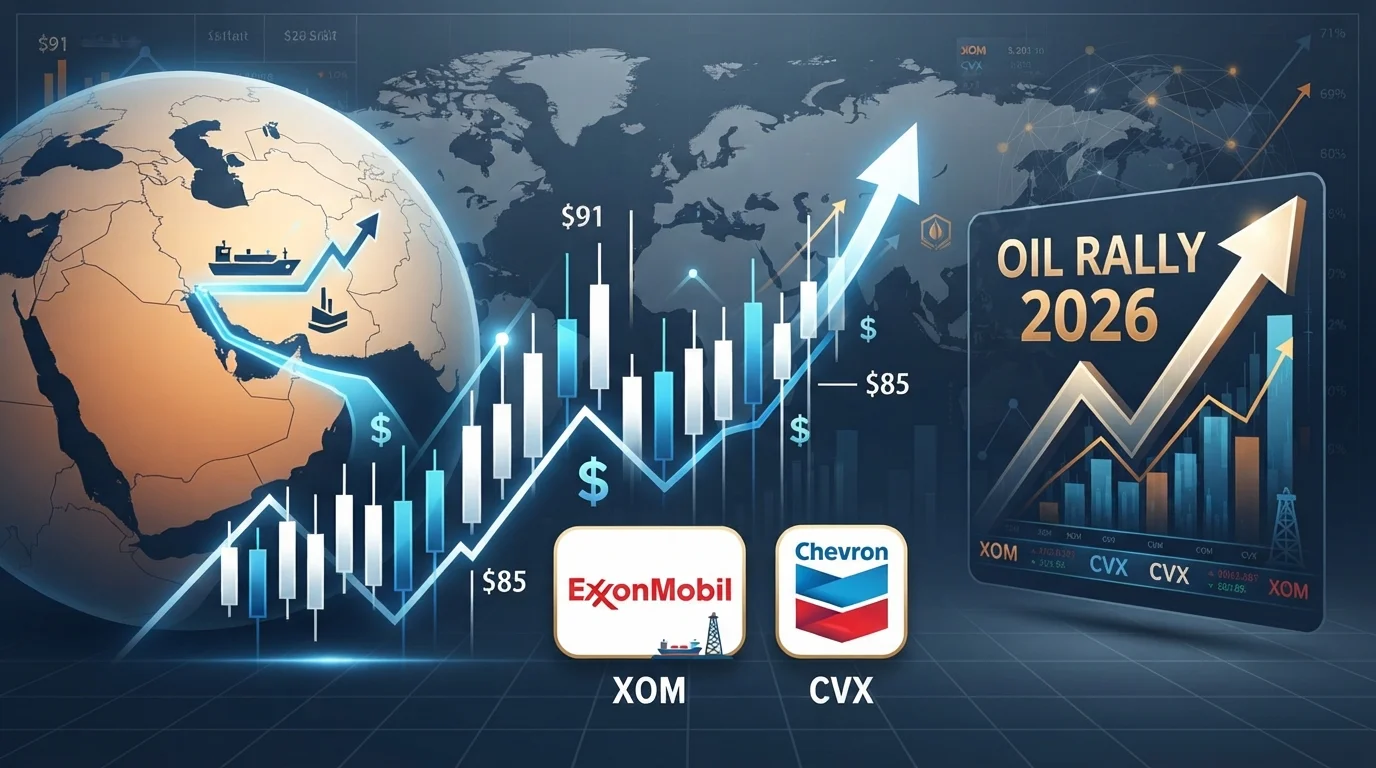
Crude oil prices have surged to their highest levels in months, with Brent crude trading between $85 and $91 per barrel as geopolitical tensions in the Middle East continue to disrupt global supply chains. The ongoing closure of the Strait of Hormuz, a critical chokepoint for approximately 20% of global oil shipments, has created a supply squeeze that shows no signs of easing in the near term. For investors, this presents both opportunities and challenges as energy stocks outperform the broader market while inflationary pressures mount.
The Energy Information Administration (EIA) now forecasts Brent crude to average around $87 per barrel for the entirety of 2026, a significant upward revision from earlier estimates. This price environment has already delivered substantial gains for energy investors, with major oil companies like ExxonMobil and Chevron posting year-to-date returns exceeding 25%. However, the situation remains fluid, and investors must carefully consider both the upside potential and the risks associated with geopolitical instability.
What makes this oil rally particularly noteworthy is its divergence from traditional demand-driven price increases. Unlike previous cycles where economic growth fueled consumption, the current surge is primarily supply-constrained, driven by the inability of Middle Eastern producers to move their product to market. This structural shift has implications for how investors should approach energy sector allocations in the coming quarters.
For investors seeking to automate their trading strategies during this volatile period, consider using Alphio AI's copy trading feature to mirror successful traders and smart money wallets who are capitalizing on the energy sector momentum.

The Strait of Hormuz Crisis: Understanding the Supply Shock
The Strait of Hormuz has long been recognized as one of the world's most strategically important waterways, with approximately 21 million barrels of oil passing through it daily under normal circumstances. The current closure, stemming from escalating tensions between Iran and the United States, has effectively removed this critical artery from the global supply network, forcing producers to seek alternative routes that are both more expensive and less efficient.
Iran's insistence that the strait will not reopen without major concessions from Washington has created a stalemate that markets are increasingly pricing as a prolonged disruption. Tehran's demands for compensation and diplomatic recognition have been met with threats of economic isolation from the U.S., creating a volatile standoff with no clear resolution path. This uncertainty has been the primary driver of the risk premium now embedded in crude oil prices.
The impact extends beyond immediate supply constraints. Shipping companies are facing significantly higher insurance premiums for vessels operating in the region, while alternative routes around the Cape of Good Hope add weeks to delivery times and substantially increase transportation costs. These secondary effects are rippling through global energy markets, affecting everything from refinery margins to retail gasoline prices.
Energy analysts at Goldman Sachs have noted that even if the strait were to reopen tomorrow, the logistical backlogs and accumulated supply disruptions would take months to fully resolve. This suggests that elevated oil prices may persist well into 2027, providing a supportive backdrop for energy sector investments even after the immediate crisis subsides.
Brent vs. WTI: The Widening Spread
The divergence between Brent crude, the international benchmark, and West Texas Intermediate (WTI), the U.S. standard, has become increasingly pronounced as the Hormuz crisis unfolds. Brent has consistently traded at a premium to WTI, reflecting the greater exposure of international markets to Middle Eastern supply disruptions and the relative insulation of North American producers.
Recent trading sessions have seen Brent reach as high as $91 per barrel while WTI has remained closer to the $80-85 range. This spread benefits U.S.-focused producers who can capture domestic prices while international competitors face higher costs and supply uncertainties. For investors, this dynamic favors companies with significant North American operations over those more dependent on international markets.
The spread also has implications for refining margins. U.S. refiners with access to cheaper domestic crude feedstock are enjoying expanded margins compared to their international counterparts, creating a favorable environment for integrated oil companies with downstream operations. This has been reflected in the outperformance of majors like ExxonMobil and Chevron, which benefit from both upstream production and downstream refining capabilities.
Investors should monitor this spread as a key indicator of market sentiment regarding the duration of supply disruptions. A narrowing spread would suggest markets are pricing in a resolution to the Hormuz situation, while a widening spread indicates expectations of prolonged disruption and potential further price appreciation.
Top Energy Stocks to Watch in 2026
ExxonMobil (XOM): The Integrated Giant
ExxonMobil has emerged as the standout performer among major oil companies in 2026, with shares gaining approximately 31% year-to-date. The company's integrated business model, spanning upstream exploration, midstream transportation, and downstream refining, has proven particularly resilient in the current environment. This diversification allows Exxon to capture value across the entire oil value chain, from wellhead to gas pump.
The company's recent quarterly results demonstrated impressive operational execution, with management successfully controlling costs while capitalizing on higher commodity prices. Exxon's Permian Basin operations continue to be a growth driver, with production increasing steadily even as the company maintains capital discipline. The firm's commitment to returning capital to shareholders through dividends and buybacks has also resonated with income-focused investors.
At current prices near $153 per share, Exxon trades at a reasonable valuation relative to its earnings power. Analysts project the stock could reach $180 per share, representing approximately 18% upside from current levels. This target would place the stock at roughly 27 times trailing earnings, in line with the broader S&P 500 average and suggesting further room for appreciation if oil prices remain elevated.
Chevron (CVX): Dividend Strength Meets Growth
Chevron has delivered a solid 29% year-to-date gain, trailing Exxon by only a narrow margin while offering investors a more attractive dividend yield. At a quarterly dividend of $1.71 per share, CVX currently yields approximately 4.5%, making it an appealing choice for income-oriented investors seeking exposure to the energy sector. This yield is particularly attractive in the current environment where fixed-income alternatives offer lower returns.
The company's acquisition of Hess Corporation has strengthened its position in key growth areas, particularly the Guyana offshore basin, which has emerged as one of the most exciting new oil provinces in decades. Chevron's disciplined capital allocation and focus on high-return projects have enabled it to generate substantial free cash flow even during periods of lower oil prices, providing a cushion should commodity prices normalize.
Wall Street analysts have an average price target of $217 for Chevron shares, representing about 8.5% upside from current levels around $186. While this upside appears more modest than Exxon's projected gains, the higher dividend yield provides a more immediate return component that may appeal to conservative investors. The company's strong balance sheet also provides flexibility for opportunistic acquisitions or increased shareholder returns.
The Fed's Dilemma: Oil Prices and Monetary Policy
The surge in oil prices has created a significant challenge for Federal Reserve policymakers as they navigate the delicate balance between controlling inflation and supporting economic growth. The latest Consumer Price Index data showed inflation remaining elevated relative to the Fed's 2% target, with energy costs contributing significantly to headline inflation readings.
Core inflation, which strips out volatile food and energy components, has shown signs of moderating, with recent monthly readings coming in below expectations. However, the Fed remains concerned that persistently high energy prices could feed into broader inflationary pressures through increased transportation and manufacturing costs. This creates a policy dilemma, as raising interest rates to combat inflation could slow economic growth without directly addressing supply-driven energy price increases.
Current market pricing suggests the Fed will hold interest rates steady at the upcoming September meeting, with traders assigning low probabilities to rate hikes in the near term. This dovish outlook has provided some support for risk assets, including energy stocks, as investors anticipate continued accommodative monetary policy. However, should oil prices continue to climb and inflation expectations become unanchored, the Fed may be forced to reconsider its patient approach.
For investors looking to stay ahead of Fed policy shifts, Alphio AI's agentic trading feature can help automate portfolio adjustments based on changing macroeconomic conditions and market sentiment.

Investment Strategies for the Current Environment
Direct Energy Exposure
For investors seeking direct exposure to rising oil prices, the integrated oil majors offer a balanced approach with lower volatility than pure-play exploration and production companies. ExxonMobil and Chevron provide exposure to commodity prices while offering the stability of diversified operations and consistent dividend payments. These stocks are suitable for core portfolio holdings in the energy sector.
Midstream Infrastructure
Companies like Enbridge (ENB) and Enterprise Products Partners (EPD) offer exposure to the energy sector without direct commodity price risk. These midstream operators earn fees for transporting and storing oil and natural gas, providing more stable cash flows that are less sensitive to price volatility. Their attractive dividend yields, often exceeding 6%, make them appealing for income-focused investors.
Energy Transition Plays
While the current oil rally has shifted attention back to traditional energy, long-term investors should not ignore the ongoing energy transition. Companies with exposure to natural gas, which is increasingly viewed as a bridge fuel in the decarbonization process, may offer the best of both worlds. Chevron's growing LNG business and Exxon's low-carbon solutions division represent ways to gain exposure to this trend within established energy companies.
Risk Management
Given the geopolitical uncertainties driving current oil prices, investors should approach energy sector allocations with appropriate risk management. Position sizing should reflect the volatile nature of commodity markets, and investors should be prepared for significant price swings as the Hormuz situation evolves. Stop-loss orders and diversification across multiple energy subsectors can help manage downside risk.
Global Implications and Market Outlook
The surge in oil prices has far-reaching implications beyond the energy sector, affecting everything from inflation expectations to currency markets and global economic growth forecasts. Emerging market economies that are net oil importers face particular challenges, as higher energy costs strain current account balances and put pressure on local currencies.
European economies, already grappling with energy security concerns following recent geopolitical developments, face additional headwinds from elevated oil prices. The euro has weakened against the dollar in part due to these concerns, creating a feedback loop where currency depreciation makes dollar-denominated oil imports even more expensive for European consumers and businesses.
Looking ahead, the trajectory of oil prices will depend heavily on developments in the Middle East and the potential for a negotiated resolution to the Hormuz crisis. The EIA's forecast of $87 per barrel average for 2026 assumes a gradual normalization of supply flows, but this outlook remains highly uncertain. Investors should prepare for scenarios ranging from a rapid resolution that sends prices lower to an escalation that could push Brent above $100 per barrel.
For those interested in setting up automated responses to market movements, Alphio AI's automations feature allows you to create conditional workflows that execute trades based on predefined criteria, helping you capitalize on volatility without constant monitoring.

Conclusion
The 2026 oil price surge presents a compelling investment opportunity for those willing to navigate the associated geopolitical risks. With Brent crude trading at multi-month highs and energy stocks outperforming the broader market, investors have multiple avenues to gain exposure to this trend. The integrated oil majors, particularly ExxonMobil and Chevron, offer an attractive combination of capital appreciation potential and dividend income.
However, the situation remains fluid, and investors must remain vigilant regarding developments in the Middle East. The closure of the Strait of Hormuz represents an unprecedented supply disruption that could persist longer than markets currently anticipate. Diversification across energy subsectors and prudent position sizing are essential risk management tools in this environment.
For long-term investors, the current environment also serves as a reminder of the importance of energy security and the ongoing transition to a more diversified global energy mix. While traditional oil and gas companies are benefiting from today's high prices, the structural shift toward cleaner energy sources continues, creating opportunities for patient capital willing to look beyond the current cycle.
To execute trades seamlessly during these volatile market conditions, explore Alphio AI's conversational trading platform, which allows you to manage positions through natural language commands and stay on top of market movements in real-time.

Whether you're looking to capitalize on the current oil rally or position your portfolio for the energy transition, the key is to remain informed, diversified, and prepared for multiple scenarios. The energy sector has always been cyclical, and while the current upcycle has delivered impressive returns, prudent investors will maintain a long-term perspective while enjoying the near-term benefits of higher oil prices.
FAQs
Why are oil prices rising in 2026?
Oil prices are surging primarily due to the closure of the Strait of Hormuz, a critical shipping channel for approximately 20% of global oil supply. Geopolitical tensions between Iran and the United States have disrupted normal trade flows, creating a supply squeeze that has pushed Brent crude above $85-91 per barrel. The situation is compounded by increased shipping insurance costs and the need for alternative, more expensive routes.
Which energy stocks are performing best in 2026?
ExxonMobil (XOM) and Chevron (CVX) are the standout performers, with year-to-date gains of approximately 31% and 29% respectively. These integrated oil majors benefit from their diversified operations spanning upstream production, midstream transportation, and downstream refining. Their strong balance sheets and commitment to shareholder returns through dividends and buybacks have made them favorites among energy investors.
How is the Federal Reserve responding to higher oil prices?
The Federal Reserve is currently maintaining interest rates steady in the 3.5-3.75% range, adopting a patient approach as it monitors inflation data. While headline inflation remains elevated due to energy costs, core inflation (excluding food and energy) has shown signs of moderating. The Fed faces a dilemma as raising rates could slow economic growth without directly addressing supply-driven energy price increases. Markets currently expect the Fed to hold rates steady through the September meeting.
What is the outlook for oil prices through the end of 2026?
The Energy Information Administration (EIA) forecasts Brent crude to average around $87 per barrel for 2026, with prices potentially remaining elevated into early 2027. This outlook assumes a gradual normalization of supply flows through the Strait of Hormuz, though the timeline for reopening remains highly uncertain. Some analysts believe prices could exceed $100 per barrel if tensions escalate further, while a diplomatic resolution could send prices lower.
What are the best ways to invest in the energy sector right now?
Investors have several options for energy sector exposure: (1) Integrated oil majors like XOM and CVX for balanced exposure with dividends; (2) Midstream infrastructure companies like Enbridge and Enterprise Products Partners for stable fee-based income; (3) Energy ETFs for diversified exposure; and (4) Selective E&P companies for pure-play commodity exposure. Risk management through position sizing and diversification is essential given the geopolitical uncertainties driving current prices.
Related articles
- Stock Market Surges After 2026 Midterms: What the Democratic Sweep Means for Your PortfolioThe stock market rallied after Democrats won the 2026 midterms. Discover what the election means for investors, tech stocks, and the S&P 500 outlook.
- Stock Market Surges After 2026 Midterms: What the Democratic Sweep Means for Your PortfolioThe stock market rallied after Democrats won the 2026 midterms. Discover what the election means for investors, tech stocks, and the S&P 500 outlook.
- Oil Prices Surge Above $105 Amid US-Iran Conflict: Energy Investment Opportunities in November 2026Oil prices climb past $105 as US strikes Iran's Qeshm Island. Discover energy investment opportunities, top oil stocks, and market outlook for November 2026.
- Super Micro Computer (SMCI) Stock Analysis: Why $60 Billion in Orders Trades at Just $30Super Micro Computer landed $60B in AI server orders yet trades at just $30. Is SMCI stock a value trap or hidden gem? Deep dive into financials and growth prospects.
- Super Micro Computer: The 0 Billion AI Infrastructure Play Trading at a BargainSuper Micro Computer landed 0 billion in AI orders last quarter but trades at just 0. Discover why this AI infrastructure leader may be deeply undervalued in 2026.
- Berkshire Hathaway Stock Analysis: Why Greg Abel's Strategic Shift Signals a Bullish TurnBerkshire Hathaway ends 14-quarter selling streak as Greg Abel buys back $4.5B shares. Analyze BRK-B stock fundamentals, portfolio concentration, and investment thesis for August 2026.