

Municipal Bonds in 2026: Are Tax-Free Yields Worth It With Treasuries Near 5%?
Are municipal bonds worth it with Treasuries near 5%? Learn tax-equivalent yield, the muni-to-Treasury ratio, 2026 brackets, tax traps, and credit risk.

Key Takeaway
Municipal bonds have quietly become one of the more interesting corners of the 2026 bond market. With the 10-year Treasury yield trading around 5% for much of November and the Federal Reserve holding its target range at 3.75% to 4.00% after September's hike, many investors assume taxable bonds are the obvious place to park money. For investors in higher tax brackets, the math is not that simple. A AAA-rated national 10-year muni yielded about 3.25% on November 21, 2026, according to FMSbonds' market-yield table, and that coupon is generally free of federal income tax and the 3.8% net investment income tax.
The core question is the tax-equivalent yield: what a taxable bond would need to pay to match a muni after taxes. At the 24% bracket, a 3.25% muni is worth roughly a 4.28% taxable yield. At the 35% bracket it is worth about 5.00%, and for a top-bracket investor paying 37% plus the 3.8% surtax it works out to roughly 5.49%. That is the gap the market is pricing, and it moves every week as muni and Treasury yields shift.
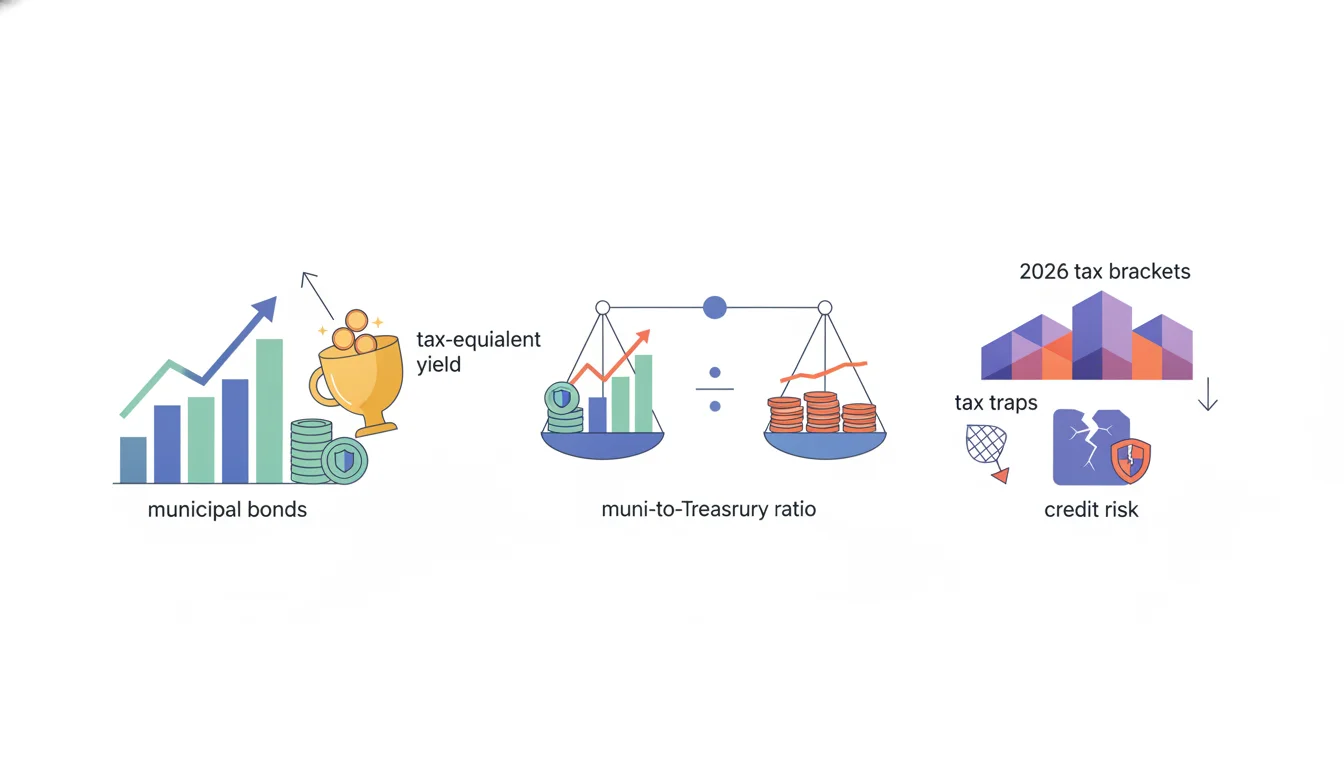
This guide explains how to compare munis with Treasuries properly, why the muni-to-Treasury ratio matters more than the headline yield, which tax traps can erase the advantage, and how to think about credit, duration, and fund structure during a volatile stock market. It is an educational framework, not a recommendation, and every investor should confirm their own bracket and state rules before acting.
Why Municipal Bonds Are Back in the Conversation
A year of record supply and rising yields
State and local governments have been borrowing heavily in 2026. Invesco's municipal desk, citing BofA Global Research, reported record new issuance of $517 billion year to date through October 28, about 5% above the same period a year earlier. Heavy supply tends to push yields higher because dealers and investors must absorb more paper, and that is part of why munis cheapened during the summer. Vanguard noted in an October 22 article that municipal yields climbed about 120 basis points in the third quarter, a move it attributed to technical headwinds rather than weaker credit.
That distinction matters. When yields rise because of supply and fund flows, rather than because issuers are getting riskier, long-term investors are being paid more for roughly the same credit profile. Vanguard's municipal team described fundamentals as broadly stronger than they have been in years, and its head of municipal fixed income, Nate Earle, said "Tax-sensitive investors have the opportunity to allocate to the sector."
The October rebound and what came after
Supply pressure does not last forever. Invesco reported that investment-grade tax-exempt bonds returned 3.85% in October, citing Bloomberg data, and called it the best October for the Bloomberg Municipal Bond Index since the index began tracking returns in 1980. The same desk expected only about $33 billion of new issuance in November, citing JPMorgan strategists, as refunding activity slowed and the holiday calendar approached.
Lighter supply and steady demand usually support prices into year-end. Invesco's Mark Paris wrote that "Demand should be well supported by historically high tax-exempt yields." That is an expectation, not a guarantee, and the stock market sell-off this month is a reminder that sentiment can change quickly across every asset class.
Why the stock sell-off sharpens the question
When equities fall sharply, investors often move toward high-quality bonds for stability and income. In 2026 that impulse runs into a tax question. Treasury bills and notes offer headline yields close to 4% to 5%, but that interest is fully taxable at the federal level. For a household already facing a large tax bill from realized gains, salary, or a Roth conversion, the after-tax yield is what actually lands in the account. Munis compete on that after-tax basis, and right now the comparison is closer than many investors assume.
How Tax-Equivalent Yield Really Works
The basic formula
The tax-equivalent yield, or TEY, converts a tax-free yield into the taxable yield you would need to earn the same amount after tax. The formula is the muni yield divided by one minus your marginal tax rate. If a muni yields 3.25% and your marginal federal rate is 32%, the TEY is 3.25% divided by 0.68, or about 4.78%. A taxable bond yielding less than that leaves you with less money after federal taxes, all else equal.
The key word is marginal. The rate that matters is the one applied to your next dollar of interest income, not your average tax rate across all income. Investors who use their effective rate will understate the value of munis, while those who forget about phase-outs or state taxes can overstate it.
What the 2026 brackets imply
The IRS published 2026 bracket thresholds in October 2025. For married couples filing jointly, the 24% bracket starts above $211,400 of taxable income, the 32% bracket above $403,550, the 35% bracket above $512,450, and the 37% top bracket above $768,700. Single filers hit those same rates at $105,700, $201,775, $256,225, and $640,600. The net investment income tax of 3.8% applies on top for single filers with modified adjusted gross income over $200,000 and joint filers over $250,000, and the IRS states that it does not apply to tax-exempt municipal bond interest.
Using FMSbonds' 3.25% AAA 10-year yield from November 21, the federal-only tax-equivalent yields look like this:
- 24% bracket: about 4.28%
- 32% bracket: about 4.78%
- 35% bracket: about 5.00%
- 37% bracket: about 5.16%
- 37% plus 3.8% NIIT (40.8%): about 5.49%
These are simple calculations, not quotes, and they ignore state taxes, call features, and transaction costs. They still show the basic break-even. Investors in the 35% bracket and above are often being paid at least as much in munis as in a comparable Treasury, while investors in lower brackets usually are not.
The longer end tells a stronger story
The muni yield curve is steeper than the Treasury curve this year. FMSbonds listed AAA national yields of 4.25% at 20 years and 4.70% at 30 years on November 21. A 4.70% tax-free yield is worth about 7.94% taxable for an investor at the 40.8% combined top rate, which lines up with Vanguard's October observation that tax-equivalent yields were near 8% for top-bracket buyers. Long maturities carry far more interest-rate risk, though, so the extra yield is compensation for price swings, not free money.
Reading the Muni-to-Treasury Ratio
What the ratio measures
Professional muni investors watch the ratio of AAA muni yields to Treasury yields at the same maturity. A ratio of 66% means a 10-year muni yields 66% of what a 10-year Treasury does. Because munis are tax-exempt, they normally yield less than Treasuries, and the ratio is a quick way to judge whether munis are cheap or rich relative to their own history.
According to New York Life Investments' municipal weekly, the 10-year muni-to-Treasury ratio stood at about 66% as of November 13, 2026, based on a 3.41% AAA 10-year muni and a 5.15% Treasury in its Bloomberg BVAL data. Ratios vary by data provider and maturity, so they are best compared within a single source over time rather than across vendors.
Turning the ratio into a break-even tax rate
The ratio gives you a shortcut. One minus the ratio is the break-even tax rate. A 66% ratio implies a break-even of about 34%. If your combined marginal rate on taxable interest is above that, munis win on paper; if it is below, Treasuries or other taxable bonds generally come out ahead. That single number is often more useful than staring at headline yields, because it adjusts automatically as both markets move.
When the ratio signals opportunity
Ratios tend to rise when munis are under technical pressure, such as heavy issuance, tax-season selling, or mutual fund outflows. They tend to fall when supply is light and demand is strong, which often happens around year-end and in January reinvestment season. Vanguard's Earle noted that seasonal issuance pressures typically ease during the winter holidays through January. A ratio drifting lower means munis are getting relatively more expensive, so investors who wait for a better entry may find the break-even moving against them.
The State Tax Twist Most Comparisons Miss
Treasuries are state-tax-free too
Many quick comparisons treat Treasuries as fully taxable, which is wrong for most investors. Interest on US Treasury securities is exempt from state and local income taxes. Interest on municipal bonds is generally exempt from federal tax, and often from state tax only when you buy bonds issued in your own state. So the real comparison for a resident of a high-tax state is an in-state muni, free of both federal and state tax, against a Treasury that is free of state tax but subject to federal tax.
For an investor in a state with no income tax, the federal comparison is basically the whole story. For an investor in a high-tax state, an in-state muni can look meaningfully better than the federal-only math suggests, while an out-of-state national muni may lose some of its edge because its interest may be taxed by the home state.
National versus single-state exposure
Single-state muni funds and bonds offer the biggest tax benefit for high-tax-state residents, but they concentrate credit risk in one economy and one budget. National funds spread risk across many issuers and regions but give up some state tax benefit. Neither choice is automatically right. Investors should weigh the extra after-tax yield against the loss of diversification, especially if their job, home, and other assets are already tied to the same state.
Where to check your own numbers
Because state rules differ, the safest approach is to calculate your combined marginal rate on interest, including federal, state, and the 3.8% surtax if it applies, then compare the after-tax yields directly. A tax professional can confirm how your state treats in-state versus out-of-state muni interest and whether your income sits near a phase-out where the marginal rate is higher than the bracket suggests.
Tax Traps That Can Erase the Muni Advantage
Social Security and provisional income
Tax-exempt does not mean invisible. IRS Publication 915 requires taxpayers to add tax-exempt interest, explicitly including municipal bond interest, when testing whether Social Security benefits are taxable. The base amounts are $25,000 for single filers and $32,000 for married couples filing jointly. Retirees who load up on munis can still push more of their benefits into taxable income, which raises their effective marginal rate in a way the simple TEY formula does not capture.
The alternative minimum tax and private activity bonds
Some municipal bonds finance projects that benefit private parties, such as airports, stadiums, or certain housing projects. According to IRS Publication 550, interest on many of these private activity bonds issued after August 7, 1986 is a tax preference item that may be subject to the alternative minimum tax. These bonds often pay slightly higher yields to compensate. Investors who might owe AMT should check whether a fund holds AMT-subject paper, which fund documents typically disclose.
Capital gains and the de minimis rule
Munis bought at a discount in the secondary market can create taxable income when they mature or are sold. Under the de minimis rule, a bond bought at a large enough discount can turn part of that gain into ordinary income rather than a capital gain. After a year in which yields rose sharply, many older low-coupon munis trade below par, so this is a practical issue in 2026. Individual-bond buyers should ask how a discount will be taxed before assuming the whole return is tax-free.
Credit Quality: How Safe Are Munis in 2026?
Fundamentals versus headlines
Municipal credit has historically been strong at the investment-grade level, though defaults do happen, especially among unrated and high-yield issuers such as project finance deals, senior living facilities, and some small hospitals. Vanguard's October commentary said the summer weakness in munis was not caused by softening fundamentals. A slower economy would still test state and local budgets over time.
Investors should separate general obligation bonds, backed by an issuer's taxing power, from revenue bonds backed by a specific stream such as tolls, water fees, or hospital revenue. Both can be high quality, but the risk drivers differ. Revenue bonds depend on the health of one project or system, while general obligation credit depends on the broader tax base and political will to fund debt service.
High-yield munis offer more income and more risk
Bloomberg's high-yield municipal index carried a yield to worst near 5.9% in mid-November, well above the roughly 4.2% on the broad investment-grade muni index, according to Bloomberg index data as of November 13. On a tax-equivalent basis that is a striking yield, but high-yield munis behave more like credit assets than safe havens. They can fall alongside stocks in a risk-off market, and recovery rates in defaults can be low. For most investors they belong, if at all, in a small, deliberate slice of a bond allocation.
The role of bond insurance
Some municipal bonds carry insurance from companies such as Assured Guaranty, which guarantees timely payment of principal and interest if the issuer fails. Insurance can lift a bond's rating and liquidity, but it also introduces a second credit to monitor: the insurer. Investors should treat insurance as an added layer of protection rather than a substitute for understanding the underlying issuer.
Funds, ETFs, or Individual Bonds?
The case for muni ETFs and funds
Muni ETFs and mutual funds give small investors diversification across hundreds of issuers, professional credit research, and easy liquidity. Flows show that investors are leaning toward ETFs. Invesco, citing JPMorgan data, reported $3.5 billion of inflows into muni ETFs in the week ended October 28 while open-end mutual funds saw $1.8 billion of outflows, the eighth straight week of that divergence. Lower costs and intraday trading are part of the appeal.
The trade-off is that a fund never matures. Its price moves with interest rates indefinitely, so an investor who needs a fixed sum on a fixed date carries more uncertainty than someone holding a bond to maturity.
The case for individual bonds and ladders
Individual bonds held to maturity return par if the issuer pays, which makes them useful for funding known future expenses. A ladder of bonds maturing every year or two spreads reinvestment risk and lets an investor reinvest at prevailing rates as each rung matures. The downsides are wider bid-ask spreads for small trades, the work of researching each credit, and less diversification unless the portfolio is fairly large.
Matching duration to your goal
Whatever the vehicle, duration should match the time horizon. With the Fed still debating further hikes ahead of its December meeting, longer-duration munis carry real price risk if yields keep climbing. Short and intermediate maturities offer less yield but more stability, while long maturities pay more to compensate for volatility. Investors who want to track ratio and yield moves without checking screens every day can automate the routine: Alphio's Scheduled Task feature can run recurring checks on rates and portfolio exposure and send updates on a set schedule.

Building a Muni Decision Framework for Year-End
Start with your marginal rate, not the yield
The most important input is your own tax picture for 2026 and 2027. A year with large capital gains, a bonus, or a Roth conversion may push you into a higher bracket, temporarily raising the value of tax-exempt income. A year with lower income may do the opposite. Writing down your expected combined marginal rate is the first step, and the break-even ratio tells you whether munis clear that bar at current prices.
Compare against the right alternative
The right comparison depends on where the money would otherwise go. For cash-like money, compare short munis or tax-exempt money market funds with Treasury bills, remembering that bills are state-tax-free. For core bond holdings, compare intermediate munis with Treasury or investment-grade corporate funds of similar duration. Comparing a 30-year muni with a 3-month T-bill mixes up yield, duration, and risk in a way that leads to poor decisions.
Keep munis in the right account
Munis belong in taxable brokerage accounts. Holding them inside an IRA or 401(k) wastes the tax exemption, because withdrawals from traditional retirement accounts are taxed as ordinary income anyway. Taxable bonds and higher-yielding credit generally make more sense inside tax-deferred accounts, while munis do their work in accounts where interest would otherwise be taxed every year. Before acting, investors can pressure-test a plan in plain language with Alphio's Conversational Trading, asking how a muni sleeve would change portfolio duration, income, and sector exposure.

Conclusion
Municipal bonds are not a universal answer, but in late 2026 they deserve a fresh look from anyone paying high marginal tax rates. With 10-year AAA munis near 3.25% and the muni-to-Treasury ratio around 66% in mid-November, the break-even tax rate sits in the mid-30s. That favors investors in the 35% and 37% brackets, especially those subject to the 3.8% surtax or living in high-tax states, while investors in lower brackets will often do better with Treasuries or taxable bonds of similar quality and duration.
The details decide the outcome: state tax treatment, Social Security provisional income, AMT exposure on private activity bonds, discount-bond taxation, credit quality, and duration risk while the Fed weighs more hikes. Run the after-tax math with your own numbers, compare against the right alternative, and keep munis in taxable accounts where the exemption actually helps.
For investors who want to turn that discipline into a repeatable process, Alphio's Scheduled Task can run recurring rate and portfolio checks, and Conversational Trading can help you think through allocation changes before you place a trade. Investors who prefer rules-based execution once their limits are set can explore Autonomous Trading. None of these tools changes the underlying risks, but they can make a sound plan easier to follow.
FAQs
Are municipal bonds worth it in 2026?
They can be for investors in higher tax brackets. With 10-year AAA munis near 3.25% in late November and the muni-to-Treasury ratio around 66%, the break-even tax rate is roughly 34%, so investors in the 35% and 37% brackets often earn more after tax in munis than in comparable Treasuries.
How do I calculate tax-equivalent yield on a muni bond?
Divide the muni yield by one minus your marginal tax rate. A 3.25% muni for an investor in the 32% bracket equals about 3.25 divided by 0.68, or roughly 4.78% on a taxable basis. Include state tax and the 3.8% net investment income tax if they apply to you.
Is municipal bond interest completely tax-free?
Not always. Muni interest is generally exempt from federal income tax and the 3.8% NIIT, but it counts toward the test for taxing Social Security benefits, some private activity bonds can trigger the AMT, and out-of-state munis may be taxed by your home state. Bonds bought at a discount can also create taxable income.
Should I buy munis or Treasuries if the 10-year Treasury yields 5%?
Compare after-tax yields at the same maturity. Treasuries are exempt from state income tax but taxed federally, while in-state munis are typically exempt from both. If your combined marginal rate is above the break-even implied by the muni-to-Treasury ratio, munis usually come out ahead.
Should I hold municipal bonds in an IRA?
Generally no. Withdrawals from traditional IRAs and 401(k)s are taxed as ordinary income, so the muni tax exemption is wasted inside those accounts. Munis usually make the most sense in taxable brokerage accounts, while taxable bonds fit better in tax-deferred accounts.
Related articles
- Is the 60/40 Portfolio Still Working? How Bonds Hedged the November 2026 Stock Sell-OffIs the 60/40 portfolio still working? See how bonds hedged the November 2026 stock sell-off, why correlations flip, and how to modernize a balanced portfolio.
- Should I Sell My Stocks? What to Do When the Stock Market Crashes in 2026The Dow just had its worst week since 2020. Should you sell? See what history shows about panic selling, when selling makes sense, and how to triage now.
- Margin Calls in the 2026 Correction: How Margin Debt Turns a Sell-Off Into Forced SellingStocks just had their worst week since 2020 with $1.45T of margin debt in play. Learn how margin calls work, your trigger price, and how to respond in 2026.
- Nvidia Stock Earnings Preview August 2026: Why AI Demand Could Drive a Post-Earnings SurgeNvidia stock analysis ahead of August 26 earnings. Explore AI chip demand, Blackwell rollout, and why analysts predict NVDA could soar post-earnings.
- Gold Price Prediction for August 2026: Key Levels, Fed Policy Impact, and Investment StrategiesExpert gold price analysis for August 2026. Discover key support levels, Fed policy impact, and actionable strategies for precious metals investors.
- Gold Price Forecast 2026: Central Bank Buying and Fed Policy Drive Bullion to Record TerritoryGold price forecast 2026: Central bank buying, Fed rate cuts, and geopolitical tensions drive bullion to record highs. Expert analysis on XAU/USD outlook.