

Is the 60/40 Portfolio Still Working? How Bonds Hedged the November 2026 Stock Sell-Off
Is the 60/40 portfolio still working? See how bonds hedged the November 2026 stock sell-off, why correlations flip, and how to modernize a balanced portfolio.

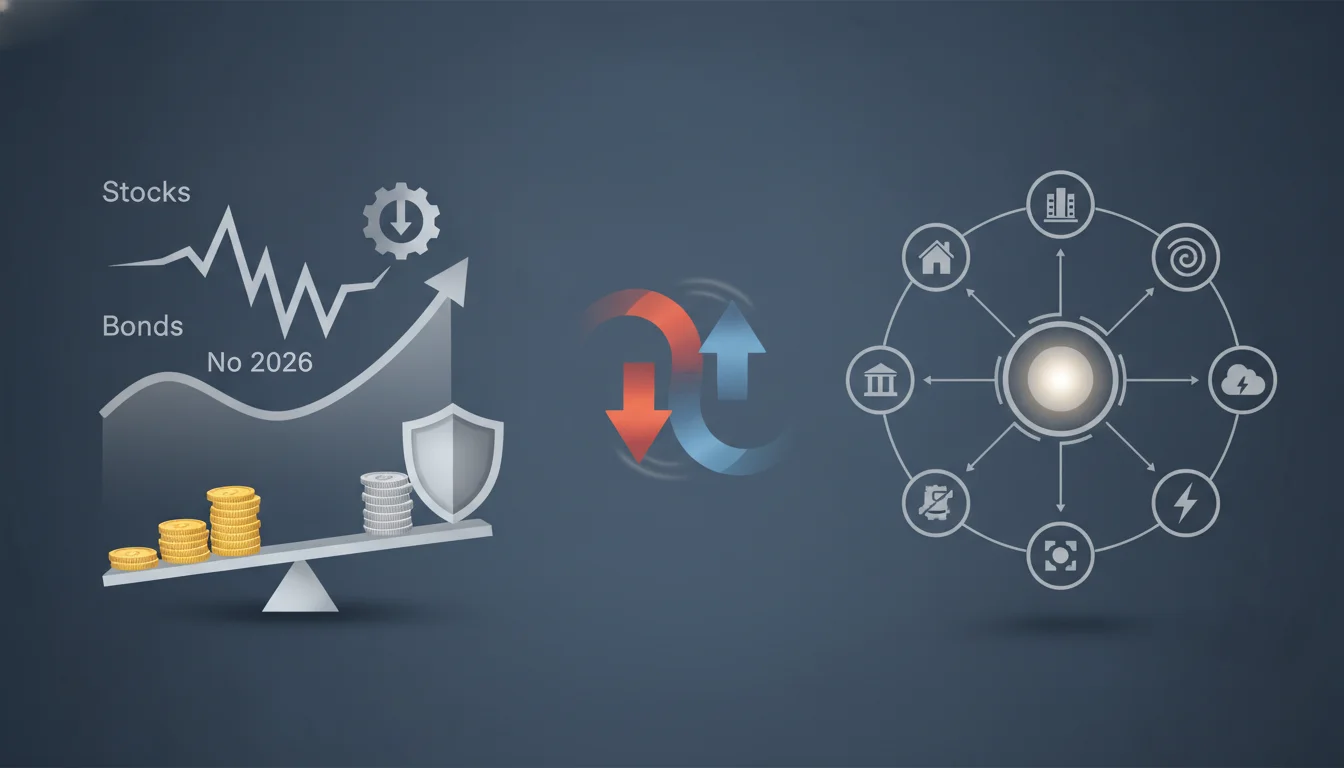
Key Takeaway
The 60/40 portfolio, 60% stocks and 40% bonds, has been declared dead more times than almost any idea in investing. Then came Friday, November 20, 2026. The S&P 500 fell 3.7% to 6,910.39 and the Nasdaq Composite dropped 5.28%, according to CNBC, capping an 8.6% weekly loss for the S&P 500 that pushed it into correction territory. On the same day, Treasuries rallied hard. CNBC reported the 10-year yield fell about 12 basis points to roughly 4.93%, and the 2-year dropped more than 14 basis points. For one painful week, bonds did exactly what a 60/40 investor hired them to do.
That does not settle the debate. From 2022 through much of 2025, stocks and bonds frequently fell together, and the IMF warned in February 2026 that stock-bond diversification now offers less protection in sell-offs than it did from 2000 to 2019. BlackRock counted that since 2020, bonds posted negative returns in 17 of the 19 months when equities fell 2% or more. The real question is not whether 60/40 is alive or dead, but when bonds hedge stocks, when they do not, and how to build a balanced portfolio that survives both regimes.
This guide walks through what happened this week, why the stock-bond correlation flips, what a Fed that is still debating rate hikes means for the bond sleeve, and practical ways to modernize a 60/40 portfolio without abandoning the discipline that makes it work. It is educational content, not personalized advice, and every market figure carries its source and as-of date.
What This Week's Sell-Off Revealed About the 60/40 Portfolio
A stress test in real time
Diversification theory is easy to agree with on a calm day. It gets tested when the screen turns red. This week's decline was driven largely by worries around the AI trade, including concerns about the pace of AI capital spending and a Reuters report that the SEC is exploring possible accounting issues at Nvidia, which sent the stock down about 14% on Friday. CNBC reported the Dow lost 8% on the week, its worst week since March 2020, while the Nasdaq fell about 10%, its largest one-week drop in more than six years.
A portfolio that held only U.S. large-cap stocks absorbed the full force of that move. A 60/40 investor felt roughly six-tenths of it on the equity side, and then got something back from the bond side. LPL Financial's Lawrence Gillum told CNBC that "the safe-haven bid is clearly alive and well." That is the classic textbook behavior: when growth fears dominate, investors sell risky assets and buy government bonds, pushing yields down and bond prices up.
Where the bond rally came from
The details of Friday's Treasury move matter for anyone holding bonds as a hedge. According to NAVERA's weekly data review, the 10-year cash yield closed at about 4.95%, down roughly 10.6 basis points from Thursday's 5.05% close, while the 10-year TIPS real yield fell about 6.5 basis points to 2.80%. In other words, most of the rally came from falling real yields, which is what you would expect when the market reprices growth risk, rather than from a collapse in inflation expectations.
The front end moved even more. The 2-year yield fell more than 14 basis points intraday per CNBC, reflecting a shift in Fed expectations. CNBC cited CME FedWatch showing roughly a 92% probability of a quarter-point hike at the December meeting, down slightly from Thursday. Markets did not abandon the idea of a hike, but they trimmed the odds of an aggressive one, and that alone was enough to lift short- and intermediate-term bond prices.
One good week is not a regime change
It would be a mistake to treat one Friday as proof that the old relationship is fully back. Yields across the curve remain high by the standards of the past 15 years, with the 30-year near 5.3% according to CNBC, and the Fed is still debating whether to tighten further. Governor Christopher Waller told CNBC on November 18 that a half-point hike may be needed, saying the Fed may have to "shock people." A bond hedge that works when growth fears dominate can stop working quickly if inflation fears return.
That is why balanced investors should take this week as useful evidence rather than a verdict. It shows that, with starting yields near 5%, Treasuries once again have room to rally in a growth scare. It does not show that bonds will rally in every scare, especially one driven by inflation, fiscal stress, or a hawkish surprise from the Fed.
Why the Stock-Bond Correlation Flips
The inflation regime decides
The most important variable for a 60/40 portfolio is not the level of stocks or bonds but the sign of their correlation. When the main macro risk is weak growth, bad news hurts stocks and helps bonds, so the correlation is negative and the two assets offset each other. When the main risk is inflation, bad news can hurt both at once, because higher inflation pushes yields up and bond prices down while also squeezing equity valuations.
The IMF's February 2026 blog by Tobias Adrian, Johannes Kramer, and Sheheryar Malik places the turning point "around the end of 2019." From 2000 to 2019, the inverse relationship helped investors manage risk. Since then, the authors argue, inflation and supply shocks after the pandemic, heavier government bond issuance to finance deficits, and rising term premiums have weakened the hedge, so that losses compound when both assets fall together.
What 2022 taught balanced investors
The clearest example is 2022, when the Fed raised rates aggressively to fight inflation. Vanguard calculated that a U.S. 60/40 portfolio returned about negative 16.1% that year, and the Bloomberg U.S. Aggregate bond index lost about 13% through late December, its worst year since its 1976 inception. Investors who expected bonds to cushion a falling stock market instead watched both sides of the portfolio drop together.
Forvis Mazars, in an analysis dated November 2026, found that stocks and bonds fell together in 11 of the 22 months from January 2022 to October 2023, compared with only one such month in each of the dot-com and global financial crisis drawdowns. That is the scenario that gives the 60/40 its bad reputation, and it is a real risk that investors must plan for rather than dismiss.
Fiscal supply and the term premium
A newer driver is the sheer volume of government debt. When the Treasury issues more bonds than investors want to absorb at current prices, yields have to rise to clear the market, and that extra compensation is the term premium. The IMF notes that issuance outpaced central bank balance-sheet runoff in recent years. Rising term premiums can push long-term yields up even during periods of equity weakness, which undermines the hedge precisely when investors need it.
That is why the duration of your bond holdings matters. Long-term bonds are the most sensitive to term-premium shocks and inflation surprises, while short- and intermediate-term Treasuries are more tied to Fed policy expectations. In a growth scare, like Friday, the front and middle of the curve tend to respond strongly. In a fiscal or inflation scare, the long end can be the weakest part of the portfolio.
The Case That 60/40 Is Still Working
The recovery since 2022
Critics who called the 60/40 dead in 2022 had a strong case on the evidence of that year. What came next weakened it. Forvis Mazars calculated that an illustrative 60/40 portfolio returned approximately 33.6% from January 2022 to August 2026, with global equities up about 65% and global government bonds down about 3.8% over the same stretch. The firm wrote that subsequent performance "suggests those claims were premature."
Note what drove that result. Strong equity returns did almost all the work, while bonds were roughly flat to negative. That is a recovery, but it is also a warning: if equity returns are weaker from here, a bond sleeve that merely breaks even will not be enough. Forvis Mazars itself cautioned that strong equity returns cannot be relied upon to make up for weak bond performance.
Starting yields have reset the math
The biggest change since 2021 is that bonds now pay meaningful income. When the 10-year Treasury yielded around 1.5%, the bond sleeve offered little return and little room to rally. With the 10-year near 4.9% to 5.0% this month, a high-quality bond portfolio starts with a much larger income cushion, and yields have room to fall substantially in a recession scare, which is where price gains come from.
Vanguard's 2026 economic and market outlook, published in December 2025, projected returns on high-quality U.S. bonds of around 4% over the coming decade, and said its models suggested a 40/60 portfolio could match a 60/40 over the next decade with less risk, given stretched equity valuations. Those are projections, not promises, and Vanguard stresses that they are not portfolio advice. But they show how much the relative appeal of bonds has improved.
Equity concentration raises the value of ballast
The equity side of a 60/40 portfolio is riskier than it looks. BlackRock, citing FactSet data as of March 31, 2026, noted that the 10 largest S&P 500 companies made up about 37% of the index's market cap, compared with 29% in 2020 and 19% in 2010. When a handful of AI-linked giants drive the index, a shock to that theme, like this week's, hits a large share of a "diversified" equity fund at once.
That concentration is an argument for, not against, holding a real bond allocation. If your stock exposure is effectively a concentrated bet on a few mega-cap technology names, then a sleeve of assets that behaves differently is more valuable, not less. The work is making sure the bond sleeve is built to hedge the risks you actually face.
The Fed Factor: Holding Bonds While Rates May Still Rise
Hikes are the bond investor's biggest near-term risk
The awkward fact of late 2026 is that the Fed is debating tightening even as stocks wobble. NAVERA's summary of the October minutes noted the target range was held at 3.75% to 4.00%, with two voters preferring a hike, and CNBC reported markets assigning roughly 92% odds to a quarter-point increase at the December 8–9 meeting as of Friday. A hike usually pushes short-term yields up and can briefly weigh on bond prices.
For a 60/40 investor, the question is how much of that is already priced. When markets assign a 92% chance to a move, much of the impact sits in current yields. The risk is a bigger-than-expected move, such as the half-point hike Waller floated, or a signal of more hikes to come. That scenario would likely hurt both stocks and bonds in the short run, the same pattern that made 2022 so painful.
Duration choices inside the bond sleeve
Not all bonds react the same way to the Fed. Short-term Treasuries and T-bills mostly track policy rates, so they offer stability and income but little hedge value in a growth scare. Intermediate-term Treasuries, roughly five to 10 years, balance income with meaningful price sensitivity. Long-term bonds offer the largest potential gains in a deflationary shock but also the largest losses in an inflation or fiscal shock.
Many advisors treat intermediate Treasuries as the core hedge, with short-term holdings for liquidity and inflation-protected bonds as a partial defense against the 2022 scenario. Friday offered a reminder of why: the 2-year and 5-year moved roughly as much as the 10-year, per NAVERA, delivering hedge value without the full volatility of 30-year bonds.
Inflation protection as a second line of defense
If the main risk to a 60/40 portfolio is inflation, Treasury Inflation-Protected Securities deserve a look. TIPS principal adjusts with the Consumer Price Index, so they hold up better than nominal bonds when inflation surprises to the upside. With 10-year TIPS real yields near 2.8% as of November 20, according to NAVERA, investors are being paid a historically high real return for that protection.
TIPS are not a perfect hedge. They still carry real-rate risk, so they can fall when real yields rise sharply, as they did in 2022. But blending nominal Treasuries for growth scares with TIPS for inflation scares gives the bond sleeve two different tools rather than relying on one relationship that may or may not hold.
How to Modernize a 60/40 Portfolio Without Abandoning It
Diversify the diversifiers
BlackRock's April 2026 research argues that because bonds have been a less reliable hedge since 2020, investors should consider carving out room for liquid alternatives, such as long-short or market-neutral strategies, and the firm noted that March 2026 was the second-weakest month for 60/40 portfolios since 2022. Others favor modest allocations to gold, which the IMF observed has more than doubled since the start of 2024, or to trend-following strategies that can profit from sustained moves in either direction.
These additions come with their own costs, complexity, and periods of underperformance, so they should be sized carefully. The point is not to replace bonds but to avoid depending on a single relationship. A portfolio with several sources of ballast is less exposed to any one of them failing at the wrong moment.
Rebalancing is where the edge lives
The 60/40 portfolio's quiet superpower is rebalancing. After a week like this one, stocks are a smaller share of the portfolio than the target and bonds are a larger share. Rebalancing means selling some of what held up and buying some of what fell, which enforces buying low and selling high without any forecast. It is also psychologically difficult, which is exactly why a written rule helps.
Common rules include rebalancing on a calendar schedule, such as quarterly or annually, or when an allocation drifts more than five percentage points from target. Tax-advantaged accounts are the easiest place to rebalance without triggering capital gains. If you want a reminder that fires on schedule rather than on emotion, an Alphio Scheduled Task can run a recurring allocation check and flag when drift crosses your threshold.

Match the mix to the money's job
The 60 and the 40 are not sacred numbers. A 30-year-old saving for retirement might reasonably hold far more stocks, while a retiree drawing income might prefer 40/60 or 50/50. What matters is that the mix reflects when the money is needed and how much decline you can tolerate without abandoning the plan. A portfolio you will actually hold through a correction beats a theoretically optimal one you will sell in a panic.
Before changing your allocation after a week like this, write down the reasons. If the change is driven by a shift in your goals, horizon, or income needs, it is planning. If it is driven only by the last five trading days, it is probably the market talking. If you prefer to talk through scenarios before acting, Alphio's Conversational Trading lets you ask how a given allocation would have behaved in past sell-offs before you place an order.
Practical Allocation Choices for Late 2026
Building the bond sleeve
The following is an illustrative framework, not a recommendation, for how some balanced investors think about the 40% side today. Each sleeve has a specific job, and the weights should reflect your own risk tolerance and tax situation.
- Core intermediate-term Treasuries or a broad high-quality bond fund for growth-scare protection and income.
- Short-term Treasuries or T-bills for liquidity, spending needs, and dry powder for rebalancing.
- TIPS for inflation-surprise protection, accepting some real-rate risk.
- A modest diversifier sleeve, such as gold or a liquid alternative, sized so its underperformance would not derail the plan.
The aggregate bond market offers a single-fund version of the core sleeve. Watching its rating and price trend alongside Treasuries can help you see whether credit is behaving like a hedge or like an equity proxy during stress.
What to avoid in the bond sleeve
The most common mistake is reaching for yield in a way that turns the bond sleeve into a second equity bet. High-yield corporate bonds and lower-quality credit tend to fall alongside stocks in a sell-off because their fortunes are tied to the same economy. They can play a role in an income portfolio, but they should not be counted as part of the hedge.
Conclusion
This week offered a timely reminder of why the 60/40 portfolio has survived so many obituaries. As the S&P 500 slid into a correction on November 20, 2026, Treasuries rallied and yields fell, cushioning balanced investors the way the strategy intends. Yet the hedge is not guaranteed. The 2022 experience, the IMF's warning about weaker diversification since 2020, and a Fed still weighing rate hikes all show that stocks and bonds can fall together when inflation, not growth, is the dominant fear.
The practical answer is not to abandon 60/40 but to modernize it. Spread bond duration across the curve, add inflation protection, consider a modest diversifier sleeve, keep credit risk out of the hedge, and match the overall mix to the money's job. Above all, rebalance on a rule rather than a feeling, because that is where a balanced portfolio earns its keep after weeks like this one.
If you want help staying disciplined, an Alphio Scheduled Task can run your allocation check on a fixed calendar, while Alphio Autonomous Trading can execute a predefined rebalancing strategy within the risk limits you set. Either way, decisions made on a plan tend to age better than decisions made during an 8.6% week.
FAQs
What is a 60/40 portfolio?
A 60/40 portfolio holds about 60% in stocks for growth and 40% in high-quality bonds for income and stability. It is typically rebalanced periodically so the mix returns to target as markets move.
Did bonds protect stocks during the November 2026 sell-off?
Yes, at least on November 20, 2026. CNBC reported the S&P 500 fell 3.7% while the 10-year Treasury yield dropped about 12 basis points, meaning bond prices rose and partly offset stock losses.
Why did the 60/40 portfolio fail in 2022?
In 2022 the Fed raised rates aggressively to fight high inflation, which pushed bond prices and stock prices down at the same time. Vanguard calculated a U.S. 60/40 portfolio lost about 16.1% that year.
Is the 60/40 portfolio still a good strategy in 2026?
Many firms, including Vanguard and Forvis Mazars, argue it still has merit because bond yields near 5% offer real income and room to rally. Others, such as BlackRock and the IMF, caution that bonds are a less reliable hedge since 2020, so diversifying the bond sleeve is prudent.
How often should I rebalance a 60/40 portfolio?
Common approaches are rebalancing on a set schedule, such as quarterly or annually, or when an allocation drifts more than about five percentage points from target. Rebalancing inside tax-advantaged accounts or with new contributions can reduce tax costs.
Related articles
- Municipal Bonds in 2026: Are Tax-Free Yields Worth It With Treasuries Near 5%?Are municipal bonds worth it with Treasuries near 5%? Learn tax-equivalent yield, the muni-to-Treasury ratio, 2026 brackets, tax traps, and credit risk.
- Should I Sell My Stocks? What to Do When the Stock Market Crashes in 2026The Dow just had its worst week since 2020. Should you sell? See what history shows about panic selling, when selling makes sense, and how to triage now.
- Margin Calls in the 2026 Correction: How Margin Debt Turns a Sell-Off Into Forced SellingStocks just had their worst week since 2020 with $1.45T of margin debt in play. Learn how margin calls work, your trigger price, and how to respond in 2026.
- Risk Checklist Before Copying an AI Trading StrategyA practical risk checklist before copying an AI trading strategy: mandate clarity, external budget caps, custody, data sanity checks, and kill criteria.
- Checklist: Red Flags in Social Trading AppsA practical red-flag checklist for social trading apps: fake track records, custody issues, gross-only ROI, urgency sales, and live execution warnings.
- Position Sizing Checklist for Social and Copy TradingA practical position sizing checklist for social and copy trading: pro-rata vs fixed size, leverage caps, correlation limits, and drawdown gates.