

How to Rebalance Your Portfolio Before Year-End 2026: A Practical Guide for a Hiking Fed and a Conce
Learn how to rebalance your portfolio before year-end 2026: measure drift, pick a method, cut taxes, and handle bonds, cash and concentrated tech positions.

Key Takeaway
Most investors know they should rebalance their portfolio at least once a year, yet very few actually do it, and 2026 is a year in which skipping that step could quietly leave a lot of people holding more risk than they signed up for. The S&P 500 closed at 7,520.93 on November 10, 2026, according to the Federal Reserve Bank of St. Louis FRED database, roughly 10% above where it finished 2025 and about 4% below its October 6 record of 7,818.93 reported by Macrotrends. At the same time, the Federal Reserve has turned from cutting to hiking, Treasury bills pay above 4%, and the ten largest companies in the index account for close to 39% of its weight. A balanced portfolio built in January has very likely drifted by now.
Rebalancing is simply the act of bringing your mix of stocks, bonds and cash back to the targets you chose when you were calm. It does not require predicting the next Fed decision or the next AI earnings report. Vanguard's long-running research on the subject concludes that there is no single optimal frequency or threshold, but that a disciplined approach, such as checking once or twice a year and acting when an asset class is off by about five percentage points, keeps risk close to plan without generating excessive trading costs. The goal is risk control, not return maximization.
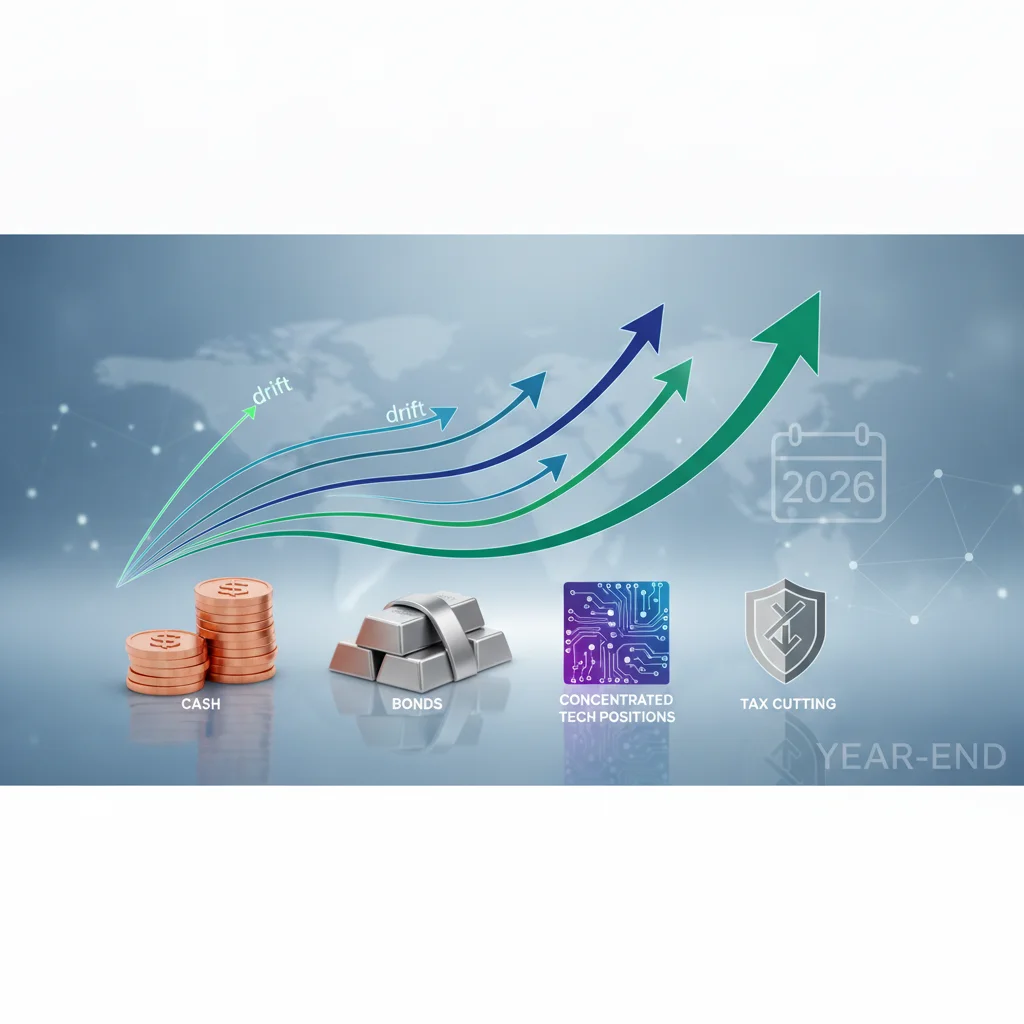
This guide explains how to rebalance your portfolio before year-end 2026: why drift matters more than usual this year, how to measure it, which rebalancing method fits different investors, how to do it with minimal taxes, and where cash, bonds and concentrated tech holdings fit in. Market data are as of the close on Tuesday, November 10, 2026 (America/New_York) unless noted. Tax figures refer to 2026 federal rules; forecasts are projections, and nothing here is personalized tax or investment advice.
Why Portfolio Rebalancing Matters More in Late 2026
A strong year leaves stock-heavy portfolios behind
The simplest reason to rebalance is arithmetic. The S&P 500 ended 2025 at 6,845.50 and closed at 7,520.93 on November 10, 2026, a gain of nearly 10% before dividends. Bonds, by contrast, have had a choppier year as the 10-year Treasury yield climbed above 5% in October before easing back to about 4.88% by November 9, according to the U.S. Treasury's daily yield curve data. When one asset class rises faster than the others, its share of your portfolio grows without you buying a single extra share.
A classic 60% stock and 40% bond portfolio shows the effect clearly. If stocks gain 10% and bonds are roughly flat, the stock sleeve grows to about 62% of the total in a single year. That sounds small, but drift compounds. Investors who skipped rebalancing in 2023, 2024 and 2025, all strong years for U.S. large caps, could easily find a portfolio that started at 60/40 now sitting near 70/30. The portfolio's expected volatility, and its likely drawdown in a bad year, has risen accordingly.
The macro backdrop has changed
The second reason is that the environment around those holdings has shifted. The Fed raised its target range to 3.75% to 4.00% in September 2026, held it on October 28, and futures markets were pricing a high probability of another quarter-point increase at the December 8 to 9 meeting after the October consumer price index came in hot on November 10. A Fed that is tightening, rather than easing, tends to pressure richly valued growth stocks and raise the yield on cash and short-term bonds. Both effects argue for reviewing whether your current mix still matches your goals.
Valuations add to the case. FactSet reported a forward 12-month price-to-earnings ratio of 17.7 for the S&P 500 as of November 5, which implies an earnings yield of about 5.6%. With the 10-year Treasury near 4.9%, the extra return investors expect for owning stocks instead of government bonds is under one percentage point. That does not predict a decline, but it means the reward for running an overweight equity position is thinner than it was a few years ago.
Concentration is hiding inside the index
The third reason is less visible. Even investors who hold nothing but a broad index fund are more concentrated than they may realize. Slickcharts data as of October 10, 2026 put the ten largest S&P 500 constituents at about 39% of the index, with Nvidia alone near 7.8%. Estimates from RBC Wealth Management and others suggest the share peaked at roughly 41% at the end of 2025. When a handful of mega-cap technology companies drive both the gains and the volatility, an index fund behaves more like a growth-tilted portfolio than the word diversified implies.
How to Measure Portfolio Drift
Start with a written target allocation
Rebalancing only works if you know what you are rebalancing toward. Before looking at any account, write down your target mix in plain percentages, for example 55% U.S. stocks, 15% international stocks, 25% bonds and 5% cash. The right numbers depend on your time horizon, income needs and ability to sit through losses, not on what the market did last month. If you have never written a target down, this is the most valuable step in the entire process, because every later decision becomes a comparison against a rule rather than a reaction to headlines.
It also helps to decide which accounts count. Many households hold a 401(k), one or two IRAs, a taxable brokerage account and perhaps a health savings account. Rebalancing works best when you treat these as a single portfolio, because you can then place trades in whichever account is most tax efficient while still hitting the overall target.
Add up every account in one view
Next, total your holdings by asset class across all accounts. A target-date fund or balanced fund should be split into its underlying stock and bond components, which fund companies publish on their websites. Cash in a money market fund counts as cash. Individual stocks should be grouped by category, and it is worth flagging any single company that represents more than 5% to 10% of your total investable assets. Concentrated positions in an employer's stock or a long-held winner are among the most common sources of hidden risk.
Once everything is in one table, compare the current weight of each asset class to its target. The difference is your drift. A simple spreadsheet is enough, though many brokerages now offer an allocation view that does the aggregation for you if all your accounts are held in one place.
Decide what counts as off target
Not every deviation is worth acting on. Trading too often can create taxes, commissions and bid-ask costs that outweigh the risk benefit. Vanguard's paper "Best Practices for Portfolio Rebalancing" tested calendar schedules and percentage thresholds and found that risk-adjusted returns did not differ dramatically between reasonable strategies. In its examples, a portfolio was flagged for rebalancing when an asset class drifted at least five percentage points from target. Many investors use that five-point band for major asset classes and a tighter relative band, such as 20% to 25% of the target weight, for smaller slices like international or small-cap stocks.
Choosing a Rebalancing Strategy
Calendar rebalancing
Calendar rebalancing means reviewing the portfolio on a fixed date, such as the first week of December or your birthday, and trading back to target regardless of how far it has drifted. Its greatest strength is simplicity. You do not need to monitor markets, and the habit is easy to keep. Year-end is a popular choice because it lines up with tax planning, required minimum distributions and annual contribution decisions.
The weakness is that markets do not move on your calendar. A sharp sell-off in March could leave you badly underweight stocks for months, missing a chance to buy at lower prices, while a quiet year could prompt trades that were not really needed.
Threshold rebalancing
Threshold rebalancing ignores the calendar and acts only when an asset class moves outside its band. This approach responds to big market moves, which is when rebalancing tends to add the most value, because it forces you to buy what has fallen and trim what has run. During the early-November 2026 technology sell-off, for instance, a threshold investor might have added to stocks while others were selling.
The catch is monitoring. A pure threshold approach requires checking allocations regularly, which is impractical for many do-it-yourself investors. Without some form of automation, the rule tends to be forgotten exactly when markets are most volatile.
The hybrid approach most investors can sustain
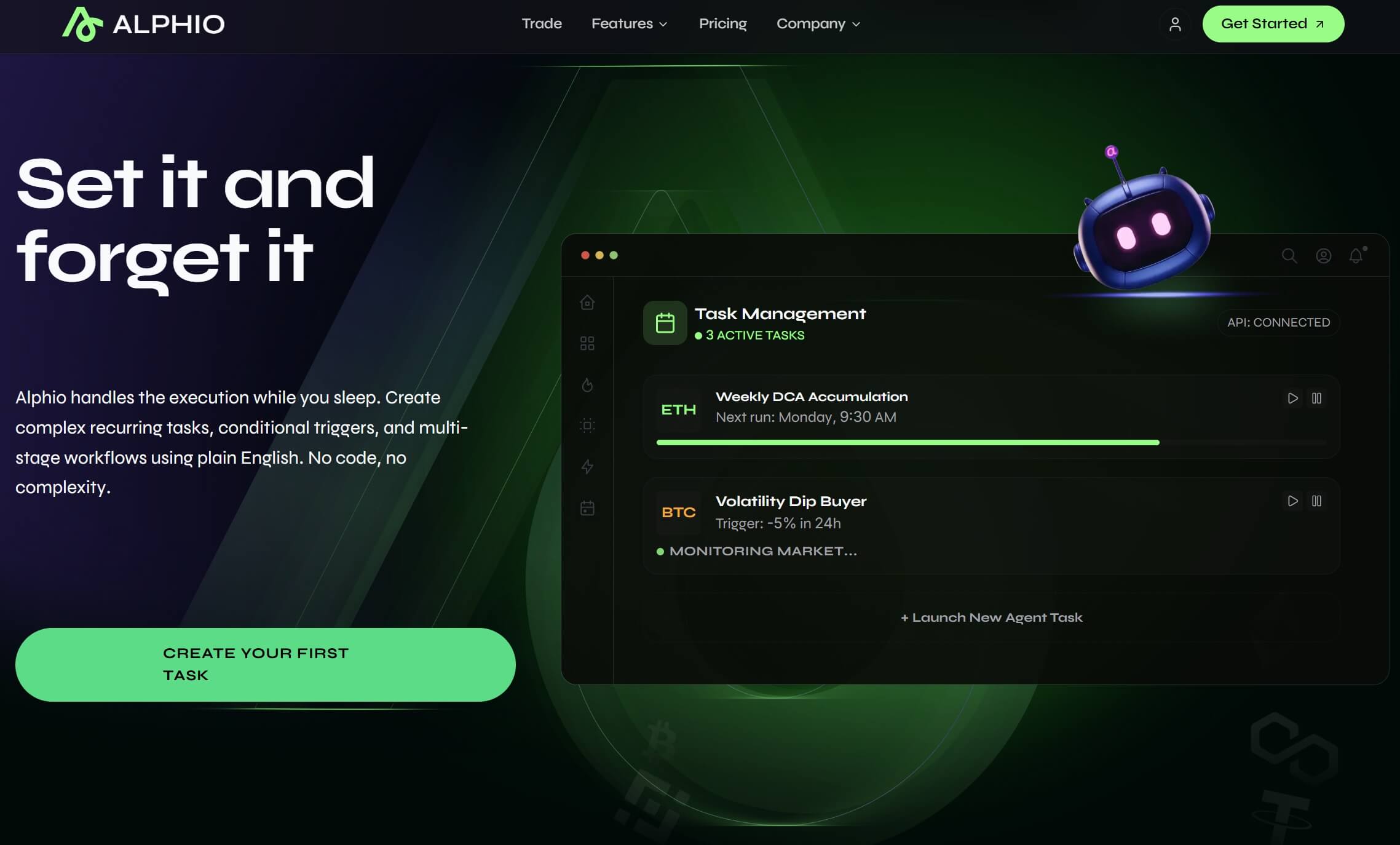
For most people the best answer combines the two: review on a schedule, but trade only if drift exceeds the band. Vanguard's research describes annual or semiannual monitoring with a roughly five-percentage-point threshold as a reasonable balance between risk control and cost. Investors who want help sticking to that rhythm can set up recurring portfolio check-ins with Alphio's Scheduled Task feature, which runs on a calendar you define and flags when your mix has moved outside the limits you wrote down.
How to Rebalance Without a Big Tax Bill
Use tax-advantaged accounts first
The most tax-efficient place to rebalance is inside retirement accounts. Selling a stock fund and buying a bond fund in a 401(k) or IRA triggers no capital gains tax, so if your overall allocation has drifted toward stocks, trimming equities inside those accounts can often fix the entire problem. Morningstar's Christine Benz has long recommended starting there, and in many cases ending there, before touching a taxable brokerage account.
This is also where the asset-location view pays off. Because you are rebalancing the household portfolio, not each account individually, it does not matter that one IRA ends up mostly in bonds while the taxable account holds mostly stocks, as long as the combined totals match your targets.
Direct new money toward what is underweight
The second tool is cash flow. Instead of selling winners, direct new contributions, dividends and interest toward the asset classes that are below target. For 2026, the IRS allows employees to contribute up to $24,500 to a 401(k) and $7,500 to an IRA, with additional catch-up amounts for workers aged 50 and older. Year-end bonuses, maturing certificates of deposit and fund distributions can all be steered in the same way. For investors who are still adding money, this approach can often close a modest gap without any taxable sale.
Retirees can use the same principle in reverse. Required minimum distributions, which generally must be taken by December 31 for those aged 73 or older, can be withdrawn from whichever holdings are overweight. That turns a required withdrawal into a rebalancing trade at no extra tax cost beyond the distribution itself.
Harvest losses and watch the 0% bracket
When you must sell in a taxable account, pair gains with losses. Positions that fell during this autumn's volatility can be sold to realize capital losses that offset gains from trimming winners, with up to $3,000 of net losses deductible against ordinary income each year. Keep the wash-sale rule in mind: buying a substantially identical security within 30 days before or after the sale disallows the loss.
Some investors can realize gains at no federal tax at all. Under IRS Revenue Procedure 2025-32, the 0% long-term capital gains rate for 2026 applies to taxable income up to about $49,450 for single filers and $98,900 for married couples filing jointly. Households in a low-income year, such as early retirees, may be able to trim appreciated stock and reset their cost basis tax-free. The 2027 thresholds and contribution limits had not been confirmed in the sources reviewed for this article; benefits consultants such as Milliman and Marsh project the 401(k) limit rising to $25,500, but that remains a projection.
Where Bonds and Cash Fit in 2026
Bonds finally pay you to rebalance into them
For much of the last decade, rebalancing out of stocks felt painful because bonds yielded so little. That is no longer the case. On November 9, the U.S. Treasury's data showed the 3-month bill at 4.24%, the 2-year note at 4.56% and the 10-year at 4.88%. A high-quality bond sleeve now offers meaningful income while it waits to act as ballast, which makes trimming an overweight equity position less costly in terms of foregone return.
Duration choices matter in a hiking cycle
Rebalancing into bonds raises a second question: how long a maturity? Longer-duration bonds rise more when yields fall but lose more when yields climb, as they did in October when the 10-year topped 5%. With the Fed debating further hikes, many investors split new bond money between short-term Treasuries and an intermediate core bond fund rather than reaching for the longest maturities. The point is to keep the bond sleeve doing its job, which is reducing portfolio volatility, rather than turning it into another rate bet.
Do not let cash become an accidental allocation
High money market yields have encouraged many investors to let cash pile up. That is fine when it is a deliberate choice, such as an emergency fund or money earmarked for a purchase within two years. It becomes a problem when cash grows simply because no one decided where to put it. If cash is more than a few points above your target, treat it as drift and invest it according to the plan, ideally in stages if a lump sum makes you uncomfortable.
Handling Concentrated Tech and AI Winners
Why winners are the hardest positions to trim
The most difficult rebalancing decisions involve positions that have done extremely well. Many investors bought large technology names years ago and now hold them at large unrealized gains, sometimes making a single stock 15% or 20% of their wealth. Selling feels like betting against a proven winner, and the tax bill feels like a penalty for success. Yet the risk is real: when a stock that large falls 30%, it can erase years of gains across the rest of the portfolio.
Staged trimming and position caps
A practical solution is to set a maximum weight for any single stock, often 5% to 10% of investable assets, and trim gradually toward it. Selling in stages across two tax years, for example part in December and part in January, can spread the gain over two returns and reduce regret if the stock keeps rising. Donating appreciated shares to charity or a donor-advised fund is another way to reduce a concentrated position without realizing the gain, for investors who already planned to give.
Check overlap with your index funds
Remember that a broad U.S. index fund already holds the largest technology companies at heavy weights. An investor who owns an S&P 500 fund, a Nasdaq-100 fund and individual shares of the same mega-cap names may have much more exposure to a handful of companies than any single statement shows. Adding up look-through exposure, at least for the top five holdings, is one of the most revealing exercises in a year-end review.
A Year-End Rebalancing Checklist for 2026
Steps to complete before December 31
The process is easier to follow when it is written down in order. A practical sequence for the rest of 2026 looks like this:
- Write or confirm your target allocation and the drift band for each asset class.
- Aggregate every account into one view and calculate current weights, including look-through exposure to your largest stocks.
- Rebalance inside tax-advantaged accounts first, then direct new contributions, dividends and any required minimum distributions toward underweight assets.
- In taxable accounts, pair any gains from trimming with harvested losses and check whether you qualify for the 0% long-term capital gains bracket.
- Set the date of your next review and decide how you will be reminded.
Timing around the December Fed meeting
Some investors wonder whether to wait until after the Fed's December 8 to 9 decision. Because rebalancing is about risk rather than prediction, there is no need to wait for a specific event. That said, mutual funds often distribute capital gains in December, so buying a fund in a taxable account just before its distribution date can create an unnecessary tax bill. Checking fund distribution calendars is a small step that can save real money.
Keeping the habit in 2027
The best rebalancing plan is the one you will actually follow next year. Whether that means a calendar reminder, an automated alert or a meeting with an adviser, the key is to make the next review the default rather than an afterthought.
Conclusion
Learning how to rebalance your portfolio is one of the few investing skills that improves outcomes without requiring any forecast. In late 2026, a year of solid stock gains, a Fed that has turned toward hiking, Treasury bills paying above 4% and an index that is unusually concentrated in a handful of technology giants have combined to push many portfolios away from their intended risk levels. Bringing them back is not a bet against stocks; it is a way to make sure your exposure reflects your plan rather than the market's latest move.
The process is straightforward: write down your targets, measure drift across every account, trade first where taxes are lowest, use new money and required distributions to do the heavy lifting, and handle concentrated winners in stages. Investors who want to turn that discipline into a repeatable workflow can explore Alphio's Scheduled Task feature for calendar-based reviews, or use Conversational Trading to ask questions about allocations and place rebalancing trades in plain language. Those who prefer to follow an experienced investor's approach can look at Copy Trade, keeping in mind that every strategy carries risk and past performance does not guarantee future results.
FAQs
How often should I rebalance my portfolio?
Vanguard's research found no single optimal frequency, but reviewing once or twice a year and trading only when an asset class drifts about five percentage points from target is a reasonable balance. This hybrid approach controls risk without generating excessive trading costs or taxes.
Is year-end a good time to rebalance?
Year-end is a popular time because it lines up with tax-loss harvesting, required minimum distributions and annual contribution planning. The exact date matters less than having a consistent schedule and following it.
How can I rebalance without paying capital gains tax?
Start by trading inside 401(k)s and IRAs, where sales are not taxed, and direct new contributions and dividends toward underweight assets. In taxable accounts, offset gains with harvested losses and check whether your income falls within the 0% long-term capital gains bracket, which for 2026 covers taxable income up to about $49,450 for single filers.
Should I wait for the December Fed meeting before rebalancing?
Rebalancing is a risk-control rule rather than a market forecast, so there is no need to wait for a specific Fed decision. Delaying trades based on expectations for rates turns rebalancing into market timing, which defeats its purpose.
What should I do if one stock has grown to a large share of my portfolio?
Many investors set a cap of 5% to 10% of investable assets for any single stock and trim toward it in stages, sometimes across two tax years to spread out the gain. Donating appreciated shares to charity is another option for those who already plan to give.
Related articles
- Bank Stocks and Rising Interest Rates: How to Invest in Financials as the Fed Tightens in 2026Are bank stocks a buy as rates rise? Learn how Fed hikes, the yield curve, deposit costs and credit quality drive bank earnings and valuations in late 2026.
- Fed Rate Hike and the Stock Market: What Investors Should Know Before December 2026A December Fed rate hike looks likely. Learn how rate hikes move stocks, what past tightening cycles show, which sectors hold up, and how to plan ahead.
- Retail Stocks and the 2026 Holiday Shopping Season: What Investors Should WatchNRF forecasts $1.013 trillion in 2026 holiday sales, but consumers are stretched. Learn how retail stocks trade around the holidays and what to watch now.
- NVIDIA Stock Analysis September 2026: Why AI Demand Keeps Breaking RecordsComprehensive NVIDIA stock analysis for September 2026. Explore how AI data center demand, Blackwell chip sales, and 70% revenue growth forecasts are driving NVDA's investment outlook.
- Top 5 Best AI Stock Trading Bots in 2026Discover the top 5 best AI stock trading bots in 2026. Compare Trade Ideas, Alphio AI, TrendSpider, Tickeron, StockHero, and Kavout for automated trading and analysis.
- 3 Best AI Trading Bots for 2026Discover the best AI trading bots for 2026. Compare Trade Ideas, Alphio AI, StockHero, TrendSpider, and TradingView for automated trading, signals, and strategy building.