

How to Evaluate a Hyperliquid or On-Chain Copy Vault
A checklist to evaluate Hyperliquid-style on-chain copy vaults: permissions, leader metrics, sizing modes, margin, and operational red flags.

Key Takeaway
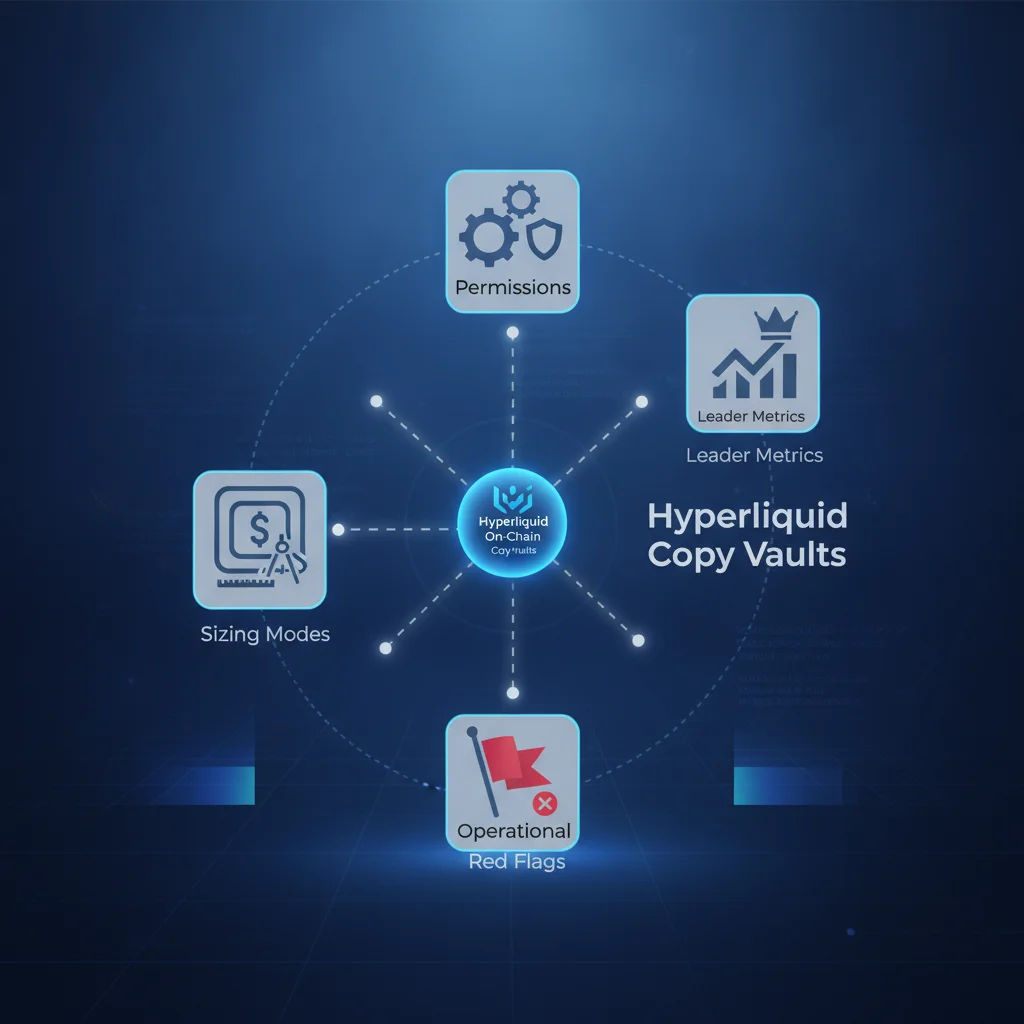
Evaluating a Hyperliquid or on-chain copy vault is less about chasing the loudest leaderboard PnL and more about reading the machine underneath the returns. On-chain perpetual copy products advertise transparency: you can see fills, leverage, and often the permission model that lets followers mirror without surrendering withdrawal rights. Transparency only helps if you know which questions to ask. A vault can be non-custodial in the transfer sense and still be uncopyable in the economic sense because of leverage, latency, or style that does not survive follower delay.
This checklist is for traders who want to evaluate Hyperliquid-style vaults and on-chain copy leads before allocating. It covers permission architecture, leader metrics that actually matter, sizing modes, margin choices, and the operational failure modes that guides keep documenting: skipped minimums, slippage after the lead, and correlated books dressed up as diversification.
Start with the permission and margin architecture
Trade rights without transfer rights
The first pass is architectural. Does following create a standing authorization that can open and close positions but cannot withdraw or transfer? Can you revoke it yourself? Do funds remain in a wallet you control? Hyperliquid-oriented explainers emphasize that separating trade scope from fund movement turns a trust problem into a permission problem. That is necessary, not sufficient. Confirm it in official docs and in a dust-sized live revoke test before you treat marketing language as fact.
Isolated versus cross, and whose leverage you inherit
Copy settings on Hyperliquid-adjacent tools often default to isolated margin for a reason: a liquidation then threatens position margin rather than the whole wallet. “Like the trader” or full cross modes can track the lead more tightly while importing wallet-wide risk. Likewise, mirrored leverage should be capped independently. A lead comfortable at high leverage on a large account can be un-survivable on yours. If the product cannot clamp leverage below the lead’s peak, size the relationship as if a full wipe of the allocation is plausible.
Leader metrics that survive skepticism
Win rate without payoff context is a trap
A seventy percent win rate can hide average losses that dwarf average wins. Look at drawdown depth and duration, average and peak leverage, median hold time, trade frequency, and whether returns concentrate in a handful of lottery tickets. Prefer leads whose losing trades are visible and survivable. Educational Hyperliquid guides keep repeating that leaderboard PnL alone is almost useless; believe them.
Capacity and follower impact
Ask whether the edge still works after followers arrive. Thin books and crowded mirrors create slippage for late copies. If the vault’s edge is being first into illiquid perps, you may be buying the residue. Prefer strategies on liquid majors if your size and delay are non-trivial, and assume you are not first even when you click quickly.
Sizing modes on-chain: choose deliberately
Pro-rata, fixed dollar, percent of trade
Pro-rata of your allocated capital is often the default because it matches fractional exposure. Fixed dollar stabilizes ticket size when the lead’s sizing is erratic. Percent of their trade needs a max-per-trade clamp so a sudden large lead order does not dominate your sleeve. Whatever you pick, set an allocation ceiling for the relationship and a wallet-level limit on total margin used by all copies. Defaults that leave those unlimited are not neutral; they are aggressive.
Minimum notionals and skipped copies
On-chain venues enforce minimums. Small pro-rata slices get skipped. Adds may batch until they clear a threshold. Allocation may be fully deployed so new entries cannot open while exits still can. Mature product docs describe these behaviors. If your candidate vault’s tooling is silent about skips, expect surprise divergence between your equity curve and the lead’s.
When you bind a vault inside Alphio Copy Trade, choose the budget first so skipped-copy dynamics are evaluated at a realistic size rather than at fantasy size.

Evaluate and follow on Alphio Copy Trade
Risk overlay: stops, drawdowns, and correlation
Relationship-level circuit breakers
Set a max cumulative loss from the vault as a percent of portfolio and a pause rule after repeated losing trades. Portfolio-level drawdown pauses matter because Hyperliquid leaders often share directional bias in violent tapes. Your “three vault diversification” can be one leveraged macro bet. Cap combined exposure by asset and by net direction across vaults.
Agents and vaults in the same book
If you also run AI strategies, treat them as additional correlated risk unless proven otherwise. Enforce external budgets on Alphio Autonomous Trading so vaults and agents cannot spend the same pain tolerance twice.

Operational due diligence unique to on-chain copy
Outages, delayed mirrors, and exit paths
Know what happens if the copy engine stalls while positions are open. Can you flatten from your wallet directly? How fast? During infrastructure stress on major venues, cancel-only behavior has appeared in the wild; your copy stack may not be as thoughtful. Practice an emergency flatten while sizes are tiny. Document it. Schedule a quarterly re-test with Alphio Scheduled Task.

Schedule vault reviews on Alphio
Transparency theater versus usable transparency
On-chain visibility is only useful if you actually look. Build a weekly habit: compare your fills to the lead’s, note lag, note skipped trades, and decide keep or cut in writing via Alphio Conversational Trading. Transparency without a review ritual is just a prettier way to hope.
Red flags specific to vault shopping
Beware vaults that advertise near-perfect curves over short windows, that suddenly change market universe, that require confusing deposit hops, or that cannot explain authorization scope in plain language. Beware social pressure to deposit quickly before “allocation closes.” Real evaluation is slow on purpose. If a vault cannot survive a week of your checklist, it cannot survive your capital.
Also beware blending prediction-market style narratives, meme flow, and perpetual leverage under one “smart money” label without separating mandates. A vault should have a coherent job. If the job description changes weekly, your unfollow rules should already be twitching.
Field notes from followers who learned the hard way about evaluate hyperliquid on chain copy vault
The most expensive lessons in crypto automation rarely come from a single bad tick. They come from missing controls that looked optional during a calm onboarding. Someone funded a hot sleeve without a revoke drill. Someone raised a budget after three green days. Someone treated a leaderboard as a due-diligence report. Someone kept a lead through style drift because lifetime ROI still sparkled. Each story is specific; the pattern is identical: evidence was replaced by narrative at the moment capital scaled.
You can interrupt that pattern with ceremony that feels almost bureaucratic. Before every increase in size related to evaluate hyperliquid on chain copy vault, require two artifacts: a one-page note of what changed since the last review, and a dust-sized test that proves the control you think you have still works. If either artifact is missing, the increase does not happen. Alphio’s Scheduled Task surface exists to make the ceremony recur, and Conversational Trading exists to make the note attach to the same place you act.
How this checklist connects to Alphio workflows
Checklists fail when they live only in blog tabs. They work when they become defaults in the product path you actually click. For followers, that usually means evaluating a lead, binding a budget, then mirroring—not mirroring first. For agent users, it means external caps before autonomy theater. Use Alphio Copy Trade when the object is a vault, whale, or followable strategy, and Alphio Autonomous Trading when the object is an agent loop that must be fenced.
Apply the checklist in Alphio Copy Trade
Fence agents in Alphio Autonomous Trading
Keep liquid market context honest while you do it. Crypto-sensitive equities such as
and
will not manage your risk for you, but they will remind you that beta clusters. If your notes on evaluate hyperliquid on chain copy vault ignore that clustering, your diversification claims are probably cosmetic.
A thirty-day adoption plan you can actually finish
Week one: write the one-pager and run dust drills only. No scaling. Week two: allow a tiny live sleeve under the strictest caps you wrote, and log every reject or skip. Week three: compare your fills and drawdowns to the thesis; demote anything that drifted. Week four: decide whether to promote, hold, or kill—then schedule the next monthly review before you celebrate. The plan is deliberately slow. Speed is how social trading apps sell. Slowness is how educational capital survives.
If you skip weeks, do not “catch up” by jumping to week four size. Restart at the last honest week. Ambition is cheap; repaired process is not. Store the week-four decision where you will see it again, ideally beside an Alphio reminder via Scheduled Task.
Questions to ask support before you increase size
Ask where funds sit overnight, how to revoke trading permissions, what happens on engine outages, how skipped copies are surfaced, whether profit share and fees are netted in displayed ROI, and how to flatten without the happy-path UI. Write the answers into your evaluate hyperliquid on chain copy vault file. If support cannot answer without delay or deflection, treat that as a soft veto on scaling. Good teams are boringly specific. Vague poetry is a risk factor.
Also ask what changed in the last ninety days: custody model, fee schedule, margin defaults, or authorization scope. Quiet changes are where yesterday’s checklist becomes today’s false comfort. A quarterly diff review is as important as the initial review.
Closing synthesis before the formal conclusion
By now the through-line should be obvious. Whether the page title centers on evaluate hyperliquid on chain copy vault or on a neighboring evaluation theme, durable copy and agent trading is a stack: custody, budgets, sizing, stops, fees, and unfollow rules. Removing one layer does not make you agile; it makes you leveraged to a single point of failure. Prefer products and habits that make the stack visible. Prefer Alphio paths that bind capital to limits before narratives get loud.
If a friend forwards a perfect curve tomorrow, you already know the response: open the checklist, run the drills, and only then discuss size. That response is the entire educational edge available to most retail followers.
Another practical reminder on evaluate hyperliquid on chain copy vault: after any platform incident in the wider market—an exchange outage, a bridge failure, a sudden venue rule change—re-run your revoke and withdraw drills even if your own stack seemed fine. Contagion often shows up as stuck exits and confused support queues. Cap size first, ask questions second.
Another practical reminder on evaluate hyperliquid on chain copy vault: after any platform incident in the wider market—an exchange outage, a bridge failure, a sudden venue rule change—re-run your revoke and withdraw drills even if your own stack seemed fine. Contagion often shows up as stuck exits and confused support queues. Cap size first, ask questions second.
Another practical reminder on evaluate hyperliquid on chain copy vault: after any platform incident in the wider market—an exchange outage, a bridge failure, a sudden venue rule change—re-run your revoke and withdraw drills even if your own stack seemed fine. Contagion often shows up as stuck exits and confused support queues. Cap size first, ask questions second.
Another practical reminder on evaluate hyperliquid on chain copy vault: after any platform incident in the wider market—an exchange outage, a bridge failure, a sudden venue rule change—re-run your revoke and withdraw drills even if your own stack seemed fine. Contagion often shows up as stuck exits and confused support queues. Cap size first, ask questions second.
Conclusion
Evaluating a Hyperliquid or on-chain copy vault means verifying permissions, reading risk metrics beyond PnL, choosing sizing modes with clamps, and practicing exits. Non-custodial trade rights are a beginning. Independent leverage caps, correlation limits, and weekly fill audits are how beginners stop subsidizing someone else’s edge.
Put vault candidates through a budget-first workflow on Alphio Copy Trade and keep any accompanying bots inside hard limits on Alphio Autonomous Trading. On-chain can be clearer than CeFi copy—if you do the homework.
FAQs
What should I check first on a Hyperliquid copy vault?
Confirm the permission model: funds location, trade-only scope, revoke path, and whether leverage and margin can be capped independently of the leader.
Is leaderboard PnL enough to choose a vault?
No. Pair returns with drawdowns, leverage, hold times, trade frequency, and whether losses look survivable. Short perfect curves deserve extra skepticism.
Which sizing mode is best for on-chain copy?
It depends. Pro-rata matches fractional exposure; fixed dollar stabilizes tickets; percent-of-trade needs a max clamp. All require allocation and leverage ceilings.
Why do some copied trades never appear?
Common reasons include minimum notional failures, full allocation, existing positions in the same market, latency, or venue rejection. Divergence from the lead can be normal.
How can Alphio help evaluate vaults?
Alphio supports a budget-first follow workflow and separate agent caps, plus scheduled and conversational reviews so vault decisions stay explicit.
Related articles
- Stock Market Surges After 2026 Midterms: What the Democratic Sweep Means for Your PortfolioThe stock market rallied after Democrats won the 2026 midterms. Discover what the election means for investors, tech stocks, and the S&P 500 outlook.
- Stock Market Surges After 2026 Midterms: What the Democratic Sweep Means for Your PortfolioThe stock market rallied after Democrats won the 2026 midterms. Discover what the election means for investors, tech stocks, and the S&P 500 outlook.
- Oil Prices Surge Above $105 Amid US-Iran Conflict: Energy Investment Opportunities in November 2026Oil prices climb past $105 as US strikes Iran's Qeshm Island. Discover energy investment opportunities, top oil stocks, and market outlook for November 2026.
- Position Sizing Strategy for Stock Investors: Systematic Rules That Survive VolatilityPractical position sizing strategy for stocks: 1% rule, fixed fractional math, stop-distance sizing, portfolio heat caps, and volatility scaling in 2026.
- REIT Investing When Interest Rates Rise: Why the 2022–24 Playbook Is Incomplete in Late 2026REIT investing when interest rates rise in 2026: FFO/AFFO, VNQ, data centers, senior housing, leverage, and why the 2022–24 rate playbook is incomplete.
- When AI Leadership Stumbles: A Practical Guide to Sector Rotation Investing in Late 2026Sector rotation investing after the 2026 tech selloff: cycle map, XLK XLF XLV XLP RSP, growth vs value, Mag7 earnings context, and portfolio rules.