

Gold Price Forecast October 2026: Rebound Signal or Deeper Correction?
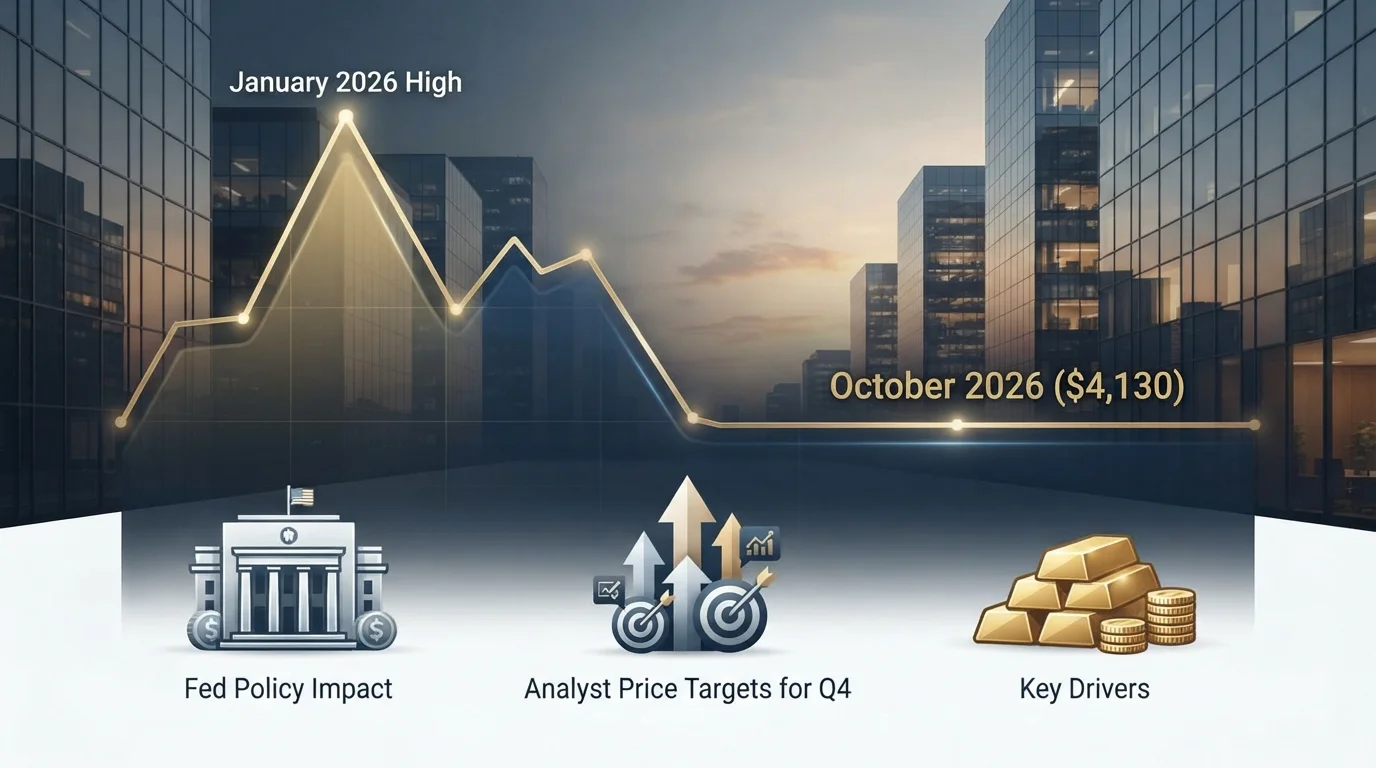
Gold prices hover near $4,130 in October 2026, down 25% from January highs. Explore key drivers, Fed policy impact, and analyst price targets for Q4.

Key Takeaway
Gold entered October 2026 at one of its most volatile crossroads in years, trading near $4,130 per ounce after sliding roughly 25% from January's record peak near $5,595. The dramatic pullback reflects a perfect storm of rising real yields, stubbornly elevated inflation, and shifting Federal Reserve policy expectations that have reshaped the investment landscape for precious metals. With the Federal Reserve's next interest rate decision scheduled for October 28, traders and long-term investors alike are asking whether the current levels represent a compelling buying opportunity or merely a pause before further downside.
Analyst forecasts for October paint a wide trading range, with expectations spanning from approximately $3,734 on the lower bound to $4,500 on the upside, suggesting significant volatility ahead. The convergence of elevated oil prices, a strengthening dollar, and the potential for further monetary tightening creates a complex backdrop for gold that defies simple directional calls. Investors navigating this environment need to understand not only the technical picture but also the macroeconomic forces that could either catalyze a rebound or extend the precious metal's longest correction in recent memory.
Why Gold Has Fallen 25% From Its 2026 Peak
The scale of gold's decline from its January 2026 high cannot be overstated. What began as a gradual drift lower accelerated into a full-blown correction as macroeconomic conditions shifted dramatically against the metal's traditional tailwinds. Understanding the root causes of this decline is essential for anyone attempting to forecast where prices might head next.
The Real Yield Squeeze
Gold's most persistent headwind throughout 2026 has been the relentless climb in real yields. The benchmark 10-year U.S. Treasury closed September at its highest month-ending yield since November 2000, reflecting both market expectations of tighter monetary policy and the persistent gap between headline inflation and the Federal Reserve's 2% target. Because gold offers no yield, rising real rates increase the opportunity cost of holding the metal, making bonds and cash increasingly attractive alternatives for risk-averse capital.
This dynamic has been particularly painful for gold because the move in yields has been driven by both nominal rate expectations and sticky inflation readings. Unlike previous cycles where gold benefited from inflation concerns even as rates rose, the current environment has seen real yields expand to levels that have historically suppressed precious metal prices for extended periods. The October 28 Fed meeting looms large because any signal that the central bank remains committed to its inflation-fighting posture could extend this yield-driven pressure further into the fourth quarter.
Dollar Strength and Global Risk Appetite
The U.S. dollar's persistent strength throughout 2026 has compounded gold's difficulties. As the greenback appreciated against major counterparts, dollar-denominated gold became more expensive for foreign buyers, sapping demand from key markets including Europe and Asia. The dollar's resilience has surprised many analysts who expected a moderation as the Fed approached the end of its hiking cycle, but sticky inflation data and robust U.S. economic performance have kept the currency bid.
Meanwhile, global risk appetite has remained relatively resilient despite geopolitical tensions, reducing the safe-haven demand that typically supports gold during periods of uncertainty. Equity markets have continued to advance on the back of strong corporate earnings, with 10 of 11 S&P 500 sectors forecast to post positive earnings growth in the third quarter. This risk-on backdrop has funneled capital away from defensive assets like gold and into growth-oriented investments.
Federal Reserve Policy: The October 28 Decision
No single factor will likely influence gold's trajectory in late October more than the Federal Reserve's interest rate decision on the 28th. Market pricing currently reflects a live chance of rate hikes at both the October and December meetings, a dramatic shift from earlier expectations that the central bank had reached the end of its tightening cycle.
Market Pricing and Fed Communication
Fed Chair Kevin Warsh has deliberately avoided providing clear guidance on the October meeting outcome, noting that the central bank is no longer in the business of prejudging decisions and that he wants investors to focus on economic data rather than attempting to read policy tea leaves. This communication strategy has introduced additional uncertainty into markets, with traders forced to weigh competing signals from inflation reports, labor market data, and financial conditions.
For gold specifically, the binary nature of the October decision creates significant event risk. A rate hike or hawkish pause that signals additional tightening ahead could push the metal toward the lower end of analyst forecasts, potentially testing the critical $4,000 psychological level. Conversely, a dovish hold that acknowledges cooling economic momentum could trigger a relief rally, particularly if accompanied by softer inflation data in the days preceding the meeting.
Historical Context for Gold During Rate Hikes
Looking back at previous Fed tightening cycles provides important context for how gold might behave in the weeks ahead. Historically, gold has often declined in the months preceding rate hikes as yields rise, but has frequently staged recoveries once the actual tightening is implemented and the uncertainty removed. This pattern suggests that even a hawkish October outcome might not necessarily extend the bearish trend indefinitely, particularly if the market judges that the Fed is nearing the true end of its cycle.
However, the current cycle differs from historical precedents in one crucial respect: the starting point for real yields is already elevated, meaning the Fed has less room to tighten before triggering meaningful economic slowing. This constraint could ultimately prove supportive for gold if the central bank is forced to pivot sooner than currently anticipated.
Oil Prices and the Inflation-Gold Connection
Elevated crude oil prices have added an additional layer of complexity to the gold outlook. Brent crude has surged to approximately $105 per barrel in October, with the U.S. Energy Information Administration forecasting an average of about $105 for the fourth quarter, representing a $14 increase from just one month earlier. This surge in energy costs has direct implications for both inflation expectations and gold's attractiveness as an inflation hedge.
The Paradox of Oil-Driven Inflation
Traditionally, rising oil prices and inflation expectations have supported gold prices because investors purchase the metal as a store of value when fiat currency purchasing power erodes. However, the current environment has produced a paradox: while oil-driven inflation remains elevated, the Federal Reserve's commitment to fighting that inflation through higher interest rates has actually undermined gold's appeal. The opportunity cost of holding non-yielding gold has risen faster than the inflationary impulse from expensive energy, creating an unusual divergence between inflation and precious metal prices.
This dynamic could shift if oil prices continue climbing and the Fed signals that it is unwilling or unable to respond with additional tightening due to growth concerns. In such a scenario, gold might regain its inflation-hedge status as real yields stabilize while consumer prices remain elevated. For now, however, the market appears focused on the Fed's reaction function rather than the inflationary signal itself.
Energy's Impact on Mining Costs
Higher oil prices also affect gold through the supply side by increasing production costs for mining operations. Diesel fuel, electricity, and transportation expenses represent significant inputs for gold extraction, and sustained elevated energy costs can squeeze miner margins or incentivize production cuts. While this supply-side effect typically operates with longer lags than demand-side moves, it provides a theoretical floor for gold prices that grows more relevant the longer energy costs remain elevated.
Analyst Price Targets and Technical Levels
Market technicians and fundamental analysts have produced a wide range of forecasts for gold in October, reflecting the genuine uncertainty surrounding the Fed's next moves and the durability of the current trend. Understanding these levels provides a useful framework for risk management and position sizing.
Support and Resistance Levels
Technical analysts have identified several critical price zones that are likely to govern gold's behavior through month-end. On the downside, support is clustered around the $4,100 level, with deeper support near $4,066 and the psychologically important $4,000 threshold. A sustained break below $4,000 would mark a significant technical deterioration and could open the door to a test of the $3,734 lower bound projected by some analysts for the month.
On the upside, initial resistance sits near $4,226, with more substantial barriers at $4,280 and $4,335. A convincing move above $4,335 would suggest that the correction from January's highs has run its course and that a more sustained recovery may be underway. The width of this trading range underscores the market's uncertainty and the potential for large directional moves once the Fed provides clarity.
Long-Term Forecast Perspectives
Beyond the immediate October outlook, longer-term gold forecasts remain constructive for bulls willing to look through the current volatility. Several forecast models project average prices between $3,942 and $4,208 by month-end, suggesting that even in a bearish scenario, the metal may not fall dramatically below current levels. The confluence of elevated government debt levels, geopolitical fragmentation, and persistent inflation concerns provides fundamental support that becomes more relevant as the Fed's tightening cycle eventually concludes.
For investors with multi-year horizons, the 25% drawdown from January's highs could represent an attractive accumulation opportunity, particularly if the macroeconomic backdrop eventually shifts back toward the low-rate, high-uncertainty environment that powered gold's previous bull market.
Gold vs. Other Safe-Haven Assets
The relative performance of gold compared to other defensive investments reveals important insights about market positioning and sentiment. Understanding where capital is flowing provides clues about whether the current gold weakness reflects broad-based risk appetite or specific factors affecting precious metals alone.
Treasury Bonds and Cash
U.S. Treasury bonds have been the primary beneficiaries of the rotation away from gold, with the 10-year yield reaching multi-decade highs and attracting significant inflows from investors seeking yield and safety. Cash instruments have also grown more attractive as short-term rates have risen, creating genuine competition for the capital that might otherwise flow into gold during uncertain times.
The relative appeal of these alternatives will diminish if the Fed eventually cuts rates, which remains the baseline expectation for 2027 once inflation is judged to be under control. When that pivot occurs, gold's lack of yield becomes less of a disadvantage, and historical patterns suggest that capital tends to rotate back into precious metals as real yields decline.
For traders looking to automate their response to shifting market conditions, consider using Alphio AI's automations feature to set conditional workflows that adjust your portfolio allocation based on Fed policy signals and yield movements.

Equity Market Divergence
Perhaps the most striking feature of the current market is the divergence between gold's weakness and equity market strength. While gold has corrected 25% from its highs, major stock indices have continued to advance, fueled by strong corporate earnings and optimism around artificial intelligence investment. Micron Technology and NVIDIA have been the top two contributors to S&P 500 earnings growth in the third quarter, illustrating how sector-specific dynamics are driving equity returns even as macro uncertainty persists.
This divergence cannot persist indefinitely. Either equities will eventually reflect the same macro headwinds that have pressured gold, or gold will find support as investors recognize that the risk environment remains challenging despite equity market complacency. The resolution of this divergence will likely depend on whether the Fed's October decision tips the balance toward growth concerns or inflation resolve.
Investment Strategies for the Current Gold Environment
Navigating gold's volatile October environment requires a thoughtful approach that accounts for both the downside risks from Fed tightening and the upside potential from a policy pivot or safe-haven revival.
Dollar-Cost Averaging for Long-Term Investors
For investors with multi-year time horizons, the current correction offers an opportunity to accumulate gold at prices not seen since late 2025. Dollar-cost averaging into a gold allocation over the coming weeks and months allows investors to build positions without attempting to time the exact bottom, which is notoriously difficult in volatile commodity markets.
The key risk to this approach is that gold could continue declining if the Fed maintains a hawkish posture through the end of 2026. Investors employing this strategy should size their positions appropriately and maintain sufficient liquidity to continue averaging down if prices fall further toward the $3,700-$4,000 range.
Tactical Trading Around the Fed Decision
Short-term traders may find opportunities in the volatility surrounding the October 28 Fed meeting. Historical patterns suggest that gold often experiences large directional moves in the 48 hours following a Fed decision, as the market digests both the policy announcement and the accompanying press conference commentary.
Risk management is paramount for tactical approaches, as the wide range of analyst forecasts implies the potential for significant adverse moves. Position sizing should reflect the event-driven nature of the trade, and traders should be prepared to adjust quickly as the market's interpretation of the Fed's guidance becomes clear.
For those interested in copying the strategies of experienced traders during volatile periods like this, Alphio AI's copy trading feature allows you to mirror Hyperliquid Vaults and Smart Money Wallets to stay aligned with market-smart positioning.

Portfolio Diversification Considerations
Gold's 25% decline serves as a reminder that even traditional safe-haven assets can experience significant drawdowns. Investors should view gold as one component of a diversified defensive allocation rather than a standalone protection strategy. Combining gold exposure with other uncorrelated assets, including select fixed income instruments and alternative investments, can provide more robust portfolio protection than gold alone.
The current environment also highlights the importance of rebalancing. Investors who entered 2026 with significant gold allocations may find that the decline has reduced their precious metals exposure below target levels. Rebalancing back to strategic allocations can be a disciplined way to take advantage of lower prices without attempting to make directional market calls.
Global Demand Trends and Central Bank Buying
While price action has been dominated by Western monetary policy expectations, underlying demand dynamics from global consumers and central banks remain important structural supports for gold.
Emerging Market Demand
Physical gold demand from China and India, the world's two largest consumers, has shown resilience despite higher prices earlier in the year. As prices have corrected, retail buying interest has reportedly increased, with consumers in both countries viewing the decline as a buying opportunity for jewelry and investment products. This physical demand provides a floor for prices that becomes more relevant as speculative selling pressure exhausts itself.
Currency dynamics also play a role here. While dollar-based gold prices have fallen significantly, the depreciation of some emerging market currencies against the dollar means that local-currency gold prices have not declined as dramatically, limiting the purchasing power improvement for foreign buyers.
Central Bank Accumulation
Central banks around the world have been net buyers of gold for several years, driven by desires to diversify reserves away from the U.S. dollar and reduce vulnerability to sanctions. This structural demand source is unlikely to disappear regardless of short-term price volatility, and any additional weakness in gold may actually accelerate purchases from reserve managers viewing the decline as an attractive entry point.
The geopolitical fragmentation that has driven central bank buying remains firmly in place, suggesting that this demand pillar will continue to provide long-term support for prices even if Western investment flows remain negative in the near term.
Conclusion
Gold's 25% decline from its January 2026 peak has created one of the most debated investment setups in recent memory. Trading near $4,130 in late October, the metal sits at a critical juncture where Federal Reserve policy, energy prices, and shifting risk appetites are creating genuine uncertainty about the path forward. The wide range of analyst forecasts, spanning from approximately $3,734 to $4,500 for the month, reflects this uncertainty and the potential for significant volatility around the October 28 Fed decision.
For long-term investors, the current correction may represent an attractive accumulation opportunity, particularly if the Federal Reserve is approaching the end of its tightening cycle and real yields eventually peak. The structural supports for gold, including central bank buying, emerging market demand, and elevated government debt levels, remain intact even if they have been overshadowed by near-term monetary policy concerns.
Tactical traders should approach the coming weeks with caution and robust risk management, recognizing that the Fed's October decision could trigger large directional moves in either direction. The convergence of elevated oil prices, sticky inflation, and uncertain monetary policy creates an environment where surprises are likely and complacency is dangerous.
As you evaluate your own gold positioning and broader portfolio strategy, consider leveraging advanced trading tools to navigate volatile markets more effectively. Alphio AI's agentic trading can help automate portfolio management with AI-powered strategies that adapt to changing macro conditions in real time.

For a more intuitive approach to executing trades during fast-moving markets, explore Alphio AI's conversational trading interface, which allows you to place and manage orders through natural language chat.

Whether gold stages a dramatic rebound from current levels or continues its correction toward the $4,000 threshold, the October 2026 environment demands active monitoring, flexible positioning, and a clear understanding of the macroeconomic forces driving price action. Investors who remain disciplined and informed will be best positioned to capitalize on the opportunities that emerge from this period of exceptional uncertainty.
FAQs
Why has gold fallen 25% from its January 2026 high?
Gold has declined due to a combination of rising real yields, persistent Federal Reserve tightening expectations, dollar strength, and resilient risk appetite in equity markets. The opportunity cost of holding non-yielding gold has increased significantly as Treasury yields reached multi-decade highs.
What is the gold price forecast for October 2026?
Analysts forecast gold trading between approximately $3,734 and $4,500 in October 2026, with an average expected price around $3,942 to $4,208 by month-end. Key technical support sits near $4,100 and $4,000, while resistance levels are found at $4,226, $4,280, and $4,335.
How will the October 28 Fed decision affect gold prices?
The Federal Reserve's October 28 interest rate decision is the most significant near-term catalyst for gold. A hawkish pause or rate hike could pressure prices toward the $4,000 level, while a dovish hold that signals the end of tightening could trigger a relief rally above $4,300.
Is gold still a good inflation hedge with current oil prices?
Gold's traditional inflation-hedge status has been challenged in the current environment because rising interest rates have increased the opportunity cost of holding gold faster than inflation has eroded purchasing power. However, if the Fed eventually stops tightening while inflation remains elevated, gold's inflation-hedge appeal could return.
Should investors buy gold at current prices near $4,130?
For long-term investors, the 25% correction from January highs may represent an attractive accumulation opportunity, particularly through dollar-cost averaging. However, tactical traders should exercise caution given the volatility expected around the October 28 Fed meeting and the potential for further downside if tightening continues.