

Mutual Fund Capital Gains Distributions 2026: How to Avoid a Tax Bill in a Down Market
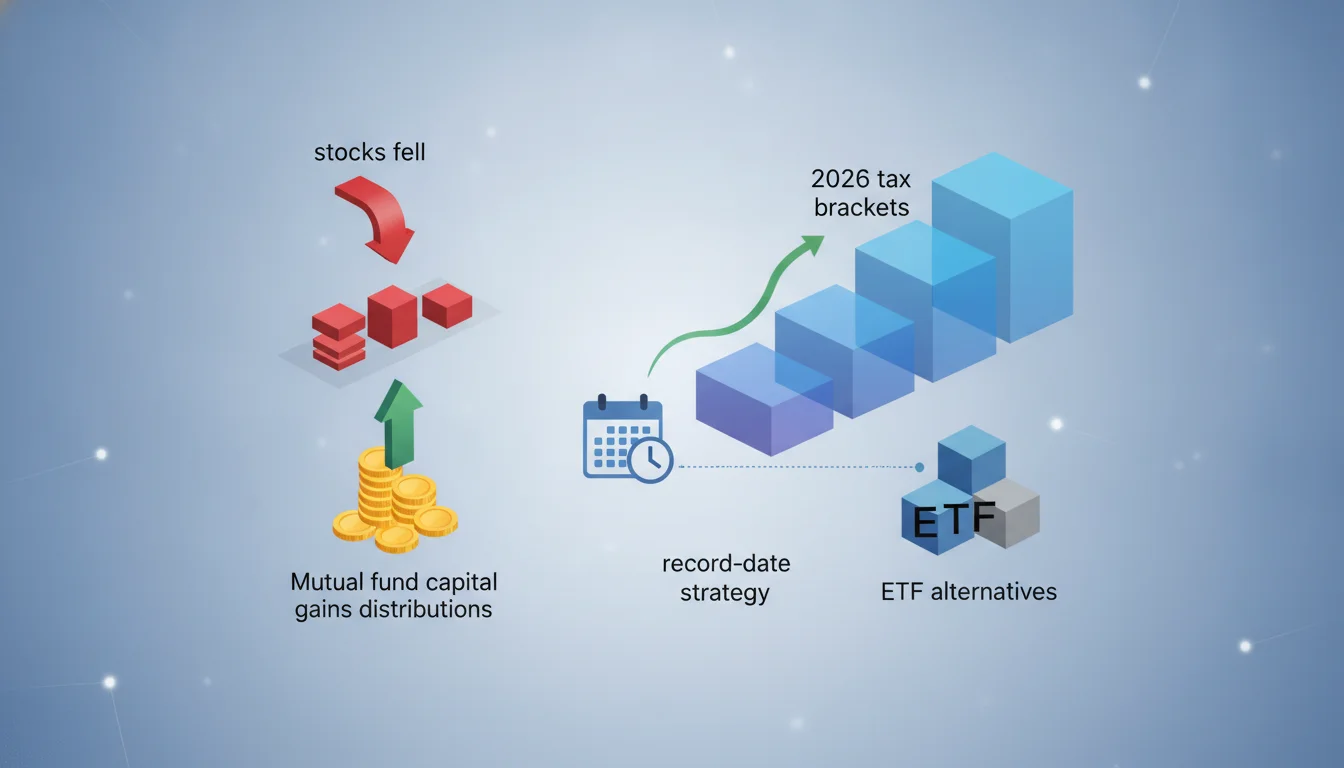
Stocks fell, but mutual fund capital gains distributions are still coming. See the 2026 estimates, tax brackets, record-date strategy, and ETF alternatives.

Key Takeaway
A falling market does not protect you from a capital gains tax bill. As of the close on Friday, November 20, 2026, the S&P 500 sat at 6,910.39 after a 3.7% one-day drop, an 8.6% weekly loss, and a slide of more than 10% from its October 6 record, according to AP and CNBC market wraps. The Nasdaq Composite fell 5.3% that day and turned negative for the year. Yet many investors who hold actively managed mutual funds in taxable brokerage accounts will still receive year-end capital gains distributions in December, and they will owe tax on that money even if the fund's share price is lower than it was in October.
This is not a glitch. Mutual funds are required to pass realized net gains through to shareholders, and those gains can come from stocks sold earlier in the year, from years of appreciation in long-held positions, or from managers selling winners to meet redemptions. Preliminary estimates published by fund companies and compiled by YCharts in October show some equity funds projecting distributions above 50% of net asset value, with peer-group medians between roughly 8% and 17%. In a year when shareholders are pulling money out of active funds, the people who stay behind can end up holding the tax bill.
The practical question for the next five weeks is what to do about it. This guide explains how distributions work, what the 2026 estimates show, how the 2026 capital gains brackets and the 3.8% Net Investment Income Tax apply, when selling before the record date makes sense, why buying a fund just before a distribution is a classic mistake, and how ETFs and the new ETF share classes change the calculation. None of this is tax advice for your specific situation, but the framework will help you ask better questions before December record dates arrive.
Why a Down Market Can Still Mean a Big Tax Bill
Gains are realized when the manager sells, not when you do
A mutual fund is a pass-through vehicle. When the portfolio manager sells a stock for more than the fund paid, the fund realizes a gain, and after netting against realized losses it must distribute the net amount to shareholders, usually once a year in December. Your own purchase price is irrelevant to that calculation. If the fund bought Nvidia or Microsoft years ago and trimmed the position this spring, the realized gain reflects the fund's cost basis, not yours. That is why an investor who bought the fund last year can receive a distribution built on gains earned long before they arrived.
The timing mismatch is what makes 2026 painful. Much of the realized gain this year was locked in while markets were climbing toward the October high. The correction that followed lowered share prices, but it did not undo trades that were already booked. A fund can therefore show a negative return for the fourth quarter while still announcing a double-digit distribution.
Redemptions force sales from the remaining shareholders' portfolio
The second driver is outflows. According to the Investment Company Institute's 2026 Fact Book, mutual funds had net outflows of $552 billion in 2025, a long-running trend as investors migrate to ETFs and index products. When shareholders redeem, the fund usually has to raise cash by selling securities, and in an older fund those securities often carry large embedded gains. The departing shareholder takes the cash, while the gain lands on the shareholders who remain.
Morningstar's annual previews have repeatedly tied the largest distributions to funds with heavy outflows or manager changes, and 2026 looks similar. When a fund is shrinking and the market is falling at the same time, managers have fewer realized losses available to offset the gains, so the distribution can be large relative to a shrinking asset base.
Concentrated tech winners raise the stakes
This year has an added twist. Technology and AI-related stocks were the market's biggest winners for several years, which means many growth funds carry very large unrealized gains in a handful of names. As those stocks swung sharply this autumn, with the Philadelphia Semiconductor Index falling 10.7% on November 20 alone according to market wraps, some managers trimmed positions to control risk or meet redemptions, crystallizing gains that had been building for years.
How Capital Gains Distributions Actually Work
Record date, ex-date, and the NAV drop
Every distribution has a record date, which determines who receives it, and an ex-dividend date, when the fund's net asset value is reduced by the amount paid out. If a fund with a $50 NAV distributes $10 per share, the NAV falls to roughly $40 on the ex-date, all else equal. You have not lost money on paper, because you receive $10 in cash or reinvested shares, but you have moved $10 from a tax-deferred unrealized position into a taxable event. Most fund families set their record dates between early and late December, and many publish preliminary estimates in October and November with final figures shortly before payment.
Long-term versus short-term distributions
Fund distributions come in flavors, and the flavor determines the tax rate. Long-term capital gain distributions, reported in box 2a of Form 1099-DIV, are taxed at long-term capital gains rates. IRS guidance states that capital gain distributions are treated as long-term "regardless of how long you have owned the shares." Short-term gains realized by the fund are a different story: they are paid out as ordinary dividends and taxed at your ordinary income rate, which can be much higher. A fund that traded actively in a volatile year may carry a meaningful short-term component, so it is worth reading the breakdown in each estimate rather than just the headline percentage.
Reinvesting does not avoid the tax
Many investors have distributions automatically reinvested and assume no tax is due because no cash hit their account. That assumption is wrong. Reinvested distributions are taxable in the year paid, exactly as if you had received cash and bought new shares. The upside is that reinvested amounts increase your cost basis, so you should not pay tax on that same money again when you eventually sell. Keeping accurate basis records, or confirming that your broker tracks them, matters more than most investors realize.
What the 2026 Estimates Are Showing
Outliers above 50% of NAV
YCharts published a 2026 capital gains watchlist on October 26, built on CapGainsValet estimates, and the top of the list is striking. Columbia Seligman Technology & Information Fund (Class C) carried the largest estimate in the dataset at 96.50% of NAV. Virtus Zevenbergen Technology Fund (Class C) was estimated at 71.48%, PGIM Jennison Health Sciences Fund (Class C) at 58.76%, and Nationwide Renaissance Small Cap Growth Fund at 55.43%. The median among funds in the top percentile was 38.04%. YCharts stresses that these numbers are preliminary and change as fund companies revise them.
Peer-group medians tell the broader story
The outliers grab headlines, but peer-group medians are more useful for most investors. In the YCharts data, small growth funds had the highest median estimate at 16.67% of NAV, followed by small value at 16.22%. Large value funds had a median of 11.68%, slightly above large growth at 10.75%, while large core was the lowest at 8.19%. Even "boring" diversified equity funds, in other words, are projecting distributions that could add up to a real tax bill for a sizable taxable position.
Where to find your fund's number
Most large fund companies, including Capital Group, T. Rowe Price, MFS, Columbia Threadneedle, and Loomis Sayles, post preliminary year-end estimates on their tax-center pages, typically with record dates and ex-dates. Morningstar and aggregators such as CapGainsValet compile lists across fund families. Because estimates are revised as markets move and redemptions continue, check again in early December before making a final decision, and treat any figure you see now as a projection rather than a commitment.
The Tax Math: 2026 Brackets and NIIT
The 2026 long-term capital gains thresholds
Under IRS Revenue Procedure 2025-32, the 0%, 15%, and 20% long-term capital gains rates are unchanged for 2026, but the income thresholds were adjusted for inflation. The 0% rate applies to taxable income up to $49,450 for single filers, $98,900 for married couples filing jointly, and $66,200 for heads of household. The 15% rate applies above those levels up to $545,500 for single filers, $613,700 for joint filers, and $579,600 for heads of household, with 20% applying above those amounts. These thresholds apply to total taxable income, so a large distribution can push part of your gains into a higher band.
The 3.8% surtax on investment income
Higher earners face an additional layer. The IRS applies a 3.8% Net Investment Income Tax when modified adjusted gross income exceeds $200,000 for single filers and heads of household, $250,000 for married couples filing jointly, and $125,000 for married filing separately. Capital gain distributions count as net investment income. For a high-income household, the effective federal rate on a long-term distribution can therefore reach 23.8%, before state income taxes.
A simple illustration
Consider a hypothetical investor with a $100,000 position in a growth fund that projects a 20% long-term distribution. That investor would receive about $20,000 in taxable gains. In the 15% bracket, the federal tax would be roughly $3,000; at 23.8%, it would be about $4,760. If the fund's share price has also fallen 10% during the correction, the investor is paying tax on a fund that lost money for them this quarter. The numbers are illustrative only, but they show why a few hours of homework in late November can be worth far more than most portfolio tweaks.
Should You Sell Before the Record Date?
When selling makes sense
Selling a fund before its record date avoids the distribution, but it triggers your own realized gain or loss instead. The decision comes down to comparing your personal gain with the fund's projected distribution. If you bought recently, or bought near the October high and are now underwater, selling before the record date can be a clean win: you realize little gain or even a loss, sidestep a large distribution, and can redeploy the proceeds into a more tax-efficient vehicle. This is especially relevant in 2026, because many investors added to funds during the summer rally and are sitting on losses after the correction.
When selling makes things worse
The math flips for long-term holders with very low cost basis. If you bought a fund a decade ago, your embedded gain may be far larger than this year's distribution, and selling would accelerate more tax than it avoids. In that case, accepting the distribution and leaving the position in place may be the lower-cost path. Watch the holding period too: shares held one year or less produce short-term gains taxed at ordinary rates. Also note that IRS rules generally treat a loss on fund shares held six months or less as long-term to the extent of capital gain distributions received, which limits a quick "collect and dump" strategy.
Pair the decision with harvested losses
The correction has created realized-loss opportunities elsewhere in many portfolios. Losses harvested in a taxable account can offset distributed gains dollar for dollar, and up to $3,000 of excess net loss can offset ordinary income each year, with the rest carried forward. If you plan to repurchase a similar position, be mindful of the wash-sale rule, which disallows a loss if you buy a substantially identical security within 30 days before or after the sale. Coordinating fund sales, loss harvesting, and replacement purchases is exactly the kind of multi-step process that benefits from a written plan.
Investors who prefer to set reminders around record dates and estimate revisions can use Alphio's Scheduled Task to run recurring check-ins through December, so key dates do not slip during a volatile holiday month.

Don't Buy the Distribution
The classic December mistake
The most avoidable error is buying a mutual fund in a taxable account just before its record date. An investor who puts $20,000 into a fund on December 10 that distributes 15% on December 15 immediately receives about $3,000 of taxable income and sees the NAV fall by the same amount. Nothing about the investment improved; the investor simply converted part of their own principal into a tax bill. Advisers call this "buying the dividend," and it is especially common when investors deploy year-end bonuses or rebalance in December.
Correction-buying needs extra care this year
After an 8.6% weekly drop in the S&P 500, many investors will be tempted to put cash to work quickly. That instinct can be reasonable, but the vehicle matters. If you want broad equity exposure in a taxable account before year-end, an index ETF or a fund that has already paid its distribution may be a better entry point than an active fund on the eve of a payout. Waiting until after the ex-date, or choosing an ETF, often costs nothing in market exposure terms while avoiding a needless tax hit.
Tax-advantaged accounts change the answer
Everything above applies to taxable accounts. Inside an IRA, 401(k), or other tax-deferred account, distributions are not taxed when paid, so record dates are mostly irrelevant. That is one reason asset location, meaning which holdings sit in which accounts, is such a powerful tool. Tax-inefficient active funds often belong in retirement accounts, while tax-efficient index ETFs and individual stocks you plan to hold for years can live in taxable accounts.
ETFs, Index Funds, and the New ETF Share Classes
Why ETFs rarely distribute gains
Exchange-traded funds are not immune to capital gains distributions, but they are structurally better at avoiding them. Most ETFs use in-kind creation and redemption, handing low-basis shares to authorized participants instead of selling them for cash, which purges embedded gains without a taxable sale. State Street Global Advisors reports that in 2025 just 7% of all ETFs distributed capital gains compared with 52% of mutual funds. Morningstar's 2025 survey similarly found that only a small fraction of ETFs projected any distribution at all.
ETF share classes are arriving
For decades, Vanguard was the only firm using a structure that let ETFs and mutual funds share one portfolio. That changed when the SEC granted Dimensional Fund Advisors exemptive relief in November 2025, and law-firm and industry reports describe a wave of additional approvals during 2026, with the ICI noting trading relief for these multi-class ETF shares in March. Analysts expect the ETF share class to make affiliated mutual funds more tax-efficient over time, although the actual tax savings are still a projection and implementation depends on fund boards and distribution arrangements.
Switching has its own cost
Moving from a mutual fund into an ETF is not free if the fund has a large embedded gain in your account. The sale itself is taxable. For many investors, the best approach is to stop adding new money to tax-inefficient funds in taxable accounts, direct new contributions toward ETFs or index funds, and gradually migrate when losses, low-income years, or the 0% bracket make the switch cheap.
A Year-End Checklist for Taxable Fund Investors
Five steps to complete before mid-December
The process is straightforward, and the payoff comes from doing it in order rather than reacting after the 1099s arrive in February:
- List every mutual fund you hold in a taxable account, along with your cost basis and purchase dates.
- Look up each fund's preliminary distribution estimate, record date, and short-term versus long-term split.
- Compare each projected distribution with your own unrealized gain or loss in the position.
- Identify harvestable losses elsewhere in the portfolio and check wash-sale windows.
- Decide which positions to hold, sell before the record date, or move into ETFs, and recheck estimates in early December.
Watch the macro calendar too
The week of November 23 is shortened by Thanksgiving, with US markets closed Thursday and closing early on Friday. The PCE inflation report, the Federal Reserve's preferred inflation gauge, is scheduled for Wednesday and could move markets ahead of the Fed's December meeting. Volatility can change your own gains and losses quickly, so a sale that looked attractive on Monday may look different by the following week. Build in a cushion and avoid making record-date decisions on the last possible day.
Know when to call a professional
If your distributions are large, you have significant unrealized gains, you are near a bracket threshold or the NIIT line, or you are coordinating with Roth conversions or charitable giving, a tax professional can save you more than they cost. The checklist is designed to make that conversation faster, not to replace it.
Conclusion
The 2026 correction has created an uncomfortable combination for taxable mutual fund investors: lower share prices and, in many cases, large December distributions built on gains realized earlier in the year or forced by redemptions. Preliminary estimates show medians around 8% to 17% of NAV across equity peer groups and outliers well above 50%. With 2026 thresholds of $49,450 and $98,900 for the 0% bracket and a 3.8% surtax above $200,000 or $250,000 of modified AGI, the difference between acting now and doing nothing can run into thousands of dollars.
The core rules are simple. Check every fund's estimate and record date, compare the payout with your own gain, harvest losses where they exist, avoid buying funds just before distributions, and favor ETFs and tax-advantaged accounts for tax-inefficient strategies. Investors who want help organizing the research can ask questions in plain language through Alphio's Conversational Trading, and those who prefer a rules-based approach to portfolio decisions can explore Autonomous Trading, always after setting their own risk and tax limits. A distribution you plan for is a manageable cost; one you discover in February is just a surprise.
FAQs
Why do mutual funds pay capital gains distributions when the market is down?
Funds must distribute net gains they realized during the year, even if share prices later fell. Gains booked before the October 2026 peak, or created by selling appreciated stocks to meet redemptions, can still be paid out in December.
Do I owe tax on reinvested capital gains distributions?
Yes. Reinvested distributions are taxable in the year they are paid in a taxable account, just like cash distributions. They do increase your cost basis, so you should not be taxed on that amount again when you sell.
Should I sell a mutual fund before the record date to avoid a distribution?
It depends on your own gain or loss in the fund. If you bought recently or are underwater, selling before the record date can avoid a large taxable payout; if you have a very low cost basis, selling may trigger more tax than the distribution itself.
What are the 2026 long-term capital gains tax rates?
The rates remain 0%, 15%, and 20%. Under IRS Rev. Proc. 2025-32, the 0% rate applies up to $49,450 of taxable income for single filers and $98,900 for joint filers, and higher earners may also owe the 3.8% Net Investment Income Tax.
Are ETFs better than mutual funds for avoiding capital gains distributions?
Generally yes in taxable accounts. Because most ETFs use in-kind redemptions, State Street reports only 7% of ETFs distributed capital gains in 2025 versus 52% of mutual funds, though switching from an existing fund can trigger your own taxable gain.
相關文章
- ISM Manufacturing PMI and the Stock Market: How to Read the December 2026 ReportThe ISM Manufacturing PMI lands Dec 1, 2026 as the Fed eyes a hike. Learn what the PMI measures, which subindexes move stocks and how sectors tend to react.
- Copper Prices After the Record: How to Invest in Copper Stocks and ETFs in Late 2026Copper is down about 17% from its September 2026 record. Learn why prices fell and how copper stocks, miner ETFs, futures funds and physical trusts compare.
- Triple Witching December 2026: What Expires on Dec. 18 and How Investors Should PlanTriple witching hits Dec. 18, 2026, alongside the S&P 500 rebalance, Fed and CPI. Learn what expires, how it moves prices, and how investors can plan ahead.
- Berkshire Hathaway Stock Analysis: Why Greg Abel's Strategic Shift Signals a Bullish TurnBerkshire Hathaway ends 14-quarter selling streak as Greg Abel buys back $4.5B shares. Analyze BRK-B stock fundamentals, portfolio concentration, and investment thesis for August 2026.
- Berkshire Hathaway Under Greg Abel: A New Investment Era BeginsGreg Abel ended Berkshire's 14-quarter selling streak with $4.5B buybacks. Discover how Abel's concentrated portfolio strategy signals a new era for BRK.B investors.
- Fed Rate Cut Impact on Stock Market 2026: What Investors Need to KnowAnalyzing how the Federal Reserve's potential rate cuts could impact stock markets in August 2026. Key sectors to watch and investment strategies for investors.