

Donating Appreciated Stock in 2026: Giving Tuesday, DAFs and the New Charitable Tax Rules
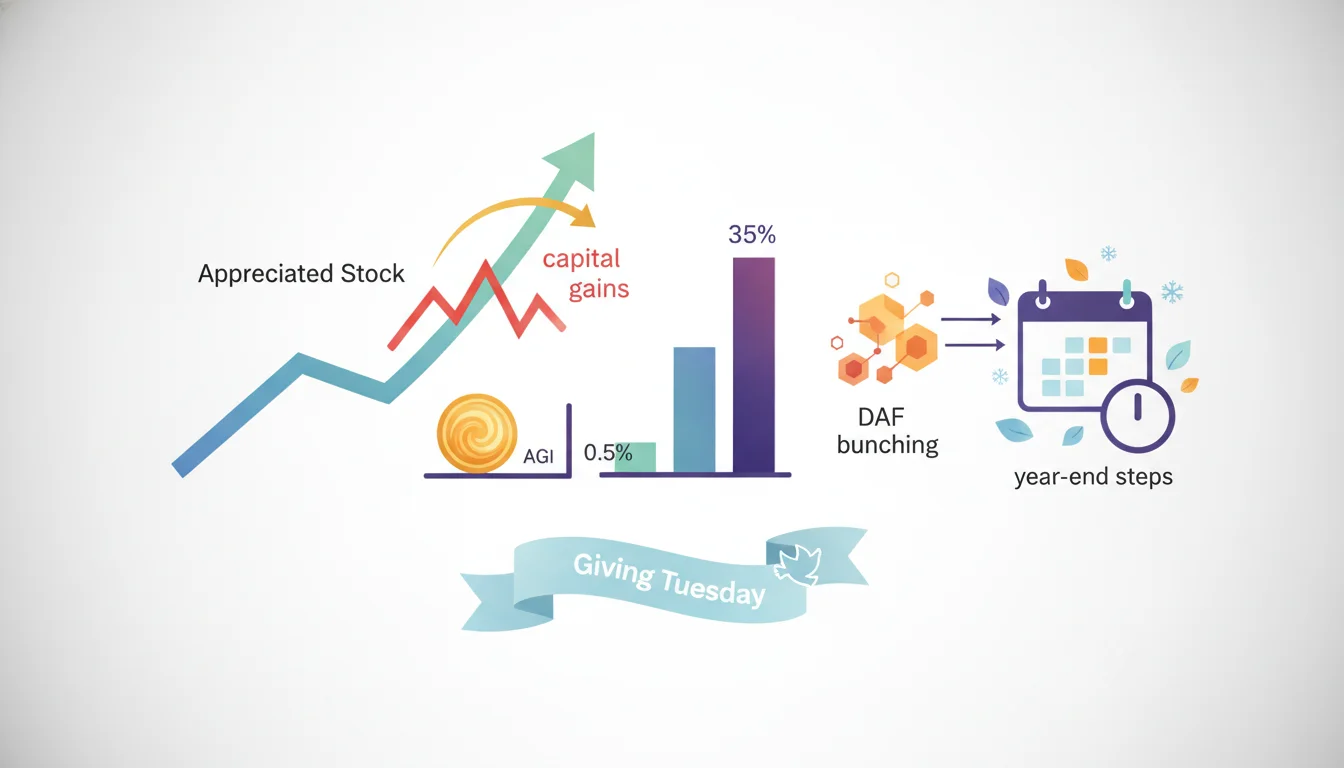
How donating appreciated stock works in 2026: avoid capital gains, the new 0.5% AGI floor, 35% cap, DAF bunching and year-end steps before Giving Tuesday.

Key Takeaway
Giving Tuesday falls on December 1, 2026, and for investors it is a useful reminder that the most tax-efficient charitable gift is often not cash at all. Donating shares of stock that have risen in value, and that you have held for more than one year, generally lets you deduct the full fair market value of the shares while never paying capital gains tax on the appreciation. The charity, as a tax-exempt organization, can sell the shares without owing tax either. For anyone sitting on large paper gains after the multi-year run in U.S. equities, that combination can make the same gift cheaper for you and bigger for the cause.
The rules changed in 2026. Under the One Big Beautiful Bill Act (P.L. 119-21), itemizers now face a floor equal to 0.5% of adjusted gross income before charitable gifts become deductible, taxpayers in the 37% bracket see the value of itemized deductions capped at 35 cents on the dollar, and non-itemizers regain a small deduction of up to $1,000 (single) or $2,000 (joint) for cash gifts to qualifying charities. Those changes make planning more important: who itemizes, what you give, and whether you route the gift through a donor-advised fund all matter more than they did a year ago.
This guide explains how a stock donation works, what the 2026 rules mean in practice, how to choose which shares to give, and the year-end mechanics that trip people up. It is educational, not tax or investment advice; rules depend on your situation, and anyone giving a meaningful amount should confirm details with a tax professional before December 31, 2026.
Why Donating Appreciated Stock Beats Writing a Check
The double tax benefit, explained
When you sell a stock that has gone up, you owe capital gains tax on the difference between the sale price and your cost basis. If you then donate the after-tax cash, the charity receives less than the shares were worth, and your deduction is based on that smaller amount. When you give the shares themselves, IRS Publication 526 says you can generally deduct the fair market value of capital gain property, and the built-in gain is never realized by you. In other words, you skip one layer of tax entirely while keeping the full deduction.
The second benefit is on the charity's side. Public charities and donor-advised fund sponsors are tax-exempt, so when they sell the donated shares, they keep the entire proceeds. That is why many large nonprofits and every major donor-advised fund platform maintain brokerage accounts specifically to receive securities. For the donor, the practical work is a transfer request rather than a sale.
A simple worked example
Consider a hypothetical investor who bought shares for $10,000 more than three years ago that are now worth $30,000. Assume a 15% long-term capital gains rate, which in 2026 applies to single filers with taxable income between $49,450 and $545,500 under the IRS inflation adjustments in Revenue Procedure 2025-32. Selling first would trigger $3,000 of federal tax on the $20,000 gain, leaving $27,000 to donate. Giving the shares directly delivers the full $30,000 to the charity, and the deduction, if the donor itemizes, is $30,000 rather than $27,000.
The gap widens for higher earners. Above the 20% capital gains threshold, and for taxpayers subject to the 3.8% net investment income tax, the tax avoided on the same gain could be close to $4,800. State income taxes can add more. These are illustrative numbers, not a forecast, but they show why financial planners consistently rank appreciated stock ahead of cash for donors who already own long-term winners.
The holding period rule you cannot skip
The fair-market-value deduction applies only to long-term capital gain property, meaning assets held more than one year. Shares held one year or less are treated as ordinary income property, and Publication 526 says the deduction is generally limited to your basis. If you bought a stock in March 2026 and it has doubled, donating it this year would earn a deduction for only what you paid. Checking the purchase date of each tax lot before you give is the single most important step in the process.
What Changed for Charitable Deductions in 2026
The new 0.5% of AGI floor for itemizers
Starting with the 2026 tax year, individuals who itemize can deduct charitable contributions only to the extent their total gifts exceed 0.5% of their contribution base, which is essentially adjusted gross income. Greenberg Traurig's October 2025 analysis of the law notes that the floor applies to all contribution types and that amounts disallowed by the floor may be carried forward under complex rules. Fidelity Charitable gives a simple illustration: a couple with $300,000 of AGI can deduct only gifts above $1,500.
For a large stock gift, the floor is a modest haircut. For someone who spreads small donations across many years, it can wipe out a meaningful share of the deduction. That is one reason the floor encourages concentrating, or bunching, gifts into fewer years, a strategy discussed below.
The 35% cap for the top bracket
Taxpayers in the 37% bracket now receive a reduced benefit from itemized deductions. The Tax Foundation explains that itemized deductions are reduced by 2/37 of the lesser of total itemized deductions or income above the start of the 37% bracket, which effectively caps the value at 35 cents per dollar instead of 37. For a top-bracket donor, a $100,000 stock gift therefore saves somewhat less in income tax than it would have in 2025. The capital gains tax avoided on the appreciation is unaffected, which makes appreciated stock relatively more attractive compared with cash for these donors.
A deduction returns for non-itemizers, with limits
The Tax Foundation estimates that nearly 86% of taxpayers will take the standard deduction in 2026, so the new permanent above-the-line deduction of up to $1,000 per filer, or $2,000 for joint filers, matters for many households. Fidelity Charitable notes that it applies to cash donations to certain charities, is not indexed for inflation, and excludes gifts to donor-advised fund sponsors and some private foundations. A gift of stock does not qualify, so a non-itemizer who wants to give shares gets the capital gains benefit but no income tax deduction for the gift.
AGI Limits, Carryovers and the Election Most Donors Miss
Thirty percent for stock, sixty percent for cash
The 2026 law permanently kept the 60% of AGI limit for cash gifts to public charities, a point confirmed by Fidelity Charitable, the Tax Foundation and Greenberg Traurig. Long-term appreciated property given to public charities and donor-advised funds is subject to a lower ceiling: Publication 526 limits that deduction to 30% of AGI. For most donors, the 30% limit never binds. It becomes relevant for people giving away a large concentrated position, such as founders, early employees or long-time holders of a single mega-cap stock.
Private foundations and the twenty percent tier
Gifts of capital gain property to most private non-operating foundations face an even tighter 20% of AGI limit under Publication 526. Families that run their own foundation sometimes route appreciated shares through a donor-advised fund instead, partly because of the higher limit and partly because of simpler administration. The trade-off is control: a foundation can hire staff and set its own grant policy, while a donor-advised fund account holder only recommends grants that the sponsor must approve.
Five-year carryover and the basis election
If a gift exceeds the applicable AGI limit, Publication 526 allows the excess to be carried forward and deducted over the next five years. Donors who expect their income to fall, such as those planning to retire, should model whether they will actually use the carryover. There is also an election that allows capital gain property to be counted under the higher 50% limit, but only if you reduce the deduction to your basis. That election rarely makes sense for highly appreciated shares, yet it can help when the gain is small and the donor wants a larger deduction in the current year. It must be made on the original or a timely amended return.
Donor-Advised Funds Versus Giving Shares Directly
How a donor-advised fund works
A donor-advised fund, or DAF, is an account held at a sponsoring public charity, such as the charitable arms of large brokerages or community foundations. You contribute cash or securities, take the deduction in the year of the contribution, and recommend grants to operating charities over time. The assets can be invested while they wait. National Philanthropic Trust, one of the largest independent sponsors, reported that donor-recommended grants from its own program grew 20% in fiscal 2025 to more than $6.6 billion, a sign of how central these vehicles have become.
DAFs are especially useful for stock gifts because many small charities cannot easily accept securities. You transfer the shares once to the sponsor, which sells them tax-free, and then send cash grants to as many organizations as you like. Publication 526 adds a requirement worth knowing: you need a contemporaneous written acknowledgment from the sponsor confirming it has exclusive legal control of the donated assets.
Bunching gifts under the new floor
The 0.5% floor and the high standard deduction reward donors who give larger amounts less often. Instead of giving $10,000 a year for five years, a donor might contribute $50,000 of appreciated stock to a DAF in one year, itemize that year, and take the standard deduction in the other years while still granting $10,000 annually. The floor is paid once rather than five times, and the itemized deduction lands in a single year where it clears the standard deduction by a wide margin. The Tax Foundation and Greenberg Traurig both flagged bunching as a likely response to the 2026 rules.
When giving directly still makes sense
Direct gifts to a charity's brokerage account avoid any sponsor fees and get money to the organization immediately. They also suit donors who give to one or two large institutions, such as a university or hospital with an established gift desk. For non-itemizers, neither route yields an income tax deduction for stock, but the direct route at least avoids DAF administrative costs. The right choice depends on how many organizations you support, how much flexibility you want, and whether you plan to itemize this year.
Which Shares to Give, and Which to Sell
Start with the biggest long-term gains
The most efficient shares to donate are usually the lots with the largest gain relative to their value, provided you have held them more than a year. A position that has tripled delivers far more tax savings per dollar donated than one up 10%. Investors who bought big technology names years ago often find their highest-gain lots there, and those positions frequently also represent the largest concentration risk in the portfolio.
Reviewing valuation before choosing what to give can help frame the decision, but the tax logic does not depend on your view of the stock. If you still like the company, you can donate the shares and repurchase the same stock with cash, a point covered below.
Never donate a stock with a loss
Shares that are worth less than you paid are the wrong asset to give. If you donate them, your deduction is limited to the current market value and the loss simply disappears. Selling first lets you realize the capital loss, which can offset gains and up to $3,000 of ordinary income per year, and then you can donate the cash proceeds. For a portfolio with both winners and losers after a volatile 2026, the efficient combination is often to give the winners and sell the losers.
Rebuying to reset your cost basis
A useful technique for donors who want to keep their market exposure is to donate appreciated shares and use the cash they would have given to buy the same stock again. The new shares carry a fresh, higher cost basis, which reduces future capital gains. The wash-sale rule applies to losses, not gains, so repurchasing immediately after a donation of appreciated shares does not trigger it. The practical result is the same portfolio, a smaller embedded tax bill, and a larger gift.
Investors who rebalance on a fixed calendar can fold this into a routine. Tools such as Alphio's Scheduled Task can be set to send reminders about year-end deadlines and lot reviews, so the decision is made with time to spare rather than on December 30.

Market Context: Big Gains, Concentration and a Volatile Year
Where the indexes stand heading into December
U.S. markets closed on Thanksgiving Day, November 26, 2026, and reopen for an abbreviated session on Friday. As of the close on Wednesday, November 25, the S&P 500 stood at 7,182.78 and the Dow Jones Industrial Average at 50,182.95, according to CNBC's market coverage. The prior session had marked the S&P 500's eighth loss in nine days, as chip stocks led a pullback from earlier highs. Even after that softness, the S&P 500 sits roughly 50% above its 2023 year-end close of about 4,770, so many long-term holders carry substantial unrealized gains.
Concentration risk is the hidden reason to give
Strong multi-year returns from a handful of mega-cap technology stocks have left many portfolios more concentrated than their owners intended. Trimming a concentrated position usually means paying capital gains tax, which is why investors often hold on longer than their risk tolerance suggests. Donating some of the most appreciated shares is one of the few ways to reduce concentration without a tax bill, and it pairs naturally with a broader year-end rebalancing plan.
Giving decisions should not become market calls
It is tempting to wait for a better price before donating, but timing a gift around short-term moves introduces risk that has nothing to do with charitable goals. The deduction is based on the fair market value on the date the gift is completed, which for publicly traded shares is generally the average of the high and low prices that day. A donor who has already decided how much to give is usually better served by focusing on which lots to use and completing the transfer well before the deadline.
Year-End Mechanics: Deadlines, Paperwork and QCDs
Timing the transfer
A stock gift counts for 2026 only when it is completed in 2026, and Publication 526 ties completion to delivery: shares sent through an agent or the issuing company are not considered delivered until they are transferred on the company's books. In practice, electronic transfers between brokerages can take several business days, and charities and DAF sponsors often post early-December cut-off guidance. Starting the process the week of Giving Tuesday leaves room for errors such as a wrong account number or a missing letter of authorization.
Paperwork the IRS expects
Donors who give noncash property worth more than $500 in total must file Form 8283 with their return, and Publication 526 directs that contributions of publicly traded securities be reported in Section A. You also need a written acknowledgment from the charity or sponsor for any gift of $250 or more. A short checklist covers most of what can go wrong:
- Confirm each lot has been held more than one year and shows a gain.
- Get the receiving organization's brokerage account details and DTC number directly from the charity or sponsor.
- Specify the exact lots to transfer so your broker does not default to a different cost-basis method.
- Keep the written acknowledgment and file Form 8283 if total noncash gifts exceed $500.
- Track the date the shares actually arrive, since that date sets the gift's value and tax year.
Qualified charitable distributions for retirees
Donors age 70 and a half or older have another tool. A qualified charitable distribution moves money directly from an IRA to a charity, is excluded from taxable income, and can count toward required minimum distributions. The annual limit, which is indexed for inflation under SECURE 2.0, is $111,000 per person for 2026, according to Kiplinger and other planning publications, up from $108,000 for 2025 per IRS Publication 526. QCDs cannot go to donor-advised funds, but because they lower AGI rather than relying on an itemized deduction, they sidestep both the new 0.5% floor and the 35% cap. Retirees with appreciated taxable shares and large IRAs may use both strategies together.
Conclusion
Giving Tuesday is a good moment to treat charitable giving as part of portfolio management rather than an afterthought. Donating long-term appreciated stock lets you avoid capital gains tax and, if you itemize, deduct the full market value, a combination cash cannot match. The 2026 rules add new wrinkles: a 0.5% of AGI floor, a 35% value cap for the top bracket, and a cash-only deduction for non-itemizers. Together they make bunching through a donor-advised fund, careful lot selection and early transfers more valuable than before.
The disciplined approach is to decide the amount you want to give, pick the highest-gain long-term lots, sell rather than donate any losers, and finish the transfer well before December 31. Investors who want help staying on schedule can use Alphio's Scheduled Task for deadline reminders, and those who want to rebuild positions after a donation can explore Conversational Trading to place repurchase orders in plain language. Readers interested in ongoing portfolio management can also review Copy Trade. None of these tools replaces advice from a tax professional, and no strategy guarantees a particular tax or investment outcome.
FAQs
Is it better to donate stock or cash to charity?
If you have held the shares more than one year and they have gained value, donating the stock is usually more tax-efficient. You avoid capital gains tax on the appreciation and, if you itemize, can generally deduct the full fair market value. Cash is better when the stock has a loss, because selling first lets you claim the capital loss.
What changed for charitable deductions in 2026?
Under the One Big Beautiful Bill Act, itemizers can deduct charitable gifts only above 0.5% of AGI, and the value of itemized deductions is capped at 35% for taxpayers in the 37% bracket. Non-itemizers can deduct up to $1,000, or $2,000 for joint filers, of cash gifts to qualifying charities, but not gifts to donor-advised funds.
How much appreciated stock can I deduct in one year?
Gifts of long-term appreciated property to public charities and donor-advised funds are generally limited to 30% of AGI, and gifts to most private foundations to 20%. Any excess can be carried forward and deducted over the next five years under IRS Publication 526.
Can I donate stock and buy it back?
Yes. You can donate appreciated shares and use cash to repurchase the same stock, which resets your cost basis higher and reduces future capital gains. The wash-sale rule applies to losses, not gains, so it is not triggered by this strategy.
What is the deadline to donate stock for a 2026 tax deduction?
The gift must be completed by December 31, 2026, which generally means the shares must arrive in the charity's or sponsor's account by then. Brokerage transfers can take several business days, so starting in early December is prudent.
相關文章
- Copper Prices After the Record: How to Invest in Copper Stocks and ETFs in Late 2026Copper is down about 17% from its September 2026 record. Learn why prices fell and how copper stocks, miner ETFs, futures funds and physical trusts compare.
- Triple Witching December 2026: What Expires on Dec. 18 and How Investors Should PlanTriple witching hits Dec. 18, 2026, alongside the S&P 500 rebalance, Fed and CPI. Learn what expires, how it moves prices, and how investors can plan ahead.
- Santa Claus Rally 2026: Will December Deliver After a Correction and a Fed Hike?Will the Santa Claus rally show up in 2026? See December seasonality data, the Fed hike and CPI calendar, failed-rally history, and how to plan your trades.
- NVIDIA Stock Analysis 2026: Is NVDA Still a Buy Amid $1 Trillion AI Demand?Comprehensive NVIDIA stock analysis for 2026. Explore NVDA's $1 trillion AI chip demand, earnings growth, valuation metrics, and investment risks. Expert outlook on AI infrastructure leader.
- Fed's Hawkish Turn: June 2026 Dot Plot Signals Rate Hikes AheadFederal Reserve holds rates at 3.50%-3.75% but dot plot signals potential rate hikes in 2026. Learn what this means for SPY, QQQ, and your investment portfolio.
- US Dollar Hits 13-Month High: What Fed Policy Means for Forex Traders in June 2026The US Dollar surged to 13-month highs as markets price in Federal Reserve rate hikes. Discover forex trading strategies, currency pair analysis, and what this means for traders.