

Covered Call ETFs in a Volatile Market: How Much Income Is Worth the Capped Upside?
Covered call ETFs like JEPI and JEPQ yield 8% to 12% as the VIX jumps. How they work, total return vs yield, taxes, 5% Treasury competition, and how to choose.

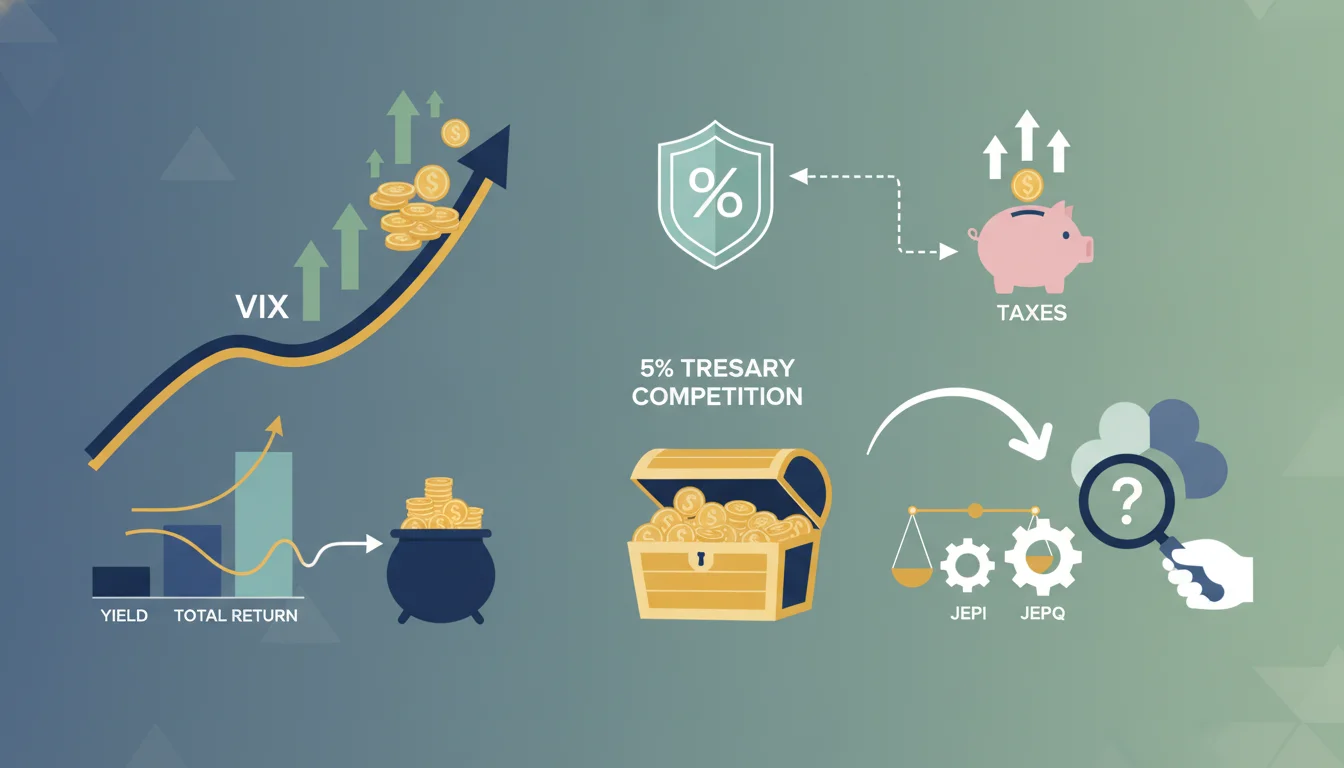
Key Takeaway
Covered call ETFs have become one of the most popular income tools of the decade, and November 2026 is exactly the kind of market that puts them in the spotlight. On Monday, November 16, the S&P 500 fell 1.9% to 7,416.59 and the Nasdaq Composite dropped 2.5%, according to the Associated Press, as chip stocks sold off ahead of Nvidia's earnings report. The Cboe Volatility Index (VIX) jumped 18.7% to 22.91. When volatility rises, the option premiums that covered call funds collect rise with it, so these products tend to advertise their most eye-catching yields precisely when investors feel most nervous.
Those yields are real cash, but they are not free money. JPMorgan's JEPI showed a 12-month rolling dividend yield of 8.01% and the Nasdaq-focused JEPQ showed 11.87% as of November 16, per JPMorgan Asset Management. Both numbers sit well above the 5.12% 10-year Treasury yield reported by the U.S. Treasury that same day. The price of that income is a cap on upside, full exposure to most of the downside, and tax treatment that is often less friendly than ordinary stock dividends. Over long periods, the classic buy-write benchmark has delivered stock-like returns with lower volatility, but it has lagged badly in strong bull years.
This guide explains how covered call ETFs work, why high volatility both helps and hurts them, how the major fund designs differ, what the opportunity cost looks like with Treasury yields above 5%, and how to decide whether one belongs in your portfolio. Market data are as of the close on November 16, 2026 (America/New_York) unless noted. Fund figures come from issuer documents and change daily. This is general education, not personalized investment advice.
What Covered Call ETFs Actually Do
The basic trade: sell upside, collect premium
A covered call is one of the oldest option strategies. An investor who owns a stock or index sells someone else the right to buy it at a set price, the strike, before a set date. In exchange, the investor collects a premium up front. If the market stays below the strike, the option expires worthless and the seller keeps both the shares and the premium. If the market rallies above the strike, the gains above that level go to the option buyer. The strategy turns uncertain future upside into certain present cash, which is why it appeals to investors who value income over maximum growth.
A covered call ETF packages this process into a single ticker. The fund holds a basket of stocks, sells call options against the basket or against an index, and passes the premium to shareholders, usually monthly. Investors get the strategy without opening an options account, managing expiration dates, or rolling positions themselves. That convenience, plus monthly distributions, explains much of the category's growth.
How big the category has become
The growth has been remarkable. ETFIQ data cited by Vista Shares counted 396 U.S. covered call and option income ETFs with $216.3 billion in net assets as of November 13, 2026. Morningstar data cited by First Trust showed record net inflows into its derivative income category of $33 billion in 2024 and $56 billion in 2025. Different data providers define the category differently, so these numbers are not directly comparable, but the direction is unmistakable: option income has moved from a niche strategy to a mainstream retirement income product.
JEPI alone held $46.42 billion in net assets and JEPQ held $41.08 billion as of November 16, per JPMorgan.
Why the yield headline can mislead
The distribution yield is the number most investors see first, and it is also the easiest to misread. It reflects cash paid out, not total return, and it moves with option premiums that can shrink quickly when markets calm down. Some funds also report a tiny 30-day SEC yield, which captures dividends and interest net of expenses but excludes option premium. Global X's August 31, 2026 fact sheet listed QYLD's 12-month trailing distribution rate at 12.26% while its 30-day SEC yield was just 0.02%. That gap does not mean the distribution is fake. It means almost all of the payout comes from selling options, not from the underlying stocks' dividends.
Why High Volatility Changes the Math
Volatility raises option premiums
Option prices depend heavily on expected volatility. When the VIX climbs from around 19 to nearly 23 in a single session, as it did between November 13 and November 16, buyers pay more for the same call option because a large move has become more likely. Covered call funds are option sellers, so a higher-volatility market lets them collect more premium per month for the same strike distance. This is why distribution rates often rise after sell-offs and fall during calm rallies.
The current backdrop is unusually busy. Chipmakers led Monday's decline after the Commerce Department closed a loophole that let Chinese firms rent Nvidia computing capacity overseas, CNBC reported, and investors were still digesting the resignation of Nvidia's chief executive on November 12. Nvidia was scheduled to report earnings after the close on Tuesday, November 17. Event risk like this inflates option prices across technology-heavy indexes, which flows directly into funds that sell Nasdaq-100 calls.
But volatility cuts both ways
Higher premiums arrive because the market expects bigger moves, and covered call funds only partially protect against the downside moves. The premium acts as a cushion: in a simplified example, if a fund collects 1% in a month and the index falls 5%, the fund still loses about 4% before fees and stock selection effects. In a sharp bear market, that cushion is thin. Meanwhile, if the market snaps back violently, as it often does after volatility spikes, the sold calls cap the rebound. Investors can end up with most of the decline and only part of the recovery.
This asymmetry is the central trade-off of the strategy. Covered calls tend to shine in sideways or gently rising markets with elevated volatility. They tend to lag in strong rallies and offer only modest relief in deep declines.
The S&P 500 setup right now
The S&P 500 was up 8.3% year to date at the November 16 close, according to the AP, but it had fallen for three straight sessions and closed about 5% below its October 6 record of 7,818.93. That is a market that has gained ground but is now choppy, with elevated volatility and a clear catalyst calendar. Investors considering covered call ETFs should picture both paths: a range-bound market through year-end, where option income is a real advantage, and a sharp rebound, where it becomes a drag.
How the Major Covered Call ETF Designs Differ
At-the-money index buy-writes: QYLD and XYLD
The oldest and simplest designs follow Cboe buy-write indexes. QYLD tracks the Cboe Nasdaq-100 BuyWrite V2 Index, and XYLD tracks the Cboe S&P 500 BuyWrite Index (BXM). According to the QYLD prospectus, the fund sells a succession of one-month at-the-money index call options against its stock holdings each month. Selling at-the-money calls maximizes premium, which is why distribution rates are high, but it also gives away nearly all upside each month. Both funds charge a 0.60% gross expense ratio, per Global X.
The long-run results reflect that design. As of August 31, 2026, QYLD's annualized NAV return since its 2013 inception was 8.87%, and XYLD's was 8.34%, according to Global X fact sheets. Those are respectable numbers, but they trail what the underlying indexes delivered during one of the strongest decades for large-cap U.S. stocks.
Active, partial-upside funds: JEPI and JEPQ
JPMorgan's funds take a different approach. JEPI holds a defensive portfolio of stocks selected through a proprietary risk-adjusted ranking and adds an options overlay that sells out-of-the-money S&P 500 index calls, largely through equity-linked notes. Its prospectus allows up to 20% of net assets in those notes. JEPQ applies a similar concept to the Nasdaq-100, aiming for lower beta and volatility than the index. Selling out-of-the-money calls collects less premium per option but leaves room for some upside before the cap kicks in. Both funds charge 0.35%, per JPMorgan.
The yield gap between the two reflects the volatility of their underlying markets. Nasdaq-100 options are pricier because the index moves more, so JEPQ's 11.87% trailing yield runs well above JEPI's 8.01%.
Tax-aware index option funds: SPYI and QQQI
A newer group of funds focuses on after-tax income. NEOS's SPYI and QQQI sell SPX and NDX index options, which are Section 1256 contracts. Gains and losses on those contracts are taxed 60% as long-term and 40% as short-term regardless of holding period, according to NEOS fact sheets, and the funds can harvest tax losses on their options. As of October 31, 2026, SPYI showed a 12-month trailing distribution rate of 11.84% and QQQI 14.13%, with a 0.68% expense ratio for each. NEOS notes that distributions have been classified as return of capital, which has its own tax implications that investors should confirm on their year-end forms.
Yield Versus Total Return: What History Shows
The long-run buy-write record
The best long-term evidence comes from the BXM index, which Cboe calculates with a base date of June 30, 1986, using backtested data before its 2002 launch. A study by Hewitt EnnisKnupp, published by Cboe, found that from mid-1986 through January 2012, the BXM and the S&P 500 both returned 9.17% a year, but the BXM did so with an annualized standard deviation of 11.37% versus 15.87% for the S&P 500. That is the strongest case for covered calls: similar returns over a full cycle with a noticeably smoother ride.
Where the strategy lags
The same history shows when covered calls struggle. According to a March 2026 First Trust analysis, the S&P 500 returned 17.86% in 2025 while the BXM returned 8.91%, and in all 14 years when the S&P 500 gained at least 10%, the BXM trailed it. Strong bull markets are the worst environment for a strategy that sells upside every month. The period studied by Hewitt EnnisKnupp also included two severe bear markets, which helped the buy-write's relative showing. Investors should not assume the next decade will have the same mix.
Covered Calls Versus 5% Treasury Yields
The new opportunity cost
For most of the 2010s, an 8% yield looked spectacular next to near-zero bond rates. That comparison has changed. The 10-year Treasury yield was 5.12% on November 16, per the Treasury Department, and the Federal Reserve held its policy rate at 3.75% to 4.00% on October 28 after raising it in September. Futures markets were pricing roughly 29 basis points of additional tightening for December as of November 12, according to Reuters. Investors can now lock in meaningful income without equity risk.
That shifts the question. JEPI's roughly 8% yield is about 3 percentage points above the 10-year Treasury, and that extra income comes with full stock market drawdown risk. JEPQ's yield premium is larger, but so is its exposure to the technology volatility that dominated this week's tape. An investor who simply wants income may find Treasuries, T-bills, or money market funds offer a better risk-adjusted deal. An investor who wants stock exposure with smoother income may still prefer a covered call fund.
Where they fit in an income portfolio
A practical approach treats covered call ETFs as one sleeve of an income plan rather than the entire plan. Bonds and cash provide stability and predictable yield, dividend growth stocks provide rising income over time, and covered call funds provide high current cash flow with some equity participation. Sizing matters more than fund selection: a modest allocation can boost portfolio income without making the investor dependent on option premiums that may fall when markets calm.
If you want to track distributions, VIX moves, and Treasury yields without checking screens every day, Alphio's Scheduled Task feature can run recurring checks on the funds and signals you care about and alert you when your own rules are triggered.
Taxes, Fees, and the Fine Print
Not all distributions are qualified dividends
Ordinary stock dividends held long enough are often taxed at lower qualified dividend rates. Option premium is different. The QYLD prospectus warns that distributions may be taxable as ordinary income or capital gains, and that option income limits the share eligible for qualified dividend treatment. JPMorgan says JEPI's distributions may be classified as ordinary income or return of capital, and a large share of its payout comes from equity-linked notes rather than stock dividends. For investors in high tax brackets, that can reduce after-tax yield meaningfully, which is one reason many hold these funds in IRAs or other tax-advantaged accounts. Where part of a payout is classified as return of capital, it lowers cost basis instead of creating current taxable income, so review each fund's Section 19a-1 notices and year-end 1099-DIV.
Fees compound over decades
Expense ratios range from 0.35% for JEPI and JEPQ to 0.60% for QYLD and XYLD and 0.68% for SPYI and QQQI, per issuer documents. Those fees look small next to double-digit yields, but they come out of total return every year. A plain S&P 500 index fund can cost a few basis points. Over a 20-year retirement, the gap adds up, so the strategy should earn its fee through better risk-adjusted outcomes, not just a bigger headline number.
How to Choose a Covered Call ETF
Match the design to your goal
Start with the job you need the fund to do. Investors who want the highest current cash flow and accept limited growth may lean toward at-the-money buy-write designs. Investors who want income plus some long-term growth may prefer funds that sell out-of-the-money calls or overwrite only part of the portfolio. Investors in taxable accounts may weigh index-option funds that use Section 1256 treatment. A short checklist helps keep the decision disciplined:
- Compare total return with the underlying index over at least three to five years, not just the trailing yield.
- Check how much of the portfolio is overwritten and whether calls are at or out of the money.
- Read the expense ratio, the distribution history, and any return-of-capital notices.
- Decide which account the fund belongs in based on how its distributions are taxed.
- Size the position so that a 20% to 30% equity drawdown would not derail your income plan.
Look under the hood at the stock portfolio
Fund performance depends on the stocks as well as the options. JEPI's defensive stock selection means it may behave differently from the S&P 500 even before the options overlay, and JEPQ's Nasdaq exposure ties it to mega-cap technology. Investors already heavy in large tech stocks should check for overlap. For anyone writing calls directly on individual holdings instead of using a fund, the valuation of the underlying stock matters a great deal, because selling upside on a stock that is already cheap can mean surrendering the rebound you were waiting for.
Consider doing it yourself on single stocks
Investors comfortable with options can sell covered calls on stocks they already own, choosing their own strikes and expirations. This offers more control and can make sense for concentrated positions in large, liquid companies. It also brings more work, assignment risk, and the temptation to sell calls on a stock right before a big move. Analyst sentiment and recent momentum can help frame whether a stock is a sensible candidate.
If you would rather think through these choices in plain English, Alphio's Conversational Trading lets you ask questions such as how an income fund's total return compares with the index or what a covered call position would look like on a stock you hold, before placing any order.
Risks to Watch Through Year-End
Event risk from earnings and policy
The weeks ahead include Nvidia's earnings, the December Fed meeting, and ongoing U.S.-China trade talks at the APEC summit in Shenzhen. Each can trigger large moves. For covered call funds, a sharp sell-off would hurt net asset value, while a sharp rally would test how much upside the funds give up. Neither outcome is a reason to avoid the strategy, but both are reasons to size it sensibly.
Premium compression if volatility fades
If markets calm after these catalysts and the VIX falls back toward its lower ranges, option premiums will shrink and monthly distributions can decline. Investors who buy a fund because of a trailing yield set during a volatile stretch should expect that income to vary. Distributions are not fixed coupons.
Conclusion
Covered call ETFs offer a genuine trade: they convert uncertain stock market upside into steady monthly cash. In a week when the VIX jumped to 22.91 and the S&P 500 sat about 5% below its record, that trade looks especially tempting, and yields of roughly 8% for JEPI and nearly 12% for JEPQ reflect the richer option premiums available. The long-run buy-write record shows the strategy can deliver stock-like returns with less volatility over a full cycle, but it also shows consistent underperformance in strong bull markets and only partial protection in steep declines. With the 10-year Treasury above 5%, the bar for taking equity risk in pursuit of income is higher than it has been in years.
The sensible approach is to choose a fund design that matches your goal, judge it on total return and after-tax income rather than headline yield, place it in the right account, and size it as one sleeve of a broader income plan. Investors who want their rules carried out consistently can explore Alphio's Autonomous Trading, which executes a defined strategy without emotional second-guessing, while those who want to learn from experienced investors can review real strategies through Alphio Copy Trade. Whatever you choose, remember that income is only valuable if the capital behind it survives.
FAQs
What is a covered call ETF?
A covered call ETF holds a portfolio of stocks and sells call options against those holdings or against an index. The option premium is passed to shareholders as regular distributions, usually monthly. In exchange, the fund gives up some or all of its upside above the option strike prices.
Are covered call ETFs good when volatility is high?
Higher volatility raises option premiums, so covered call funds can collect more income when the VIX climbs, as it did to 22.91 on November 16, 2026. However, volatile markets can also fall sharply, and the premium only partly cushions losses. The strategy works best in sideways or gently rising markets.
What is the difference between JEPI and JEPQ?
JEPI holds a defensive portfolio of S&P 500 stocks and sells out-of-the-money S&P 500 index calls, while JEPQ applies a similar approach to the Nasdaq-100. Because Nasdaq options are more expensive, JEPQ's 12-month yield was 11.87% versus 8.01% for JEPI as of November 16, 2026, per JPMorgan. JEPQ also carries more technology exposure and volatility.
How are covered call ETF distributions taxed?
Much of the income comes from option premium, which is often taxed as ordinary income rather than as qualified dividends, and some funds classify payouts as return of capital. Funds using index options such as SPYI and QQQI rely on Section 1256 treatment of 60% long-term and 40% short-term for option gains. Check each fund's 1099-DIV and consider holding these funds in tax-advantaged accounts.
Do covered call ETFs beat the S&P 500?
Over long full cycles, the Cboe S&P 500 BuyWrite Index has delivered returns similar to the S&P 500 with lower volatility, according to a Hewitt EnnisKnupp study covering 1986 to 2012. In strong bull years, however, covered calls usually lag; in 2025 the S&P 500 returned 17.86% while the BXM returned 8.91%, per First Trust. They are best viewed as income and volatility tools, not outperformance tools.
Ähnliche Artikel
- Leveraged ETFs in the 2026 Sell-Off: Why TQQQ and SOXL Dip Buyers Got Crushed by Volatility DecayLeveraged ETFs like TQQQ and SOXL fell hard in the 2026 sell-off. Learn how daily resets and volatility decay work, and how to size and time-box 3x trades.
- Dividend Stocks vs 5% Treasury Yields: How Income Investors Should Adapt in 2026With 10-year Treasury yields above 5% and the S&P 500 yielding about 1.1%, here is how to judge dividend stocks, avoid yield traps, and build income in 2026.
- Roth Conversion in a Down Market: How to Use the 2026 Sell-Off Before December 31Stocks fell 8% from their high. Learn how a Roth conversion in a down market works, how to size it with 2026 tax brackets, and the traps to avoid by Dec 31.
- Energy Stocks 2026: Oil Majors vs AI Power Demand—How Investors Should Split the TradeInvest in energy stocks 2026 by separating oil majors' cash returns from AI data-center power demand—allocation splits, falsifiers, and a practical watchlist.
- Hawkish Fed Hold Explained: What It Means for Stock Investors in 2026What a hawkish Fed hold means for stock investors—rates, valuations, sector leadership, and a practical Fed-day checklist timed for the Oct 28 2026 meeting.
- Visa FY2026 Q4 Deep Dive: Beat on Spend, Sold on Incentives & FY27 GuideSell-side deep dive into Visa Q4/FY2026: resilient consumer spend beat, client incentives +21%, FY27 low-double-digit guide, capital return, and the long vs short debate.