

NVIDIA Q2 2026 Earnings: $46.7B Revenue Beat Shows AI Demand Remains Unstoppable
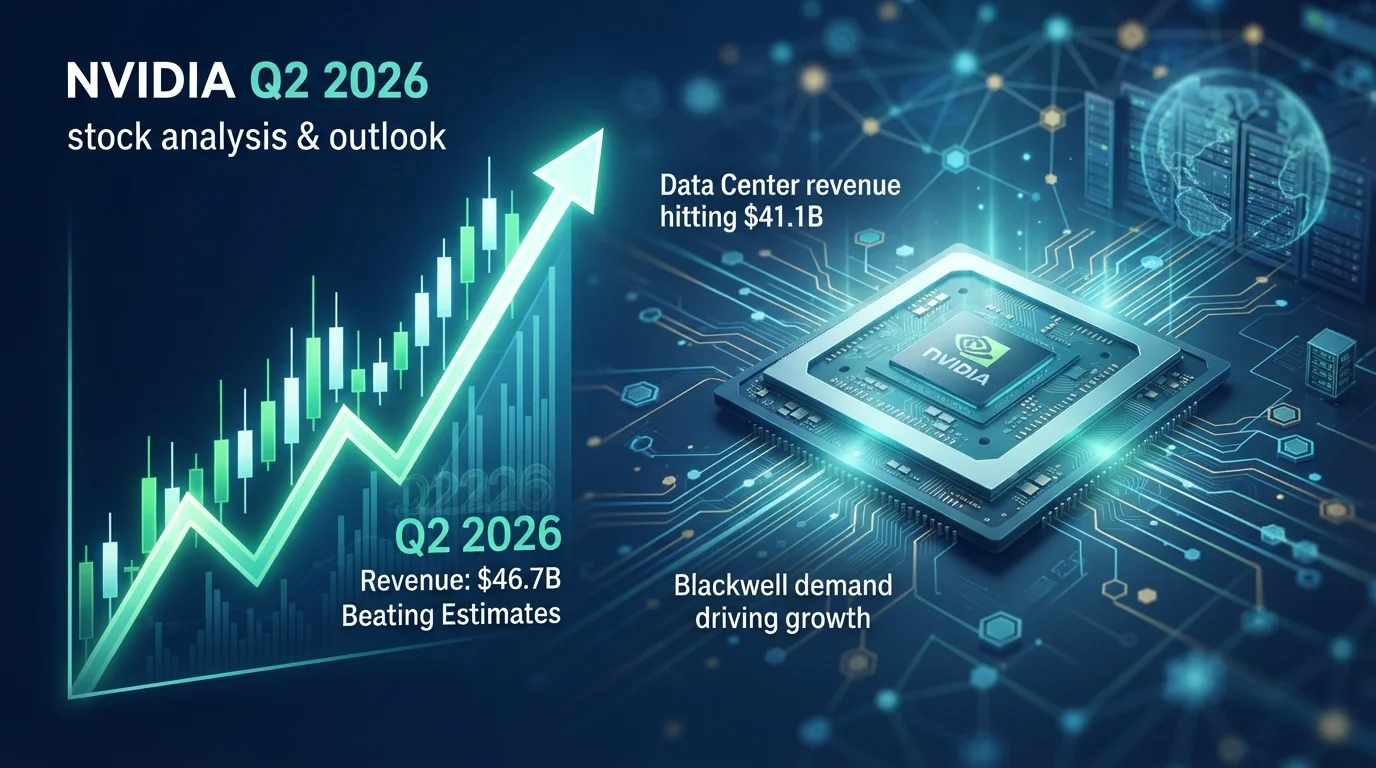
NVIDIA reports Q2 2026 earnings with $46.7B revenue, beating estimates. Data Center revenue hits $41.1B. Blackwell chip demand drives growth. Stock analysis & outlook.

Key Takeaway
NVIDIA delivered another exceptional quarter in Q2 fiscal 2026, reporting revenue of $46.7 billion that beat Wall Street estimates by 1.32% and represented a remarkable 56% year-over-year increase. The AI chip leader earned $1.05 per share, surpassing the consensus estimate of $1.01 by nearly 4%. These results demonstrate that despite concerns about potential AI infrastructure spending slowdowns, demand for NVIDIA's accelerated computing platforms continues to accelerate at an unprecedented pace.
The standout performer was NVIDIA's Data Center segment, which generated $41.1 billion in revenue and now accounts for approximately 88% of total company revenue. This segment grew 56% year-over-year, driven by the rapid scaling of the company's next-generation Blackwell architecture and surging networking revenue that nearly doubled to $7.25 billion. Large cloud service providers represented roughly half of Data Center revenue, underscoring how hyperscalers like Microsoft, Google, Amazon, and Meta continue to aggressively expand their AI infrastructure capabilities.
Looking forward, management provided bullish guidance for Q3 fiscal 2026, projecting revenue of $54.0 billion plus or minus 2%. This guidance suggests continued acceleration as Blackwell Ultra ramps production and gross margins recover toward the mid-70% range by fiscal year-end. For investors evaluating AI exposure in their portfolios, NVIDIA's Q2 results reinforce the company's dominant position in the AI infrastructure buildout.
Breaking Down the Q2 2026 Numbers
NVIDIA's fiscal second quarter ended July 27, 2026, delivered results that exceeded expectations across virtually every metric. Revenue of $46.74 billion represented 6% sequential growth from Q1 and an impressive 55.6% increase compared to the same quarter last year. This marks the sixth consecutive quarter that NVIDIA has beaten earnings per share estimates, demonstrating consistent execution even as the company scales to unprecedented revenue levels.
The earnings per share of $1.05 beat the consensus estimate of $1.01 by 3.96%, while revenue surpassed the $46.1 billion analyst expectation. GAAP gross margins came in at 72.4%, with a one-time $180 million release of previously reserved H20 inventory providing a modest tailwind. The company continues to guide toward non-GAAP gross margins in the mid-70% range by fiscal year-end as supply constraints ease and product mix optimization continues.
Operating expenses are growing in the high-30% range for the full fiscal year as NVIDIA invests heavily in research and development to maintain its technological edge. The company expects GAAP and non-GAAP operating expenses of approximately $5.9 billion and $4.2 billion respectively in Q3, reflecting continued investment in next-generation chip architectures, software ecosystems, and AI infrastructure solutions.
Data Center: The Engine Powering NVIDIA's Growth
The Data Center segment remains the crown jewel of NVIDIA's business, generating $41.1 billion in Q2 revenue and growing 56% year-over-year. This segment has transformed NVIDIA from a gaming-focused graphics company into the dominant infrastructure provider for the AI revolution. Within Data Center, compute revenue reached $33.8 billion while networking revenue surged 98% year-over-year to $7.25 billion, driven by strong adoption of NVLink compute fabric, XDR InfiniBand, and Ethernet solutions for AI deployments.
The Blackwell architecture, NVIDIA's latest generation of AI accelerators, saw revenue grow 17% sequentially including the new Blackwell Ultra variants. CEO Jensen Huang described Blackwell as the AI platform the world has been waiting for, noting that production is ramping at full speed to meet extraordinary demand. The company's compute commitments jumped significantly, with customers locking in future supply to secure access to these critical AI training and inference chips.
Large cloud service providers continue to drive the majority of demand, representing approximately 50% of Data Center revenue. These hyperscalers are engaged in an arms race to build out AI infrastructure, with each committing tens of billions of dollars annually to data center expansion. Microsoft's Azure, Google Cloud Platform, Amazon Web Services, and Meta Platforms remain NVIDIA's largest customers, though enterprise adoption is accelerating as companies across industries deploy AI solutions.
For investors seeking exposure to the AI infrastructure buildout, understanding NVIDIA's Data Center dynamics is essential. The company's networking business, which includes the acquisition of Mellanox, has become increasingly important as AI clusters scale to tens of thousands of GPUs. The ability to move data efficiently between chips has become as critical as raw compute power, giving NVIDIA an integrated advantage that competitors struggle to match.

Investors looking to capitalize on the AI infrastructure boom can explore Alphio AI's agentic trading feature to automate portfolio management with AI-powered strategies that respond to earnings momentum and sector rotation trends.
Blackwell Architecture: The Next Growth Phase
NVIDIA's Blackwell architecture represents a generational leap in AI computing capabilities, and its rapid ramp is driving the company's optimistic forward guidance. Blackwell Data Center revenue grew 17% sequentially in Q2, with the new Blackwell Ultra variants beginning to contribute meaningfully to results. The architecture delivers exceptional performance improvements for training large language models, running inference at scale, and powering the emerging field of agentic AI applications.
The transition from the previous Hopper architecture to Blackwell is proceeding smoothly, with customers eager to upgrade their infrastructure to access the improved performance and efficiency. NVIDIA's supply chain has scaled to meet this demand, though the company continues to operate with a significant order backlog. The compute commitments from customers have grown substantially, providing visibility into demand extending well into future quarters.
Blackwell's impact extends beyond raw performance metrics. The architecture introduces new capabilities for running trillion-parameter models more efficiently, reducing the total cost of ownership for AI infrastructure. This efficiency advantage is particularly important as AI models continue to grow in size and complexity, with leading models now requiring tens of thousands of GPUs for training. NVIDIA's ability to deliver these capabilities while maintaining software compatibility gives customers confidence in their infrastructure investments.
The networking components that connect Blackwell chips have also seen dramatic improvements, with NVLink enabling high-speed communication between GPUs and InfiniBand providing the backbone for large-scale AI clusters. These networking solutions have become a significant revenue driver in their own right, with networking revenue nearly doubling year-over-year to $7.25 billion.
Gaming and Consumer: Steady Performance
While Data Center dominates NVIDIA's revenue, the Gaming segment delivered solid results with $4.3 billion in revenue, up 49% year-over-year. The launch of the GeForce RTX 5060 GPU was particularly noteworthy, becoming NVIDIA's fastest-ramping x60-class GPU ever. This success demonstrates continued strong demand from PC gamers and content creators upgrading to take advantage of AI-enhanced features like DLSS 4 and real-time ray tracing.
The Professional Visualization segment generated $601 million in revenue, growing 32% year-over-year as designers, architects, and media professionals adopt AI-powered creative tools. NVIDIA's Omniverse platform continues to gain traction for industrial digital twin applications, though this remains a relatively small portion of overall revenue compared to the core gaming and data center businesses.
The Automotive segment showed impressive growth of 69% year-over-year to $586 million, driven by strong adoption of NVIDIA's self-driving platforms. Major automakers continue to select NVIDIA DRIVE for their autonomous vehicle programs, with design wins translating into growing production volumes as these vehicles reach market. While automotive remains a small portion of total revenue, the multi-year design cycles suggest this business will continue growing steadily as autonomous driving capabilities expand.
Market Reaction and Stock Performance
NVIDIA's stock reacted positively to the earnings release, though the magnitude of the move was relatively modest given the strong results. Shares gained approximately 3.1% on the day of the report, outperforming both the S&P 500 and NASDAQ. However, the stock has experienced some volatility in subsequent sessions, with shares trading down roughly 3.3% in the week following earnings.
Over the past 30 days, NVDA has gained approximately 3.56%, slightly outperforming the S&P 500's 2.66% advance over the same period. The stock has faced some pressure from broader market concerns about AI infrastructure spending sustainability and potential competition from custom silicon developed by hyperscalers. However, NVIDIA's results suggest these concerns may be overblown, with demand continuing to outstrip supply.
Analysts remain overwhelmingly bullish on NVIDIA, with the majority maintaining Buy or Strong Buy ratings. The average price target implies significant upside from current levels, with many analysts raising their targets following the Q2 beat. Key areas of focus for investors include the pace of Blackwell ramp, competitive dynamics with AMD and custom silicon, and the sustainability of data center spending growth into 2027 and beyond.
Forward Guidance: The Road Ahead
NVIDIA's Q3 fiscal 2026 guidance points to continued acceleration, with management projecting revenue of $54.0 billion plus or minus 2%. This represents approximately 15% sequential growth and suggests the company is successfully ramping Blackwell production to meet surging demand. The guidance excludes any potential H20 shipments to China, reflecting continued uncertainty around export restrictions.
GAAP and non-GAAP gross margins are expected to be 73.3% and 73.5% respectively, plus or minus 50 basis points, with the company continuing to target non-GAAP gross margins in the mid-70% range by fiscal year-end. Operating expenses are guided to approximately $5.9 billion on a GAAP basis and $4.2 billion on a non-GAAP basis, reflecting continued investment in R&D and go-to-market capabilities.
The full-year fiscal 2026 outlook suggests NVIDIA will generate revenue approaching $200 billion, a remarkable achievement for a company that was generating less than $20 billion annually just a few years ago. This growth trajectory underscores the transformative impact of AI on the technology industry and NVIDIA's central role in enabling this transformation.

For traders looking to mirror successful strategies in volatile tech stocks, Alphio AI's copy trading feature allows you to follow top-performing traders and smart money wallets executing data-driven strategies.
Competitive Landscape and Risks
While NVIDIA maintains a dominant position in AI accelerators, competitive pressures are intensifying. AMD continues to challenge NVIDIA in both data center and gaming, with its MI300 series accelerators gaining traction among customers seeking alternatives. Intel is also investing heavily in AI chips, though its efforts have yet to gain significant market share.
Perhaps the more significant long-term threat comes from hyperscalers developing their own custom silicon. Google has been using its TPUs for years, Amazon has Trainium and Inferentia, and Microsoft is reportedly developing its own AI accelerators. These custom chips could potentially reduce NVIDIA's market share among its largest customers over time, though the complexity of AI software ecosystems provides some protection.
Geopolitical risks remain a concern, with U.S. export restrictions limiting NVIDIA's ability to sell certain products to China. The company released $180 million of previously reserved H20 inventory in Q2 from sales outside China, but the long-term impact of these restrictions on the Chinese market remains uncertain. China historically represented a significant portion of NVIDIA's data center revenue, and ongoing restrictions could limit growth potential.
Supply chain risks have eased somewhat but remain a consideration. NVIDIA's ability to meet demand depends on TSMC's manufacturing capacity and the broader semiconductor supply chain. Any disruptions to these supply chains could impact NVIDIA's ability to deliver products, though the company's scale and relationships provide some protection.
Investment Implications and Strategy
NVIDIA's Q2 2026 results reinforce the company's position as the primary beneficiary of AI infrastructure spending. For investors, the key question is whether current valuations adequately reflect the growth opportunity or if expectations have become too elevated. Trading at a premium valuation multiple, NVIDIA needs to continue executing flawlessly to justify its market capitalization.
The bullish case centers on the sustainability of AI infrastructure spending and NVIDIA's ability to maintain its technological lead. If AI continues to transform industries and drive demand for accelerated computing, NVIDIA's current growth rates could continue for several years. The company's software ecosystem, including CUDA and its various AI platforms, creates significant switching costs that protect its market position.
The bearish case focuses on valuation concerns and competitive threats. Any slowdown in AI spending or market share loss to competitors could lead to significant multiple compression. Investors should monitor quarterly results closely for signs of demand deceleration or margin pressure that could indicate a shift in the competitive dynamics.

Traders can leverage Alphio AI's automation features to set conditional workflows that respond to earnings announcements, price movements, and technical indicators without constant monitoring.
Conclusion
NVIDIA's Q2 2026 earnings demonstrate that the AI infrastructure buildout remains in full swing, with the company delivering record results that exceeded expectations across all key metrics. The $46.7 billion in revenue and $1.05 in earnings per share reflect insatiable demand for AI accelerators, with the Data Center segment now representing nearly 90% of total revenue.
The rapid scaling of Blackwell architecture, with revenue growing 17% sequentially, points to continued growth acceleration in coming quarters. Management's guidance for Q3 revenue of $54.0 billion suggests the company is successfully navigating supply constraints and meeting customer demand. For investors with appropriate risk tolerance, NVIDIA remains the purest play on AI infrastructure growth.
However, valuation remains a key consideration, with the stock trading at a significant premium that assumes continued flawless execution. Investors should size positions appropriately and be prepared for volatility as the market digests quarterly results and assesses the sustainability of AI spending growth. The long-term opportunity remains compelling, but the path forward may include periods of consolidation as the business scales to unprecedented levels.

Ready to execute trades with confidence? Explore Alphio AI's conversational trading platform to manage your portfolio through natural language commands and AI-powered insights. Whether you are trading NVIDIA on earnings momentum or building a diversified tech position, Alphio provides the tools to trade smarter in today's volatile markets.
FAQs
What were NVIDIA's Q2 2026 earnings results?
NVIDIA reported Q2 fiscal 2026 revenue of $46.7 billion, beating estimates of $46.1 billion by 1.32%. Earnings per share came in at $1.05, surpassing the consensus estimate of $1.01 by nearly 4%. This represents 56% year-over-year revenue growth and marks the sixth consecutive quarter of EPS beats.
How much revenue did NVIDIA's Data Center segment generate in Q2 2026?
NVIDIA's Data Center segment generated $41.1 billion in Q2 2026, up 56% year-over-year and representing approximately 88% of total company revenue. Within Data Center, compute revenue reached $33.8 billion and networking revenue surged 98% to $7.25 billion.
What is NVIDIA's Blackwell architecture?
Blackwell is NVIDIA's next-generation AI accelerator architecture that delivers exceptional performance improvements for training large language models and running AI inference at scale. Blackwell Data Center revenue grew 17% sequentially in Q2 2026, with Blackwell Ultra production ramping at full speed to meet extraordinary demand.
What is NVIDIA's guidance for Q3 2026?
NVIDIA guided Q3 fiscal 2026 revenue to $54.0 billion, plus or minus 2%, representing approximately 15% sequential growth. The company expects GAAP gross margins of 73.3% and non-GAAP gross margins of 73.5%, with full-year non-GAAP margins targeting the mid-70% range.
Is NVIDIA stock a good buy after Q2 2026 earnings?
NVIDIA's Q2 results demonstrate continued strong execution and AI demand, with the company beating estimates and providing bullish guidance. However, the stock trades at a premium valuation, so investors should consider their risk tolerance, position sizing, and portfolio diversification. Analysts remain predominantly bullish with Strong Buy ratings, but potential risks include competitive pressures and geopolitical export restrictions.