

Nvidia Earnings & Fed Jackson Hole: The Two Market Catalysts Defining August 2026
Nvidia's Q2 earnings and Fed Chair Warsh's Jackson Hole speech are the two biggest market catalysts this week. Here's what investors need to know.

Key Takeaway
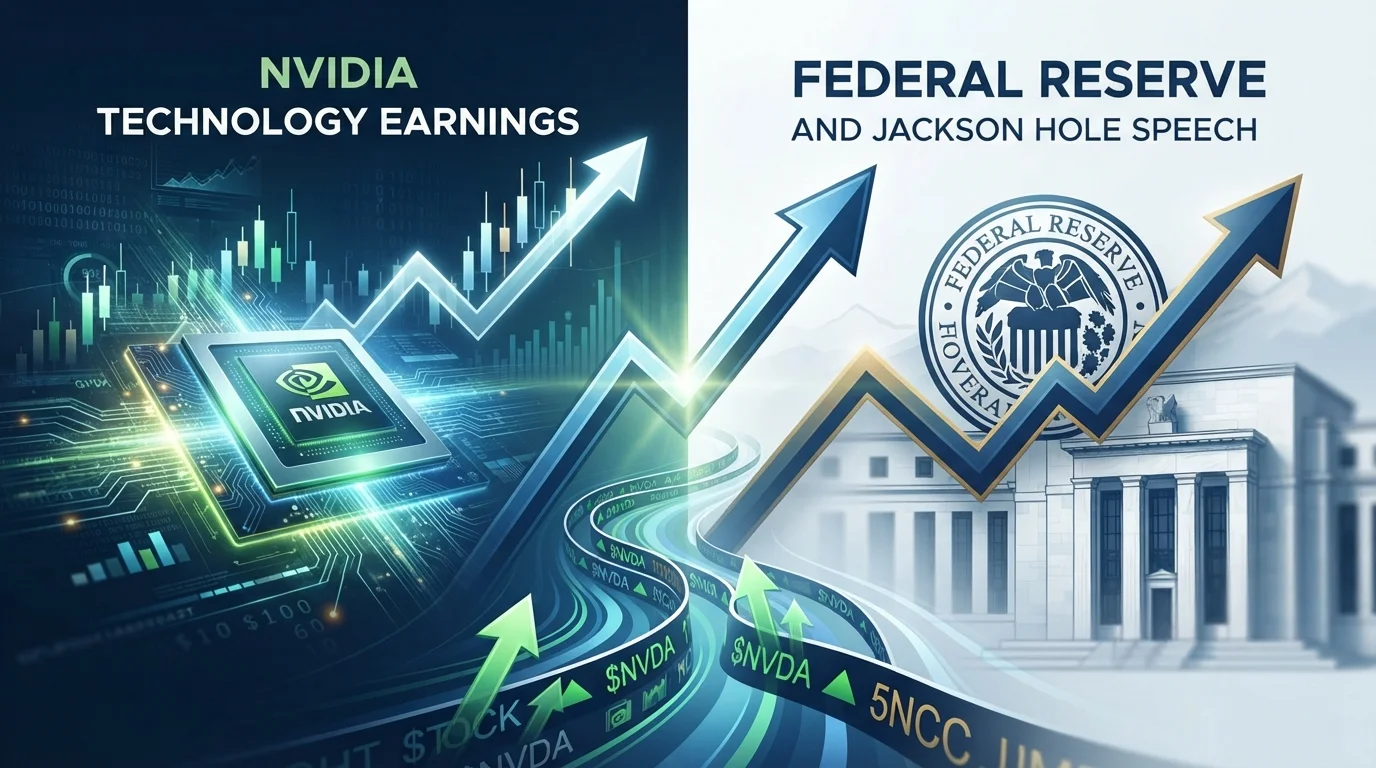
This week presents investors with a rare convergence of two major market-moving events: Nvidia's highly anticipated Q2 fiscal 2027 earnings report on August 26 and Federal Reserve Chair Kevin Warsh's inaugural Jackson Hole speech on August 28. These back-to-back catalysts have the potential to reshape market sentiment heading into September, with implications stretching far beyond the semiconductor sector and monetary policy circles.
Wall Street analysts expect Nvidia to deliver quarterly revenue between $93 billion and $95 billion, representing approximately 95% year-over-year growth driven by insatiable demand for AI accelerators and the successful ramp-up of the company's next-generation Blackwell architecture. Meanwhile, markets are searching for clarity from the new Fed Chair on the central bank's interest rate trajectory, with inflation concerns remaining elevated despite recent moderation in headline figures.
For investors seeking to navigate these volatile waters, understanding both the micro-level dynamics of Nvidia's business and the macro-level signals from the Federal Reserve will be crucial. The interplay between technology sector growth and monetary policy has never been more pronounced, making this week's events particularly significant for portfolio positioning.
Nvidia Earnings Preview: The AI Chip Leader's Next Chapter
Nvidia stands at a critical juncture as it prepares to report its second-quarter earnings, with expectations running extraordinarily high following more than a year of explosive growth in AI infrastructure spending. The company has become the primary beneficiary of the generative AI revolution, with its data center revenue surging as cloud providers, enterprises, and sovereign nations race to build out AI computing capacity.
Analysts are projecting GAAP earnings of approximately $2.06 per share for Q2, which would represent nearly double the year-ago result. This earnings growth reflects not just volume expansion but also pricing power, as Nvidia's advanced AI chips command premium valuations in a supply-constrained environment. The company's gross margins have expanded significantly as product mix shifts toward higher-value AI accelerators.
The data center segment remains the primary growth engine, with revenue expected to grow well above 100% year-over-year. Cloud hyperscalers including Microsoft, Amazon, Google, and Meta continue to aggressively expand their AI infrastructure, with Nvidia chips forming the backbone of their training and inference capabilities. The recent ramp of Blackwell-based products adds another layer of growth potential, though supply constraints may limit near-term contribution.
For investors looking to capitalize on the AI infrastructure boom, consider using Alphio AI's copy trading feature to mirror successful traders who have positioned themselves ahead of major earnings events.

What to Watch in Nvidia's Earnings Report
Beyond the headline revenue and earnings figures, several key metrics will determine how markets react to Nvidia's report. Guidance for the upcoming quarter will be particularly scrutinized, as investors seek confirmation that AI demand remains robust despite concerns about potential saturation or delays in large language model deployments.
The company's commentary on Blackwell ramp progress will be critical. Nvidia's next-generation architecture promises significant performance improvements, but manufacturing complexity and supply chain constraints could impact volume shipments. Any indication of delays or yield issues could pressure the stock, even if current quarter results exceed expectations.
China revenue exposure represents another key concern, with U.S. export restrictions limiting sales of advanced AI chips to Chinese customers. Nvidia has developed lower-performance variants to comply with regulations, but competitive dynamics in this massive market remain challenging. Management's commentary on how they're navigating geopolitical tensions will be closely watched.
Competition is intensifying, with AMD making strides in the AI accelerator market and custom silicon efforts from Google (TPU), Amazon (Trainium), and Microsoft potentially reducing reliance on Nvidia chips over time. While Nvidia maintains a commanding technology lead, investors should monitor any signs of market share pressure or pricing competition.
The Jackson Hole Symposium: Warsh's First Test
The Federal Reserve's annual Jackson Hole Economic Policy Symposium takes on added significance this year as it marks Kevin Warsh's first appearance as Fed Chair. Warsh, who assumed leadership on May 22, 2026, has maintained a cautious approach to communications, making this speech a critical opportunity to establish his policy framework and credibility with markets.
The 2026 symposium theme, "Financial Innovation: Implications for Payments and Policy," suggests Warsh may address longer-term structural issues alongside immediate monetary policy concerns. However, markets will be primarily focused on any signals regarding the Fed's interest rate trajectory, particularly given persistent inflation concerns and recent volatility in Treasury markets.
For traders looking to automate their response to Fed policy shifts, Alphio AI's agentic trading feature can help manage portfolio adjustments based on macroeconomic signals.

Interest Rate Expectations and Market Pricing
Current market pricing suggests a divided view on the Fed's next moves, with September rate hike odds hovering around one-in-three according to fed funds futures. This uncertainty reflects conflicting signals from recent economic data: inflation has moderated from peak levels but remains above the Fed's 2% target, while labor market conditions have shown signs of cooling without collapsing.
Warsh's predecessor faced similar challenges, ultimately choosing to hold rates steady while emphasizing data-dependent decision making. Whether Warsh maintains this cautious approach or signals a more decisive policy direction will significantly impact market positioning. Treasury yields have been volatile in recent weeks, with the 10-year rate fluctuating between 4.0% and 4.5% as investors digest mixed economic signals.
The Treasury Department's recent moves to increase issuance of short-term paper while buying back longer-dated bonds has added another layer of complexity to the interest rate outlook. This "operation twist" style maneuver aims to cap long-term yields, but critics argue it tethers government interest expense more closely to Fed policy decisions.
Market Implications: Tech Stocks and Beyond
The confluence of Nvidia earnings and Fed communications creates a particularly complex environment for technology stocks, which have been highly sensitive to both AI-related developments and interest rate expectations. The sector's significant weighting in major indices means these catalysts have broad market implications.
Higher-for-longer interest rates would pressure tech valuations by reducing the present value of future earnings growth. However, if Nvidia demonstrates that AI-related investment remains robust despite monetary tightening, this could support the narrative that certain technology subsectors can outperform even in a higher rate environment.
Semiconductor stocks beyond Nvidia are also in focus, with AMD and Micron having rallied ahead of the earnings report. The iShares Semiconductor ETF (SOXX) has shown strong momentum, suggesting investors are positioning for positive sector developments. However, any disappointment from Nvidia could trigger broader semiconductor selling as AI-related multiples compress.
For investors seeking to set up conditional trading workflows based on these market events, Alphio AI's automations feature enables sophisticated rule-based strategies.

Sector Rotation and Portfolio Positioning
The outcome of this week's events could accelerate or reverse recent sector rotation trends. Financial stocks have benefited from higher interest rates, while growth-oriented technology names have faced valuation pressure. A more dovish Fed signal could reignite growth stock outperformance, while hawkish commentary might reinforce value sector leadership.
Energy and commodity sectors remain sensitive to both economic growth expectations and inflation dynamics. Warsh's commentary on the Fed's inflation outlook will influence positioning in these inflation-sensitive areas. Meanwhile, defensive sectors including utilities and consumer staples could see renewed interest if growth concerns intensify.
International markets are also watching closely, as Fed policy has significant spillover effects on global capital flows and currency markets. Emerging market equities have faced pressure from dollar strength and higher U.S. rates, making Warsh's guidance particularly relevant for international portfolio allocation.
Risk Factors and Volatility Expectations
Options markets are pricing elevated volatility around both the Nvidia earnings release and Jackson Hole speech, reflecting uncertainty about potential outcomes. The CBOE Volatility Index (VIX) has ticked higher in recent sessions as investors hedge against adverse scenarios.
Downside risks for Nvidia include guidance disappointment, Blackwell ramp delays, or indications of demand normalization. While AI infrastructure investment appears durable, any signs of saturation in training workloads or delays in enterprise AI adoption could pressure the stock's premium valuation.
For the Fed, the primary risk is a communication misstep that either unnerves markets with hawkish surprises or undermines inflation-fighting credibility with dovish signals. Warsh's limited track record as Chair adds uncertainty about his communication style and market interpretation of his remarks.
Long-Term Investment Themes
Beyond the immediate trading dynamics, this week's events highlight several enduring investment themes. The AI infrastructure build-out represents a multi-year capital expenditure cycle that extends well beyond any single earnings report. Companies enabling AI deployment across hardware, software, and services layers are positioned for sustained growth.
Monetary policy normalization remains an ongoing process, with the Fed seeking to calibrate rates to achieve price stability without triggering unnecessary economic weakness. The path to this equilibrium remains uncertain, creating ongoing volatility but also opportunities for disciplined investors.
For those looking to execute trades efficiently during these volatile periods, Alphio AI's conversational trading interface provides an intuitive way to manage positions through natural language commands.
Conclusion
This week's dual catalysts of Nvidia earnings and the Jackson Hole symposium represent a microcosm of the broader market dynamics facing investors in 2026. The intersection of technological innovation and monetary policy creates both opportunities and challenges that require careful navigation.
For Nvidia, the bar is set high, but the company's dominant position in AI infrastructure provides a compelling long-term growth narrative. Short-term volatility is likely regardless of the earnings outcome, but the underlying demand trends supporting data center growth appear durable.
For Fed policy, Warsh's challenge is communicating a credible path to price stability while maintaining flexibility to respond to evolving economic conditions. Markets may not get definitive answers, but even subtle shifts in tone could drive significant positioning adjustments.
Investors should approach this week with a clear plan for various scenarios, maintaining appropriate position sizing and diversification to manage event-driven volatility. The ability to adapt quickly as new information emerges will be crucial for capitalizing on opportunities while protecting against downside risks.
To enhance your trading capabilities during these market-moving events, explore Alphio AI's copy trading to follow smart money positioning, agentic trading for automated portfolio management, and conversational trading for seamless trade execution.
FAQs
When is Nvidia reporting Q2 fiscal 2027 earnings?
Nvidia is scheduled to report its second-quarter fiscal 2027 earnings on August 26, 2026, after the market close. This is one of the most anticipated earnings releases of the quarter given Nvidia's central role in AI infrastructure.
What are Wall Street's expectations for Nvidia's Q2 revenue?
Analysts expect Nvidia to report quarterly revenue between $93 billion and $95 billion, representing approximately 95% year-over-year growth. GAAP earnings per share are expected to be around $2.06, nearly double the year-ago result.
When is Fed Chair Kevin Warsh speaking at Jackson Hole?
Fed Chair Kevin Warsh is scheduled to deliver his keynote address at the Jackson Hole Economic Policy Symposium on Friday, August 28, 2026. This marks his first Jackson Hole appearance as Federal Reserve Chair.
What is the theme of the 2026 Jackson Hole symposium?
The 2026 Jackson Hole Economic Policy Symposium theme is 'Financial Innovation: Implications for Payments and Policy.' The symposium runs from August 27-29, 2026, in Jackson Hole, Wyoming.
How might Nvidia earnings and Jackson Hole impact the broader market?
Nvidia's earnings could influence technology sector sentiment and AI-related stocks, while Warsh's speech may provide clarity on Fed interest rate policy. Together, these events could drive significant volatility and potentially reshape sector rotation trends heading into September.