

Gold Price Forecast August 2026: Will Fed Policy Drive Gold to $4,900?
Gold price forecast for August 2026: Analysis of Fed rate policy impact, inflation hedge demand, and expert predictions targeting $4,500-$4,900 range.

Key Takeaway
Gold prices are navigating a complex landscape in August 2026, trading in a technical no-man's land between the 200-day moving average around $4,340 and the 50-day moving average at $4,730 per ounce. The precious metal faces conflicting pressures from persistent inflation concerns, shifting Federal Reserve policy expectations, and growing fiscal uncertainty that continues to drive institutional demand for gold as a wealth preservation tool.
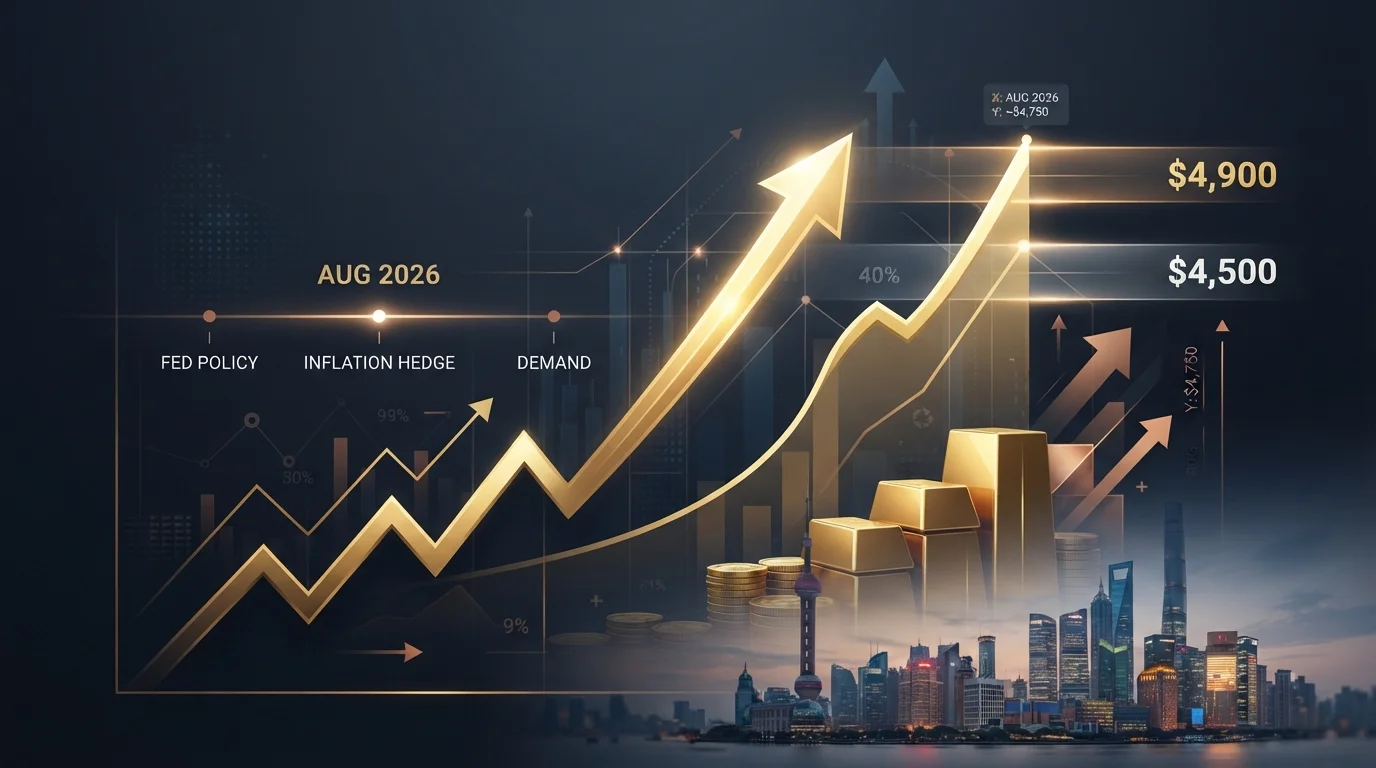
Wall Street analysts have established year-end price targets clustering between $4,500 (JPMorgan) and $4,900 (Goldman Sachs), suggesting a recovery trajectory rather than new record highs for the second half of 2026. The consensus view reflects expectations that gold will consolidate within the $4,000-$4,700 range before potentially breaking higher as monetary policy clarity emerges and geopolitical tensions sustain safe-haven demand.
For investors seeking exposure to gold's potential upside while managing risk, consider using Alphio AI's copy trading feature to mirror successful commodity traders and smart money positioning in precious metals.

Current Gold Market Overview
August 2026 Price Action
Gold entered August 2026 trading near $4,071 for August futures contracts, reflecting a period of consolidation following the volatile price action seen earlier in the year. The precious metal has struggled to establish a clear directional trend as traders weigh competing narratives around Federal Reserve policy, inflation persistence, and global economic stability.
The technical picture reveals gold trapped between significant moving averages, with the 200-day moving average providing support near $4,340 while the 50-day moving average caps upside advances around $4,730. This compression zone typically precedes significant breakout moves, though the direction remains dependent on catalysts from monetary policy developments and macroeconomic data releases.
Trading volumes have remained elevated compared to historical averages, indicating sustained institutional interest despite the sideways price action. Central bank purchasing continues to provide underlying support, with emerging market nations diversifying reserves away from dollar-denominated assets amid concerns about fiscal sustainability in developed economies.
Market Sentiment and Positioning
Speculative positioning in gold futures has moderated from extreme bullish levels seen earlier in 2026, creating room for fresh buying to emerge on positive catalysts. The Commitment of Traders data shows managed money accounts maintaining net long positions, though significantly reduced from peak levels, suggesting caution rather than conviction among institutional speculators.
Retail investor interest has remained robust, with physical gold demand from major consuming regions like India and China showing seasonal strength. Gold-backed exchange-traded funds have experienced mixed flows, with North American funds seeing modest outflows while European and Asian products attract fresh capital seeking inflation protection.
Billionaire hedge fund manager John Paulson recently told CNBC that gold is only in the early stages of a long-term rally, citing loss of faith in paper currency and runaway government spending as fundamental drivers that will persist for years. Paulson, who has been a gold bull since 2009, represents the view that structural factors supporting gold extend beyond near-term monetary policy fluctuations.
Federal Reserve Policy Impact on Gold
Interest Rate Expectations
The Federal Reserve's policy trajectory remains the primary driver of gold price dynamics in August 2026. CME FedWatch data reveals a 64.2% probability that the Fed will hold rates steady at 350-375 basis points, while traders still price a 35.8% chance of a hike to 375-400 basis points. This uncertainty creates volatility for gold, which typically performs well in low or declining rate environments but faces headwinds when real yields rise.
The 2-year Treasury yield, which closely tracks expectations for Federal Reserve interest rate policy, has traded around 4.15-4.25%, reflecting the market's divided view on the policy path ahead. Higher yields increase the opportunity cost of holding non-yielding assets like gold, creating a direct headwind for precious metals when rate hike expectations build.
However, all 104 economists surveyed by Reuters expect the Federal Reserve to eventually pivot toward rate cuts, though timing remains debated. The consensus view suggests that restrictive monetary policy has achieved its intended effect of cooling inflation, and the central bank will shift focus toward supporting growth as recession risks emerge.
Inflation Dynamics and Real Yields
Persistent inflation concerns continue to support gold's appeal as an inflation hedge, with the Consumer Price Index remaining elevated at 332.813. Traditional assets offer meager real returns when inflation is factored in, making gold an attractive alternative for preserving purchasing power over extended time horizons.
The relationship between gold and real yields (nominal Treasury yields minus inflation expectations) remains the key valuation metric for precious metals. Current real yields around 1.5-2% are not historically extreme, leaving room for gold to appreciate if inflation proves stickier than expected or if the Fed cuts nominal rates faster than inflation declines.
Energy-driven inflation presents a particular challenge for the Federal Reserve, as supply-side factors are less responsive to monetary policy tools. If oil prices remain elevated above $80 per barrel due to ongoing supply disruptions, the Fed may face difficult choices between controlling inflation and supporting growth, potentially creating a stagflationary environment that historically benefits gold.
For traders looking to automate their response to Fed policy shifts, Alphio AI's agentic trading offers automated portfolio management that can adjust gold exposure based on real-time macroeconomic data releases.

Expert Price Predictions and Targets
Wall Street Consensus
Major investment banks have established year-end gold price targets that reflect cautious optimism about the precious metal's prospects. JPMorgan maintains a $4,500 target, representing modest upside from current levels, while Goldman Sachs projects a more bullish $4,900 price point that would require a significant catalyst to achieve.
The divergence in targets reflects different assumptions about Federal Reserve policy timing and the persistence of inflation. Goldman Sachs appears to be pricing in earlier and more aggressive rate cuts, which would weaken the dollar and support gold prices. JPMorgan's more conservative target suggests expectations for a later pivot or stickier inflation that prevents real yields from falling substantially.
Analysts at both firms acknowledge that gold's path will be determined by whether the economy achieves a soft landing or descends into recession. A soft landing scenario with gradual rate cuts would likely support gold modestly, while a recessionary environment could drive safe-haven demand that pushes prices toward the upper end of forecast ranges.
Technical Analysis Levels
Technical analysts identify critical support and resistance levels that will determine gold's trajectory through the remainder of 2026. The $4,000 level represents major psychological and technical support, with a break below potentially triggering stop-loss selling that could drive prices toward $3,800. Conversely, a decisive break above $4,730 would target $4,900 and potentially set up a test of all-time highs above $5,000.
The consolidation pattern observed since mid-2026 resembles a symmetrical triangle formation, which typically resolves in the direction of the preceding trend. Given gold's strong performance in the first half of the year, technical traders lean toward an eventual upside breakout, though the timing remains uncertain.
Momentum indicators present a mixed picture, with the Relative Strength Index hovering near neutral levels and MACD showing declining momentum despite price stability. This divergence between price and momentum often precedes significant moves, though the direction requires confirmation from fundamental catalysts.
Macroeconomic Factors Supporting Gold
Fiscal Concerns and Debt Dynamics
The Congressional Budget Office's June review of the FY2027 budget projects federal debt held by the public rising from 100% of GDP in FY2026 to 121% by FY2036, surpassing the 106% post-WWII record set in 1946. This trajectory raises concerns about fiscal sustainability and the potential for debt monetization that would debase the currency and benefit gold.
As debt issued at lower rates matures and gets refinanced at much higher yields, the risk of a debt spiral increases. Interest payments on the national debt are projected to consume an ever-larger share of federal revenue, potentially crowding out other spending priorities and forcing difficult political choices about taxation and entitlement reform.
Gold has historically served as a hedge against fiscal profligacy and currency debasement. Investors concerned about the long-term value of fiat currencies increasingly view gold as essential portfolio insurance, particularly as reduced policy visibility pushes uncertainty about how policymakers will address these structural challenges.
Geopolitical Risk Premium
Ongoing geopolitical tensions continue to support safe-haven demand for gold, even as some headline risks have moderated. The closure of the Strait of Hormuz has kept oil prices elevated above $80 per barrel, creating inflationary pressures while simultaneously driving risk-off flows into precious metals.
Regional conflicts and great power competition show no signs of resolution, suggesting that geopolitical risk premiums will remain embedded in gold prices for the foreseeable future. Central banks in affected regions have accelerated gold purchases as a means of diversifying reserves and reducing dependence on currencies that could be weaponized through sanctions.
The intersection of energy security concerns and geopolitical rivalry creates a complex environment where gold benefits from multiple channels. Energy price shocks drive inflation that supports gold, while geopolitical uncertainty drives safe-haven flows, creating a potentially powerful combination for precious metals.
Investment Strategies for Gold in 2026
Portfolio Allocation Approaches
Financial advisors typically recommend gold allocations between 5-10% of a diversified portfolio, though individual circumstances may warrant higher or lower percentages. Gold's low correlation with traditional assets like stocks and bonds makes it valuable for portfolio diversification and risk reduction, particularly during periods of market stress.
Investors can gain gold exposure through multiple vehicles, each with distinct advantages and trade-offs. Physical gold provides the purest exposure but involves storage and security considerations. Exchange-traded funds like GLD offer convenient liquidity and price transparency but carry counterparty risks and management fees. Gold mining stocks provide leveraged exposure to gold prices but introduce company-specific risks and operational challenges.
The optimal approach depends on individual investment objectives, risk tolerance, and tax considerations. Many investors choose a blended approach, combining physical gold for wealth preservation with ETFs for trading flexibility and mining stocks for growth potential.
Timing and Entry Strategies
Dollar-cost averaging remains a prudent approach for building gold positions, particularly given the current uncertainty about near-term price direction. By spreading purchases over time, investors reduce the risk of deploying capital at a local peak while ensuring participation if prices break out to the upside.
Technical traders may prefer to wait for confirmation of a breakout above $4,730 before establishing significant long positions, accepting the risk of missing the initial move in exchange for greater confidence in the trend. Stop-loss orders below $4,000 can help manage downside risk if the breakout fails and prices reverse lower.
Options strategies can provide exposure to gold's upside while limiting capital at risk. Call options on GLD or gold futures allow investors to participate in price appreciation with defined risk, though time decay works against buyers of short-dated options. More sophisticated strategies like bull call spreads can reduce premium costs while maintaining upside exposure.
To set up conditional workflows for your gold trading strategy, explore Alphio AI's automations to execute trades based on predefined price levels and technical signals.

Risks and Challenges for Gold Bulls
Dollar Strength Headwinds
The U.S. dollar's performance remains a critical variable for gold prices, as the two assets typically exhibit inverse correlation. If the Federal Reserve maintains higher rates for longer than expected while other central banks cut more aggressively, dollar strength could cap gold's upside regardless of other supportive factors.
The dollar's reserve currency status creates structural demand that can persist even when fundamental factors suggest weakness. Safe-haven flows during periods of global stress often benefit the dollar initially, creating short-term headwinds for gold even when the precious metal eventually benefits from the same risk-off sentiment.
Currency intervention by foreign central banks could also impact gold indirectly. If major economies take steps to weaken their currencies to support exports, dollar strength could follow, creating a challenging environment for dollar-denominated commodities including gold.
Technical Breakdown Risk
While technical analysts generally favor an eventual upside resolution to gold's consolidation, the risk of a breakdown below $4,000 cannot be dismissed. Such a move would likely trigger algorithmic selling and stop-loss orders that could drive prices significantly lower in a short period.
A sustained break below the 200-day moving average would shift the technical outlook from neutral to bearish, potentially attracting fresh short selling from momentum traders. The $3,800 level represents the next major support zone, with a break below that opening the door to a deeper correction toward $3,500.
Investors should position size appropriately for the possibility of adverse price action, ensuring that potential losses from a gold decline would not materially impact overall portfolio performance. Risk management through position sizing and stop-loss orders is essential in volatile commodity markets.
Conclusion
Gold's outlook for the remainder of 2026 reflects a balance between supportive structural factors and near-term uncertainty about Federal Reserve policy. The precious metal is likely to remain range-bound between $4,000 and $4,700 until greater clarity emerges on the timing and pace of rate cuts, with a breakout likely to occur in the direction of the policy surprise.
Long-term investors should focus on gold's role as portfolio insurance and wealth preservation rather than attempting to time short-term price movements. The structural factors supporting gold, including fiscal unsustainability, geopolitical fragmentation, and currency debasement concerns, are likely to persist regardless of near-term monetary policy fluctuations.
For traders seeking to capitalize on gold's eventual breakout, maintaining flexibility and managing risk through appropriate position sizing will be essential. The convergence of technical compression and fundamental uncertainty suggests that when the breakout does occur, it could be sharp and sustained.
Ready to trade gold with AI-powered insights? Try Alphio AI's conversational trading to execute trades via chat and get real-time market analysis for precious metals and other assets.

Additionally, consider using Alphio AI's copy trading to mirror successful gold traders, or explore agentic trading to automate your precious metals investment strategy with AI-powered portfolio management.
FAQs
What is the gold price forecast for August 2026?
Analysts expect gold to trade within a range of $3,580-$4,645 in August 2026, with most year-end targets clustering between $4,500 (JPMorgan) and $4,900 (Goldman Sachs). The price is currently consolidating between the 200-day moving average at $4,340 and the 50-day moving average at $4,730.
How does Federal Reserve policy affect gold prices?
Gold typically performs well in low or declining interest rate environments because lower rates reduce the opportunity cost of holding non-yielding assets. When the Fed raises rates or maintains restrictive policy, real yields increase and create headwinds for gold. Current market pricing shows a 64.2% probability of the Fed holding rates steady.
Is gold a good hedge against inflation?
Gold has historically served as an effective inflation hedge, preserving purchasing power when fiat currencies lose value. With the Consumer Price Index elevated at 332.813 and persistent inflation concerns, gold remains attractive for investors seeking protection against wealth erosion from rising prices.
What are the key support and resistance levels for gold?
Critical support for gold is at $4,000, with a break below potentially triggering selling toward $3,800. Resistance is found at the 50-day moving average around $4,730, with a decisive break above targeting $4,900 and potentially all-time highs above $5,000.
How can investors gain exposure to gold?
Investors can access gold through physical bullion, exchange-traded funds (ETFs) like GLD, gold mining stocks, futures contracts, and options strategies. Each approach offers different trade-offs between convenience, liquidity, leverage, and risk. Financial advisors typically recommend 5-10% gold allocation in diversified portfolios.