

Fed Signals Rate Hike Coming: Warsh's Jackson Hole Speech Reshapes Market Outlook for Fall 2026
Fed Chair Kevin Warsh's Jackson Hole speech signals potential rate hikes. Analysis of inflation concerns, market impact, and investment strategies for September 2026.

Key Takeaway
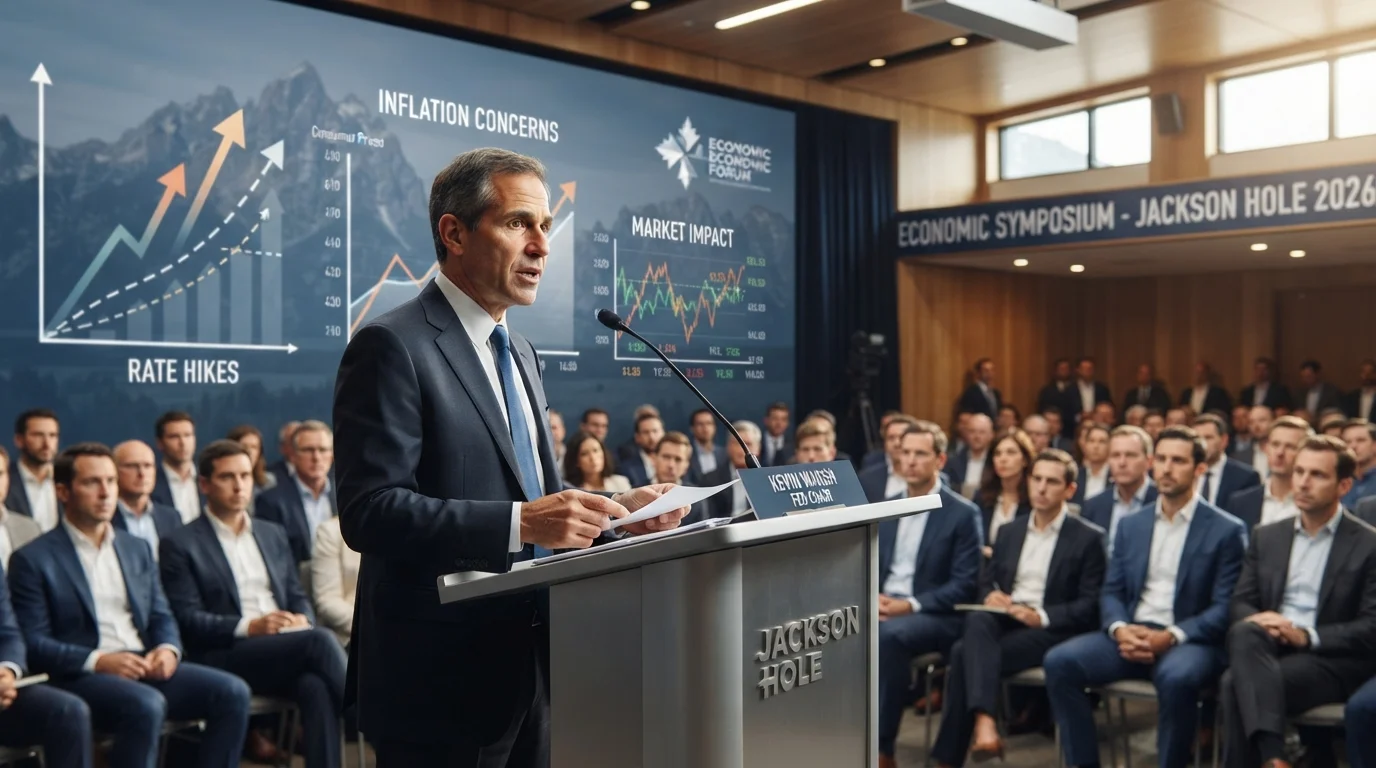
Federal Reserve Chair Kevin Warsh delivered a landmark speech at the Jackson Hole Economic Policy Symposium on August 28, 2026, sending shockwaves through global financial markets by signaling that the central bank may need to raise interest rates in the coming months to combat persistent inflation. This marked a significant shift in monetary policy communication, as Warsh abandoned his previous reluctance to provide forward guidance and instead offered the clearest indication yet that borrowing costs could rise before year-end.
The speech immediately triggered a repricing of rate expectations across fixed income markets, with traders now pricing in a higher probability of a September or October rate increase. Treasury yields spiked on the news, while equity markets experienced heightened volatility as investors recalibrated their portfolios for a potentially more restrictive monetary environment. The implications extend far beyond U.S. borders, as the dollar strengthened against major currencies and emerging market assets faced renewed pressure.
For investors, Warsh's comments represent a critical inflection point that demands careful portfolio repositioning. The era of ultra-low interest rates that has defined markets since the financial crisis appears to be definitively ending, and those who fail to adapt their strategies risk significant underperformance. Understanding the nuances of Warsh's message and its potential trajectory will be essential for navigating the months ahead.
The Jackson Hole Speech: Parsing Warsh's Message
Inflation Remains Too High
At the core of Warsh's address was an unambiguous acknowledgment that inflation continues to run above the Federal Reserve's 2% target. While he did not specify exact figures, market participants interpreted his remarks as confirmation that recent price data has failed to show the sustained deceleration policymakers had hoped for. This represents a notable departure from earlier optimism that inflationary pressures were transitory and would naturally subside as supply chain disruptions resolved.
Warsh emphasized that the Fed remains humble and never naive about the challenges of price stability, suggesting that the central bank has learned painful lessons from its previous underestimation of inflation's persistence. This humility translates into a more hawkish stance, as policymakers now appear willing to act preemptively rather than waiting for definitive proof that inflation is entrenched.
The labor market's strength provides additional cover for potential rate increases. With unemployment near historic lows and wage growth showing signs of acceleration, Warsh indicated that the economy can withstand tighter monetary conditions without tipping into recession. This assessment aligns with the Fed's dual mandate but shifts the balance decisively toward price stability over maximum employment.
Timing and Trajectory: When Will Rates Rise?
While Warsh stopped short of explicitly committing to a September rate hike, his language left little doubt that such a move is under serious consideration. Market pricing immediately shifted, with the CME FedWatch Tool showing increased odds of a 25-basis-point increase at the September Federal Open Market Committee (FOMC) meeting. Some analysts now believe the Fed could deliver multiple hikes before year-end if inflation data fails to cooperate.
The trajectory of rate increases remains highly dependent on incoming economic data. Warsh made clear that the Fed will remain data-dependent, with each meeting representing a fresh opportunity to assess conditions and adjust policy accordingly. This approach provides flexibility but also introduces uncertainty, as markets must constantly recalibrate expectations based on monthly inflation reports, employment data, and other economic indicators.
For investors seeking to stay ahead of Fed policy shifts, consider using Alphio AI's copy trading feature to mirror successful traders who specialize in macroeconomic positioning and interest rate strategies.

Market Reaction: Bonds, Stocks, and the Dollar
Treasury Yields Spike
The fixed income market reacted immediately and violently to Warsh's remarks. The yield on the 2-year Treasury note, which closely tracks expectations for Fed policy, jumped more than 10 basis points in the hours following the speech. Longer-dated yields also rose, though the curve flattened somewhat as investors priced in a higher terminal rate while simultaneously worrying about the economic impact of tighter policy.
This repricing has significant implications for borrowers and savers alike. Mortgage rates, which had shown signs of stabilizing, are likely to resume their upward trajectory. Corporate borrowers face higher refinancing costs, potentially squeezing profit margins for highly leveraged companies. Conversely, savers may finally begin to see meaningful returns on cash deposits after years of near-zero yields.
Equity Market Volatility
Stock markets displayed the characteristic uncertainty that accompanies monetary policy inflection points. Major indexes initially sold off sharply as higher discount rates reduced the present value of future earnings, particularly for high-growth technology companies with profits projected far into the future. However, defensive sectors including utilities, consumer staples, and healthcare showed relative resilience, reflecting their ability to pass through cost increases to consumers.
Financial stocks presented a mixed picture. Banks typically benefit from higher interest rates through improved net interest margins, but concerns about loan defaults in a slowing economy offset some of this optimism. The sector's performance in the coming weeks will likely serve as a bellwether for broader market sentiment regarding the Fed's ability to engineer a soft landing.
Dollar Strength and Global Implications
The U.S. dollar strengthened notably against major currencies following Warsh's speech, as higher U.S. rates increased the attractiveness of dollar-denominated assets. This creates challenges for emerging market economies that have borrowed heavily in dollars and now face the dual headwinds of rising debt service costs and capital outflows.
Commodity prices showed mixed reactions. Gold, traditionally a hedge against inflation, initially rose on the inflationary implications of Warsh's comments but later retreated as the prospect of higher real rates reduced its relative attractiveness. Oil prices remained relatively stable, with supply concerns from geopolitical tensions offsetting demand worries stemming from potential economic slowing.
Investment Strategies for a Rising Rate Environment
Fixed Income Repositioning
Traditional bond portfolios face significant headwinds in a rising rate environment, as falling bond prices erode total returns. Investors should consider shortening duration to reduce interest rate sensitivity, focusing on bonds with maturities of 1-3 years rather than longer-dated issues. Floating-rate securities, including bank loans and Treasury Inflation-Protected Securities (TIPS), offer natural hedges against rising rates.
Credit quality becomes increasingly important as monetary tightening increases default risk. Investment-grade corporate bonds and agency mortgage-backed securities offer attractive risk-adjusted returns compared to high-yield alternatives. For those seeking income, dividend-paying stocks with strong balance sheets may provide better total return prospects than traditional fixed income.
Equity Sector Rotation
Historical patterns suggest that rising rate environments favor certain equity sectors over others. Financials, as mentioned, typically benefit from improved lending margins. Energy stocks often perform well when inflation drives commodity prices higher. Healthcare and consumer staples offer defensive characteristics that become more valuable during periods of economic uncertainty.
Conversely, technology and other growth sectors face headwinds as higher discount rates reduce the present value of distant earnings. Real estate investment trusts (REITs) and utilities, which compete with bonds for income-oriented investors, may underperform as Treasury yields become more competitive. Investors should consider rebalancing toward value-oriented sectors while maintaining exposure to quality growth names with strong cash flows.
For those looking to automate their portfolio adjustments in response to changing rate environments, Alphio AI's agentic trading offers sophisticated automation tools to manage your investments dynamically.

Alternative Investments
Private credit and direct lending strategies have gained popularity as banks retreat from certain lending activities under regulatory pressure. These investments often feature floating rates that adjust with benchmark interest rates, providing natural inflation protection. However, liquidity constraints and credit risk require careful due diligence.
Infrastructure investments, including toll roads, airports, and utilities, typically generate stable cash flows that can be contractually linked to inflation. These assets offer attractive yield alternatives to traditional fixed income while providing portfolio diversification benefits. The key is selecting assets with strong competitive positions and pricing power that can withstand economic downturns.
The Global Context: International Monetary Policy Divergence
European Central Bank's Dilemma
While the Fed signals potential tightening, the European Central Bank (ECB) faces a different set of challenges. Eurozone inflation has shown more encouraging signs of deceleration, and economic growth remains fragile in several member states. This divergence creates policy challenges for the ECB, which must balance the needs of stronger northern economies against the vulnerabilities of peripheral nations.
The euro has weakened against the dollar as interest rate differentials widen, potentially exacerbating imported inflation in Europe. ECB President Christine Lagarde has emphasized data-dependent policy, but the central bank's room to maneuver appears more constrained than the Fed's. Investors should monitor ECB communications closely for signs of whether European policymakers will follow the Fed's lead or maintain a more accommodative stance.
Emerging Market Pressures
Emerging market economies face perhaps the most challenging environment as Fed tightening strengthens the dollar and draws capital back to the United States. Countries with large dollar-denominated debt burdens, including Turkey, Argentina, and several Asian nations, are particularly vulnerable to balance of payments crises. Currency depreciation in these markets can trigger inflationary spirals that force local central banks to raise rates even as their economies slow.
Selectivity becomes crucial when investing in emerging markets during periods of Fed tightening. Countries with strong current account surpluses, substantial foreign exchange reserves, and limited dollar debt are better positioned to weather the storm. Mexico and several Southeast Asian nations fit this profile and may offer attractive entry points for patient investors.
Historical Precedents: Lessons from Past Tightening Cycles
The 1994 Bond Market Massacre
The most severe bond market reaction to Fed tightening occurred in 1994, when Chairman Alan Greenspan's surprise rate increases triggered massive losses across fixed income portfolios. The 10-year Treasury yield rose more than 200 basis points in a matter of months, devastating investors who had grown complacent during the low-volatility environment of the early 1990s.
The lesson for today's investors is that rate cycles can turn quickly and violently, particularly when market positioning has become one-sided. Current bond market positioning appears less extreme than in 1994, but the proliferation of risk parity strategies and leveraged fixed income products creates potential for forced selling if volatility spikes.
The 2004-2006 Gradual Approach
The Fed's most recent sustained tightening cycle, which began in 2004 under Greenspan and continued under Ben Bernanke, featured a gradual approach with 17 consecutive 25-basis-point increases. This measured pace allowed markets to adjust without significant disruptions, and the economy continued expanding throughout the cycle.
However, the current environment differs in important ways. Inflation is higher and more persistent than in the mid-2000s, and the Fed may feel compelled to move more aggressively to prevent inflation expectations from becoming unanchored. The risk of a policy error, either tightening too much and causing a recession or too little and allowing inflation to spiral, appears elevated.
Looking Ahead: Key Data Points to Watch
August Employment Report
The upcoming August employment report will provide crucial input for the Fed's September decision. Strong job creation and wage growth would reinforce the case for immediate tightening, while signs of labor market cooling might give policymakers pause. The unemployment rate, currently near historic lows, bears particular attention as an indicator of economic slack.
Average hourly earnings growth has exceeded 4% annually in recent months, well above the pace consistent with 2% inflation when productivity growth is taken into account. If wage pressures continue building, the Fed may conclude that inflation has become entrenched in the labor market, requiring more aggressive policy response.
August CPI and PCE Data
The Consumer Price Index (CPI) and Personal Consumption Expenditures (PCE) price index represent the Fed's primary inflation gauges. Core PCE, which excludes volatile food and energy prices, has remained stubbornly above 3% despite the Fed's previous rate increases. A reacceleration in either headline or core measures would virtually guarantee a September hike.
Housing costs, including rents and owners' equivalent rent, comprise a significant portion of inflation indices and tend to move with long lags. Recent moderation in housing market activity suggests these components may decelerate in coming months, but the timing remains uncertain. Services inflation, excluding housing, has proven particularly persistent and may require sustained tight policy to subdue.
To set up automated alerts for key economic data releases and market movements, explore Alphio AI's automations feature for conditional workflows that trigger based on your specified criteria.

Conclusion
Kevin Warsh's Jackson Hole speech marks a pivotal moment in monetary policy that investors cannot afford to ignore. By signaling potential rate hikes while inflation remains above target, the Fed Chair has made clear that price stability takes precedence over other considerations. This shift has immediate implications for portfolio positioning across asset classes and demands a reassessment of strategies that have worked in the low-rate environment of recent years.
The path forward remains uncertain, with much depending on incoming economic data and how financial markets respond to tightening conditions. History suggests that the Fed can successfully navigate rate increases without triggering recession, but the margin for error is slim. Investors should prepare for continued volatility while maintaining focus on long-term fundamentals and valuations.
For those seeking to navigate this complex environment, Alphio AI offers powerful tools to enhance your trading and investment decisions. Whether through copy trading to mirror successful strategies, agentic trading for automated portfolio management, or conversational trading to execute trades via natural language, Alphio provides the technology you need to stay ahead in evolving markets. The coming months will test investors' adaptability. Make sure you have the right tools at your disposal.
FAQs
What did Fed Chair Kevin Warsh say at Jackson Hole 2026?
At the Jackson Hole Economic Policy Symposium on August 28, 2026, Fed Chair Kevin Warsh signaled that the Federal Reserve may need to raise interest rates in the coming months to combat persistent inflation. He emphasized that inflation remains too high and that the Fed has work to do on rates, marking a shift toward more hawkish monetary policy.
When will the Fed likely raise interest rates?
Based on Warsh's speech and market pricing, most analysts expect a rate hike either at the September 2026 FOMC meeting or in October/December 2026. The exact timing depends on incoming economic data, particularly inflation reports and employment figures. Warsh maintained data-dependent policy but made clear that tightening is under serious consideration.
How do rising interest rates affect stock markets?
Rising interest rates typically pressure stock markets by increasing borrowing costs for companies and reducing the present value of future earnings. Growth stocks, particularly in technology, tend to underperform as higher discount rates reduce their valuation multiples. Defensive sectors like utilities, consumer staples, and healthcare often show relative resilience, while financials may benefit from improved lending margins.
What investment strategies work best when rates are rising?
In rising rate environments, investors should consider shortening bond portfolio duration, focusing on floating-rate securities, and rotating toward value-oriented equity sectors. Financials, energy, and defensive consumer stocks typically outperform. Alternative investments like private credit and infrastructure can provide inflation protection. Maintaining quality focus and strong balance sheets becomes increasingly important as monetary tightening increases default risks.
How does Fed policy affect international markets?
Fed tightening typically strengthens the U.S. dollar as higher rates attract capital flows, creating challenges for emerging markets with dollar-denominated debt. European and Asian central banks face pressure to either follow the Fed's lead or accept currency depreciation and potential inflationary pressures. Commodity prices often decline as the stronger dollar makes commodities more expensive in other currencies, though supply factors can offset this effect.