

Nvidia Q2 Earnings August 2026: Record Revenue, AI Chip Demand, and Stock Outlook
Nvidia reports record Q2 2026 earnings with $96.2B revenue. Analysis of AI chip demand, Blackwell growth, data center performance, and NVDA stock price forecast for investors.

Key Takeaway
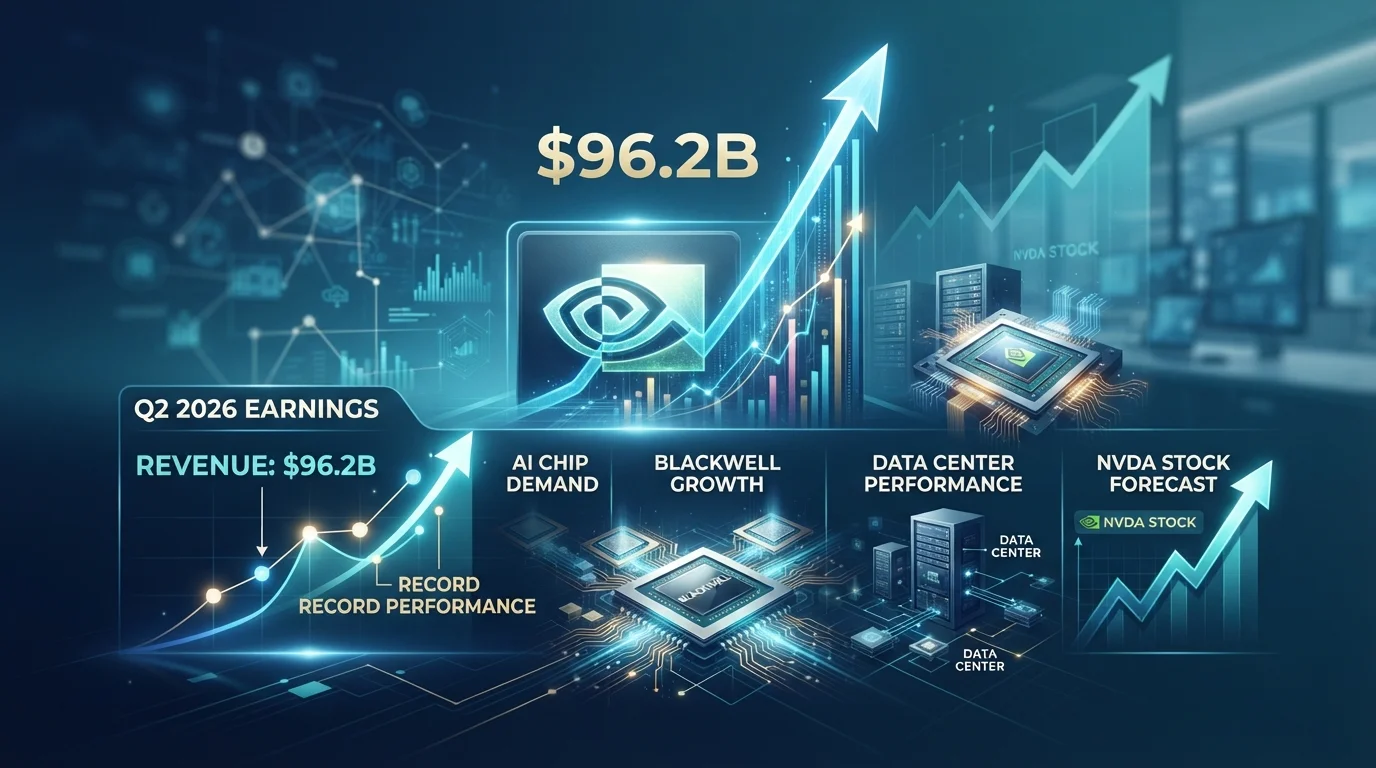
Nvidia's second-quarter fiscal 2027 earnings report, released on August 26, 2026, delivered another stunning demonstration of the company's dominance in the artificial intelligence chip market. The semiconductor giant reported quarterly revenue of approximately $96.2 billion, representing an extraordinary 96% year-over-year increase that significantly exceeded Wall Street's already elevated expectations. This performance underscores Nvidia's position as the primary beneficiary of the global AI infrastructure buildout, with its data center business generating the vast majority of total revenue as cloud providers, enterprises, and governments race to deploy AI capabilities.
The market's reaction to Nvidia's earnings was notably nuanced, with shares rising approximately 4% in after-hours trading immediately following the announcement, yet the stock has experienced significant volatility throughout 2026. Despite a 14% year-to-date gain that trails the broader S&P 500's performance, analysts remain overwhelmingly bullish on Nvidia's prospects. Price targets cluster between $275 and $325, with the consensus target around $305 implying substantial upside from current trading levels near $219. The key question for investors is whether Nvidia can sustain its extraordinary growth rates as competition intensifies and the AI market matures.
Nvidia's Q2 2026 Earnings Breakdown
Record Revenue Performance
Nvidia's Q2 fiscal 2027 results represent one of the most impressive quarters in corporate history, with revenue reaching approximately $96.2 billion compared to roughly $49 billion in the year-ago period. This growth trajectory reflects the insatiable demand for AI accelerators as organizations worldwide invest heavily in building AI infrastructure. The company's GAAP earnings per share came in at approximately $2.06, nearly double the year-ago result and well ahead of analyst estimates.
The magnitude of Nvidia's revenue growth becomes even more remarkable when considered in historical context. Just three years ago, Nvidia was generating roughly $7 billion in quarterly revenue. The company's transformation from a gaming-focused graphics card manufacturer to the dominant supplier of AI infrastructure has created one of the most valuable enterprises in history, with a market capitalization exceeding $5 trillion.
Data Center Dominance
The data center segment has become Nvidia's crown jewel, generating approximately $89 billion in Q2 revenue and representing the primary growth engine for the company. This massive figure reflects triple-digit year-over-year growth driven by volume sales of AI accelerators to hyperscale cloud providers including Microsoft, Amazon, Google, and Meta, as well as enterprise customers and sovereign governments building AI factories.
Nvidia's networking business, which includes the Mellanox acquisition, contributed approximately $7.25 billion in revenue, nearly doubling from the prior year. This networking growth is particularly significant as it demonstrates Nvidia's ability to capture value beyond just GPU sales, positioning the company as a comprehensive AI infrastructure provider rather than merely a chip supplier.
For investors seeking exposure to the AI revolution through automated trading strategies, consider exploring Alphio AI's copy trading feature to mirror successful traders who specialize in semiconductor and technology stocks.

Blackwell Architecture: The Next Growth Phase
Blackwell Ultra Ramp
Nvidia's next-generation Blackwell architecture represents the company's most ambitious product transition yet, and early deployment momentum has exceeded expectations. The Blackwell Ultra platform, which began shipping in volume during Q2, delivers unprecedented performance for training and inference of large language models and other generative AI workloads. This architecture is specifically designed to handle the massive computational requirements of next-generation AI models, offering significant improvements in both performance and energy efficiency compared to the previous Hopper generation.
The successful ramp of Blackwell production is critical for maintaining Nvidia's technological leadership position. The company's ability to transition customers from Hopper to Blackwell while simultaneously meeting explosive demand demonstrates the operational excellence that has become a hallmark of Nvidia's execution under CEO Jensen Huang's leadership.
Competitive Positioning
While competitors including AMD, Intel, and various startups are developing alternative AI accelerators, Nvidia maintains a commanding lead through its comprehensive ecosystem approach. The company's CUDA software platform has become the industry standard for AI development, creating significant switching costs for customers considering alternative hardware. Additionally, Nvidia's networking solutions, including InfiniBand and Ethernet products, enable customers to build large-scale AI clusters that would be difficult to replicate with competitor offerings.
Market Context and Valuation Considerations
Interest Rate Environment
Nvidia's valuation exists within a broader market context that includes significant uncertainty around Federal Reserve policy. The 10-year Treasury yield has surged above 4.7% in August 2026, which puts pressure on valuations for stocks that derive significant value from expected future growth. Money markets have fully priced in a Fed rate hike by December 2026, with some analysts anticipating a quarter-point increase as early as September.
This rising rate environment creates headwinds for high-growth technology stocks, as higher discount rates reduce the present value of future cash flows. However, Nvidia's extraordinary revenue growth and expanding margins provide some insulation from these broader market pressures, as the company's fundamentals continue to strengthen even as valuation multiples compress.
Institutional Ownership Dynamics
Recent analysis from Morgan Stanley revealed that Nvidia is the most "under-owned" of the mega-cap technology stocks, with average weighting in institutional portfolios falling below 5% in the second quarter, significantly lagging its nearly 8% weight in the benchmark S&P 500 index. This ownership gap suggests potential for increased institutional buying as portfolio managers rebalance to match benchmark weights, providing a potential catalyst for the stock.
For investors interested in automating their portfolio management with AI-powered strategies, Alphio's agentic trading feature offers sophisticated tools to optimize positions in high-growth technology stocks like Nvidia.

Forward Guidance and Growth Sustainability
Revenue Outlook
Nvidia's forward guidance for Q3 fiscal 2027 will be closely watched by investors seeking to understand whether the company can sustain its extraordinary growth rates. Management commentary on the earnings call emphasized continued strong demand visibility extending multiple quarters into the future, driven by the ongoing buildout of AI infrastructure by major cloud providers and enterprises.
The company's guidance for data center revenue growth will be particularly important, as this segment now represents the overwhelming majority of total revenue. Any signs of demand moderation or competitive pressure could significantly impact the stock's valuation, given the high expectations embedded in current prices.
Margin Trajectory
Nvidia's gross margins have expanded significantly during the AI boom, reflecting the company's pricing power and operational leverage. The transition to Blackwell production could create temporary margin pressure as manufacturing yields ramp, but long-term margin trends remain favorable as the company benefits from scale economies and software-like revenue streams from its growing services business.
Investment Risks and Considerations
Competition Intensification
While Nvidia currently dominates the AI accelerator market, competition is intensifying from multiple directions. AMD has made significant strides with its MI300 series accelerators and has secured commitments from major cloud providers. Intel is investing heavily in its Gaudi product line, though market traction has been limited to date. Additionally, custom silicon efforts by Google (TPU), Amazon (Trainium/Inferentia), and Microsoft (Maia) could reduce demand for Nvidia's off-the-shelf solutions over time.
Geopolitical and Regulatory Risks
Nvidia faces ongoing geopolitical risks related to export restrictions on advanced AI chips to China, which historically represented a significant portion of revenue. The company has developed cut-down versions of its products to comply with U.S. export controls, but these restrictions may limit long-term growth in the Chinese market. Additionally, increasing regulatory scrutiny of AI technologies could create compliance costs or limit certain applications.
For traders looking to set up conditional workflows and automated responses to earnings announcements, Alphio's automations feature provides powerful tools to execute trades based on predefined criteria.

Conclusion
Nvidia's Q2 2026 earnings report confirms the company's position as the dominant force in AI infrastructure, with record revenue of $96.2 billion demonstrating the insatiable global demand for AI accelerators. The successful ramp of Blackwell production, expanding data center revenue, and strong forward guidance suggest that Nvidia's growth story remains intact despite intensifying competition and a challenging interest rate environment.
For investors, the key question is whether Nvidia's current valuation adequately reflects both the extraordinary growth opportunities and the increasing competitive and macroeconomic risks. With analyst price targets suggesting 25-45% upside from current levels, the stock remains a compelling opportunity for those who believe in the continued expansion of AI infrastructure spending. However, the high expectations embedded in the stock price mean that any disappointment in future quarters could result in significant volatility.
Investors seeking to capitalize on Nvidia's growth story and other AI-related investment opportunities can leverage Alphio's conversational trading platform to execute trades, monitor positions, and access real-time market analysis through an intuitive chat interface.

The AI revolution is still in its early stages, and Nvidia's comprehensive ecosystem of hardware, software, and networking solutions positions the company to capture a significant share of the trillions of dollars in expected AI infrastructure investment over the coming decade. For long-term investors with appropriate risk tolerance, Nvidia remains a core holding in the technology sector despite near-term valuation concerns.
FAQs
What were Nvidia's Q2 2026 earnings results?
Nvidia reported Q2 fiscal 2027 revenue of approximately $96.2 billion, representing 96% year-over-year growth. GAAP earnings per share were approximately $2.06, nearly double the year-ago result. The data center segment generated approximately $89 billion in revenue, driven by strong demand for AI accelerators.
What is Nvidia's Blackwell architecture?
Blackwell is Nvidia's next-generation AI chip architecture designed for training and inference of large language models and generative AI workloads. The Blackwell Ultra platform began shipping in volume during Q2 2026, delivering significant improvements in performance and energy efficiency compared to the previous Hopper generation.
What is the analyst price target for Nvidia stock?
Analyst price targets for Nvidia cluster between $275 and $325, with a consensus target around $305. This implies potential upside of 25-45% from current trading levels near $219. The stock has gained approximately 14% year-to-date in 2026.
What are the main risks facing Nvidia?
Key risks include intensifying competition from AMD, Intel, and custom silicon efforts by major cloud providers; geopolitical risks related to China export restrictions; regulatory scrutiny of AI technologies; and the challenge of sustaining extraordinary growth rates as the AI market matures.
How does the Federal Reserve's interest rate policy affect Nvidia stock?
Rising interest rates create headwinds for high-growth stocks like Nvidia by reducing the present value of future cash flows. The 10-year Treasury yield above 4.7% and expectations of Fed rate hikes by year-end 2026 put pressure on valuation multiples. However, Nvidia's strong fundamentals provide some insulation from these broader market pressures.