

Nvidia Earnings August 2026: AI Chip Demand Analysis & Stock Forecast
Nvidia's Q2 FY2027 earnings preview: Wall Street expects $93-95B revenue driven by Blackwell chip demand. Analysis of AI chip market dominance and NVDA stock outlook.

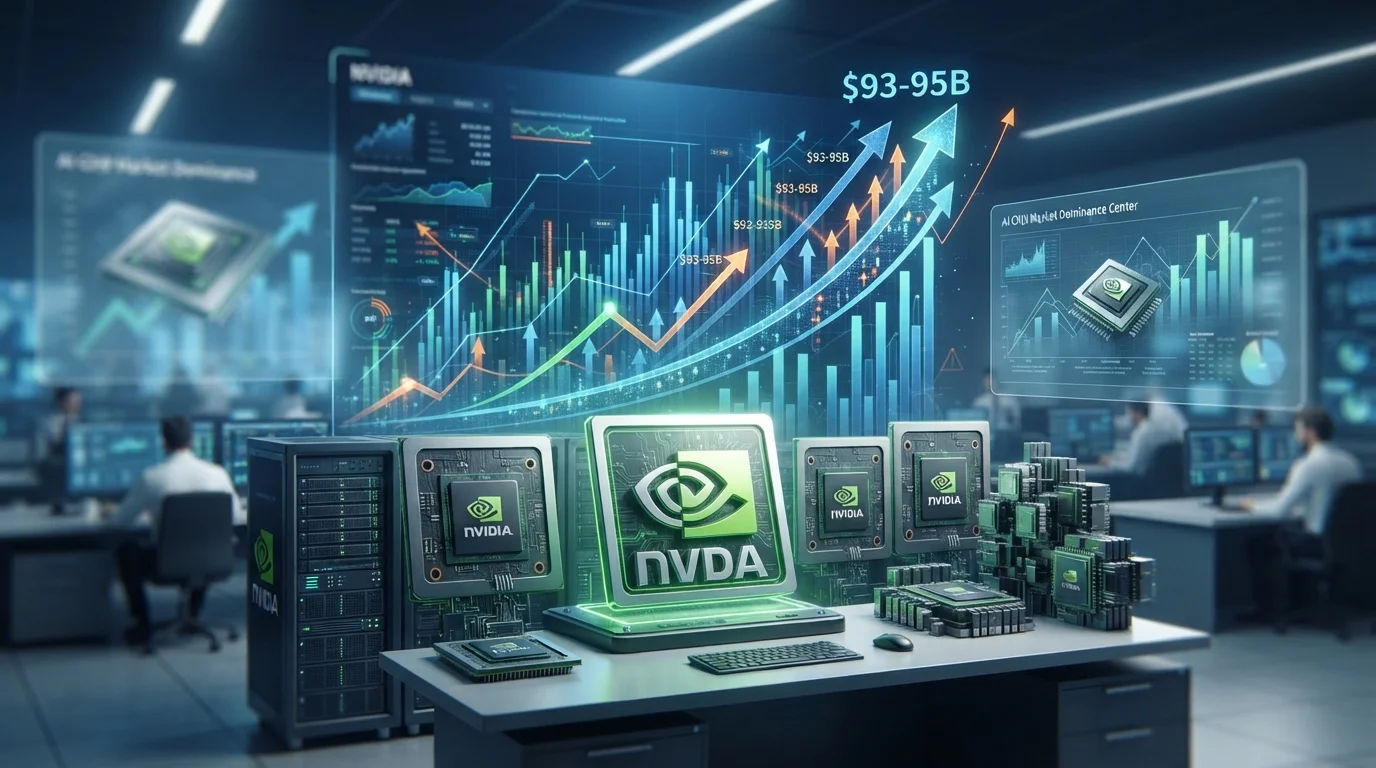
Key Takeaway
Nvidia stands at a critical juncture as it prepares to report its second-quarter earnings on August 26, 2026. Wall Street expects the semiconductor giant to deliver approximately $93-95 billion in revenue, representing a remarkable 95% year-over-year growth rate that would cement the company's dominance in the artificial intelligence chip market. This anticipated performance is driven primarily by insatiable demand for AI accelerators and the successful ramp-up of Nvidia's next-generation Blackwell architecture.
The data center segment has become the engine of Nvidia's growth, now accounting for approximately 87% of total revenue. In the first quarter of fiscal 2027 alone, data center revenue reached a staggering $75.2 billion, up 92% from the prior year and establishing a new quarterly record for the semiconductor industry. The Blackwell platform, featuring the B200 and GB200 superchips, has emerged as the primary growth driver as cloud providers, enterprises, and AI startups race to secure computing capacity for training and inference workloads.
For investors evaluating Nvidia's stock ahead of earnings, the key questions center on guidance for the remainder of fiscal 2027, the pace of Blackwell adoption, and how management addresses emerging competition from AMD and custom silicon initiatives by hyperscalers. The stock's valuation, while demanding, may be justified if the company can maintain its technological edge and capture the majority of the expanding AI infrastructure market.
Nvidia's Q2 FY2027 Earnings Preview
Wall Street analysts have set extraordinarily high expectations for Nvidia's second-quarter results, reflecting the company's pivotal role in the AI revolution. The consensus revenue estimate of $93-95 billion would represent approximately 95% growth compared to the same quarter in the prior year, a figure virtually unprecedented for a company of Nvidia's scale. Earnings per share are expected to reach $2.09, more than double the year-ago figure.
The magnitude of these expectations underscores how dramatically the AI chip market has expanded. Just three years ago, Nvidia's quarterly revenue hovered around $7-8 billion. The current forecast represents more than a twelvefold increase, driven by the explosion of generative AI applications and the massive infrastructure investments required to support them. Major cloud providers including Amazon, Microsoft, Google, and Meta have collectively committed hundreds of billions of dollars to AI infrastructure, with Nvidia chips representing the largest component of these capital expenditures.
Management's guidance for the third quarter will be equally important as the reported second-quarter results. Investors will be looking for confirmation that demand remains robust and that supply constraints are easing as Blackwell production ramps. Any indication of demand moderation or competitive pressure could trigger significant stock volatility given the elevated expectations embedded in the current valuation.
Blackwell Architecture: The New Growth Engine
Nvidia's Blackwell platform represents the most significant architectural advancement in the company's data center GPU lineup since the introduction of the Hopper architecture. The flagship B200 GPU delivers approximately 20 petaflops of FP4 compute performance, a substantial leap from the H100's capabilities. More importantly, the GB200 "Grace Blackwell" superchip combines the B200 GPU with a 72-core Grace CPU on a single die, enabling CPU-GPU coherency and dramatically reducing data movement bottlenecks for large AI models.
The Blackwell ramp has already driven record-breaking financial results. In the first quarter of fiscal 2027, Blackwell-based products accounted for the majority of data center revenue for the first time, surpassing the previous Hopper generation. The GB200 NVL72 rack-scale system, which connects 72 B200 GPUs and 36 Grace CPUs via high-speed NVLink interconnects, has been particularly popular among hyperscalers building large-scale AI training clusters.
Production ramp challenges have been a recurring theme in Nvidia's recent earnings calls, and the second-quarter report should provide updates on manufacturing yields and delivery timelines. Taiwan Semiconductor Manufacturing Company (TSMC) produces the Blackwell chips using its advanced 4-nanometer process, and any constraints in advanced packaging capacity could limit Nvidia's ability to meet demand. Investors should listen for commentary on the CoWoS (Chip-on-Wafer-on-Substrate) packaging capacity expansion, which has been a bottleneck for AI chip production across the industry.
For investors seeking to capitalize on the AI infrastructure buildout, consider using Alphio AI's copy trading feature to mirror successful traders and smart money wallets that are positioned for the semiconductor sector's continued growth.

Data Center Revenue Dominance
The data center segment's transformation from a minor contributor to Nvidia's primary revenue source has been one of the most dramatic shifts in the technology industry over the past three years. In fiscal 2026, data center revenue reached approximately $193.7 billion, representing roughly 90% of total company revenue. This compares to just 40% three years earlier, illustrating how AI demand has fundamentally restructured Nvidia's business model.
The customer base for Nvidia's data center products has also evolved significantly. While hyperscalers remain the largest buyers, enterprise adoption has accelerated as companies across industries deploy AI for applications ranging from customer service automation to drug discovery. The company's software ecosystem, including the CUDA parallel computing platform and specialized libraries for AI workloads, has created significant switching costs that reinforce customer loyalty even as competitors introduce alternative hardware solutions.
Full-year fiscal 2027 data center revenue estimates now range from $350-400 billion, implying continued hypergrowth from the already elevated base. This growth trajectory depends on maintaining technological leadership, expanding production capacity, and successfully navigating the transition from training-focused workloads to inference, where the economics and competitive dynamics differ meaningfully.
Competitive Landscape: AMD and Intel Challenge
While Nvidia maintains a commanding position in the AI accelerator market with an estimated 75-86% market share, competition is intensifying. AMD has emerged as the most credible challenger, with its MI300X and upcoming MI350X accelerators gaining traction among cloud providers seeking to diversify their supply chains. AMD's data center segment revenue reached $16.6 billion in 2025, up 32% year-over-year, and CEO Lisa Su has projected AI GPU revenue to grow 114% to $15 billion in 2026.
The MI350X, AMD's flagship AI accelerator, matches the B200's FP8 compute performance on paper, though Nvidia's CUDA software ecosystem remains a significant competitive moat. The decade of investment in CUDA has created a massive library of optimized code and a large developer community that would require substantial effort to migrate to alternative platforms. However, AMD's ROCm software stack has improved meaningfully, and the company's open-source approach appeals to some customers concerned about vendor lock-in.
Intel represents a longer-term competitive threat with its planned Crescent Island AI data center GPU launch by year-end 2026. While Intel's current Gaudi accelerators have gained limited traction, the company's manufacturing capabilities and entrenched relationships with enterprise data centers could enable meaningful market share gains if Crescent Island delivers competitive performance. Intel's Data Center and AI segment reported $16.9 billion in fiscal 2025 revenue, primarily from x86 server CPUs rather than AI accelerators.
The most significant long-term competitive risk may come from custom silicon initiatives by hyperscalers themselves. Google, Amazon, Microsoft, and Meta have all invested heavily in developing their own AI chips, which could displace Nvidia products for internal workloads over time. However, the complexity of AI chip design and the rapid pace of innovation suggest that Nvidia's general-purpose GPUs will remain the preferred solution for many customers, particularly those without the scale to justify custom silicon development.
AI Chip Market Outlook and Growth Drivers
The AI chip market has expanded far beyond initial expectations, with total addressable market estimates now exceeding $500 billion annually by 2027. This growth is driven by the proliferation of AI applications across virtually every industry, from autonomous vehicles and healthcare diagnostics to financial modeling and content creation. Each of these applications requires specialized computing infrastructure, creating sustained demand for high-performance AI accelerators.
Training large language models and other foundation models remains the most compute-intensive application, with frontier models requiring tens of thousands of GPUs running for months at a time. However, inference workloads—running trained models to generate responses or predictions—are growing even faster as AI applications reach production deployment. Inference has different hardware requirements than training, favoring efficiency and cost-effectiveness over raw compute performance, which could create opportunities for specialized inference chips.
The geographic expansion of AI infrastructure represents another growth driver. While the United States and China have led AI development to date, regions including Europe, the Middle East, and Southeast Asia are investing heavily in domestic AI capabilities. Sovereign AI initiatives, driven by concerns about data privacy and technological independence, are creating new markets for Nvidia's products as countries seek to build domestic AI computing capacity.
For traders looking to automate their exposure to the AI sector's volatility, Alphio's agentic trading capabilities offer sophisticated portfolio management tools that can adapt to changing market conditions.

Investment Implications and Stock Valuation
Nvidia's stock trades at a premium valuation that reflects the company's dominant market position and extraordinary growth trajectory. At current prices, the stock commands a forward price-to-earnings multiple significantly higher than the broader semiconductor sector, implying that investors expect the company to maintain its competitive advantages and growth rates for years to come.
The bull case for Nvidia centers on the company's technological leadership, the durability of its software ecosystem, and the continued expansion of AI applications. If the company can maintain 80%+ market share in a $500+ billion market while generating industry-leading margins, the current valuation could prove conservative. The Blackwell generation is expected to drive several years of upgrade cycles as customers refresh their infrastructure to support larger and more capable AI models.
The bear case focuses on competitive threats, potential demand saturation, and the risk that AI investment could prove cyclical rather than secular. If hyperscalers begin to moderate their capital expenditures or if custom silicon displaces Nvidia products more rapidly than expected, revenue growth could decelerate sharply. The stock's valuation leaves little room for disappointment, and any indication of demand weakness could trigger significant downside.
Analyst sentiment remains overwhelmingly positive, with 62 analysts covering the stock and the average rating standing at "Strong Buy." Price targets range from $180 to $250, with the consensus around $220 implying meaningful upside from current levels. However, analyst estimates have historically lagged Nvidia's actual results, with the company consistently exceeding expectations throughout the AI boom.
Supply Chain and Production Considerations
Nvidia's ability to meet the extraordinary demand for its products depends heavily on its supply chain partners, particularly TSMC for chip manufacturing and various providers for advanced packaging and memory components. The company has worked to diversify its supply chain, but TSMC remains the sole source for advanced GPU manufacturing, creating concentration risk.
CoWoS packaging capacity has been the primary bottleneck constraining AI chip production across the industry. TSMC has announced significant capacity expansion plans, but bringing new capacity online takes time. Nvidia has also explored alternative packaging approaches and has reportedly qualified additional packaging providers to supplement TSMC's capacity. The second-quarter earnings call should provide updates on supply chain progress and any remaining constraints.
Memory supply represents another critical dependency, with high-bandwidth memory (HBM) from SK Hynix, Samsung, and Micron required for AI accelerators. HBM supply has been tight, and Nvidia's competitors have secured supply agreements that could limit availability. The transition to HBM3E for Blackwell products adds complexity to the supply chain, though yields are reportedly improving.
To set up automated alerts for Nvidia earnings announcements and other market-moving events, explore Alphio's automation features for conditional workflows that trigger based on your specified criteria.

Conclusion
Nvidia's second-quarter fiscal 2027 earnings report represents a pivotal moment for the AI chip leader and the broader technology sector. With Wall Street expecting revenue of $93-95 billion and 95% year-over-year growth, the company faces the challenge of meeting extraordinarily high expectations while navigating an increasingly competitive landscape. The Blackwell architecture's successful ramp has positioned Nvidia to capture the majority of AI infrastructure spending, but investors should monitor guidance for indications of demand sustainability and competitive dynamics.
The long-term investment thesis for Nvidia remains compelling, driven by the secular expansion of AI applications and the company's technological leadership. However, the stock's premium valuation requires continued execution and the absence of significant competitive disruption. For investors considering a position ahead of earnings, understanding the company's supply chain constraints, competitive positioning, and guidance trajectory will be essential for making informed decisions.
As the AI revolution continues to reshape the technology landscape, Nvidia's role as the primary enabler of AI infrastructure positions the company for sustained growth. Whether the stock offers attractive risk-adjusted returns from current levels depends on the duration of the AI investment cycle and the company's ability to maintain its market dominance in the face of intensifying competition.
Ready to execute trades based on Nvidia's earnings results? Try Alphio's conversational trading interface to place orders quickly and efficiently through natural language commands.

FAQs
When is Nvidia reporting Q2 FY2027 earnings?
Nvidia is scheduled to report its second-quarter fiscal year 2027 earnings on August 26, 2026, after the market close. This is one of the most anticipated earnings releases of the year given Nvidia's central role in the AI infrastructure buildout.
What revenue does Wall Street expect from Nvidia in Q2 FY2027?
Analysts expect Nvidia to report quarterly revenue between $93 billion and $95 billion, representing approximately 95% year-over-year growth. Earnings per share are expected to reach $2.09, more than double the prior-year figure.
What is Nvidia's Blackwell architecture?
Blackwell is Nvidia's next-generation GPU architecture featuring the B200 GPU and GB200 superchip. The B200 delivers approximately 20 petaflops of FP4 compute, while the GB200 combines the B200 GPU with a 72-core Grace CPU on a single die for enhanced AI workload performance.
How much of Nvidia's revenue comes from data centers?
Data center revenue now accounts for approximately 87-90% of Nvidia's total revenue, up from just 40% three years ago. In Q1 FY2027, data center revenue reached $75.2 billion, up 92% year-over-year and establishing a new quarterly record.
Who are Nvidia's main competitors in the AI chip market?
Nvidia holds 75-86% of the AI accelerator market. AMD is the primary competitor with 5-7% market share and its MI300X/MI350X accelerators. Intel is developing its Crescent Island GPU for launch by year-end 2026. Hyperscalers including Google, Amazon, and Microsoft are also developing custom AI chips.