

S&P 500 Stock Market Outlook August 2026: Navigating Current Market Conditions
Get the latest S&P 500 market outlook for August 2026. Technical analysis, key stock picks, and expert forecast for SPY, NVDA, AAPL, and major sectors.

Key Takeaway
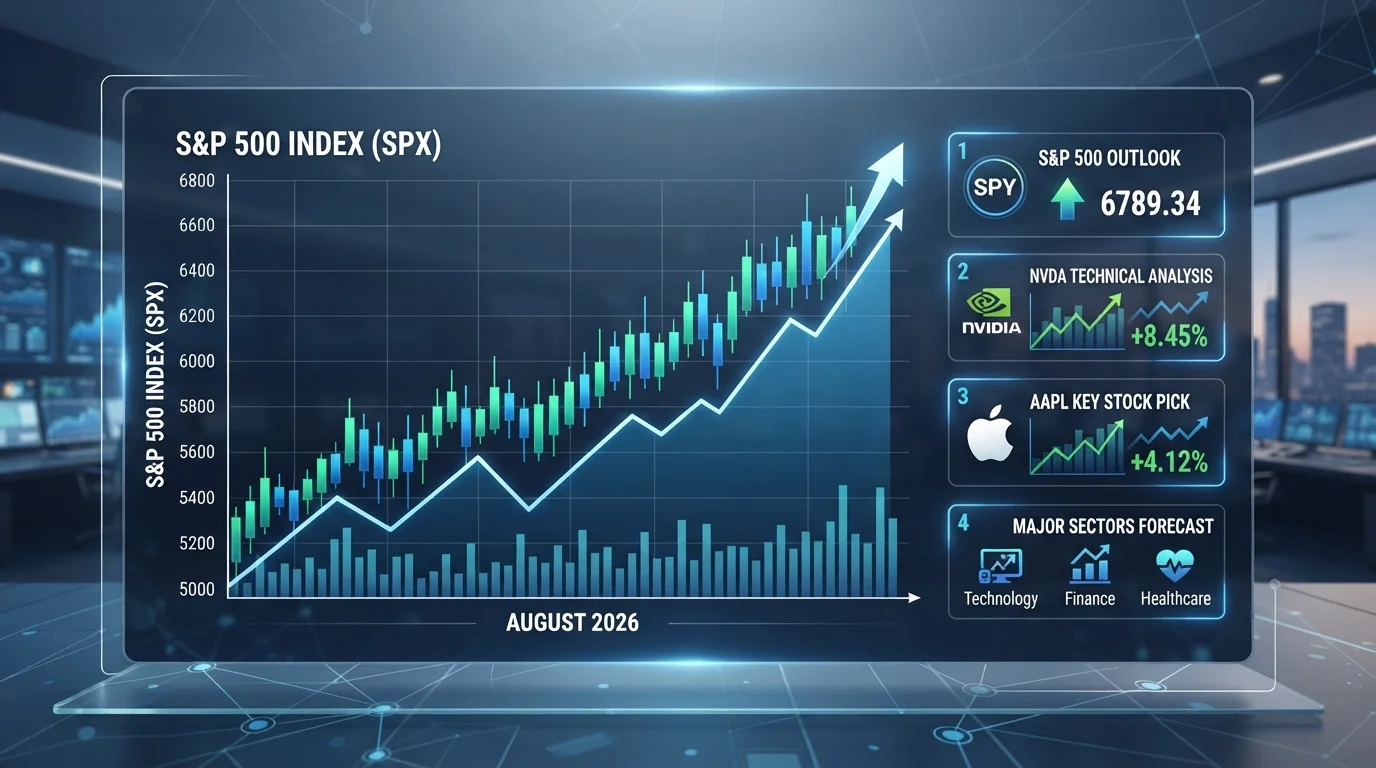
The S&P 500 has demonstrated remarkable resilience throughout 2026, posting a year-to-date return of 13.49% as of early August. This performance significantly outpaces the category average of 5.14%, highlighting the continued dominance of large-cap technology stocks within the index. With the SPY ETF trading near all-time highs around $768, investors are increasingly focused on whether this momentum can sustain through the remainder of the year.
Several key factors are driving current market dynamics. The concentration of top holdings, with NVIDIA commanding 7.55% and Apple representing 7.04% of the index, means that performance increasingly depends on these mega-cap technology leaders. The Federal Reserve's monetary policy trajectory, ongoing trade negotiations, and corporate earnings quality will likely determine whether the market can extend its gains or faces a well-deserved consolidation period.
Current Market Overview
S&P 500 Performance Analysis
The State Street SPDR S&P 500 ETF Trust (SPY) has delivered impressive returns across multiple timeframes, making it a standout performer in the current market environment. The fund's one-year return of 23.94% and three-year annualized return of 21.38% demonstrate the durability of the bull market that has persisted despite various macroeconomic headwinds.
Trading volume has remained robust, with daily averages around 53 million shares indicating sustained institutional interest. The ETF's tight expense ratio of just 0.09% continues to make it an attractive vehicle for both retail and institutional investors seeking broad market exposure. With net assets exceeding $795 billion, SPY remains the world's largest and most liquid ETF.
Sector Performance and Leadership
Technology continues to dominate the S&P 500, with the information technology sector contributing disproportionately to overall index performance. The top 10 holdings now account for 37.62% of total assets, reflecting the market's concentration in a handful of dominant companies. This concentration presents both opportunities and risks for investors.
Financial stocks, represented by JPMorgan Chase at 1.46% of the index, have benefited from higher interest rate environments and resilient consumer spending. Meanwhile, communication services and consumer discretionary sectors have shown mixed results as shifting consumer preferences and advertising market dynamics create winners and losers within these segments.
Top Holdings Deep Dive
NVIDIA: The AI Revolution Leader
NVIDIA's position as the largest holding in the S&P 500 reflects the market's enthusiasm for artificial intelligence infrastructure. The company's data center revenue continues to surge as cloud providers and enterprises rush to deploy AI capabilities. With a 7.55% weighting in SPY, NVIDIA's performance has an outsized impact on overall index returns.
The company's competitive moat in AI accelerators remains formidable, though increasing competition from AMD and custom silicon solutions from hyperscalers poses long-term questions. Investors should monitor quarterly earnings for signs of demand sustainability and margin pressure as the AI market matures.
Apple: Consumer Resilience Tested
Apple's 7.04% weighting makes it the second-largest component of the S&P 500. The company's ability to maintain premium pricing and expand its services ecosystem has supported earnings despite headwinds in key markets like China. The upcoming iPhone cycle and AI integration across Apple's product lines represent potential catalysts for the stock.
However, regulatory scrutiny in both the United States and European Union regarding App Store practices and device interoperability could impact future revenue streams. Apple's capital return program, including aggressive share buybacks, continues to provide downside support for the stock price.
Microsoft: Cloud and AI Synergy
Microsoft's 5.36% index weighting reflects its dual leadership in enterprise cloud computing and artificial intelligence. The company's Azure platform continues to gain market share against Amazon Web Services, while its partnership with OpenAI positions it at the forefront of generative AI adoption in enterprise settings.
The integration of AI capabilities across Microsoft's Office 365 and productivity suite creates opportunities for both revenue growth and customer retention. Valuation remains a key consideration, as the stock trades at premium multiples that require sustained execution to justify.
Macroeconomic Factors Shaping the Market
Federal Reserve Policy Outlook
Monetary policy remains the single most important variable for equity market performance. After the Federal Reserve's aggressive hiking cycle, markets are now pricing in potential rate cuts as inflation moderates toward the central bank's 2% target. The timing and magnitude of these cuts will significantly impact equity valuations, particularly for growth stocks that are sensitive to discount rate changes.
For investors seeking to navigate these uncertain monetary policy waters, consider using Alphio AI's autonomous trading feature to automate your portfolio management and respond quickly to Fed policy shifts.
The yield curve, which inverted during the rate hiking cycle, is gradually normalizing. This process typically creates volatility across asset classes as investors recalibrate growth expectations and recession probabilities. Historical patterns suggest that equity markets can perform well during the early stages of rate cuts, provided the economy avoids a severe contraction.
Trade Policy and Geopolitical Considerations
Recent tariff announcements on components critical for solar panels and semiconductors highlight ongoing trade tensions that could impact specific sectors. Investors should maintain awareness of how shifting trade policies might affect supply chains and input costs for multinational corporations.
Energy sector dynamics are also evolving, with offshore wind developers reassessing projects amid regulatory uncertainty. The Permian Resources Corporation and other energy producers are navigating a complex environment where fossil fuel demand remains resilient while renewable transition efforts face headwinds.
Technical Analysis and Market Structure
Support and Resistance Levels
From a technical perspective, the S&P 500 has established strong support around the $760 level for SPY, with resistance near the all-time highs around $772. The market's ability to hold above key moving averages, including the 50-day and 200-day, suggests that the intermediate trend remains constructive.
Volume analysis reveals that advances have been accompanied by healthy participation, while pullbacks have occurred on lighter volume. This pattern typically indicates that institutional investors remain net buyers, providing a foundation for potential further gains.
Market Breadth Considerations
While the cap-weighted S&P 500 has performed well, market breadth metrics warrant attention. The concentration of gains in a small number of mega-cap stocks has created a bifurcated market where the average stock has underperformed the index. This dynamic can create opportunities in undervalued sectors while also raising concerns about the sustainability of the current rally.
For traders looking to identify opportunities across the entire market spectrum, Alphio AI's copy trading feature allows you to mirror successful strategies and smart money movements.
The advance-decline line and the percentage of stocks trading above their 200-day moving averages are key breadth indicators to monitor. Deterioration in these metrics while the index continues to rise would represent a bearish divergence suggesting potential underlying weakness.
Sector Opportunities and Risks
Technology: AI Infrastructure Buildout
The technology sector's outperformance has been driven by capital expenditure related to artificial intelligence infrastructure. Cloud providers, semiconductor manufacturers, and data center operators have all benefited from this trend. However, investors must consider whether current valuations adequately reflect the timeline and magnitude of AI-driven revenue growth.
Historical patterns from previous technology cycles suggest that infrastructure investment typically precedes widespread application deployment by several years. Companies that can successfully transition from providing AI infrastructure to monetizing AI applications may offer the most compelling long-term opportunities.
Healthcare: Defensive Positioning
Healthcare stocks have underperformed the broader market but may offer defensive characteristics as the economic cycle matures. Aging demographics and innovation in biotechnology and medical devices create secular growth tailwinds. The sector's relative valuation discount to technology could attract rotation flows if market leadership broadens.
Financials: Net Interest Income Dynamics
Banks and financial institutions have benefited from higher interest rates through expanded net interest margins. However, this tailwind may be approaching its peak as the Federal Reserve signals potential rate cuts. Investors should focus on institutions with diversified revenue streams and strong credit quality in their loan portfolios.
Investment Strategies for Current Conditions
Dollar-Cost Averaging Approach
For long-term investors, maintaining a consistent dollar-cost averaging strategy into broad market ETFs like SPY remains a prudent approach. This method smooths out volatility and removes the psychological challenge of market timing. Given the market's current proximity to all-time highs, patience and discipline are essential.
Sector Rotation Considerations
Active investors may consider modest sector rotation away from the most extended technology names toward more reasonably valued areas of the market. Healthcare, select financials, and industrial sectors may offer better risk-adjusted returns if the current market broadening continues.
Set up conditional trading workflows with Alphio AI's automation features to execute your sector rotation strategy without constant monitoring.
Risk Management Essentials
Regardless of market outlook, maintaining appropriate risk management practices is essential. Position sizing, diversification across asset classes, and maintaining liquidity for opportunities all contribute to long-term investment success. Consider your personal time horizon and risk tolerance when making allocation decisions.
Conclusion
The S&P 500 enters August 2026 in a position of strength, with solid year-to-date gains and constructive technical momentum. However, the market's heavy reliance on a handful of mega-cap technology stocks creates concentration risk that investors should not ignore. The Federal Reserve's policy trajectory, ongoing trade negotiations, and corporate earnings quality will be key determinants of market direction in the months ahead.
For investors with appropriate time horizons, the current environment suggests maintaining equity exposure while being prepared for potential volatility. The combination of strong earnings growth, moderating inflation, and potential monetary policy easing provides a supportive backdrop for stocks, even if the pace of gains moderates from the first half of the year.
Ready to take control of your investments? Execute trades via chat with Alphio AI's conversational trading platform and stay ahead of market movements with AI-powered insights.
Alternatively, explore Alphio AI's copy trading to mirror top-performing strategies and autonomous trading features to automate your portfolio management with cutting-edge AI technology.
FAQs
What is the current outlook for the S&P 500 in August 2026?
The S&P 500 shows a positive outlook with 13.49% year-to-date returns as of August 2026. The index is trading near all-time highs around $768, driven by strong technology sector performance, particularly from AI-related stocks like NVIDIA. However, investors should monitor Federal Reserve policy decisions and market concentration risks.
Which stocks have the largest impact on S&P 500 performance?
NVIDIA (7.55%), Apple (7.04%), and Microsoft (5.36%) are the three largest holdings in the S&P 500 and collectively represent about 20% of the index. These mega-cap technology stocks have disproportionate influence on overall index performance due to their significant weightings.
How might Federal Reserve policy affect the stock market?
Federal Reserve interest rate decisions significantly impact equity valuations, particularly for growth stocks. As inflation moderates toward the 2% target, markets are pricing in potential rate cuts. Historically, stocks perform well during early rate-cut cycles if the economy avoids severe contraction, though uncertainty around timing creates volatility.
Is the current market rally sustainable?
The sustainability of the current rally depends on several factors: continued earnings growth from technology leaders, successful navigation of Federal Reserve policy transitions, and broadening market participation beyond mega-cap stocks. While the trend remains constructive, concentration risk in a few names warrants caution and diversification.
What investment strategy works best in current market conditions?
A balanced approach combining dollar-cost averaging into broad market ETFs like SPY with selective exposure to undervalued sectors offers prudent risk management. Consider maintaining core equity positions while being prepared for potential volatility. Tools like Alphio AI's copy trading and autonomous trading can help automate strategy execution.