

NVIDIA Stock Analysis September 2026: Why AI Demand Keeps Breaking Records
Comprehensive NVIDIA stock analysis for September 2026. Explore how AI data center demand, Blackwell chip sales, and 70% revenue growth forecasts are driving NVDA's investment outlook.

Key Takeaway
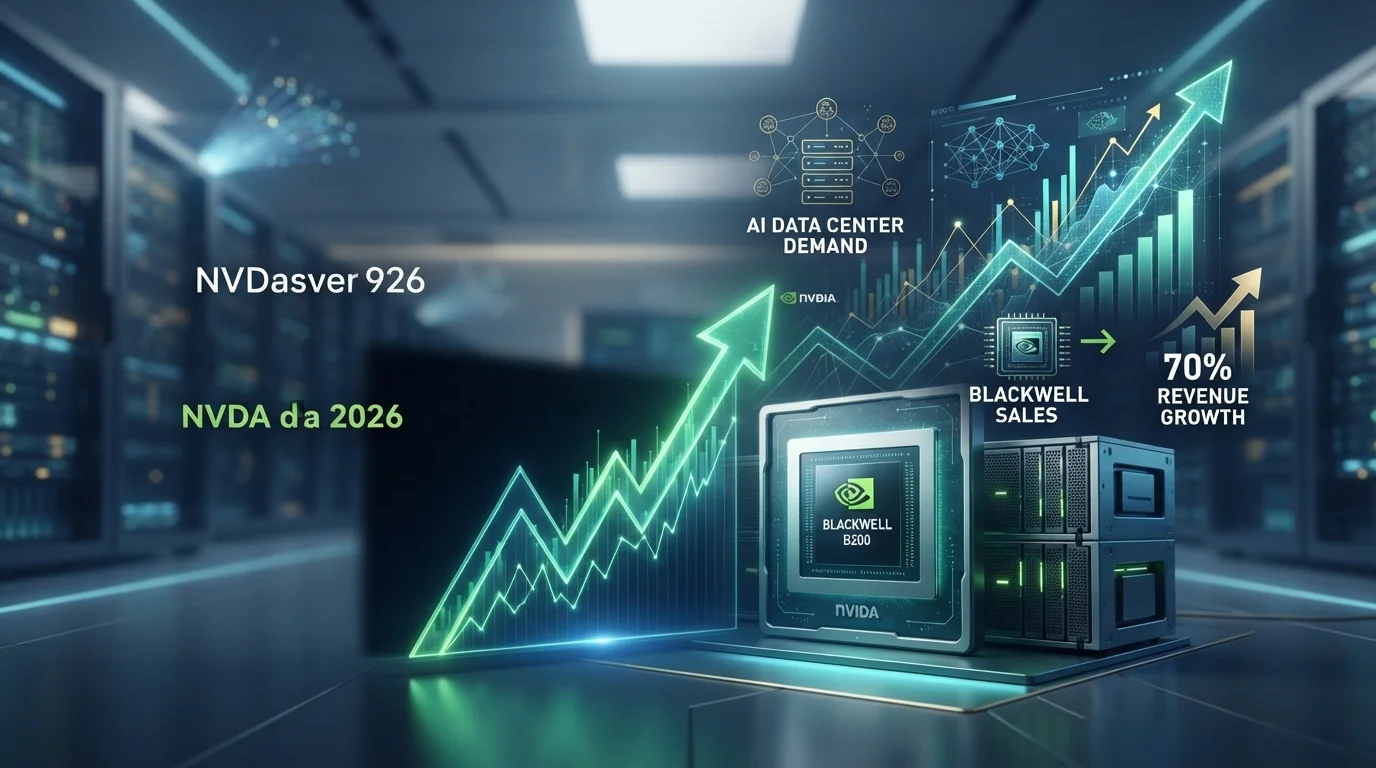
NVIDIA continues to dominate the semiconductor landscape in September 2026, with its stock representing one of the most compelling growth stories in the entire equity market. The company's recent earnings report revealed that data center revenue surged 92% year-over-year to $75.2 billion, cementing NVIDIA's position as the premier AI infrastructure provider. Management has guided for approximately 70% revenue growth in fiscal 2028, far exceeding analyst expectations and signaling that the AI boom is far from over.
For investors evaluating NVIDIA stock in the current environment, the investment thesis rests on three pillars: unmatched technological leadership in AI accelerators, a $500 billion booking pipeline through 2026, and the strategic transition to the Blackwell architecture that has been effectively sold out through mid-2026. However, risks remain, including customer concentration among hyperscalers, intensifying competition from AMD and custom silicon initiatives, and the potential for supply chain constraints to limit growth. Wall Street analysts have lifted their price target to $330, reflecting continued confidence in the company's trajectory despite these challenges.
NVIDIA's Q2 2026 Earnings: Breaking Down the Numbers
NVIDIA's most recent quarterly results demonstrated why the company commands a market capitalization approaching $4.3 trillion, the highest ever recorded for a semiconductor company. Revenue reached $44.06 billion in the quarter, representing a 69% year-over-year increase that surpassed even the most optimistic analyst projections. This growth was not driven by a single segment but rather by broad-based strength across the company's product portfolio, with data center chips accounting for the overwhelming majority of total sales.
The data center segment, which has become the engine driving NVIDIA's growth, reported revenue of $75.2 billion on a trailing twelve-month basis, jumping an astounding 92% year-over-year. This figure underscores how central AI infrastructure spending has become to NVIDIA's business model. What makes this growth particularly impressive is that it comes from a base that was already experiencing rapid expansion, meaning the company is compounding growth on top of growth rather than benefiting from easy comparisons.
Management's guidance for the upcoming quarter called for revenue of $65.0 billion, plus or minus 2%, well above the $62 billion consensus estimate. Perhaps more importantly, NVIDIA projected non-GAAP gross margins of 75%, a level that demonstrates the company's exceptional pricing power in an environment where demand significantly exceeds supply. These margins are among the highest in the semiconductor industry and reflect the scarcity value of NVIDIA's AI accelerators.
The Blackwell Architecture: NVIDIA's Next Growth Engine
The transition to NVIDIA's Blackwell GPU architecture represents one of the most significant product cycles in the company's history. Blackwell chips, which began shipping in volume during the third quarter of fiscal 2026, have generated unprecedented demand from hyperscale customers who are racing to build out AI training and inference infrastructure. The architecture delivers performance improvements that justify premium pricing, with each GPU representing a meaningful technological leap over the previous Hopper generation.
What distinguishes Blackwell from previous product launches is the sheer scale of demand. Morgan Stanley reported that customers are requesting 100,000-unit blocks, creating a deep enterprise backlog that extends well into 2027. NVIDIA's management revealed a staggering $500 billion booking pipeline through 2026, providing visibility into demand that is rare in the semiconductor industry. This pipeline effectively insulates the company from near-term demand volatility and provides a foundation for sustained growth.
Supply constraints, rather than demand weakness, represent the primary challenge for Blackwell. SK Hynix supplies the majority of HBM3e stacked memory required for Blackwell chips, while TSMC's CoWoS packaging capacity is fully allocated through at least mid-2027. These bottlenecks mean that NVIDIA's manufacturing capacity, not customer demand, is the current constraint on growth. For investors, this dynamic is double-edged: it confirms the strength of demand but also limits the company's ability to fully capitalize on that demand in the near term.
TrendForce estimates that Blackwell platforms will account for over 70% of NVIDIA's high-end GPU shipments in 2026, led by the GB300 and B300 series. This concentration reflects the rapid adoption of the new architecture and the declining share of the older Hopper generation as customers transition to the latest technology.
AI Demand: The Structural Tailwind Behind NVIDIA's Growth
The demand for AI computing infrastructure shows no signs of slowing as we enter September 2026. Major hyperscalers including Microsoft, Google, Amazon, and Meta continue to announce massive capital expenditure programs focused on building AI data centers. These companies collectively represent the majority of NVIDIA's data center revenue, and their spending commitments extend multiple years into the future.
CEO Jensen Huang has consistently emphasized that demand for AI is increasing, not plateauing, as enterprises move beyond experimentation into production deployments. The shift from AI training to inference workloads is particularly significant for NVIDIA because inference requires ongoing compute capacity rather than one-time training runs. As more AI applications are deployed in production environments, the installed base of NVIDIA chips generates recurring demand for upgrades and expansions.
The software ecosystem surrounding NVIDIA's hardware provides a powerful moat that competitors struggle to replicate. CUDA, NVIDIA's parallel computing platform, has become the industry standard for AI development, with millions of developers trained on the platform. This software advantage means that even if competitors produce chips with superior raw performance, the switching costs for customers remain high. NVIDIA's recent quarterly results showed that this software moat continues to translate into pricing power and customer loyalty.
For investors seeking to capitalize on the AI infrastructure boom, NVIDIA remains the most direct and liquid way to gain exposure to this trend. While the stock has experienced significant volatility throughout 2026, with price swings of 14% or more in either direction, the underlying business fundamentals have continued to strengthen.
Consider using Alphio AI's copy trading feature to mirror successful traders who are positioning for continued AI infrastructure growth.

Competitive Landscape: AMD, Custom Silicon, and Market Share
While NVIDIA dominates the AI accelerator market, competition is intensifying from multiple directions. AMD has emerged as the most credible challenger, with its MI300 series chips gaining traction among customers seeking alternatives to NVIDIA's ecosystem. The PHLX Semiconductor Sector index's 63% gains in 2026 have outpaced NVIDIA's 21% stock price increase, suggesting that investors are beginning to price in a more competitive landscape.
Custom silicon initiatives from hyperscalers represent a longer-term threat to NVIDIA's market position. Google has developed its TPU chips for internal use, Amazon has Trainium and Inferentia, and Microsoft is investing in custom AI silicon through its Maia program. These initiatives are not immediately threatening to NVIDIA's business because they primarily serve internal workloads rather than external customers, but they could reduce hyperscaler dependence on NVIDIA over time.
The competitive dynamics are further complicated by the concentration of NVIDIA's customer base. A small number of hyperscalers account for the majority of data center revenue, creating customer concentration risk that investors must monitor. Any slowdown in capital expenditure from these customers would have an outsized impact on NVIDIA's financial results. However, the diversity of AI workloads and the global nature of demand provide some mitigation against this concentration risk.
Valuation and Analyst Sentiment
NVIDIA's valuation has been a subject of intense debate among investors. The stock trades at a premium multiple that reflects its exceptional growth prospects, but this premium also creates vulnerability if growth decelerates faster than expected. Analysts have lifted their average price target to $330 from $310, citing continued strength in AI data center demand, tighter supply across key components, and reinforced confidence in the company's central role in the AI infrastructure buildout.
The bull case for NVIDIA stock rests on the company's ability to sustain growth rates that far exceed the broader semiconductor industry. With management guiding for 70% revenue growth in fiscal 2028, the company is effectively forecasting that the AI infrastructure buildout will continue at an accelerated pace. If this guidance proves accurate, the current valuation could look conservative in hindsight.
However, bears point to the cyclical nature of semiconductor demand and the potential for AI spending to follow a similar pattern to previous technology infrastructure cycles. The risk of overbuilding in AI data centers, followed by a period of digestion, cannot be dismissed entirely. Historical precedents from the dot-com era and the cloud computing buildout suggest that infrastructure investment tends to run ahead of actual demand, creating boom-bust cycles.
Supply Chain Constraints and Manufacturing Challenges
The global semiconductor supply chain continues to present challenges for NVIDIA's ability to meet demand. The CoWoS advanced packaging capacity at TSMC, which is essential for assembling HBM memory with GPU dies, remains fully allocated through mid-2027. This bottleneck limits NVIDIA's ability to ramp production even when customers are willing to pay premium prices for expedited delivery.
Memory supply represents another constraint. SK Hynix is the primary supplier of HBM3e for NVIDIA's data center products, and while the company is expanding capacity, the lead times for memory production mean that supply increases lag demand growth by several quarters. Samsung and Micron are attempting to enter the HBM market, but qualification timelines and yield challenges have limited their ability to provide meaningful supply in the near term.
These supply constraints have a silver lining for NVIDIA's pricing power. When demand exceeds supply by a wide margin, the company can maintain premium pricing without fear of losing customers to competitors. This dynamic has contributed to the exceptional gross margins that NVIDIA has reported in recent quarters. However, supply constraints also create frustration among customers and could accelerate efforts to develop alternative solutions.
Explore Alphio AI's agentic trading to automate your portfolio management with AI-powered strategies that can respond to supply chain developments in real time.

Risks and Considerations for Investors
Investing in NVIDIA stock requires careful consideration of several risk factors that could impact the investment thesis. The most significant risk is the potential for AI demand to decelerate as the initial wave of infrastructure buildout matures. If hyperscalers begin to slow their capital expenditure growth, NVIDIA's revenue growth could decelerate rapidly given the concentration of its customer base.
Geopolitical tensions represent another material risk. Export restrictions on advanced semiconductors to China have already impacted NVIDIA's ability to sell its most advanced chips in that market. Further restrictions could limit the company's addressable market and force it to develop lower-performance variants for restricted markets. The ongoing trade tensions between the United States and China create uncertainty that is difficult to quantify but potentially significant.
Regulatory scrutiny of the AI industry is increasing, with governments around the world considering rules that could impact how AI models are trained and deployed. While these regulations are unlikely to directly restrict NVIDIA's chip sales, they could slow the pace of AI adoption and indirectly impact demand for the company's products. Investors should monitor regulatory developments as a potential headwind for the AI infrastructure sector.
Finally, valuation risk remains a concern for investors entering at current levels. NVIDIA's stock price reflects extremely optimistic assumptions about future growth, and any disappointment relative to these expectations could trigger a significant correction. The stock's historical volatility, with drawbacks of 30% or more during previous growth scares, suggests that investors should be prepared for meaningful price swings.
Conclusion
NVIDIA stock remains one of the most compelling growth stories in the equity market as we enter September 2026, but the investment case requires careful evaluation of both opportunities and risks. The company's dominance in AI accelerators, $500 billion booking pipeline, and transition to the Blackwell architecture provide a strong foundation for continued growth. Management's guidance for 70% revenue growth in fiscal 2028 suggests that the AI infrastructure buildout is still in its early stages.
However, investors must weigh these positives against the risks of customer concentration, intensifying competition, supply chain constraints, and the potential for AI demand to eventually decelerate. The stock's premium valuation leaves little room for error, and any disappointment on growth or margins could trigger significant price volatility.
For long-term investors who believe that AI will transform the global economy over the coming decade, NVIDIA represents a direct and liquid way to gain exposure to this trend. The company's technological leadership, software ecosystem, and manufacturing partnerships create competitive advantages that are difficult to replicate. While the stock is unlikely to deliver the exponential returns of earlier years, the underlying business remains exceptionally well-positioned for the AI era.
To stay ahead of market movements and automate your trading strategies, consider using Alphio AI's automations to set conditional workflows that respond to earnings announcements and supply chain developments.
Alternatively, explore conversational trading to execute trades via chat and receive real-time market insights on NVIDIA and other semiconductor stocks.

FAQs
Is NVIDIA stock a good buy in September 2026?
NVIDIA stock remains attractive for growth-oriented investors given its 70% revenue growth guidance and $500 billion booking pipeline. However, the premium valuation requires careful consideration of risk tolerance. Analysts maintain a consensus price target of $330, reflecting continued confidence in AI infrastructure demand.
What is driving NVIDIA's data center revenue growth?
NVIDIA's data center revenue is being driven by massive AI infrastructure spending from hyperscalers including Microsoft, Google, Amazon, and Meta. The transition to the Blackwell architecture has generated unprecedented demand, with the platform accounting for over 70% of high-end GPU shipments in 2026.
What are the main risks for NVIDIA investors?
Key risks include customer concentration among hyperscalers, intensifying competition from AMD and custom silicon initiatives, supply chain constraints limiting production, geopolitical export restrictions, and the potential for AI infrastructure spending to eventually decelerate after the initial buildout phase.
How does the Blackwell architecture compare to previous generations?
Blackwell represents a significant technological leap over the Hopper generation, offering substantial performance improvements for AI training and inference workloads. The architecture has been effectively sold out through mid-2026, with customers requesting 100,000-unit blocks and creating a deep enterprise backlog.
What is NVIDIA's revenue guidance for fiscal 2028?
NVIDIA management has guided for approximately 70% revenue growth in fiscal 2028, far exceeding analyst estimates. This guidance is supported by a $500 billion booking pipeline through 2026 and continued strength in AI data center demand from hyperscale customers.