

Fed Chairman Warsh's Jackson Hole Warning: Rate Hikes Back on the Table as Inflation Persists
Fed Chairman Kevin Warsh's Jackson Hole speech signals potential rate hikes amid persistent inflation. Analysis of market impact, investment strategies, and sector implications for investors.

Key Takeaway
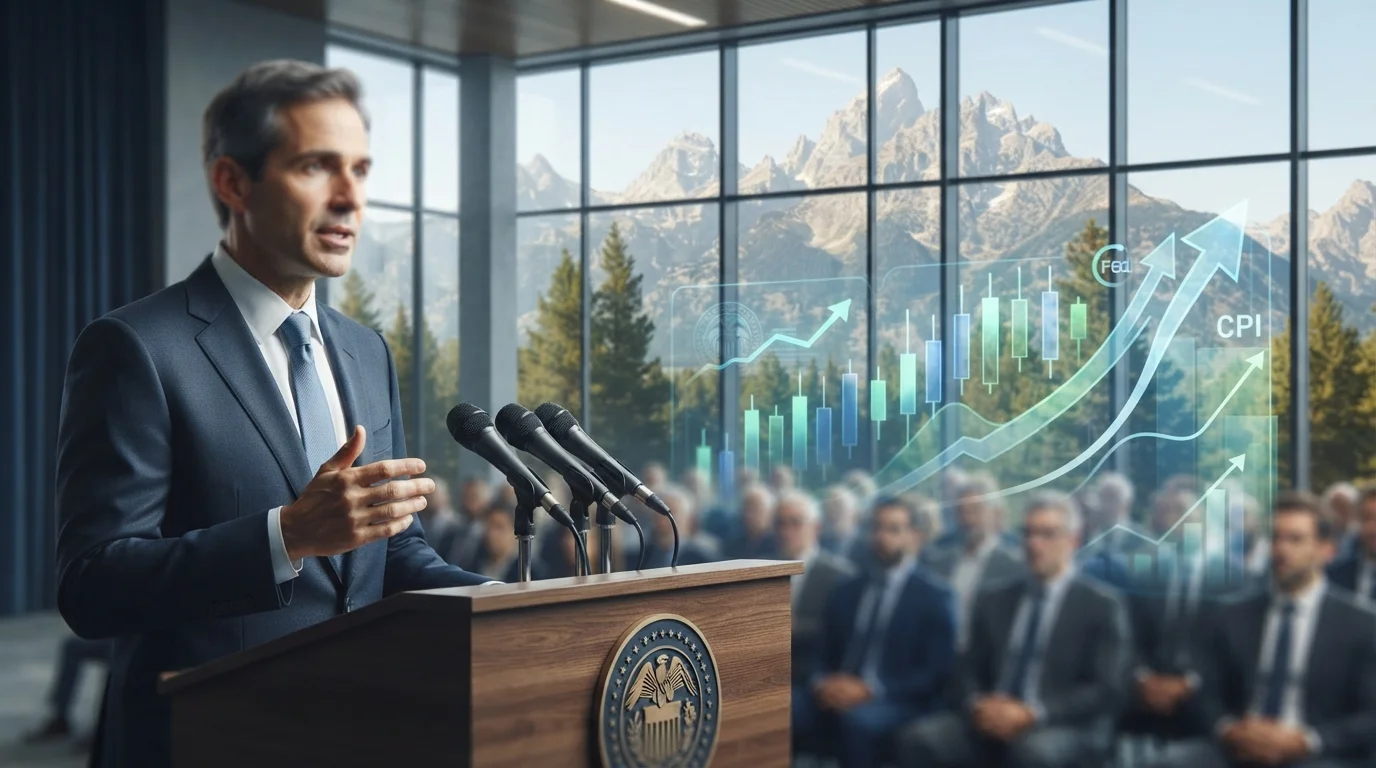
Federal Reserve Chairman Kevin Warsh delivered a stark message at the annual Jackson Hole Economic Symposium on August 28, 2026, signaling that interest rate hikes may be necessary if inflation does not show meaningful progress toward the central bank's 2% target. This marked shift in tone has sent ripples through financial markets, with the S&P 500 declining 0.26% on Friday while Treasury yields climbed as investors recalibrated their expectations for monetary policy in the coming months.
Warsh's speech represents a significant departure from the market's previous assumption that the Fed had completed its tightening cycle and would maintain rates at current levels through much of 2026. The Fed Chairman explicitly stated that inflation remains concerning and that the central bank has no tolerance for persistently elevated inflation. This hawkish pivot has increased the probability of a September rate hike to approximately 38%, with markets pricing in over 70% odds of higher rates by December according to the CME FedWatch Tool.
For investors, this policy shift carries profound implications across asset classes. Equity markets may face continued pressure as higher discount rates reduce the present value of future corporate earnings. Bond yields have already begun reflecting tighter policy expectations, with the 2-year Treasury note yield closely tracking short-term Fed policy movements. The dollar has strengthened against major currencies as international investors anticipate higher U.S. yields, while gold has retreated from recent three-month highs as the opportunity cost of holding non-yielding assets increases.
Understanding the Jackson Hole Speech: What Warsh Actually Said
The Inflation Reality Check
Warsh's address at the Jackson Hole symposium provided the clearest signal yet of the Federal Reserve's evolving stance on monetary policy. Speaking from the historic mountain resort in Wyoming, the Fed Chairman acknowledged that while the labor market remains stable and consumer spending has proven resilient, inflation continues to run above the central bank's comfort zone. The latest Personal Consumption Expenditures (PCE) price index showed a 3.7% year-over-year increase in July, substantially higher than the Fed's 2% target and above market expectations.
The significance of Warsh's remarks extends beyond the immediate inflation data. By emphasizing that the Fed has no tolerance for sustained price pressures, he effectively drew a line in the sand that markets had not fully anticipated. This language suggests that the central bank is prepared to sacrifice some economic growth to ensure price stability, a trade-off that investors had hoped to avoid. The Chairman's commitment to using interest rates as the primary tool for managing inflation reinforces the traditional Fed playbook, even as some market participants had speculated about alternative approaches involving quantitative adjustments or regulatory measures.
Rate Hike Probabilities Shift Dramatically
The market's reaction to Warsh's speech was swift and decisive. Prior to the Jackson Hole address, futures markets had largely priced in a pause in the Fed's rate-cutting cycle, with expectations centered on rates remaining in the current 3.50% to 3.75% range through year-end. Following the speech, those probabilities shifted dramatically, with traders now assigning meaningful odds to rate increases rather than merely holding steady.
This repricing of Fed policy expectations has had cascading effects across financial markets. The 2-year Treasury yield, which typically moves in tandem with short-term rate expectations, has risen sharply as investors demand higher compensation for the prospect of tighter monetary policy. Meanwhile, the 10-year Treasury yield has climbed above 4.5%, reflecting both near-term rate expectations and concerns about the long-term inflation outlook. The yield curve, which had been steepening in anticipation of economic recovery, has begun to flatten as the front end of the curve adjusts to the possibility of additional tightening.
For investors seeking to navigate this shifting interest rate environment, consider using Alphio AI's copy trading feature to mirror successful traders who specialize in fixed-income and macro strategies.

Market Impact: How Stocks Are Responding to Fed Uncertainty
S&P 500 and Nasdaq Under Pressure
The equity market's response to Warsh's hawkish pivot has been measured but unmistakably negative. The S&P 500 declined 0.26% on Friday, closing at 7,711.05, while the Nasdaq Composite dropped 0.53% to 26,405. Despite these daily declines, the broader trend remains more nuanced. The S&P 500 actually posted a positive week overall, suggesting that some investors view the Fed's inflation focus as ultimately supportive of long-term economic stability, even if it creates near-term volatility.
Sector performance has revealed important distinctions in how different industries are positioned for a higher-rate environment. Financial stocks have generally outperformed, as rising yields improve net interest margins for banks and insurance companies. Technology shares, particularly those with high growth expectations and distant profit timelines, have faced the greatest pressure as higher discount rates reduce the present value of future earnings. This rotation from growth to value has been a recurring theme throughout 2026 and appears likely to continue if the Fed follows through on its rate hike threats.
The divergence between large-cap and small-cap performance has also widened in the wake of Warsh's speech. The Russell 2000 index of smaller companies has held up relatively well, trading less than 1% below its all-time highs, suggesting that domestic-focused businesses may be less vulnerable to the international capital flow disruptions that often accompany Fed policy shifts. This resilience in small caps could present opportunities for investors willing to look beyond the mega-cap technology names that have dominated market narratives in recent years.
The Tech Sector's Vulnerability
Technology stocks have borne the brunt of the market's rate hike concerns, with the sector experiencing heightened volatility as investors reassess valuation multiples. Companies trading at premium price-to-earnings ratios based on expectations of robust future growth face particular pressure when discount rates rise, as the mathematical impact on present value calculations is most pronounced for earnings far in the future.
However, not all technology companies are equally exposed. Established players with strong current cash flows and reasonable valuations have demonstrated relative resilience, while speculative names with minimal current earnings have sold off more sharply. This bifurcation within the tech sector underscores the importance of fundamental analysis in a rising rate environment, as the rising tide lifts all boats dynamic that characterized the low-rate era gives way to more selective investment approaches.
For investors interested in automating their tech sector exposure with AI-powered strategies, explore Alphio's agentic trading features to dynamically adjust portfolio allocations based on changing macro conditions.

Bond Market Reactions: Treasury Yields Surge
The Yield Curve Responds to Policy Expectations
The fixed-income market has been the most direct beneficiary or victim of shifting Fed expectations, depending on one's positioning. Treasury yields across the curve have risen meaningfully since Warsh's speech, with the 2-year note yield climbing to approximately 4.16% and the 10-year yield pushing above 4.5%. This steepening of the yield curve reflects both the market's repricing of near-term Fed policy and concerns about the longer-term inflation trajectory.
The 30-year Treasury yield has been particularly noteworthy, declining slightly to 5.20% even as shorter maturities have risen. This unusual pattern suggests that while markets expect tighter policy in the near term, there remains confidence that the Fed will ultimately succeed in containing inflation over the longer horizon. Alternatively, it could reflect concerns that aggressive tightening might eventually lead to economic weakness, prompting future rate cuts that would benefit longer-duration bonds.
For fixed-income investors, this environment presents both challenges and opportunities. Existing bond portfolios have experienced mark-to-market losses as yields have risen, but new investments can capture higher income streams than have been available in years. The key question facing bond investors is whether the current yield levels adequately compensate for the risk of additional Fed tightening, or whether yields could rise further if inflation proves more persistent than currently anticipated.
Corporate Credit Spreads Widen
Corporate bond markets have also felt the impact of shifting Fed expectations, with credit spreads, the additional yield investors demand for holding corporate debt rather than Treasuries, widening modestly across investment-grade and high-yield categories. This spread widening reflects concerns that tighter monetary policy could slow economic growth and increase default risks, particularly for companies with significant debt burdens or exposure to cyclical industries.
Investment-grade corporate bonds have experienced relatively modest spread widening, as the strong balance sheets and diversified revenue streams of major corporations provide a buffer against economic uncertainty. High-yield bonds, by contrast, have seen more significant spread expansion, as investors demand greater compensation for the elevated default risks that typically accompany Fed tightening cycles. This divergence between investment-grade and high-yield performance underscores the importance of credit quality in a rising rate environment.
Gold and Commodities: Safe Haven or Rate Victim?
Gold Retreats from Three-Month Highs
Gold prices have experienced a notable pullback from recent highs following Warsh's hawkish speech, with the precious metal retreating from above $4,600 per ounce to trade around the $4,500 level. This decline reflects the dual pressures of a stronger dollar and rising real interest rates, both of which increase the opportunity cost of holding non-yielding assets like gold.
Despite the near-term weakness, gold's longer-term outlook remains supported by several fundamental factors. Persistent inflation concerns, geopolitical tensions, and questions about the sustainability of government debt levels all provide potential catalysts for gold demand. Analysts at LiteFinance project gold could trade in a range of $3,580 to $4,645 in August, with potential to reach $4,880 if Fed policy proves less restrictive than currently feared.
The relationship between gold and interest rates is complex and not always linear. While rising rates typically pressure gold prices by increasing the opportunity cost of holding the metal, they can also support gold if the rate increases are driven by inflation concerns that exceed the nominal yield gains. This dynamic means that gold's performance in the coming months will depend not just on whether the Fed raises rates, but on whether those increases successfully contain inflation or merely chase rising price levels.
Energy and Industrial Commodities
Energy markets have shown mixed reactions to the Fed policy shift, with crude oil prices trading in a relatively narrow range as investors weigh the competing influences of potential demand destruction from tighter monetary policy against ongoing supply constraints. Brent crude has maintained levels above $80 per barrel, supported by geopolitical tensions and OPEC+ production discipline, even as concerns about global economic growth have capped upside potential.
Industrial metals have faced headwinds from the stronger dollar and concerns about Chinese economic growth, with copper prices retreating from recent highs. The red metal's performance is often viewed as a barometer of global economic health, and its weakness suggests that investors are becoming more cautious about the growth outlook in the face of potential Fed tightening. This could have implications for mining stocks and commodity-dependent economies, which may face pressure if metal prices continue to decline.
Investment Strategies for a Higher Rate Environment
Sector Rotation Opportunities
The prospect of higher interest rates creates both risks and opportunities across equity sectors, and investors may benefit from rotating toward industries that historically perform well in tightening cycles. Financial stocks, particularly banks and insurance companies, typically benefit from rising rates as they can earn higher spreads on lending activities and investment portfolios. The S&P 500 Financials sector has already begun outperforming, suggesting that some investors are positioning for this dynamic.
Healthcare and consumer staples sectors may also offer defensive characteristics in a rising rate environment, as their stable cash flows and dividend yields become relatively more attractive when bond yields rise. These sectors tend to have lower volatility than the broader market and can provide ballast to portfolios during periods of Fed-induced uncertainty. However, investors should be selective within these sectors, as companies with significant debt loads may face pressure from higher borrowing costs.
Energy stocks present a more nuanced picture, as they can benefit from inflationary pressures that often accompany Fed tightening, but may face demand destruction if higher rates successfully slow economic growth. The sector's strong free cash flow generation and relatively low valuations provide some downside protection, but commodity price volatility remains a significant risk factor.
Fixed-Income Positioning
For fixed-income investors, the current environment calls for a careful reassessment of duration exposure and credit quality. Shorter-duration bonds are less sensitive to interest rate changes and may provide a safer haven if the Fed continues to tighten policy. Floating-rate securities, which adjust their coupon payments based on prevailing interest rates, can also provide protection in a rising rate environment.
Credit quality becomes increasingly important as monetary policy tightens, as companies with weaker balance sheets may face refinancing challenges and increased default risks. Investment-grade corporate bonds and government-backed securities may offer more attractive risk-adjusted returns than high-yield alternatives in this environment, even if the yield pickup is more modest.
For investors seeking to automate their fixed-income allocation strategies, Alphio's automation features allow you to set conditional workflows that adjust portfolio duration and credit exposure based on changing Fed policy signals.

The Global Perspective: International Implications
Dollar Strength and Emerging Markets
The prospect of higher U.S. interest rates has supported the dollar against major currencies, creating both opportunities and challenges for international investors. A stronger dollar benefits U.S. consumers by making imports cheaper and can support domestic-focused companies that face less competition from foreign rivals. However, it creates headwinds for multinational corporations that generate significant revenue overseas, as foreign earnings translate back into fewer dollars.
Emerging market economies face particular challenges from a stronger dollar and higher U.S. rates, as capital tends to flow toward higher-yielding developed market assets during Fed tightening cycles. Countries with significant dollar-denominated debt or large current account deficits may experience currency depreciation and financial stress as borrowing costs rise. This dynamic has historically led to periodic emerging market crises during Fed tightening cycles, and investors should monitor developments carefully.
Central Bank Coordination Questions
Warsh's hawkish pivot also raises questions about coordination among major central banks, as the European Central Bank and Bank of Japan have maintained more accommodative policy stances. This divergence in monetary policy approaches can create volatility in currency markets and complicate investment decisions for global portfolios. If the Fed raises rates while other central banks hold steady or ease further, the dollar could strengthen significantly, creating feedback loops that impact trade balances and economic growth.
The Bank of England and other developed market central banks face their own inflation challenges and may be forced to follow the Fed's lead if price pressures prove persistent globally. This potential for coordinated tightening across major economies could amplify the impact on global growth and asset prices, creating a more challenging environment for risk assets than a Fed-only tightening cycle.
Looking Ahead: What to Watch in September
The September FOMC Meeting
All eyes now turn to the Federal Open Market Committee's September meeting, where policymakers will have the opportunity to either validate or contradict the market's revised rate expectations. The meeting will be accompanied by updated economic projections and the quarterly dot plot showing individual committee members' rate expectations, providing crucial guidance for investors attempting to navigate the shifting policy landscape.
Key data releases between now and the September meeting will heavily influence the Fed's decision-making process. The August employment report, due in early September, will provide important information about labor market conditions and wage pressures. Inflation data, including the Consumer Price Index and Personal Consumption Expenditures reports, will be scrutinized for signs of whether price pressures are moderating or persisting at elevated levels.
Market Positioning and Sentiment
Investor positioning heading into the September meeting will also be critical in determining market reactions to any Fed announcements. If markets have already fully priced in rate hike expectations, the actual announcement may produce a sell the rumor, buy the news reaction that supports asset prices. Conversely, if investors have maintained dovish positions in anticipation of a Fed pause, a hawkish surprise could trigger more significant selling pressure.
Sentiment indicators suggest that investor optimism has moderated in recent weeks, with measures of bullish sentiment declining from elevated levels earlier in the year. This more cautious positioning may provide some cushion against negative surprises, as investors have already begun adjusting their portfolios for a less accommodative policy environment. However, a significant hawkish surprise could still trigger meaningful volatility as remaining bullish positions are unwound.
For real-time trade execution and market monitoring, leverage Alphio's conversational trading interface to execute trades via chat and stay on top of rapidly changing market conditions.
Conclusion
Federal Reserve Chairman Kevin Warsh's Jackson Hole speech has fundamentally altered market expectations for monetary policy in the months ahead. By explicitly acknowledging that inflation remains too high and signaling a willingness to raise interest rates if necessary, Warsh has challenged the market's previous assumption that the Fed's tightening cycle had concluded. This hawkish pivot has already impacted asset prices across equities, bonds, currencies, and commodities, and the full implications may take months to fully materialize.
For investors, the key takeaway is that the era of predictable, accommodative monetary policy may be giving way to a more uncertain environment where inflation concerns take precedence over growth support. This shift favors investment strategies that can adapt to changing conditions, whether through sector rotation, duration management, or tactical asset allocation. Companies with strong balance sheets, pricing power, and durable competitive advantages are likely to outperform in this environment, while speculative investments and highly leveraged businesses may face significant headwinds.
The coming weeks will be critical in determining whether Warsh's Jackson Hole warning translates into actual policy action or represents merely a rhetorical attempt to manage market expectations without following through with rate increases. Investors should remain vigilant, monitoring incoming economic data and Fed communications for clues about the central bank's true intentions. In this environment of heightened uncertainty, diversification and risk management become more important than ever, as the potential for significant market moves in either direction has increased substantially.
Ready to navigate the shifting interest rate landscape with confidence? Start using Alphio AI's copy trading feature to mirror successful traders who specialize in macro-driven strategies, or explore agentic trading to automate your portfolio adjustments based on Fed policy signals. For hands-on traders, our conversational trading interface lets you execute trades and monitor positions through simple chat commands.
FAQs
What did Fed Chairman Kevin Warsh say at Jackson Hole 2026?
At the Jackson Hole Economic Symposium on August 28, 2026, Fed Chairman Kevin Warsh signaled that interest rates may need to rise if inflation doesn't show meaningful progress toward the Fed's 2% target. He described inflation as concerning and stated the Fed has no tolerance for persistently elevated inflation, marking a hawkish shift from previous market expectations of a policy pause.
How did the stock market react to Warsh's Jackson Hole speech?
The S&P 500 fell 0.26% and the Nasdaq dropped 0.53% on the day of the speech, though the S&P 500 still posted a positive week overall. Technology stocks faced particular pressure due to their sensitivity to higher discount rates, while financial stocks generally outperformed as rising yields improve bank profit margins.
What is the probability of a Fed rate hike in September 2026?
According to the CME FedWatch Tool, markets are now pricing in approximately a 38% chance of a September rate hike, with over 70% odds of higher rates by December 2026. This represents a significant shift from prior expectations that the Fed would maintain rates in the 3.50% to 3.75% range through year-end.
Which sectors perform best when the Fed raises interest rates?
Financial stocks, particularly banks and insurance companies, typically benefit from rising rates as they earn higher spreads on lending activities. Healthcare and consumer staples sectors often provide defensive characteristics with stable cash flows. Technology and highly leveraged companies generally face headwinds as higher discount rates reduce the present value of future earnings.
How should investors position their portfolios for potential Fed rate hikes?
Investors should consider reducing duration in fixed-income portfolios, favoring shorter-term bonds and floating-rate securities. In equities, rotating toward financials, healthcare, and consumer staples while reducing exposure to speculative growth stocks may be prudent. Maintaining diversification and focusing on companies with strong balance sheets and pricing power can help navigate uncertainty.