

Gold Price Forecast August 2026: Fed Policy, Central Bank Demand & Expert Price Targets
Gold price forecast for August 2026: Expert analysis of Fed rate policy impact, central bank buying, inflation hedge demand, and price targets from $4,500 to $6,300.

Key Takeaway
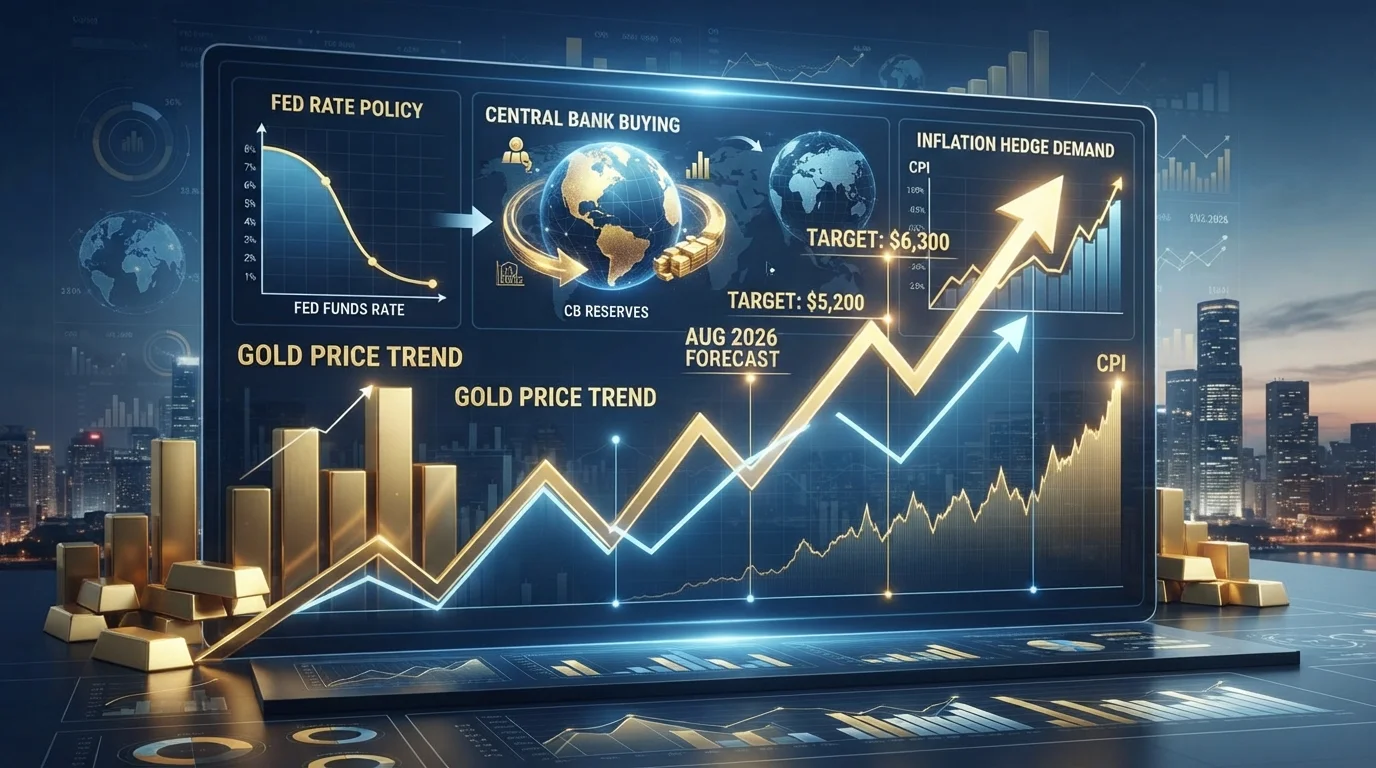
Gold prices have experienced a remarkable rally throughout 2026, with the precious metal currently trading above $4,400 per ounce as August draws to a close. The confluence of persistent inflation concerns, Federal Reserve policy uncertainty, and unprecedented central bank buying has created a perfect storm driving gold to new heights. Major investment banks have issued bold price forecasts, with Goldman Sachs targeting $4,900 per ounce by year-end while J.P. Morgan projects an even more aggressive $6,000 average for Q4 2026.
The relationship between Federal Reserve interest rate policy and gold prices remains the critical variable for investors to watch. Research from Goldman Sachs quantifies this relationship precisely: every 50 basis points of Federal Reserve easing adds approximately $120 per ounce of support to gold prices. This occurs because lower interest rates reduce the opportunity cost of holding non-yielding assets like gold, making the precious metal more attractive relative to interest-bearing alternatives such as Treasury bonds.
However, the gold market faces a complex crosscurrent. While inflation remains elevated above the Fed's 2% target, recent economic data suggests resilience in consumer spending that could delay rate cuts. Investors seeking exposure to gold should consider using Alphio AI's autonomous trading feature to automate their precious metals portfolio management with AI-powered strategies that adapt to changing Fed policy signals.

Gold Price Performance in 2026: A Year of Records
The gold market has delivered extraordinary returns for investors in 2026, with prices climbing from approximately $2,600 per ounce at the start of the year to current levels above $4,400. This represents a gain of nearly 70% in just eight months, making gold one of the best-performing major asset classes of the year. The rally has been driven by a combination of factors that show little sign of abating as we approach the final quarter.
Technical analysts note that gold has broken through multiple resistance levels with conviction, establishing a strong uptrend supported by both fundamental and technical factors. The metal's performance has outpaced traditional inflation hedges and even exceeded the returns of many equity indices, demonstrating its value as a portfolio diversifier during periods of economic uncertainty.
The current price action suggests that gold has entered a new trading range, with support established around $4,200 and resistance targets extending toward $5,000. Market participants are closely watching the $4,500 level as a psychological barrier that, if breached, could trigger accelerated buying from both institutional and retail investors who have been waiting on the sidelines.
Federal Reserve Policy: The Primary Driver of Gold Prices
Federal Reserve interest rate policy remains the single most important factor influencing gold price movements in 2026. The central bank's ongoing battle with inflation has created a complex environment where every statement, economic data release, and policy meeting moves markets. Gold's sensitivity to rate expectations has never been more pronounced.
The World Gold Council's mid-year outlook projects US inflation peaking near 3.9% in Q2 2026 before cooling slightly, with the global economy expected to grow by 2.9% year-over-year. These conditions create a challenging environment for the Fed, which must balance its inflation-fighting mandate against risks to economic growth. The uncertainty surrounding the timing and magnitude of potential rate cuts has kept gold well-supported as investors seek safe-haven assets.
Recent commentary from Fed officials has emphasized a data-dependent approach to policy, meaning that gold traders must remain vigilant about incoming economic indicators. The personal consumption expenditure price index, GDP reports, and employment data all have the potential to move gold prices significantly as markets adjust their expectations for Fed policy.
For traders looking to capitalize on these policy-driven price movements, Alphio AI's scheduled task automation enables you to set conditional workflows that execute trades based on Fed announcements and economic data releases, ensuring you never miss critical market opportunities.

Central Bank Gold Buying: The Structural Demand Story
Perhaps the most significant long-term driver of gold prices in 2026 has been the relentless buying from central banks around the world. This structural demand has fundamentally altered the supply-demand dynamics of the gold market, providing a floor under prices even during periods of risk-on sentiment in broader financial markets.
The World Gold Council reports that central bank net gold demand reached 289 tonnes in Q2 2026, representing a fivefold increase from Q1's revised estimate of 57 tonnes and setting a record high for a second quarter. This extraordinary accumulation has been led by emerging market central banks seeking to diversify their reserves away from the US dollar amid geopolitical tensions and concerns about currency debasement.
China's central bank has maintained its gold purchasing program for 17 consecutive months as of April 2026, demonstrating a long-term strategic commitment to increasing the country's gold reserves. Poland, India, Kazakhstan, Brazil, and Turkey have also been among the most active buyers, with the World Gold Council forecasting total central bank purchases of approximately 850 tonnes for the full year 2026.
This official sector demand is particularly significant because it tends to be price-insensitive and long-term oriented. Unlike speculative flows that can reverse quickly, central bank buying represents a fundamental shift in how monetary authorities view gold's role in the international monetary system. J.P. Morgan's research indicates that investor demand and central bank buying are expected to average around 566 tonnes per quarter in 2026, providing substantial underlying support for prices.
Expert Price Forecasts: From Goldman Sachs to J.P. Morgan
Investment banks and research institutions have issued a wide range of gold price forecasts for 2026, reflecting differing views on the trajectory of Fed policy, inflation, and global economic growth. Understanding these forecasts can help investors frame their own expectations and position their portfolios accordingly.
Goldman Sachs currently maintains a year-end 2026 target of $4,900 per ounce, representing approximately 11% upside from current levels. The bank's analysis emphasizes the quantitative relationship between Fed easing and gold prices, suggesting that if the central bank delivers more aggressive rate cuts than currently priced into markets, gold could exceed even this optimistic target.
J.P. Morgan has issued the most bullish forecast among major banks, projecting that gold prices will average $6,000 per ounce by Q4 2026 and rise toward $6,300 by the end of 2027. This forecast is based on demand assumptions that see continued strong investor interest and central bank accumulation averaging around 566 tonnes per quarter. The bank has described gold as their "highest conviction long for the year," reflecting strong confidence in the bullish thesis.
Wells Fargo has also issued an optimistic forecast, aligning with J.P. Morgan's view of prices potentially reaching $6,300. However, not all analysts share this bullish outlook. Some market participants have noted that J.P. Morgan recently lowered its forecast from an even higher target, citing weaker-than-expected demand from certain sectors and the possibility of earlier-than-expected Fed rate hikes if inflation proves more persistent than anticipated.
Bank of America has taken a more conservative stance, predicting gold could reach $4,250 by year-end. This forecast acknowledges the supportive fundamental backdrop while recognizing that significant upside may already be priced into current levels. The wide dispersion of forecasts highlights the uncertainty surrounding the key variables that will determine gold's trajectory in the coming months.
Inflation Hedge Demand: Retail and Institutional Interest
Beyond central bank buying, both retail and institutional investors have shown increasing interest in gold as an inflation hedge throughout 2026. With consumer prices remaining elevated and real yields on traditional fixed-income investments negative in many cases, gold's appeal as a store of value has grown substantially.
Billionaire hedge fund manager John Paulson, who has been a gold bull since 2009, recently told CNBC that gold is only in the early stages of a long-term rally. His thesis centers on the loss of faith in paper currency and runaway government spending, factors that he believes will continue to drive investors toward hard assets like gold. Paulson's track record during the 2008 financial crisis lends credibility to his views, though investors should always conduct their own due diligence.
Exchange-traded funds backed by physical gold have seen significant inflows this year, with the SPDR Gold Shares (GLD) and iShares Gold Trust (IAU) both experiencing growing assets under management. These vehicles provide convenient exposure to gold prices without the storage and security concerns associated with physical ownership, making them popular among institutional investors and individual traders alike.
The inflation hedge narrative has been particularly compelling given that official inflation measures remain well above the Federal Reserve's 2% target. While the pace of price increases has moderated from the peaks seen in previous years, the persistent nature of inflation has convinced many investors that holding a portion of their portfolio in gold is prudent risk management.
For investors seeking to mirror the strategies of successful gold traders and smart money wallets, Alphio AI's copy trading feature allows you to automatically replicate the trades of top-performing precious metals investors on the platform.

Geopolitical Risks and Safe-Haven Flows
Geopolitical tensions have provided additional support for gold prices throughout 2026, with ongoing conflicts and diplomatic disputes driving periodic safe-haven flows into the precious metal. Gold's historical role as a crisis hedge has been on full display as investors seek protection against tail risks that could disrupt financial markets.
The relationship between geopolitical events and gold prices is complex and often short-lived, with initial spikes frequently giving way to selling as markets assess the actual economic impact of specific incidents. However, the cumulative effect of multiple ongoing tensions has created a persistent bid under gold prices, as investors maintain elevated allocations to safe-haven assets as insurance against potential shocks.
Central bank gold buying from emerging markets is partly motivated by geopolitical considerations, as countries seek to reduce their dependence on the US dollar-dominated international financial system. This structural shift in reserve management practices represents a long-term source of demand that is unlikely to reverse regardless of short-term developments in specific conflict zones.
The intersection of geopolitical risk and monetary policy creates a particularly supportive environment for gold. When central banks face pressure to maintain loose monetary conditions to support economic growth amid geopolitical uncertainty, the resulting negative real interest rates enhance gold's attractiveness relative to yield-bearing alternatives.
Risks to the Bullish Gold Thesis
While the bullish case for gold is compelling, investors must also consider the risks that could derail the current rally. A significant shift in Federal Reserve policy toward more aggressive rate hikes, a sustained decline in inflation, or a sharp appreciation of the US dollar could all put downward pressure on gold prices.
Recent economic data showing resilient consumer spending and a strong labor market has led some analysts to question whether the Fed will be able to deliver the rate cuts that gold bulls are expecting. If inflation proves more persistent than anticipated, the central bank may be forced to maintain higher rates for longer, increasing the opportunity cost of holding gold and potentially triggering a correction in prices.
The US dollar's performance is another critical variable to watch. Gold is priced in dollars on global markets, so a strengthening dollar makes gold more expensive for foreign buyers and can suppress demand. The dollar index (DXY) has shown resilience this year, and any significant appreciation could create headwinds for gold prices even if other fundamental factors remain supportive.
Profit-taking after the substantial gains seen in 2026 represents a shorter-term risk. With gold up nearly 70% year-to-date, some investors may be tempted to realize profits, particularly if technical indicators suggest the market is overbought. Such selling pressure could trigger a correction even if the long-term fundamental outlook remains positive.
Investment Strategies for Gold in Late 2026
Investors looking to gain exposure to gold have several options, each with its own risk-return profile and suitability for different investment objectives. Physical gold in the form of bars or coins provides the most direct exposure but involves storage costs and security considerations. Gold ETFs offer liquid, convenient access to gold prices without the logistical challenges of physical ownership.
For more sophisticated investors, gold futures and options provide leveraged exposure and the ability to implement complex strategies. However, these instruments involve significant risks and are not suitable for inexperienced traders. Mining stocks offer indirect exposure to gold prices with additional leverage through operational leverage, though they also carry company-specific risks unrelated to the underlying metal.
Dollar-cost averaging into gold positions can help mitigate timing risk for investors who believe in the long-term bullish thesis but are concerned about short-term volatility. By spreading purchases over time, investors reduce the impact of buying at a temporary peak and can build positions more methodically.
For those seeking to execute gold trading strategies through an intuitive conversational interface, Alphio AI's conversational trading platform allows you to place trades, manage positions, and monitor markets through natural language commands, making sophisticated gold trading accessible to everyone.

Conclusion
Gold has delivered exceptional returns for investors in 2026, with prices climbing nearly 70% to trade above $4,400 per ounce as August comes to a close. The combination of Federal Reserve policy uncertainty, persistent inflation, and record-breaking central bank buying has created a supportive fundamental backdrop that major investment banks believe will drive prices even higher. Forecasts from Goldman Sachs ($4,900 target) and J.P. Morgan ($6,000 average for Q4) suggest significant upside potential remains, though investors should remain mindful of risks including potential Fed hawkishness and profit-taking after such substantial gains.
For investors seeking to capitalize on the ongoing gold bull market, modern AI-powered trading platforms offer powerful tools to automate strategies and manage risk. Alphio AI's copy trading feature enables you to mirror the strategies of successful gold traders, while their autonomous trading capabilities can help automate portfolio management based on your specified parameters. Whether you prefer to set up conditional automations for specific price levels or execute trades through conversational commands, leveraging AI technology can help you navigate the gold market's complexities with greater confidence and efficiency.
The structural demand from central banks, combined with ongoing inflation concerns and geopolitical tensions, suggests that gold's bull market may have further to run. However, as with any investment, proper risk management and a clear understanding of your own investment objectives are essential for success in the precious metals market.
FAQs
What is the gold price forecast for August 2026?
Gold is currently trading above $4,400 per ounce in August 2026. Major investment banks have issued bullish forecasts, with Goldman Sachs targeting $4,900 per ounce by year-end and J.P. Morgan projecting an average of $6,000 per ounce for Q4 2026. The wide range of forecasts reflects uncertainty around Federal Reserve policy and inflation trajectory.
How do Federal Reserve interest rates affect gold prices?
Federal Reserve interest rates have a significant inverse relationship with gold prices. According to Goldman Sachs research, every 50 basis points of Fed easing adds approximately $120 per ounce of support to gold. Lower interest rates reduce the opportunity cost of holding non-yielding assets like gold, making them more attractive relative to interest-bearing alternatives.
Why are central banks buying so much gold in 2026?
Central banks purchased a record 289 tonnes of gold in Q2 2026, driven by emerging market countries seeking to diversify reserves away from the US dollar amid geopolitical tensions. China has maintained gold purchases for 17 consecutive months, while Poland, India, Kazakhstan, and Brazil have also been active buyers. The World Gold Council forecasts approximately 850 tonnes of central bank purchases for the full year 2026.
Is gold a good inflation hedge in 2026?
Gold has proven to be an effective inflation hedge in 2026, with prices rising nearly 70% year-to-date while inflation remains above the Fed's 2% target. Billionaire investor John Paulson believes gold is in the early stages of a long-term rally due to loss of faith in paper currency and government spending. However, investors should consider gold as part of a diversified portfolio rather than a standalone solution.
What are the main risks to gold prices in late 2026?
Key risks include more aggressive Federal Reserve rate hikes than currently expected, a sustained decline in inflation, significant US dollar appreciation, and profit-taking after the substantial gains seen this year. If the Fed maintains higher rates for longer due to persistent inflation, the opportunity cost of holding gold would increase, potentially putting downward pressure on prices.