

Crude Oil Price Forecast August 2026: Navigating Supply Cuts and Demand Uncertainty
Comprehensive crude oil price analysis for August 2026. Explore OPEC cuts, demand outlook, and energy investment strategies in a shifting global market.

Key Takeaway
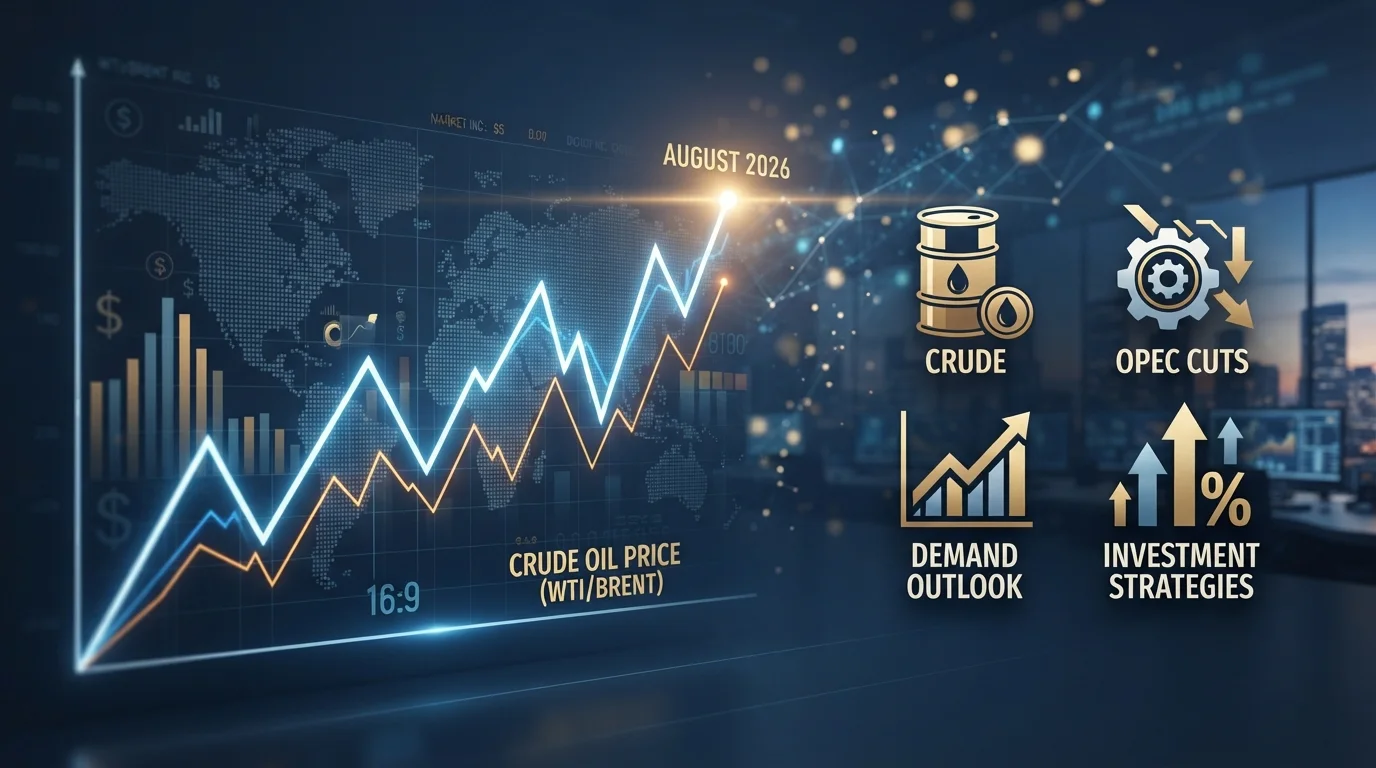
The global oil market enters August 2026 at a critical inflection point, with Brent crude trading around $85 per barrel amid conflicting signals from supply constraints and weakening demand projections. The International Energy Agency has dramatically revised its 2026 outlook, now forecasting a 1.6 million barrel per day decline in world oil demand as elevated prices and geopolitical disruptions continue to weigh on consumption patterns. This represents a significant shift from earlier expectations and introduces new complexity for energy investors navigating an increasingly volatile market environment.
Several key factors are driving current oil price dynamics. OPEC's ongoing production cuts, combined with persistent geopolitical tensions affecting shipping routes through the Strait of Hormuz, have created artificial supply scarcity that has kept prices elevated despite demand headwinds. Meanwhile, the U.S. Energy Information Administration maintains its forecast for Brent crude averaging approximately $85 per barrel in the third quarter of 2026, suggesting that current price levels may persist through the summer months. For investors seeking exposure to energy markets, understanding these competing forces is essential for making informed allocation decisions.
The divergence between supply-side constraints and demand-side weakness creates both opportunities and risks. While near-term price support appears solid due to production cuts and geopolitical premiums, the deteriorating demand outlook raises questions about sustainability at current levels. J.P. Morgan Global Research has adjusted its forecasts accordingly, projecting Brent crude to average $86 per barrel in Q3 2026 before declining to $80 in Q4 and $78 by year-end as market rebalancing takes effect through demand destruction rather than supply increases.
Understanding the Current Oil Market Landscape
Supply Constraints and OPEC Strategy
The Organization of Petroleum Exporting Countries has maintained disciplined production cuts throughout 2026, successfully preventing the price collapse that many analysts feared would accompany slowing global growth. This supply management strategy has proven effective in supporting prices, with Brent crude remaining approximately 30% higher than year-ago levels despite deteriorating demand fundamentals. The cartel's willingness to sacrifice market share for price stability represents a significant evolution in its approach to market management.
However, the effectiveness of OPEC's strategy faces mounting challenges. Non-OPEC production, particularly from U.S. shale producers, has remained more resilient than expected, partially offsetting the impact of cartel production cuts. Additionally, the ongoing closure of the Strait of Hormuz has disrupted traditional supply routes, forcing market participants to seek alternative shipping paths that increase costs and create logistical bottlenecks. These disruptions, while supporting prices in the short term, may accelerate the transition away from oil dependency in consuming nations.
For traders looking to capitalize on oil market volatility, Alphio AI's copy trading feature enables mirroring successful energy traders who specialize in commodity markets. By following experienced professionals who understand the nuances of OPEC policy and geopolitical risk, investors can gain exposure to oil price movements without requiring deep expertise in energy market fundamentals.

Demand Destruction and Economic Headwinds
The International Energy Agency's revised demand outlook reflects growing concerns about economic deceleration in major consuming regions. Annual contractions in oil demand are expected to ease from 4.9 million barrels per day in Q2 2026 to 2.8 million barrels per day in Q3, before returning to modest growth in the final quarter. This trajectory suggests that current high prices are already triggering demand destruction, particularly in price-sensitive emerging markets where fuel subsidies have been reduced or eliminated.
Developed economies are not immune to these pressures. European industrial demand has softened as manufacturers grapple with elevated energy costs, while transportation demand in North America shows signs of plateauing as consumers adopt more fuel-efficient vehicles and alternative transportation options. The combination of high prices and economic uncertainty has created a feedback loop where demand weakness reinforces economic headwinds, further suppressing consumption.
Geopolitical Factors Shaping Oil Prices
Strait of Hormuz Disruptions
The ongoing closure of the Strait of Hormuz represents one of the most significant supply disruptions in recent memory, affecting approximately 20% of global oil shipments. This bottleneck has forced producers to seek alternative export routes, increasing transportation costs and creating temporary supply shortages in certain markets. While these disruptions have provided price support, they have also accelerated efforts to reduce dependency on Middle Eastern oil through strategic reserve releases and demand reduction initiatives.
The geopolitical premium embedded in current oil prices reflects market concerns about potential escalation that could further disrupt supply chains. However, this premium also creates vulnerability to sudden price declines if diplomatic solutions emerge or if alternative supply routes become fully operational. Investors should recognize that geopolitical risk cuts both ways, and prices could experience sharp corrections if tensions ease unexpectedly.
U.S.-Iran Relations and Nuclear Talks
The deadlock in U.S.-Iran nuclear negotiations continues to cast a shadow over oil market stability. A breakthrough agreement could potentially bring additional Iranian supply to market, while continued stalemate maintains current constraints. Market participants are closely monitoring diplomatic developments, with any signs of progress likely to trigger immediate price reactions as traders adjust positions to reflect changing supply expectations.
The uncertainty surrounding these negotiations adds an additional layer of complexity to price forecasting. Even without a formal agreement, the possibility of diplomatic progress creates a ceiling on prices, as market participants remain reluctant to establish large long positions that could be quickly undermined by supply increases. This dynamic contributes to the current range-bound trading pattern that has characterized oil markets throughout the summer.
Investment Strategies for the Current Environment
Energy Sector Equities
Despite commodity price uncertainty, select energy sector equities present compelling value opportunities. Companies with low production costs, strong balance sheets, and disciplined capital allocation strategies are well-positioned to generate attractive returns even in a lower price environment. The key is identifying operators who can thrive at $70-80 per barrel rather than requiring $90+ to remain profitable.
Integrated oil majors offer additional defensive characteristics through their downstream refining and marketing operations, which often benefit from lower crude input costs. These diversified business models provide natural hedges against commodity price volatility while offering exposure to potential upside if prices remain elevated. Dividend yields in the sector have become increasingly attractive as share prices have lagged commodity price performance, creating total return opportunities for income-oriented investors.
For investors seeking to automate their energy sector allocation decisions, Alphio AI's agentic trading capabilities provide sophisticated portfolio management tools that can dynamically adjust exposure based on market conditions. These AI-powered strategies can help navigate the complex interplay between commodity prices, equity valuations, and sector rotation dynamics.

Commodity Futures and ETFs
Direct commodity exposure through futures contracts or exchange-traded funds offers pure-play exposure to oil price movements. However, investors should understand the complexities of futures curve dynamics, particularly the costs associated with rolling positions in contangoed markets. The current futures curve structure reflects expectations for declining prices over the coming quarters, which creates headwinds for long-only commodity strategies.
Exchange-traded funds that hold physical commodities or near-month futures contracts provide more accessible alternatives for retail investors. These vehicles offer daily liquidity and transparent pricing, though they may not perfectly track spot commodity prices due to the aforementioned roll costs and management fees. For tactical allocations, these ETFs can serve as effective tools for expressing views on commodity price direction without the complexity of direct futures trading.
Alternative Energy Transition Implications
Accelerating Renewable Adoption
Persistently high oil prices are accelerating the transition to renewable energy sources and electric vehicles, particularly in transportation sectors where alternatives have reached cost competitiveness. This structural shift represents a long-term headwind for oil demand that extends beyond current cyclical weakness. Governments and corporations are increasingly viewing energy security through the lens of domestic renewable generation rather than fossil fuel imports, fundamentally altering demand patterns.
The investment implications of this transition extend beyond traditional energy sector boundaries. Companies involved in renewable energy infrastructure, battery technology, and electric vehicle manufacturing are benefiting from both policy support and economic incentives created by high fossil fuel prices. Forward-looking investors are increasingly balancing commodity exposure with positions in the energy transition ecosystem, recognizing that the current market environment may represent an inflection point in long-term demand trends.
Natural Gas as a Transition Fuel
Natural gas has emerged as a favored bridge fuel during the energy transition, offering lower carbon emissions than oil or coal while providing reliable baseload power generation. This dynamic has supported natural gas prices and created opportunities for producers with significant gas exposure. The relationship between oil and gas prices has become increasingly important for energy sector analysis, as integrated companies' earnings depend on the performance of both commodities.
Investors should monitor the development of liquefied natural gas export capacity, which is creating new demand sources for North American producers while connecting regional markets to global price dynamics. The expansion of LNG infrastructure represents a significant capital investment cycle that will influence natural gas markets for years to come, creating both operational and investment opportunities across the value chain.
Risk Factors and Market Outlook
Downside Risks to Oil Prices
Several factors could trigger sharper-than-expected oil price declines in the coming months. A deeper global economic slowdown would further erode demand, potentially overwhelming OPEC's supply management efforts. Additionally, the release of strategic petroleum reserves by major consuming nations could provide temporary supply relief that undermines cartel discipline and triggers competitive production increases.
Technological developments in extraction techniques continue to lower production costs for non-OPEC suppliers, increasing the supply response to higher prices. If U.S. shale producers accelerate drilling activity in response to current price levels, the resulting production increases could quickly reverse market tightness and push prices toward marginal cost levels.
For traders concerned about managing downside risk in volatile commodity markets, Alphio AI's automation features enable setting conditional workflows that can adjust positions or implement hedging strategies based on predefined market triggers. These tools help maintain disciplined risk management even during periods of rapid price movement.

Upside Scenarios
Conversely, several catalysts could drive prices higher than current forecasts suggest. Escalation of geopolitical tensions in major producing regions could disrupt supply chains more severely than currently anticipated. Weather-related disruptions, whether hurricanes affecting Gulf of Mexico production or extreme temperatures boosting cooling demand, could create temporary supply-demand imbalances that support prices.
A stronger-than-expected economic recovery in China or other major emerging markets could revive demand growth and absorb excess supply more quickly than forecasted. The potential for coordinated fiscal stimulus in response to slowing growth could also boost commodity demand across multiple sectors, including transportation and industrial applications that drive oil consumption.
Conclusion
The crude oil market in August 2026 presents a complex investment landscape characterized by conflicting supply and demand signals. While OPEC production cuts and geopolitical disruptions have successfully supported prices near $85 per barrel, deteriorating demand outlooks and accelerating energy transition trends raise questions about sustainability at current levels. Investors must navigate these competing forces while recognizing that the market may be approaching a structural inflection point in long-term demand patterns.
For those seeking exposure to energy markets, a balanced approach that considers both near-term price dynamics and long-term transition trends appears prudent. Selective investments in low-cost producers, integrated majors with downstream diversification, and companies positioned to benefit from the energy transition offer multiple pathways for generating returns in an evolving market environment.
To execute energy sector trades with precision and access advanced market analysis tools, explore Alphio AI's conversational trading platform. The platform enables natural language trade execution and provides real-time insights that can help investors capitalize on opportunities in volatile commodity markets.

Whether you're looking to hedge existing energy exposure or establish new positions in commodity markets, understanding the complex interplay between supply constraints, demand destruction, and geopolitical risk is essential for making informed investment decisions in today's oil market.
FAQs
What is the current crude oil price forecast for 2026?
Analysts forecast Brent crude to average around $85 per barrel in Q3 2026, declining to $80 in Q4 and $78 by year-end according to J.P. Morgan Global Research. The U.S. Energy Information Administration maintains similar projections, with prices supported by OPEC cuts and geopolitical tensions despite weakening demand.
Why are oil demand forecasts being revised downward?
The International Energy Agency now forecasts a 1.6 million barrel per day decline in world oil demand for 2026, citing elevated fuel prices, economic deceleration in major consuming regions, and the ongoing closure of the Strait of Hormuz disrupting supply chains and consumption patterns.
How do OPEC production cuts affect oil prices?
OPEC's disciplined production cuts have successfully prevented price collapse despite slowing global growth, keeping Brent crude approximately 30% higher than year-ago levels. However, the effectiveness of this strategy faces challenges from resilient non-OPEC production and accelerating demand destruction.
What are the main geopolitical risks affecting oil markets?
The ongoing closure of the Strait of Hormuz affects approximately 20% of global oil shipments, while U.S.-Iran nuclear negotiations remain deadlocked. These factors create supply uncertainty and geopolitical premiums in current prices, though diplomatic breakthroughs could trigger sharp corrections.
How should investors approach energy sector investments in 2026?
Investors should consider selective exposure to low-cost producers with strong balance sheets, integrated oil majors offering downstream diversification, and companies positioned to benefit from the energy transition. A balanced approach recognizing both near-term price dynamics and long-term structural shifts appears prudent.