

NVIDIA Earnings August 2026: Record $96.2B Revenue Signals Unstoppable AI Infrastructure Boom
NVIDIA reports record $96.2B revenue with $89B data center sales. Analysis of Blackwell chip demand, AI infrastructure spending, and NVDA stock investment outlook for 2026.

Key Takeaway
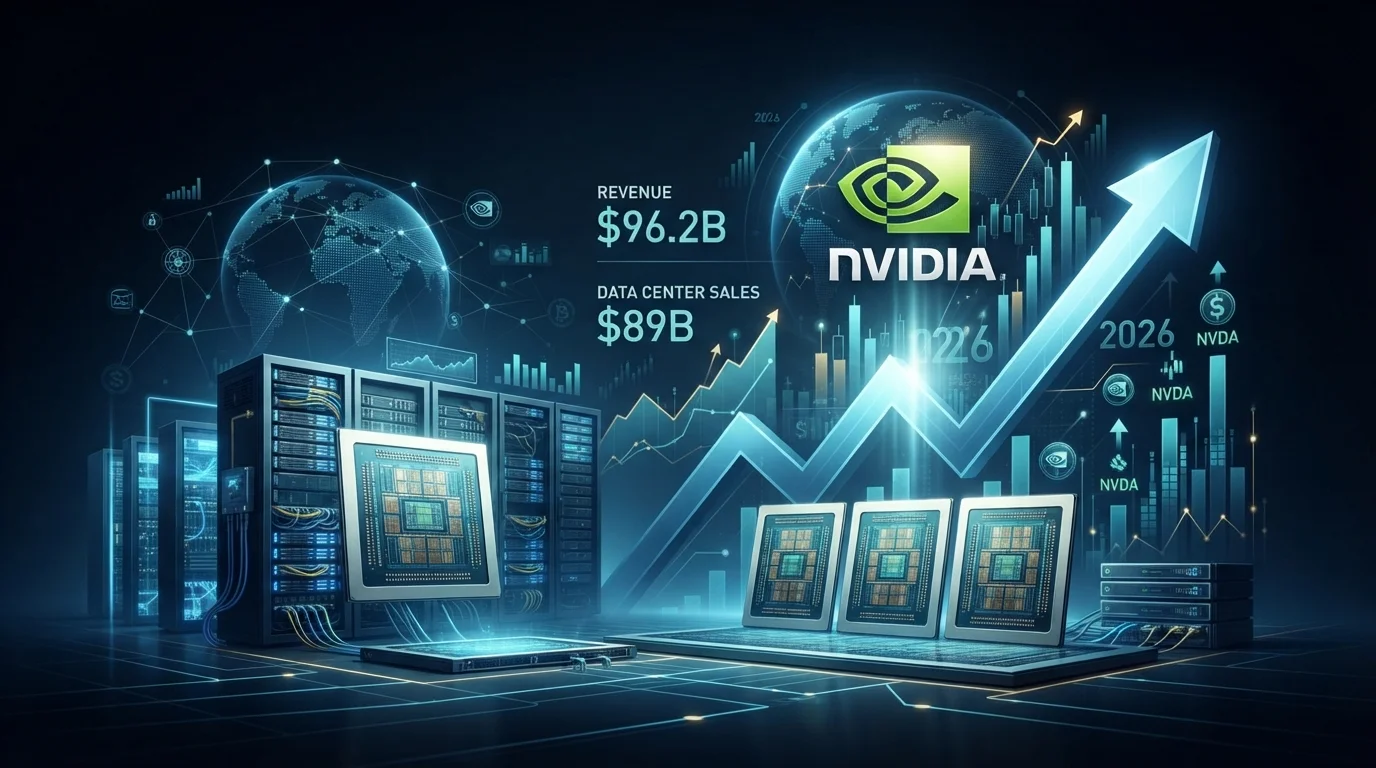
NVIDIA's fiscal second-quarter 2027 earnings report has delivered a staggering confirmation of the artificial intelligence infrastructure buildout's magnitude, with the semiconductor giant posting record revenue of $96.2 billion and data center sales surging to $89 billion. This represents a remarkable 106% year-over-year revenue growth and 116.6% data center revenue expansion, driven primarily by the accelerated ramp of Blackwell Ultra infrastructure. For investors, these numbers validate the thesis that AI spending has transitioned from experimental pilot programs to sustained, large-scale enterprise deployment across virtually every industry sector.
The implications extend far beyond NVIDIA's own stock performance. With compute commitments jumping from $119 billion to $279 billion in a single quarter and full-year data center revenue now tracking toward $170-190 billion, the company has effectively demonstrated that demand for AI computing capacity remains robust despite concerns about potential saturation or cyclical downturn. The stock's year-to-date performance of approximately 17.7% to around $219, while trailing some tech peers, may be positioning for a significant re-rating as these record results filter through analyst models and investor sentiment.
The $96.2 Billion Quarter: Breaking Down the Numbers
NVIDIA's fiscal Q2 2027 results, reported on August 26, 2026, have reset expectations for what the AI chip leader can achieve in a single quarter. The headline revenue figure of $96.2 billion not only exceeded Wall Street consensus estimates but also represented a 5.7% beat against the company's own guidance. This level of outperformance, coming on top of already elevated expectations, speaks to the continued momentum in AI infrastructure spending and the company's execution capabilities in scaling production to meet seemingly insatiable demand.
The composition of this revenue tells an equally compelling story. Data center revenue reached $89 billion, accounting for approximately 92% of total sales and growing 116.6% year-over-year while expanding 18.3% sequentially. This concentration reflects the complete transformation of NVIDIA's business model from a diversified graphics and gaming semiconductor company to the essential infrastructure provider for the global AI revolution. Gaming revenue, once the company's core business, has become a rounding error in comparison, highlighting just how dramatically the technology landscape has shifted.
Gross margins have expanded alongside revenue, with non-GAAP gross margin reaching 75% and guidance suggesting mid-70s margins sustainable into fiscal 2027. This profitability profile, rare for a hardware company at this scale, demonstrates NVIDIA's pricing power and the mission-critical nature of its products for customers building AI capabilities. When enterprises are investing hundreds of millions or billions in AI infrastructure, the cost of NVIDIA chips becomes secondary to performance and time-to-market considerations.
Blackwell Ultra: The Engine Behind the Growth
The specific driver of this quarter's exceptional performance was the ramp of Blackwell Ultra infrastructure, NVIDIA's latest generation AI computing platform. CFO Colette Kress highlighted in the quarterly commentary that Blackwell revenue grew 17% sequentially, indicating that the new architecture is successfully transitioning from initial shipments to volume production. This ramp is critical because Blackwell represents a significant architectural leap that maintains NVIDIA's competitive moat against emerging challengers.
For investors seeking to automate their trading strategies and capitalize on these technology trends, consider using Alphio AI's copy trading feature to mirror successful traders and smart money wallets who are positioning in AI infrastructure plays.

The Blackwell platform's importance extends beyond raw performance metrics. It represents NVIDIA's integrated approach to AI computing, combining high-performance GPUs with networking infrastructure, software stacks, and optimization tools that create significant switching costs for customers. When enterprises build their AI infrastructure around CUDA, NVIDIA's parallel computing platform, and the broader software ecosystem, the barriers to adopting alternative hardware solutions become substantial. This ecosystem lock-in is a key reason why NVIDIA can maintain premium pricing and margins even as competitors announce rival products.
Looking forward, management guidance suggests the Blackwell ramp is still in its early stages. With compute commitments of $279 billion now on the books and the company projecting continued growth in data center revenue through fiscal 2027, the infrastructure buildout appears to have significant runway remaining. Jensen Huang's earlier prediction of at least $1 trillion in AI infrastructure spending over the coming years is increasingly looking conservative rather than optimistic.
Data Center Dominance: Understanding the Customer Base
The $89 billion data center revenue figure becomes even more impressive when examining the customer composition driving this demand. Frontier AI labs including OpenAI, Anthropic, and Meta continue to expand their compute capacity at unprecedented rates, with training runs for next-generation large language models requiring tens of thousands of GPUs running for months. These hyperscale customers represent the visible tip of the demand iceberg, but beneath the surface, enterprise adoption is accelerating rapidly.
Cloud service providers including Amazon Web Services, Microsoft Azure, and Google Cloud Platform are major purchasers, offering NVIDIA-powered instances to enterprise customers who prefer to rent rather than own AI infrastructure. This cloud consumption model expands NVIDIA's addressable market beyond those companies with the capital and expertise to build their own data centers, creating a recurring revenue dynamic through cloud provider purchases.
Enterprise customers across financial services, healthcare, automotive, and manufacturing are increasingly deploying AI for production workloads rather than experimental projects. Banks use NVIDIA infrastructure for fraud detection and risk modeling, pharmaceutical companies accelerate drug discovery, automakers train autonomous driving systems, and manufacturers optimize supply chains. This diversification of use cases suggests that AI infrastructure demand has multiple growth vectors that can sustain investment even if any single segment experiences temporary softness.
The $279 Billion Compute Commitment: What It Means
Perhaps the most striking metric from NVIDIA's earnings report was the jump in compute commitments from $119 billion to $279 billion in a single quarter. This figure represents future revenue that is effectively contracted or highly probable based on customer commitments, providing unprecedented visibility into forward demand. For a semiconductor company, where order visibility is typically measured in weeks or months, having $279 billion in committed future business transforms the investment thesis from cyclical speculation to secular growth conviction.
Alternatively, explore agentic trading to automate your portfolio management with AI-powered strategies that can respond to earnings announcements and market movements in real-time.

The magnitude of this commitment figure relative to current revenue is worth emphasizing. At $279 billion, compute commitments represent nearly three years of current quarterly revenue run rates, suggesting that even if new order growth were to slow significantly, NVIDIA would have substantial contracted business to execute. This visibility reduces the risk of sudden revenue declines and supports the premium valuation multiples that the stock commands.
However, investors should consider the composition and timing of these commitments. Not all compute commitments convert to revenue immediately, and the timing of recognition depends on product availability, customer readiness, and deployment schedules. The concentration of commitments among a relatively small number of hyperscale customers also creates customer concentration risk, though this is mitigated by the strategic nature of the relationships and the difficulty of switching to alternative suppliers.
Competitive Landscape: Can Anyone Challenge NVIDIA?
The natural question following NVIDIA's dominance is whether competitors can erode its market position. AMD, Intel, and various startups including Cerebras and SambaNova are all pursuing the AI chip market, and cloud providers like Amazon, Google, and Microsoft are developing their own custom silicon. While these efforts are genuine and well-funded, NVIDIA's ecosystem advantages create significant barriers to meaningful market share capture.
AMD's MI300 series chips have gained some traction, particularly for inference workloads where the performance requirements are less demanding than training. However, AMD's software ecosystem remains significantly less mature than NVIDIA's CUDA platform, creating friction for developers and enterprises that have built their AI pipelines around NVIDIA tools. Intel's Gaudi accelerators have struggled to gain meaningful market share despite aggressive pricing, highlighting that raw performance specifications alone are insufficient to compete in this market.
Custom silicon from cloud providers represents a more nuanced competitive threat. Google's TPUs, Amazon's Trainium and Inferentia chips, and Microsoft's Maia processors can offer cost advantages for specific workloads within each cloud's ecosystem. However, these solutions lock customers into specific cloud platforms and lack the flexibility and broad software support that NVIDIA provides. For enterprises running multi-cloud or hybrid infrastructure strategies, NVIDIA remains the consistent layer that works everywhere.
Valuation and Investment Outlook
With the stock trading around $219 and up approximately 17.7% year-to-date, NVIDIA's valuation remains a topic of debate among investors. The company's forward price-to-earnings ratio, while elevated by historical semiconductor standards, must be evaluated in the context of the growth trajectory and market opportunity. When a company is growing revenue at over 100% annually with expanding margins and $279 billion in committed future business, traditional valuation metrics may understate the opportunity.
For investors considering scheduled automations to manage their positions, Alphio AI offers conditional workflow tools that can help execute trading strategies around earnings events and volatility.
Analyst price targets have been trending upward following the earnings beat, with many firms raising their 12-month targets to reflect the stronger-than-expected results and improved forward guidance. The bull case centers on the sustained AI infrastructure buildout, NVIDIA's ecosystem moat, and the potential for new product cycles including Blackwell to drive continued growth. The bear case focuses on valuation, customer concentration, and the risk that AI spending eventually faces budget constraints or technological disruption.
The stock's performance relative to the broader S&P 500 has been mixed in 2026, with periods of outperformance followed by consolidation. This pattern reflects the market's ongoing digestion of AI hype versus reality, with each earnings report serving as a referendum on whether the AI buildout is sustainable or approaching saturation. The August 2026 results strongly support the sustainability thesis, though investors should remain cognizant that growth rates will naturally moderate as the revenue base expands.
Risks and Considerations for Investors
While the earnings results were overwhelmingly positive, prudent investors must consider the risks that could alter the investment thesis. Geopolitical tensions, particularly regarding U.S.-China technology competition, pose a significant threat to NVIDIA's business. China has historically represented a meaningful portion of data center revenue, and export restrictions on advanced AI chips have already impacted sales. Further restrictions or retaliatory measures could create headwinds that are difficult to offset with growth in other regions.
Customer concentration represents another risk factor. With a relatively small number of hyperscale customers driving a significant portion of revenue, the loss of any major customer or a shift in their purchasing patterns could have outsized impacts. The strategic importance of AI infrastructure to these customers' business models provides some protection, but investors should monitor customer diversification trends in future earnings reports.
Technological disruption, while unlikely in the near term, remains a long-term consideration. New computing paradigms such as quantum computing, neuromorphic chips, or fundamentally different AI architectures could eventually challenge NVIDIA's GPU-centric approach. The company's significant R&D investments and track record of innovation provide some protection, but the technology industry has a history of disruptive shifts that incumbent leaders sometimes fail to anticipate.
The Broader AI Infrastructure Investment Theme
NVIDIA's results serve as a bellwether for the broader AI infrastructure investment theme that extends beyond the company itself. The data center buildout requires not just GPUs but also networking equipment, storage systems, cooling infrastructure, and power delivery systems. Companies across the semiconductor supply chain, from memory providers like SK Hynix and Micron to networking specialists like Broadcom and Marvell, benefit from the capital expenditure cycle that NVIDIA's results confirm remains robust.
For traders looking to execute positions efficiently, Alphio AI's conversational trading allows you to place trades and manage your portfolio through natural language chat commands.

The power infrastructure required to support AI data centers has become a critical constraint and investment opportunity. Training large AI models requires enormous amounts of electricity, and the availability of power at suitable locations is increasingly the limiting factor for new data center construction. Companies involved in power generation, grid infrastructure, and data center cooling are experiencing increased demand as a direct consequence of the AI buildout that NVIDIA's chips enable.
Software companies building AI applications also benefit from the infrastructure expansion that NVIDIA's results confirm. As compute capacity becomes more available and affordable (relatively), the barrier to building and deploying AI applications lowers, potentially accelerating adoption across industries. This creates a virtuous cycle where infrastructure investment enables application innovation, which in turn drives further infrastructure demand.
Conclusion
NVIDIA's August 2026 earnings report represents a watershed moment that validates the magnitude and sustainability of the AI infrastructure buildout. With $96.2 billion in quarterly revenue, $89 billion in data center sales, and $279 billion in compute commitments, the company has demonstrated that AI spending has moved well beyond experimental phases into sustained, large-scale deployment. For investors, these results provide confidence that the AI investment theme has substance beyond the hype cycles that have characterized previous technology transitions.
The investment implications extend across multiple time horizons. In the near term, the earnings beat and raised guidance support continued momentum in the stock as analysts upgrade estimates and price targets. The medium-term outlook depends on the execution of the Blackwell ramp and the conversion of compute commitments into recognized revenue. Over the longer term, NVIDIA's ability to maintain its ecosystem dominance against emerging competition while expanding into new markets such as robotics and autonomous vehicles will determine whether the company can sustain its premium valuation.
For investors seeking exposure to the AI infrastructure theme, NVIDIA remains the purest play with the strongest competitive position and most visible growth trajectory. However, the valuation demands careful consideration of entry points and position sizing. The stock's volatility around earnings events and sensitivity to AI sentiment shifts require a long-term perspective and tolerance for significant price swings. Those who believe that AI will transform the global economy over the coming decade will likely view NVIDIA's current results as merely the beginning of a much larger story.
Ready to capitalize on AI stock opportunities? Try Alphio AI's copy trading to mirror top-performing traders, or explore agentic trading to automate your AI investment strategies with intelligent portfolio management.
FAQs
What were NVIDIA's Q2 FY2027 earnings results?
NVIDIA reported record revenue of $96.2 billion for Q2 FY2027, representing 106% year-over-year growth. Data center revenue reached $89 billion (up 116.6% YoY), driven by the Blackwell Ultra infrastructure ramp. Non-GAAP gross margin was 75%, and compute commitments jumped to $279 billion.
What is Blackwell Ultra and why is it important?
Blackwell Ultra is NVIDIA's latest generation AI computing platform. It represents a significant architectural advancement that maintains NVIDIA's competitive advantage. Blackwell revenue grew 17% sequentially in Q2, indicating successful transition from initial shipments to volume production. The platform combines high-performance GPUs with networking and software for integrated AI infrastructure.
How does NVIDIA maintain its competitive moat against rivals?
NVIDIA's competitive advantages include the CUDA software ecosystem, which creates significant switching costs for developers and enterprises; integrated hardware-software solutions; ecosystem lock-in from years of AI development; and superior performance for both training and inference workloads. Competitors like AMD and Intel struggle to match this comprehensive ecosystem.
What are the main risks for NVIDIA investors?
Key risks include geopolitical tensions and export restrictions affecting China sales, customer concentration among hyperscale buyers, potential technological disruption from new computing paradigms, and valuation sensitivity to growth rate moderation. The stock also experiences significant volatility around earnings events.
Is NVIDIA stock a good investment at current levels?
NVIDIA offers exposure to the AI infrastructure buildout with strong competitive positioning and visible growth ($279B in compute commitments). However, valuation is elevated and requires a long-term perspective. The stock suits investors who believe AI will transform the economy and can tolerate volatility. Consider position sizing carefully and using tools like Alphio AI's copy trading or agentic trading to manage entries.