

Brent Crude Oil Price Forecast August 2026: Supply Risks and Geopolitical Tensions Fuel Market Rally
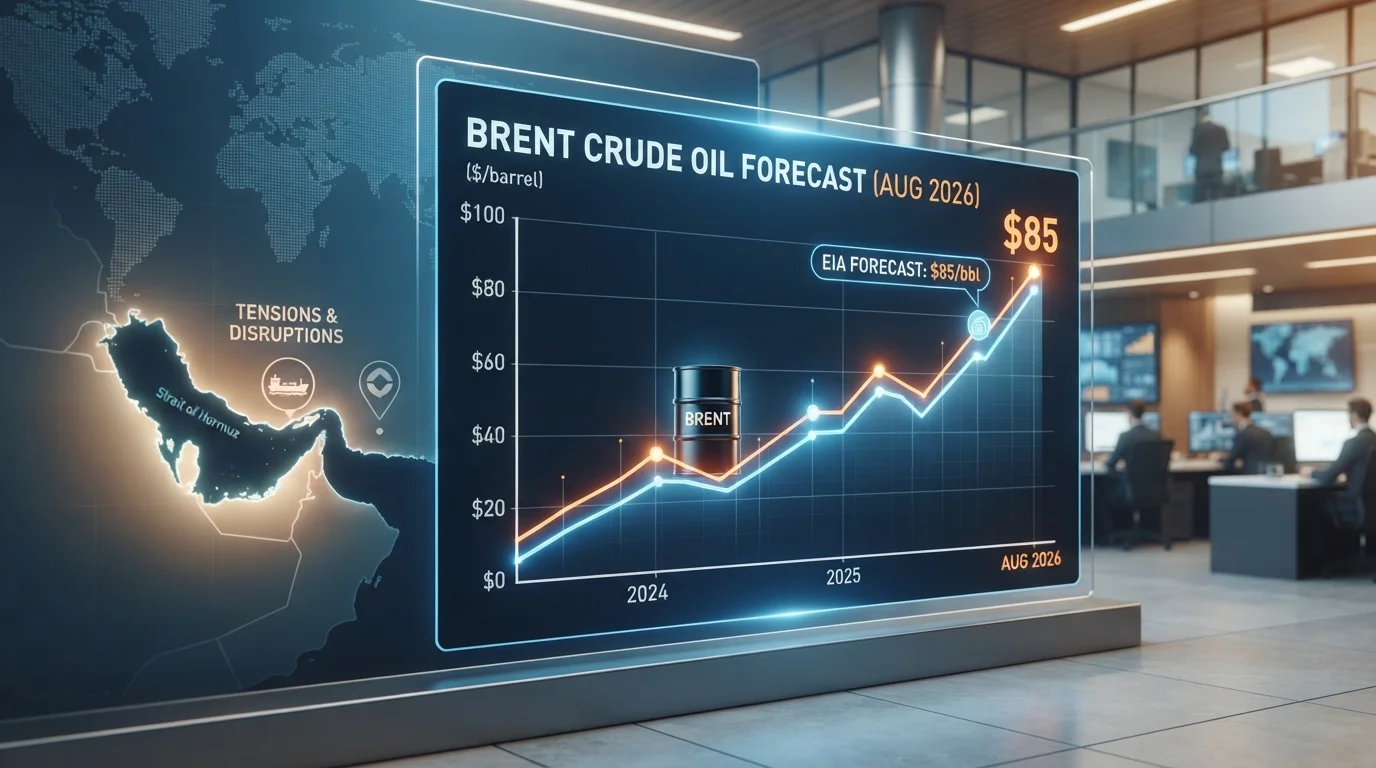
Brent crude oil price forecast for August 2026: EIA forecasts $85/barrel as Middle East tensions and Strait of Hormuz disruptions support prices. Expert analysis and outlook.

Key Takeaway
Brent crude oil prices are positioned for continued strength through August 2026, with the U.S. Energy Information Administration forecasting an average of $85 per barrel for the third quarter. Current prices have already surged to approximately $91 per barrel as of mid-August, reflecting heightened geopolitical risks in the Middle East and persistent concerns about supply disruptions through the Strait of Hormuz. The combination of OPEC+ production discipline, resilient global demand, and escalating tensions in the world's most critical oil transit chokepoint has created a bullish fundamental backdrop that could support elevated prices well into 2027.
For energy investors and traders, the current environment presents both opportunities and risks. While the supply deficit is expected to reach its highest level in five years by year-end, the potential for demand destruction at current price levels remains a key concern. The International Energy Agency has warned that reduced oil shipments through the Strait of Hormuz could keep global oil inventories tight, supporting prices even as central banks maintain elevated interest rates to combat inflation. Investors should monitor developments in the Middle East closely, as any resolution to the current tensions could trigger a sharp price correction, while further escalation could push Brent toward triple-digit territory.
Understanding the Current Oil Market Dynamics
The global oil market has undergone a significant transformation in 2026, shifting from a surplus environment to one characterized by tightening supply and growing geopolitical risks. Brent crude has rallied approximately 38% year-over-year, outperforming most other major asset classes and demonstrating the commodity's sensitivity to supply-side disruptions. This price appreciation reflects not only immediate concerns about Middle East supply routes but also deeper structural changes in the global energy landscape, including years of underinvestment in new production capacity and the accelerating energy transition that has discouraged long-term oil project development.
Several factors have converged to create this bullish environment. OPEC+ has maintained disciplined production cuts throughout 2026, with the group successfully implementing its strategy of managing supply to support prices. Saudi Arabia and Russia, the two largest producers in the group, have shown remarkable cohesion in their approach, consistently delivering on promised reductions even as higher prices have tempted some smaller members to exceed their quotas. This discipline has been essential in balancing a market that would otherwise be oversupplied given the modest growth in global demand.
The demand side of the equation has also surprised to the upside. Despite concerns about economic slowdowns in major economies, global oil consumption has remained remarkably resilient. China's economic recovery, while uneven, has supported import levels that exceed pre-pandemic norms. Meanwhile, the United States has experienced stronger-than-expected gasoline demand during the summer driving season, with consumption reaching levels not seen since 2019. This combination of constrained supply and steady demand has created the tightest market balance since the supply shocks of the early 2020s.
Middle East Tensions and the Strait of Hormuz Risk Premium
The most significant factor driving current oil prices is the elevated risk premium associated with potential disruptions to Middle East supply routes, particularly the Strait of Hormuz. This narrow waterway, through which approximately 20% of global oil consumption passes daily, has become the focal point of geopolitical concerns following recent escalations in regional tensions. Iranian officials have indicated that the critical waterway will not reopen without major concessions from the United States, creating uncertainty that has sent shockwaves through global energy markets.
The strategic importance of the Strait of Hormuz cannot be overstated. Any significant disruption to traffic through this chokepoint would have immediate and severe consequences for global oil supply. The International Energy Agency has estimated that reduced shipments through the strait could lower global oil inventories further in the coming months, keeping crude oil prices elevated even if other supply sources compensate partially. This supply deficit is projected to reach 1.8 million barrels per day, with the gap expected to widen to its highest level in five years by the end of 2026.
For investors seeking to navigate these volatile conditions, automated trading strategies can help capture opportunities while managing risk. Consider using Alphio AI's agentic trading feature to automate your portfolio management with AI-powered strategies that can respond quickly to geopolitical developments.

The market's reaction to these tensions has been pronounced, with Brent crude rallying sharply as traders price in the possibility of supply disruptions. J.P. Morgan Global Research now forecasts Brent to average $86 per barrel in the third quarter of 2026, $80 in the fourth quarter, and $78 at year-end. However, these projections assume no major supply disruption occurs. Should the situation in the Strait of Hormuz deteriorate further, prices could easily spike above $100 per barrel, particularly if the disruption coincides with the seasonal demand increase during the Northern Hemisphere winter.
EIA and Major Bank Forecasts for 2026
Leading energy forecasters have revised their oil price projections upward throughout 2026, reflecting the evolving supply-demand balance and geopolitical landscape. The U.S. Energy Information Administration, in its August Short-Term Energy Outlook, maintained its forecast for Brent crude to average around $85 per barrel in the third quarter of 2026. This projection, while lower than current spot prices, reflects the agency's expectation that some of the current risk premium will dissipate as tensions eventually ease.
J.P. Morgan's commodity research team has taken a more bullish stance, forecasting Brent to average $86 per barrel in the third quarter before moderating to $80 in the fourth quarter and $78 by year-end. The bank's analysts note that while the current supply deficit supports elevated prices, the potential for demand destruction at levels above $90 per barrel provides a natural ceiling for the market. Historical patterns suggest that sustained prices above this threshold typically trigger conservation measures and accelerate the shift toward alternative energy sources.
Goldman Sachs has similarly adjusted its outlook, with the bank's commodity strategists emphasizing the tightness in physical oil markets. The firm's analysis highlights that global inventories have drawn down faster than expected, with OECD commercial stocks falling below the five-year average for the first time since 2022. This inventory drawdown has been particularly pronounced in refined products, with gasoline and diesel stocks in key consuming regions reaching critically low levels ahead of the winter heating season.
Supply-Side Fundamentals: OPEC+ Discipline and Production Constraints
The supply side of the oil market remains tightly controlled by OPEC+, which has successfully implemented production cuts totaling approximately 5 million barrels per day from theoretical maximum capacity. Saudi Arabia, the group's de facto leader, has maintained its voluntary cut of 1 million barrels per day throughout 2026, demonstrating a commitment to market stability that has earned the kingdom significant leverage in determining global price levels. This disciplined approach has been essential in preventing the price collapses that characterized earlier periods of market oversupply.
Russia's cooperation with OPEC+ has been equally crucial, despite the country's challenges in maintaining production following Western sanctions and the withdrawal of international oilfield service companies. Russian crude exports have remained robust, with the country successfully redirecting volumes from European markets to buyers in Asia, particularly India and China. This redirection has required significant discounts to Brent prices, but has allowed Russia to maintain cash flows necessary to fund its government operations.
For traders looking to mirror successful strategies in volatile markets, Alphio AI's copy trading feature enables you to follow experienced traders and smart money wallets that have navigated similar market conditions successfully.

Non-OPEC supply growth has disappointed relative to expectations, with U.S. shale producers showing remarkable capital discipline despite higher prices. The American shale revolution that transformed global oil markets in the 2010s has matured, with producers prioritizing shareholder returns over production growth. This shift in corporate strategy has limited the supply response to higher prices, removing a key mechanism that historically provided a ceiling for oil prices during periods of tightness.
Demand Outlook and Economic Considerations
Global oil demand has proven more resilient than many analysts anticipated entering 2026, with consumption growth holding steady despite elevated prices and concerns about economic slowdowns in major economies. The International Energy Agency forecasts global demand to increase by approximately 1.2 million barrels per day in 2026, driven primarily by emerging market economies in Asia and the Middle East. This growth, while modest by historical standards, is sufficient to maintain market tightness given the constrained supply environment.
China remains the single largest source of demand growth, with the country's oil imports continuing to expand despite ongoing challenges in the property sector and broader economy. The Chinese government's stimulus measures have supported industrial activity and transportation demand, while the country's strategic petroleum reserve purchases have added an additional layer of demand that is less sensitive to price fluctuations. India's demand growth has also been robust, with the country's rapidly expanding middle class driving increased vehicle ownership and air travel.
The relationship between oil prices and economic growth has become increasingly complex in the current environment. While high oil prices traditionally act as a tax on consumers and a headwind for economic growth, the current cycle has seen some decoupling between energy costs and broader economic performance. This decoupling reflects both the declining energy intensity of developed economies and the shift toward service-based economic models that are less sensitive to commodity price fluctuations.
Investment Strategies for the Current Oil Environment
Investors seeking exposure to the current oil market environment have several options, each with distinct risk-return profiles. Direct exposure through oil futures or exchange-traded products like the United States Oil Fund provides the most straightforward correlation with spot prices but involves contango costs and the complexities of futures market mechanics. For most investors, exposure through energy equities offers a more practical approach, with the added benefit of potential dividend income and operational leverage to oil prices.
The energy sector has been the best-performing sector in the S&P 500 in 2026, with integrated oil majors and independent exploration and production companies both delivering strong returns. Companies with low production costs and strong balance sheets, such as ExxonMobil and Chevron, have benefited from the combination of higher realized prices and disciplined capital allocation. These companies have used the period of elevated prices to reduce debt, increase dividends, and repurchase shares, creating value for shareholders beyond the commodity price appreciation.
Traders can also benefit from setting up conditional workflows to capture opportunities in volatile markets. Explore Alphio AI's automations feature to set up scheduled tasks and conditional trading strategies that execute based on price movements or market events.

For those concerned about the geopolitical risks that have driven much of the recent price appreciation, options strategies can provide downside protection while maintaining upside exposure. Put spreads on oil futures or energy sector ETFs offer a cost-effective way to hedge against a potential price correction should Middle East tensions ease. Alternatively, covered call strategies can generate income from the elevated implied volatility that characterizes the current market environment.
Risks and Challenges Ahead
While the current fundamental backdrop supports elevated oil prices, several risks could derail the bullish thesis in the coming months. The most significant near-term risk is a resolution to the Middle East tensions that have driven the current risk premium. Should diplomatic efforts succeed in reopening the Strait of Hormuz and reducing regional tensions, the risk premium currently embedded in oil prices could evaporate quickly, potentially triggering a 10-15% price correction.
Demand destruction represents another key risk, particularly if current price levels persist through the winter heating season. Historical analysis suggests that sustained prices above $90 per barrel typically trigger behavioral changes among consumers, including reduced discretionary driving, increased use of public transportation, and accelerated adoption of electric vehicles. While the energy transition is a long-term process, high oil prices can accelerate the shift away from fossil fuels in ways that permanently reduce demand.
The potential for a global economic slowdown also looms over the demand outlook. Central banks in major economies have maintained elevated interest rates to combat inflation, with the Federal Reserve holding rates at 3.50% to 3.75% as of August 2026. These restrictive monetary policies could eventually trigger recessionary conditions that would significantly reduce oil demand. The CME Group's FedWatch tool indicates a nearly 55% likelihood that the FOMC will raise interest rates further at its September meeting, potentially deepening the economic headwinds facing oil demand.
Long-Term Outlook: Energy Transition and Investment Implications
Beyond the immediate market dynamics, the long-term outlook for oil markets remains shaped by the global energy transition and the shift toward renewable energy sources. While this transition will take decades to complete, the investment implications are already being felt in the oil sector. Years of underinvestment in new production capacity, driven by environmental concerns and shareholder pressure, have limited the industry's ability to respond to higher prices with increased supply.
This structural underinvestment creates a paradox for the oil market: higher prices are needed to justify new production, but those same high prices accelerate the shift toward alternatives. For investors, this dynamic suggests that oil prices may remain structurally higher than historical averages, even as long-term demand eventually peaks and begins to decline. The companies best positioned for this environment are those with low-cost reserves, strong balance sheets, and the operational flexibility to adjust production in response to market conditions.
For a more intuitive trading experience, consider using Alphio AI's conversational trading interface to execute trades and manage your portfolio through natural language commands.

The energy transition also creates opportunities in related sectors, including natural gas as a transition fuel, carbon capture technologies, and renewable energy infrastructure. Companies that can successfully navigate the shift from pure-play oil producers to integrated energy companies may be best positioned for long-term value creation. Investors should look for management teams with credible transition strategies and the capital allocation discipline to execute on those plans while maintaining profitability in the core oil business.
Conclusion
Brent crude oil prices are likely to remain elevated through the remainder of 2026, supported by a combination of OPEC+ production discipline, resilient global demand, and geopolitical tensions in the Middle East. The EIA's forecast of $85 per barrel for the third quarter appears conservative given current spot prices near $91, though the potential for demand destruction and the eventual resolution of Middle East tensions provide natural limits to the upside.
For investors, the current environment favors energy sector exposure through high-quality companies with low production costs and strong balance sheets. The structural tightness in global oil markets, driven by years of underinvestment and the energy transition, suggests that oil prices may remain higher for longer than many analysts anticipate. However, the elevated risk premium associated with Middle East tensions means that prices could be volatile, with significant downside potential should geopolitical conditions improve.
Traders and investors looking to capitalize on these market conditions should consider leveraging AI-powered trading tools to navigate the volatility. Alphio AI's copy trading allows you to mirror successful traders, while agentic trading automates portfolio management with sophisticated strategies. For those who prefer a hands-on approach, conversational trading provides an intuitive interface for executing trades and managing positions. Set up automated workflows to capture opportunities and manage risk in this dynamic market environment.
The oil market of 2026 is characterized by tight supply, steady demand, and elevated geopolitical risks—a combination that has historically supported strong returns for energy investors. While risks remain, particularly around demand destruction and potential supply disruptions, the fundamental backdrop suggests that energy commodities will continue to play an important role in diversified portfolios through the remainder of the year and beyond.
FAQs
What is the Brent crude oil price forecast for August 2026?
The U.S. Energy Information Administration forecasts Brent crude to average around $85 per barrel in the third quarter of 2026. However, current spot prices have already reached approximately $91 per barrel as of mid-August due to heightened geopolitical tensions in the Middle East and concerns about potential supply disruptions through the Strait of Hormuz.
How are Middle East tensions affecting oil prices?
Middle East tensions have added a significant risk premium to oil prices, with concerns about potential disruptions to the Strait of Hormuz—a critical chokepoint through which approximately 20% of global oil consumption passes daily. Iranian officials have indicated the waterway will not reopen without major U.S. concessions, creating uncertainty that has supported prices even as other fundamentals remain relatively stable.
What is the supply deficit outlook for 2026?
The International Energy Agency estimates the current supply deficit at approximately 1.8 million barrels per day, with the gap expected to reach its highest level in five years by the end of 2026. This tightness reflects OPEC+ production discipline, limited non-OPEC supply growth, and resilient global demand.
How might Federal Reserve policy affect oil prices?
The Federal Reserve has maintained interest rates at 3.50% to 3.75% to combat inflation, with markets pricing in a nearly 55% chance of further rate hikes. These restrictive monetary policies could eventually trigger recessionary conditions that reduce oil demand. However, higher interest rates also support the U.S. dollar, which typically creates headwinds for dollar-denominated commodities like oil.
What are the key risks to the bullish oil price outlook?
The primary risks include a resolution to Middle East tensions that would eliminate the current risk premium, demand destruction from sustained high prices above $90 per barrel, and a potential global economic slowdown triggered by restrictive monetary policy. Additionally, accelerated adoption of electric vehicles and renewable energy could reduce long-term oil demand faster than anticipated.